Senin, 21 Februari 2011

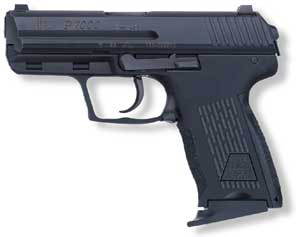
Heckler und Koch P2000

Heckler und Koch P2000 (Germany)
 
Characteristics

Type: Double Action or Combat Defence action (HK proprietary)
Chamber: 9x19mm Luger/Parabellum
Weight unloaded: 620 g
Length: 178 mm
Barrel length: 92 mm
Capacity: 13 rounds

The P2000 is the latest HK pistol, a derivative of the USP Compact, intended for police use. It is available since 2001.
The P2000 is a recoil operated, locked breech pistol, with modified Browning High Power style barrel to slide locking, and with buffering built into the recoil system, similar to the HK USP pistols. P2000 has polymer frame with intercangeable backstrap inserts (somewhat like the Walther P99), to allow ajustment of the grip to the hands of diferent sizes. The gun is externally sahped to be carried concealed with maximum comfort. P2000 also feature underbarrel acessory rails.
P2000 is available in three basic trigger configurations: CDA SA/DA trigger with decocker, classic SA/DA trigger with decocker and CDA (Combat Defence action) trigger withouth decocker or manual safety (also known as LEM trigger - Law Enforcement Modification, marketed in the USA in LEM USP Compact pistols).
The CDA trigger group featured HK patented, hammer fired system with two piece hammer. Inside the conventional, DAO hammer there is a cocking piece wich acts like SA concealed hammer, and can be cocked via the retraction of the slide, along with the hammer. When the slide goes back into the closed position, the external hammer goes down like any other DAO hammer, under the its own hammer spring, but cocking piece remains in the cocked position, with main spring loaded. When operator pressed the trigger, it goes all the way back, but due to the low power of the hammer spring, the trigger weight is much lower than in conventional DAO pistols (three weights available - 2 kg, 2.8 kg or 3.3 kg - 4.4 lbs, 6.2 lbs or 7.3 lbs respectively). When the hammer goes back all the way, the trigger mechanism releases the cocking piece, which acts on the hammer and lowers it onto the firing pin with the power of the main spring and the hammer spring, to fire the cartridge. It should be noted that the cocking piece can be cocked ONLY by slide retraction and lowered only by trigger pull, so, if the gun must be stored for the long time, the cocking piece must be lowered by dry firing the gun, to awoid main spring weakening.
The basic P2000 employs the CDA trigger system as describet above, but with added ambidextrous decocker at the rear of the frame, below the hammer (somewhat like Mauser M2). The P2000 variations, marked V1, V2 and V4 have the CDA trigger with different trigger pull weights (see above), and the P2000 V3 has conventional, SA/DA trigger mechanism with decocker at the rear side of the frame, below the hammer. All P2000 also featured internal firing pin safety.

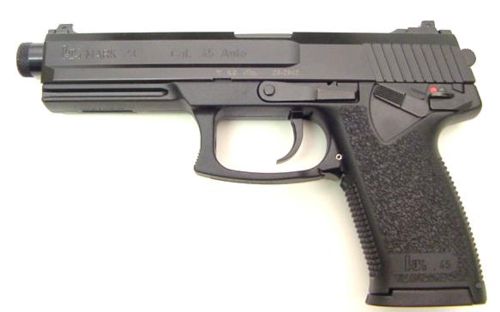
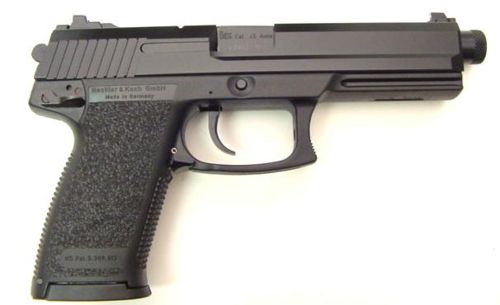
Heckler - Koch Mk.23 mod.0 US SOCOM pistol

Mk.23 mod.0 pistol, left side. Above the grip are clearly seen are separate safety (rear) and decocker (middle) levers, as well as slide stop lever (forward).
 
Mk.23 mod.0 pistol, right side. Note the extended barrel with screw-on thread protector on the muzzle.
 
Mk.23 with silencer and laser aiming device.
 
Characteristics
 
Caliber: .45 ACP
Action: Double Action
Length: 245 mm
Height: 150 mm
Width: 38,8 mm
Weight: 1100 g
Magazine capacity: 12 rounds
 
This handgun was developed under request from US SOCOM (Special Operations Command) and entered the competition with Colt for OHWS - Offensive Handgun Weapon System - first offensive handgun for US Military since the adoption of the Colt M1911 Govt. The request was issued in mid-1991, and the only other major competitor to H&K was the Colt company with its SOCOM pistol. By the 1993 H&K delivered first prototypes of its contestant, and eventually HK SOCOM pistol became the Mk.23 model 0 pistol, issued by US Special Operations command to its operators. The Mk.23 mod.0 is chambered for venerable .45ACP cartridge, which provides greater stopping power than a NATO-standard 9mm Luger cartridges. Mk.23 mod.0 is designed to safely and reliable fire most powerful .45ACP +P ammunition, either with ball (FMJ) or expansive (JHP) bullets. Mk.23 mod.0 is usually issued with quick-detachable silencers, made in USA by Knight's Armaments Co, and with laser pointing module, which installs on the underbarrel rails. First production Mk.23 model 0 pistols were delivered to users in 1996.
In general, the Mk.23 mod.0 is an extremely reliable and quite powerful combat pistol, the only drawback being a somewhat excessive size and weight, so, in some cases, operators prefer to carry smaller and lighter HK USP Tactical pistols, which share most features of Mk.23 mod.0.
Heckler-Koch also produced a civilian version of the Mk.23 mod.0 pistol, designated as Mark 23, which is sold with 10-rounds magazines, to comply with US laws.
The Mk.23 mod.0 is a short recoil operated, locked breech semiautomatic pistol. The barrel locks to the slide using one single lug, which fits to the ejection port in the slide. The patented dual recoil springs arrangement allows for decreased felt recoil and increased service life of pistol. Frame of the gun is made from high-strength polymer. The double action trigger system features a separate decocker lever, an ambidextrous safety, which allows for "cocked and locked" carry, and a slide stop. Enlarged triggerguard allows for comfortable shooting when wearing gloves. Ambidextrous magazine release lever is located in the base of the triggerguard, and should be depressed down to release magazine. Both front and rear sights are equipped with luminous dots, and mounted in dovetail grooves.

Heckle r& Koch USP pistols

HK USP in .40SW - basic version.
 
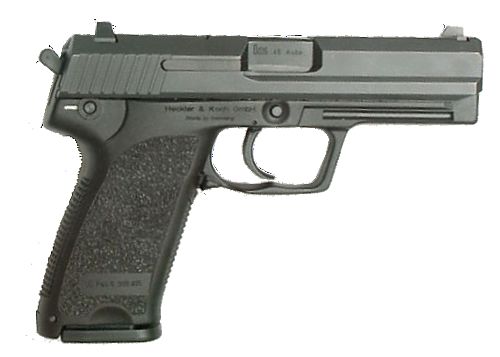
HK USP in .45ACP.
HK USP in .45ACP.

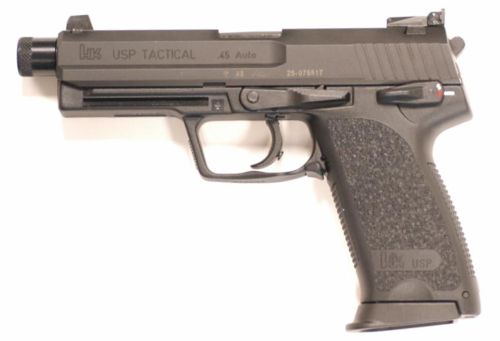
HK USP .45 Tactical with extended barrel, threaded for sound suppressor (threads are covered by protector).

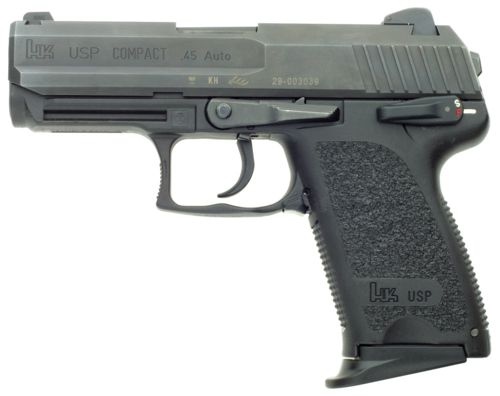
HK USP Compact .45ACP.

USP - cutaway.
USP - cutaway.

The family of the USP handguns.

Characteristics

Type: Double Action or Double Action Only
Calibers: 9x19mm Luger, .40 S&W, .45 Auto, .357SIG (USP Compact only)
Dimensions (9 x 19 version)
Length: 194 mm
Height: 136 mm
Width: 32 mm
Weight: 720 g
Capacity: USP, USP Match - 15 rds (9mm), 13 rds (.40), 12 rds (.45); USP Compact - 13 rds (9mm), 12 rds (.357 and .40), 8 rds (.45)

Heckler & Koch started the development of a new Universal Selbstlade Pistole (Universal Self-loading Pistol, or USP in short), in mid-1989. The concept of the new design was to provide a universal weapon for police and military forces, available in a variety of versions and sizes. The target market for this new weapon was apparently the USA, as the first version of the pistol, which appeared in 1993, was chambered for a new American cartridge, the .40 S&W. A 9mm version appeared a little later, and in 1995 the slightly modified 9mm USP pistol was adopted by the Bundeswehr (German army) as its new service pistol, under the designation P8. The same year the company also brought out another “America-special” version of the USP, this time in.45 ACP caliber. In 1996 the first of the Compact series of USP pistols entered production, and next year it was officially approved for German police use as the 9mm P10. Several versions of the USP were also made specifically for civilian markets, such as the USP Expert, USP Elite and USP Match. There are also several special-purpose versions of the USP. These include two original variations fitted with extended threaded barrels to be used with silencers, the .45 caliber USP Tactical and 9mm USP 9 SD, recently joined by the .45 caliber USP 45 Compact Tactical, sometimes preferred by the US Military users over the much bulkier and heavier Mark 23 Model 0 pistol of the same caliber.
USP pistols are short-recoil operated, locked-breech pistols with a polymer frame. The barrel is locked to the slide by a single lug, which engages the ejection port. Unlocking is controlled by a cam-shaped extension below the chamber, which interacts with a steel insert set into the frame. Barrels on all USP pistols have polygonal rifling, except the earliest production pistols made in 1993, and all German army P8’s. The captive recoil spring assembly includes an additional recoil spring buffer on full-size pistols and a polymer buffer on Compact pistols. The trigger is double-action, with an external hammer, an automatic firing pin safety and a frame-mounted lever, which may operate differently in different versions of the pistols, as described below. Each pistol can be easily adjusted by a gunsmith to any of the trigger mode configurations, with the replacement of a few parts that include a cam plate and a safety lever. The sights are dovetailed to the slide. Magazines on most USP pistols are of steel construction, but Bundeswehr-owned P8 pistols have semi-translucent polymer magazines. Magazine release levers are ambidextrous and located at the base of the trigger-guard.
There are nine basic variations of the USP trigger/safety arrangements, plus one specific to P8 pistols, as follows:
1. Double action trigger with manual safety on the left side. If lever is pressed below the “fire” position, it acts as a decocker, bringing the hammer down and then returning to the fire position
2. Same as No.1, but the safety lever on the right side
3. Double action trigger with decock-only lever on the left side
4. Same as No.3 but the lever on the right side
5. Double-action-only trigger with manual safety lever on the left side.
6. Same as No.5 but the lever on the right side
7. DAO trigger without any manual safety
8. P8 pistol, with “inverted” safety lever, that is, upper position of the lever is for fire and lower for safe. When the safety is applied, the hammer is decocked automatically
9. Double action trigger with manual safety on the left side. No safe decocking functionality is provided
10. Same as No.9 but the lever on the right side
How to field-strip (disassemble) HK USP pistol: 1) remove the magazine by pressing the magazine release button; 2) check that the chamber is empty; 3) retract the slide partially, so the slide release lever axle is aligned with the disassembly notch on the slide; 4) press on the slide release axis pin from the right side of the frame, then pull the slide release lever completely from the left side; 5) carefully ease the slide forward, then pull it toward the front out of the frame; 6) remove the return spring assembly from below the barrel; 7) pull the barrel out of the slide.
Reassemble in reverse order.

Heckler Koch HK P11 underwater pistol

Heckler-Koch HK P11 underwater pistol, left side.

Front view on the five-shot barrel cluster of the HK P11 underwater pistol. Note that all barrels are fired and seals penetrated.

Front view on the five-shot barrel cluster of the HK P11 underwater pistol. Note that all barrels are fired and seals penetrated.
 
Characteristics

Type Single Action multi-barrel
Caliber(s)  7.62mm underwater
Weight unloaded about 1200 g
Length 200 mm
Barrel length n/a
Magazine capacity 5 rounds in disposable barrel cluster

The HK P11 is one of the least known weapons to emerge from the Heckler & Koch factory. Developed during the early 1970s to arm frogmen (combat divers), this weapon is apparently in use with the Navies of Germany, Italy, France, Norway, the UK and the USA. This highly unusual weapon is probably the only serious rival to the Soviet underwater pistol, which appeared in late 1960s. The P11 and its ammunition is somewhat bulkier than its Soviet counterparts (the SPP-1M), but, on the other hand, the P11 has one round more capacity and a larger caliber, probably resulting in better lethality.
The HK P11 pistol is mainly unusual in the fact that it is not self-loading. Instead, it uses a quick-detachable cluster of five barrels, each factory-loaded with a powder charge and long, needle-like, drag-stabilized projectile. The pistol is reloaded by the replacement of an entire barrel cluster. In combat, the empty clusters are discarded, in training these are collected and later sent back to factory for reloading. Loaded barrels are protected from salt water by thin diaphragms, which are destroyed by the fired bullet at the instant of firing. Powder charges in each barrel are ignited using electricity, provided by two 9-Volt batteries, stored in a sealed container in the grip of the pistol. The effective range underwater depends on the depth, and is about 15 metres near to the surface. Above the water, the effective range is quoted as being around 30 metres, and while long and relatively heavy bullets can be lethal at longer ranges, the chances of hitting any target beyond the given range is minimal. This is because the barrels are not rifled, and bullets are not stabilized in the air, thus tumbling and yawing in flight through the air.

Heckler-Koch P9S pistol

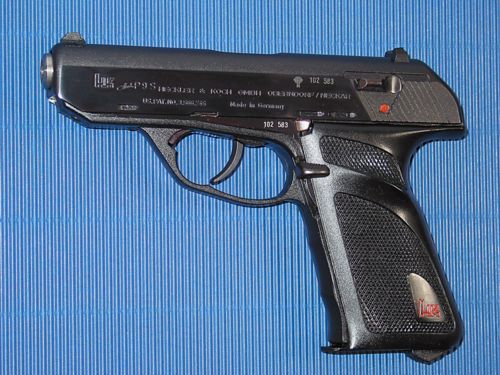
HK P9S pistol. Note the heel magazine release and a cocking/decoking lever behind the triggerguard.

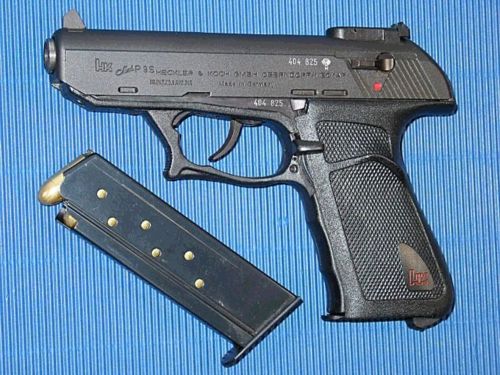
HK P9S Sport, with adjustable sights and reshaped trigger guard.

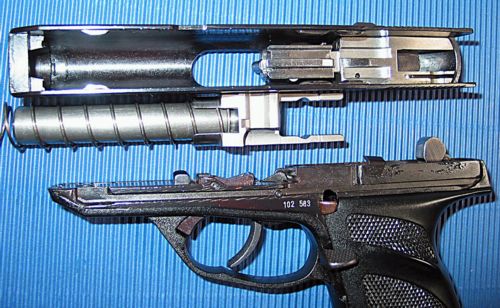
HK P9S partially disassembled. clearly seen are the barrel with its extension and cuts for rollers; and a separate two-part breechblock, inserted into the thin-walled slide.

Characteristics

Type: Double Action (P9S); Single action (P9)
Chamber: 9x19mm Luger/Para, .45ACP
Weight: 880 g empty
Length: 192 mm
Barrel length: 102 mm
Capacity: 9 (9mm) or 7 (.45) rounds

The P9 pistol was designed by the famous Heckler-Koch company during the first half of the 1960s. After much testing and prototyping, which even included a selective-fire pistol with detachable shoulder-stock, the mass production of semi-automatic P9 began in 1969. Not many of single action P9 pistols were produced, and during the early 1970s the P9 gave its way to the double-action P9S, which remained in production until 1978. The licensed version of P9S is still manufactured in Greece as EP9S (9mm only). The P9 was and probably still used by various police forces in Germany, as well as in several other countries. The .45 caliber version of P9S, fitted with longer barrel which accepted the detachable silencer, was used in limited numbers by US Navy SEALs.
The P9S is an interesting design, which is based on H-K experience, gained with production of famous G3 rifle. First, the P9 and P9S use the stamped steel frames and slides, with machined steel inserts and polymer triggerguard and front part of the grip, as well as polymer grip panels. This accounted for fast and inexpensive production. Second, the P9 and P9S featured a roller retarded (delayed) blowback action, also derived from G3 rifle. This action required a two-part breech block, machined from steel, which was inserted into stamped slide, and a machined barrel extension, with roller grooves. The stationary barrel accounted for consistent accuracy, and allowed for easy and reliable silencing of the pistol. Another interesting feature of P9 pistols was the internal (concealed) hammer, which operated in single action mode in P9 and in double action mode in P9S. The special lever, located at the left side of the grip frame, just behind the triggerguard, was used to manually cock and decock the hammer. The manual safety was located at the left side of the slide.
P9S pistols were fitted either with fixed or adjustable sights (P9S Sport model). The later also could be had with longer barrel and special target grips.
Single stack magazine of P9S held 9 9mm or 7 .45 caliber rounds, magazine release was located at the heel of the grip. Slide stop lever was located above the cock/decock lever.

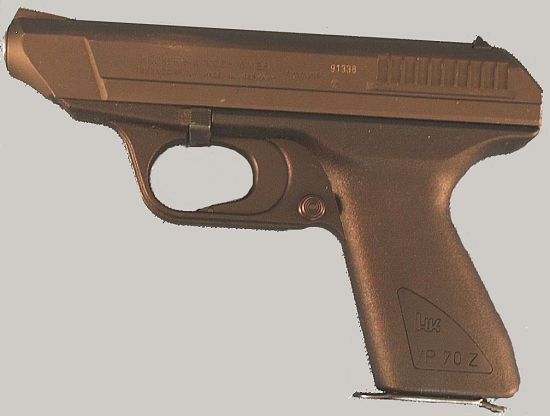
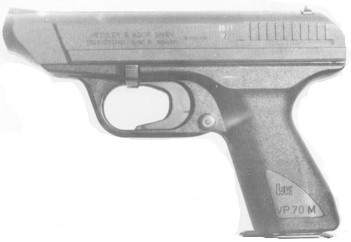
Heckler und Koch VP 70

VP 70Z - Civilian version.

VP 70M - Military version.

VP 70M with holster-stock attached.

Сlose view on fire selector built into holster-stock of the VP 70M.

Characteristics

Type: Double Action Only
Chamber: 9x19mm Luger/Parabellum
Weight unloaded: 820 g
Length: 204 mm
Barrel length: 116 mm
Capacity: 18 rounds

The VP 70 pistol is quite unique, being well ahead of its time in some respects, and while it did not catch the military or civilian market, it set the marks for the many more sucessful followers. The VP-70 (Volks Pistole model 70) had been developed by HK around 1968, and the production began in 1970. Production of the military / law enforcement version, VP-70M, had been ceased fithin few years. Civilian version, VP-70Z, had been manufactured untill 1989.
The VP-70 is a blowback operated, striker fired, double action only pistol. In military version, VP-70M, it can be used along with detachable shoulder stock - holster, which has built in fire selector device, that allows to fire single shots or three rounds bursts. Withouth the stock attached, only single shots can be fired. Another then-unique feature was the polymer frame. In fact, the VP-70 was the FIRST EVER productional pisol with polymer frame. The DAO trigger with no manual safeties was alo not so common in the early 1970s. Despite the simply blowback operation, not so common in 9mm Luger/Para handguns, the VP-70 had modest felt recoil, but heavy and long trigger pull does not helped to improve accuracy.

 
Design by Free WordPress Themes | Bloggerized by Lasantha - Premium Blogger Themes | Online Project management