The main purpose of the sniper rifle is to destroy valuable targets at extended ranges with aimed fire, and with as few ammunition as possible. In most cases, "the target" means the human being (enemy soldier, armed criminal, terrorist, president etc.), and the "as few ammunition as possible" often means "one shot". The range for sniper fire may vary from 100 meters or even less in police/counter-terror scenarios, or up to 1 kilometer or more - in military or special operations scenarios.
Some sniper rifles, mostly - large caliber ones, used also as anti-material weapons, to destroy, or, more often, render unusable or unoperable, targets such as radar cabins, jeeps, parked aircrafts etc.
History of sharp-shooting traces its ancestry well back into XIX or even into XVIII centuries. Early sniper rifles were standart issue army rifles, selected for accuracy, or privately purchased commercial target or hunting rifles. During WW I and WW II both sides used a lot of general issue bolt action rifles (such a Russian/Soviet Mosin M1991/30, US M1903A4, British SMLE No.4(t), German G98k etc.) fitted with some kind of telescopic sight. Some of general issued semi-auto rifles also were used in sniper role, such as Soviet SVT-40 and US M1 Garand.

The practice of developing the military sniper rifles from standart issue firearms is still used in many countries. Ususally, manufacturer or special military unit select some rifles for their better-than-average accuracy, then adopt these rifles for sniper role (i.e. convert them from select-fire into semi-autos, add ajustable stocks, bipods, scope mounts etc.). Many of military sniper rifles, discontinued in service or currently in use, such as US M21, German G3-ZF and G3-SG/1, were made that way.
Some sniper weapons were made for marksmen use from the scratch, because the clients wanted some special characteristics, that were unavailable in any service or commercial weapons. One such example - Soviet SVD Dragunov rifle. It was designed on Soviet Army request as a lightweight, powerful and reliable semi-auto rifle, and remains in service for almost 40 years.
But wast majority of sniper rifles, especially - police ones, were designed on existing commercially available hunting or sporting rifles. The best examples - the US military sniper rifles M24 and M40, along with many custom police rifles, were (and still are) built on Remington 700 actions, available for general public in many hunting and target rifles. Famous SIG-Sauer sniper ifles also buil on their (SIG or Sauer) hunting rifles. Some sniper rifles, mostly also police ones, designed on target/sporting rifles. To name few: Blaser R93 Tactical (Germany), Sv-98 and MC-116 (Russia).
In general, all sniper rifles may be rougly separated into 3 major categories: Miltary sniper rifles, Police/Law Enforcement tactical/sniper rifles, and Special purpose sniper rifles.

Military sniper rifles used by different military units. Along with main requirements for accuracy and sufficient effective range, military use commands some other: military sniper rifle must not be too heavy, because sniper usually must carry it for the long hours, with ammunition and other stuff. Also, military sniper rifle must be extremely reliable in any weather and climatic conditions and could withstand hundreds of rounds fired without cleaning and maintenance and without any loss of accuracy. Third, military sniper rifle must be easy to fieldstrip and easy to repair in field conditions. Also, military sniper rifle often must have backup iron sights, in case of telescope breackage.
Another requrement is that military sniper rifle must use military ammunition, conforming to international war threaties and generally available to the troops. In most cases, military sniper rifle use variants of the standart caliber army cartridges (such as 7.62mm NATO or 7.62x54mm R), specially developed for sniping.
Effective range for the standart-caliber sniper rifles against the single human-sized target may be estimated as 700-800 meters for first-shot kills. To extend effective range beyond 1000 meters, often used sniper rifles, designed to fire more powerful ammunition, such as .300 Winchester magnum (7.62x67mm) or .338 Lapua magnum (8.6x70mm).
Military sniper rifles may be further separated in two tactically diffrent categories: the sniper rifles itself, designed to achieve aimed hits at long distances, and the Designated Marksman Rifles (DMR), designed to provide accurate fire support for line troops. While the "true" sniper rifles usually are bolt action ones, to achieve maximum accuracy, the DMRs usually are semi-autos, such as Russian SVD or German G3ZF or MSG-90, to gain higher rate of fire. But the difference lays more in tactical applianses, than in the rifles itself.
Police / Law Enforcement (LE) sniper rifles are somewhat another kind of tools. If in most military/war scenarios wounded enemy is equivalent to killed enemy, or even better, in LE and counter-terror (CT) scenarios wounded criminal or terrorist may lead to many innocent wictims. Sometimes, the LE or CT sniper must not only kill the terrorist, but hit the particular part of the body - head, or hand, holding the gun, etc. So, in general, LE and CT sniper rifles require more accuracy, but at shorter distances. The majority of LE or CT scenarios require precision shooting at the distances lesser that 300, or even 100 meters. These scenarios also require really few shots per scenario - sometimes one and the only one shot. This also require extreme accuracy and stability of results in any weather conditions. LE and CT snipers also has no limitations on caliber and ammunition selection, so they could select almost any caliber/cartridge they department want, or can afford.
Usually, LE/CT sniper rifles had completely ajustable stocks to suit snipers of different statute, sometimes they got half-of-dozen ajustable screws. This is absolutely unsuitable for military sniper rifles, but for LE sniper rifles, which are usually carried to the point of action in special cases, this is OK.
Many USA made LE sniper rifles are built on the hunting "varmint" rifles. Varmint rifles are small or medium caliber hunting rifles, designed to kill small pests, such as squirrels, rabbits etc., at extended distances. Some LE sniper rifles, such as Remington 700 Police, are simply Remington 700VS varmint hunting rifle barreled actions, bedded into sniper-style stocks.
In Europe, some sniper rifles built on sniper rifles (such as Mauser 66, SIG-Sauer SSG2000, Blaser R93 Tactical), and some built on hunting rifles (such as Steyr Scout Tactical). LE/CT sniper rifles use many kinds of ammunition, from .22LR for training and short-range sniping, to .308 Win, 6.5x55mm, .300 Win magnum etc.
Special Purpose sniper rifles may be, in turn, splitted into 2 sub-categories:
Large-caliber rifles for ulra-long range sniping and ani-material use, and silenced rifles for covert operations.
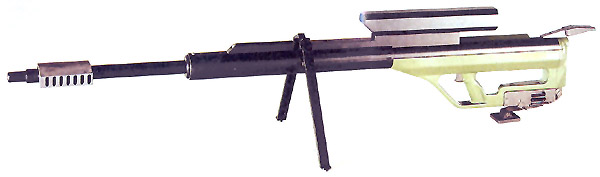
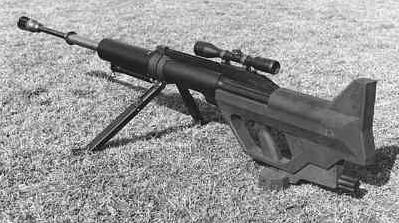
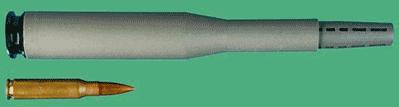
Large caiber sniper rifles usually built to use heavy machineguns ammunition, such as .50BMG (12.7x99mm) or 12.7x108mm. Effective range of such rifles is up to 1500 meters and above, depending on size of target and quality of the ammunition. General purpose machinegun ammo usually produced not-too-good accuracy, but recently some special "sniper" rounds developed in .50BMG caliber.
Silenced sniper rifles usually are used with special sub-sonic ammunition and removable or integral silencers to produce lower sound report. Sub-sonic ammo decreases effective range down to 300-400 meters, but it's worth. With the correct ammo and silencer, the sound of the gunshot could be easily mised completely at the distances of 100-200 meters at night, or even at 30-50 meters - in daily urban noize.
Sniper rifle Accuracy
The most common way of describing the accuracy of the sniper rifle is to measure average diameter of the circle, that may be drawn arount the group of bullet holes in the target. Usually, the rifle is fired from the rest with groups of the 5 (or 3) rounds, and then every group is measured. Average group diameter is the most common criteria of rifle accuracy.
Today, the thin line between "good" and "poor" accuracy is usually laid in 1MOA group. 1 MOA (Minute Of Angle) is measure of the angle, that formed with the triangle with muzzle as the top and the group as the base. 1 MOA is roughly equivalent to 1 inch group diameter at 100 yards (91 meter), or to 2 inches at 200 yards etc. So, if you read that rifle XXXX shooths 1MOA groups, it means that at 300 yards this rifle could place 5 or so bullets in circle of no more than 3 inches in diameter. Many modern sniper rifles, when loaded with right ammunition, could shoot 0.5MOA, or even 0.3MOA, which mean 1 inch groups at 300 yards, or 2 inch (50 millimeters!) groups at 600 yards (550 meters).


 08.44
08.44
 Jack The Ripper