


 02.36
02.36
 Jack The Ripper

SP-3 and PZAM silenced pistol ammunition
During the postwar period, there was much development in the field of the small arms ammunition. Soviet Union actively participated in these developments, following both mainstream and some more or less unconventional routes. The mainstream developments are well known and included 7.62x39 M43 and 5.45x39 M74 intermediate ammunition for assault rifles, as well as 9x18 ammunition for pistols. Of cause, there was much more development in these lines that it might appear at the first sight, but for now we will focus on rather more interesting types of ammunition.
During the post-war decades both USSR and its major rivals from NATO were deeply engaged in espionage and counter-espionage. These activities sometimes called for very special actions, usually described by typical Russian euphemism as “wet deeds”, or, in plain language, murders. These clandestine operations required some very special weapons, and during early 1950s the designer Igor Ya. Stechkin (better known as an author of the 9mm APS Stechkin automatic pistol), developed a very special weapon for KGB. Externally this weapon looked much like flat tin cigarette case, but internally it held three short barrels and a trigger unit. The intended use of this weapon was obvious, but the necessary compact size effectively prohibited the use of a standard silencer. As a result, Stechkin developed a special type of ammunition, which required no silencer to be fired silently. The major source of the sound of gunshot is the large volume of hot gases, violently expanding from the muzzle and creating a sound wave. Stechkin avoided this problem by encapsulating the blast of the propellant within the cartridge case. First experiments were conducted using standard 9x18 cases, but the ammunition, designated SP-1 (Spetsialnyj Patron 1 – special cartridge 1), never achieved production status. The SP-2 ammunition, which was the first to be produced in any quantity, has been based on 7.62x39 case, slightly shortened and fitted with round-nose 7.62mm bullet with aluminum core extended back into the case to rest on the internal piston. Internally this cartridge contained a small charge of propellant behind a short piston, which propelled the bullet out of the case when fired and then locked the hot powder gases inside the case. The resulting sound was almost non-existent, and the cartridge has been adopted by KGB for clandestine operations. To improve performance and somewhat confuse possible investigators, the round-nose bullet has been later replaced by standard pointed 7.62mm bullet originally used in 7.62x39 M43 ammunition. Earlies development centered on a large steel case with single-stage piston and internal firing pin, located in the base in attempt to keep high pgas pressures within the case after the discharge. This design was known as 7.62x63 PZ cartridge, which later evolved into PZA and PZAM cartridges of the basically same dimensions. This ammunition was in use since mid-1960s in S4M silent pistol. Later on, another cartridge cartridge, designated as 7.62x38 SP-3, has been developed and put in use during early 1970s, along with MSP two-barreled derringer type pistol and NRS scout shooting knife. The SP-3 featured much shorter case, because it used more compact two-stage piston system and more or less standard primers, securely crimped into the base of the cartridge. The performance of the SP-3 was about 25% less (in terms of muzzle energy) than of PZAM, but it was considered sufficient for its intended use in deep concealment last-ditch weapons used by Soviet secret intellegence agents outside of USSR.
During the post-war decades both USSR and its major rivals from NATO were deeply engaged in espionage and counter-espionage. These activities sometimes called for very special actions, usually described by typical Russian euphemism as “wet deeds”, or, in plain language, murders. These clandestine operations required some very special weapons, and during early 1950s the designer Igor Ya. Stechkin (better known as an author of the 9mm APS Stechkin automatic pistol), developed a very special weapon for KGB. Externally this weapon looked much like flat tin cigarette case, but internally it held three short barrels and a trigger unit. The intended use of this weapon was obvious, but the necessary compact size effectively prohibited the use of a standard silencer. As a result, Stechkin developed a special type of ammunition, which required no silencer to be fired silently. The major source of the sound of gunshot is the large volume of hot gases, violently expanding from the muzzle and creating a sound wave. Stechkin avoided this problem by encapsulating the blast of the propellant within the cartridge case. First experiments were conducted using standard 9x18 cases, but the ammunition, designated SP-1 (Spetsialnyj Patron 1 – special cartridge 1), never achieved production status. The SP-2 ammunition, which was the first to be produced in any quantity, has been based on 7.62x39 case, slightly shortened and fitted with round-nose 7.62mm bullet with aluminum core extended back into the case to rest on the internal piston. Internally this cartridge contained a small charge of propellant behind a short piston, which propelled the bullet out of the case when fired and then locked the hot powder gases inside the case. The resulting sound was almost non-existent, and the cartridge has been adopted by KGB for clandestine operations. To improve performance and somewhat confuse possible investigators, the round-nose bullet has been later replaced by standard pointed 7.62mm bullet originally used in 7.62x39 M43 ammunition. Earlies development centered on a large steel case with single-stage piston and internal firing pin, located in the base in attempt to keep high pgas pressures within the case after the discharge. This design was known as 7.62x63 PZ cartridge, which later evolved into PZA and PZAM cartridges of the basically same dimensions. This ammunition was in use since mid-1960s in S4M silent pistol. Later on, another cartridge cartridge, designated as 7.62x38 SP-3, has been developed and put in use during early 1970s, along with MSP two-barreled derringer type pistol and NRS scout shooting knife. The SP-3 featured much shorter case, because it used more compact two-stage piston system and more or less standard primers, securely crimped into the base of the cartridge. The performance of the SP-3 was about 25% less (in terms of muzzle energy) than of PZAM, but it was considered sufficient for its intended use in deep concealment last-ditch weapons used by Soviet secret intellegence agents outside of USSR.
| cartridge | metric designation | bullet weight | muzzle velocity | muzzle energy |
| PZAM | 7.62x63 | 8 g / 123 grain | ~ 175 m/s / 570 fps | 122 J / 90 ft-lbs |
| SP-3 | 7,62x38 | 8 g / 123 grain | ~ 150 m/s / 490 fps | 90 J / 66 ft-lbs |
 loaded 7.62mm PZA silent cartridge and fired case (note projecting piston) |  loaded 7.62mm PZAM silent cartridge and fired case (note projecting piston and slightly bottlenecked cartridge) loaded into steel clip, as used for S4M pistol |  7.62mm SP-3 cartridge and spent SP-3 case and bullet, loaded into steel clip used for MSP pistol Note that piston is of two-stage telescoped design |
SP-4 silenced ammunition
The key problem with the SP-3 and PZAM ammo were their telescoped pistons, which projected significantly from fired cases and thus made almost impossible to develop the semi-automatic weapons for these cartridges. During late 1970s and early 1980s Soviet designers solved this problem by developing the 7.62x42 SP-4 ammunition, which used the same basic principle. The telescoped two-stage piston has been replaced by single-stage piston, which did not projected from the case when fired; the standard 7.62mm M43 bullet has been replaced by the cylindrical bullet, made of mild steel, and fitted with a brass driving band at the front. This cartridge has been adopted circa 1983 by KGB and Spetsnaz elements of the Soviet Army, along with six-shot, magazine fed, blowback operated semiautomatic PSS pistol and single-shot NRS-1 scout shooting knife. The SP-4 ammunition and PSS pistols are still in use by elite Spetsnaz units within Russian armed forces, as well as by some FSB and MVD elite units. Apparently, the earlier MSP pistol with SP-3 ammo and S4M pistol with PZAM ammo were not phased out of service and still can be encountered in the hands of serious operators, who not require multi-shot capabilities of PSS / SP-4 system.
|
SP-5 and SP-6 subsonic assault rifle ammunition
Next line of development, also initiated by Spetsnaz requirements, also involved silenced weapons, but in more powerful form. Since the effective range of silenced pistols is severely limited, scout and Spetsnaz elements of the Soviet army originally employed AK and AKM rifles, fitted with detachable sound suppressors (silencers) and loaded with special versions of 7.62x39 M43 ammo, known as 7.62x39 US (Umenshennaya Skorost – Low velocity). To achieve subsonic velocity along with acceptable ballistics, these cartridges were loaded with heavier bullets, but its performance was still inadequate. So, during the late 1980s, soviet designers developed improved sub-sonic ammunition, suitable for specially designed automatic weapons. These cartridges, known as SP-5 and SP-6, were based on a 7.62x39 M43 case, necked-out to 9mm, and loaded with heavy, streamlined bullets. The SP-5 cartridge was loaded with standard “ball” bullet with lead core, and was intended for accurate sniper work out to 300-400 meters. The SP-6 cartridge featured an armour-piercing bullet with hardened steel core, which could defeat typical military type body armour at the ranges of up to 300-400 meters. Two weapons were initially developed for this ammunition, both based on the same receiver and gas operated action – VSS sniper rifle and AS assault rifle. Both weapons were selective fired, with integral sound suppressors, and used same magazines with 10- or 20-round capacity. Latter on, several more weapons were developed for 9x39 ammunition, such as SR-3 and9A-91 compact assault rifles, used by elite Internal Affairs Ministry, Police and State Security units. The one problem, associated with 9x39, as well as with most other special purpose cartridges, is that such ammunition is usually quite expensive. An attempt was made during late 1990s to produce much cheaper 9x39 AP loading, designated as PAB-9. This cartridge featured bullets with stamped (instead of machined) steel cores, as well as increased driving surfaces. As a result, accuracy was poor and barrel wear significantly increased, so this ammunition is apparently no longer in use.
|

left to right: SP-5 ball cartridge case and bullet; SP-6 AP dummy cartridge, and 7.62x39 M43 cartridge for scale
SP-10 armor piercing pistol ammunition
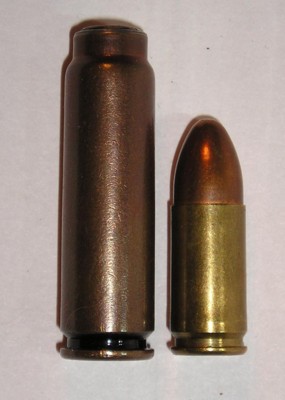
This development leads us back to pistol ammunition, but this time with improved penetration capabilities rather than stealth. The proliferation of body armor rendered most military pistols, with its ammunition being about 100 years old, almost obsolete. The one way to deal with body armor is to adopt smaller-caliber, high velocity bullets for both pistols and submachine guns. This gives additional benefit of flatter trajectory and lessened recoil, both beneficial for accuracy. At the minus side, the terminal performance of the small-caliber, light weight bullets is somewhat questionable. After initial test and research, conducted since late 1980s under the codename “Grach”, Russian armed forces adopted an improved version of the world’s most popular pistol ammo, the 9x19 Parabellum. First produced circa 1994, this version of the 9mm features an armor piercing bullet of proprietary design, and a powerful powder charge, which brings this cartridge, officially designated as 7N21, to the +P+ level, with peak pressures running up to 2 800 kg per square meter. Armor piercing bullet for 7N21 ammo features a hardened steel penetrator core, enclosed into bimetallic jacket. The space between the core and jacked is filled with polyethylene, and the tip of the penetrator is exposed at the front of the bullet, to achieve better penetration. Bullet of the similar design, but of lighter weight, is used in another service 9x19 cartridge, 7N31, which has been developed in late 1990s for theGSh-18 pistol, and latter was adopted for PP-2000 submachine gun. Another offspring of the ”Grach” trials is the 9x21 family of ammunition. Adopted by the Federal Security Bureau (FSB) of Russian Federation, this cartridge in its basic form, known as SP-10, is more or less a stretched-out 7N21 cartridge with improved performance; 9x21 ammo also available in AP-T (tracer) and SP-11 low-ricochet ball (with lead core) bullets. This ammo is used in SPS “Gyrza” pistol and in SR-2 “Veresk” submachine gun.
|

Underwater pistol and rifle ammunition
Next line of development, almost unique to the Soviet armed forces, is the underwater firearms and ammunition for these. Initially developed during late sixties, underwater cartridges propelled the long and slim drag-stabilized bullets, and were used in four-barreled SPP-1 break-open pistols. To achieve better loading and extraction, the bottlenecked brass cartridges were rimmed and loaded using special flat clips, which held all four rounds together. Both primer pockets and case necks were sealed against the water, and the steel bullets were covered by special lacquer coating. Initially satisfied with the pistol, Special Forces elements of the Soviet Navy requested further development and by the mid-1970s soviet designers brought in an unique underwater assault rifle, the APS (which, in fact, was a smoothbore weapon). This weapon used cartridges, externally similar to earlier SPS pistol ammunition, but based on the standard 5.45x39 M74 cases. This “rifle” ammunition is available in two basic forms, MPS “ball” and MPST “tracer”. Both APSunderwater automatic weapon and SPP-1M underwater pistol are still in use by Russian navy, as well as offered for export.
|

underwater cartridges, left to right:
7.62x39 M43 cartridge for scale;
4.5mm SPS cartridge case and bullet;
4.5mm SPS dummy cartridge;
5.66mm MPS dummy cartridge
Small-caliber pistol ammunition
The last development, which could be considered as a “special purpose”, took the place during 1970 – 1972 timeframe, when the KGB requested the development of an “easily concealable pocket pistol, with flat shape and not thicker than a matchbox (17mm)”. This pistol was intended as a concealed carry weapon for security personnel, as well as self-defense weapon for top ranked officials. After a short research designers rejected available western “pocket-gun” ammunition, such as 6.35x16SR and 7.65x17SR, as entirely unsatisfactory, and rapidly developed a small round, which looked more or less like scaled down 7.62x39 M43 cartridge. The 5.45x18 MPTs cartridge had a rimless bottlenecked case, made of brass, with pointed jacketed bullet. The terminal performance of this tiny cartridge is rather unspectacular, but it has a reputation for penetrating soft body armor at shorter distances. However, it is by no means an “armor piercing” ammunition, and the latter attempts to use it for larger PDW-type weapons such as full-size OTs-23 “Drotik” automatic pistol, turned into a predictable failure. Still, the extremely compact and quite reliable 5.45x18 PSM pistol is widely used as a self-defense weapon for Army and MVD generals, as well as by various law enforcement operatives, working under cover.
|

5.45mm 7N7 cartridge (right) compared to 9x19 Parabellum cartridge (left)

