Jumat, 25 Januari 2013

Kel-Tec PMR-30

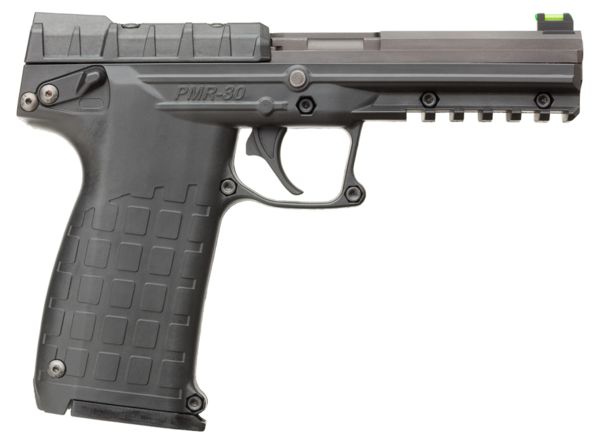
Kel-Tec PMR-30 pistol
 
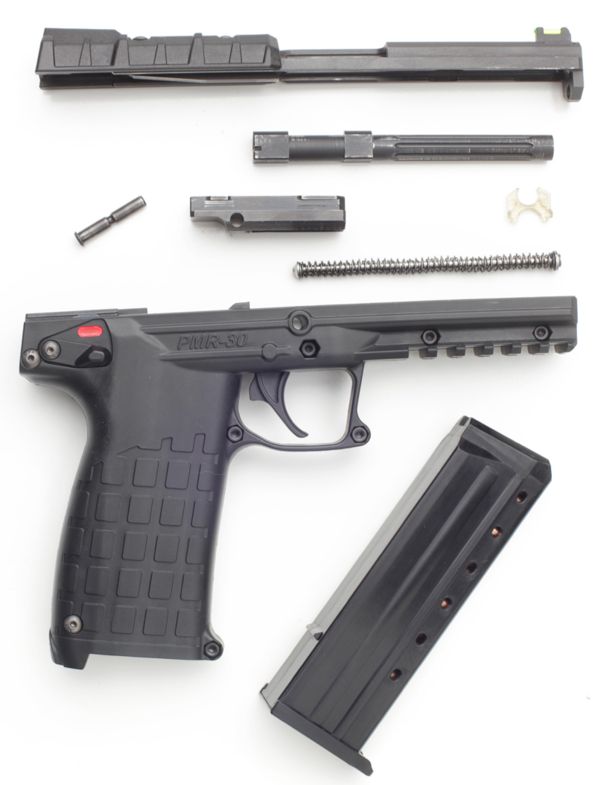
Kel-Tec PMR-30 pistol, partially disassembled


Type Single Action semiautomatic
Caliber(s)  .22 WMR (5.6mm Winchester Magnum Rimfire)
Weight unloaded 386 g / 13.6 oz
Length 201 mm / 7.9"
Barrel length 109 mm / 4.2"
Magazine capacity 30 rounds

The Kel-Tec PMR-30 pistol is a most recent development of the US-based Kel-Tec CNC Industries Co, an innovative arms-making company led by renowned small arms designer George Kellgren. The Kel-Tec PMR-30 pistol entered production in 2010, and is intended for civilian market, as an inexpensive, yet effective personal weapon for practice, small game hunting and self-defense. Thanks to the light weight and low recoil, it is suitable for most shooters, even those who can't stand recoil of the more powerful handgun ammunition. Yet, this pistol is not a toy by any means - it delivers about 190 Joules (139 Ft.Lbs) of muzzle energy per every shot, and there's plenty of shots per every magazine.
The Kel-Tec PMR-30 pistol uses interesting operating system, which manufacturer calls "hybrid blowback/locked-breech system". In my opinion, however, this system can be better described as delayed blowback, as there's actually no rigid mechanical locking between the barrel and slide upon discharge. The slide is free to recoil, and the barrel also is allowed to recoil a little against the steel insert, set into the frame. If the chamber pressure is high (gun is loaded with 'hot' versions of the .22 WMR ammo), the friction between the case and chamber walls will cause the barrel to recoil along with the case, adding its mass to the mass of the slide and thus slowing (delaying) down the initial recoil while pressure is still high. If chamber pressure is low enough, the case will start to slip out of the barrel immediately, just like in any other simple blowback weapon. To quote Kel-Tec design engineer, "It's a balancing act between the bullet friction pulling the barrel forward, and the case friction in the chamber pulling the barrel back. Bullet friction does not change much based on round pressure, but the case friction will.". The Kel-Tec PMR-30 pistol is built around a compact aluminum alloy frame, which is set into polymer (Zytel) grip frame. The slide and barrel are manufactured from steel, and the rear part of the slide is also enclosed into the polymer housing which has large cocking serrations and also carries an integral rear sight base on the top. The trigger is of single action type, with ambidextrous safety levers, conveniently located at either side of the grip frame. Double-stack, single feed magazine is also made from Zytel and has capacity of 30 rounds. Magazine release is located at the base of the grip, to provide maximum protection against accidental magazine release. The Kel-Tec PMR-30 pistol is equipped with fixed iron sights with color fiber-optic inserts; front sight is dovetailed to the slide.

Kel-tec PF-9

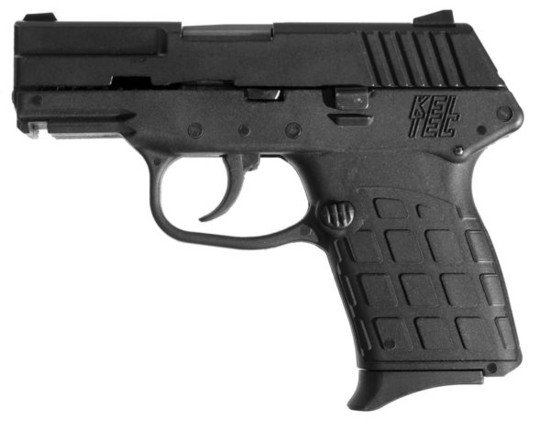
Kel-tec PF-9 pistol
Kel-tec PF-9 pistol
image: Kel-tec
 
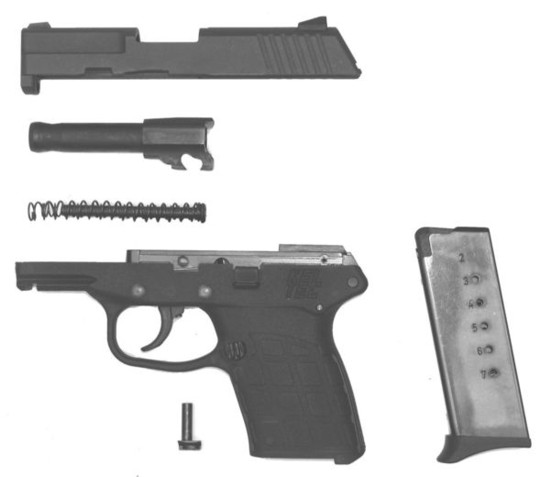
Kel-tec PF-9 pistol, partially disassembled
image: Kel-tec


Type Double Action Only semiautomatic
Caliber  9x19 Luger / Parabellum
Weight   368 g (12.7oz) empty
Length 149 mm (5.85")
Barrel length 79 mm (3.1")
Magazine capacity 7 rounds

The PF-9 is the latest creation of the US-based Kel-Tec CNC Industries company. Designed by George Kellgren, PF-9 is a further evolution of the highly successful P-11 pistol of the same maker. PF-9 has been introduced at the Shot Show 2006, and its main niche is deep concealment, self defence weapon for civilian public and police. Firing most popular and quite effective 9mm Luger / Parabellum ammunition, PF-9 offers decent firepower in the compact, lightweight and especially flat package - PF-9 is only 22mm (0.88") thick. Compared to P-11, PF-9 traded some magazine capacity for better concealment properties. It also added an integral accessory rail on the frame, below the barrel, which increases versatility of this weapon by allowing easy installation of the laser sight or small tactical flashlight.
Kel-tec PF-9 pistol is a short recoil operated, locked breech weapon that uses traditional linkless Browning system. Fame of pistol is made from durable and impact-resistant polymer, with pinned steel insert that bears slide rails. Double-action only trigger utilizes striker system with no hammer and no manual safeties. Single stack magazine holds 7 rounds, plus one in the chamber. Magazine release button is conveniently located at the base of triggerguard. Sights are of fixed type, with rear sight blade being dovetailed into the slide. Frame is made with integral, Picatinny type accessory rail below the barrel.

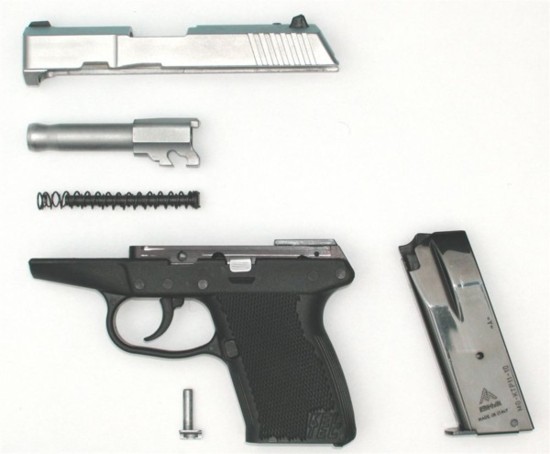
Kel-tec P-11

Kel-tec P-11 pistol
Kel-tec P-11 pistol
image: Kel-tec
 
Kel-tec P-11 pistol, partially disassembled
image: Kel-tec


Type Double Action Only semiautomatic
Caliber  9x19 Luger / Parabellum
Weight  415 g (14.4oz) empty, 575 g loaded
Length 149 mm (5.85")
Barrel length 79 mm (3.1")
Magazine capacity 10 or 12 rounds

Kel-tec P-11 pistol has been developed in 1994 by US-based Kel-Tec CNC Industries company. Designed by George Kellgren, this pistol was intended as a personal defence weapon for civilian public and back-up / off-duty carry weapon for police officers. Designed under limitations of the now-gone "Assault weapons ban", P-11 has a maximum legitimate magazine capacity of 10 rounds in the reasonably small package. This small and lightweight weapon provides serious firepower (considering its size) and during the time proved itself as a dependable weapon, well liked by its users. It also spawned a number of copies and imitations from other makers, in the form of compact, lightweight polymer-framed pistols with simple and safe DAO triggers. 
Kel-tec P-11 pistol is a short recoil operated, locked breech weapon that uses traditional linkless Browning system. Fame of pistol is made from durable and impact-resistant polymer, with pinned steel insert that bears slide rails. Double-action only trigger utilizes striker system with no hammer and no manual safeties. Double stack magazine holds 10 rounds; since the demise of Assault Weapons Ban (which was enforced between 1994 and 2004), extended capacity, 12-round magazines also are available from Kel-tec. Magazine release button is conveniently located at the base of triggerguard. Sights are of fixed type, with rear sight blade being dovetailed into the slide.

LAR Grizzly

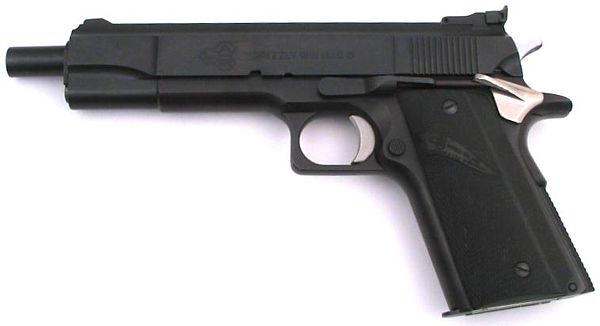
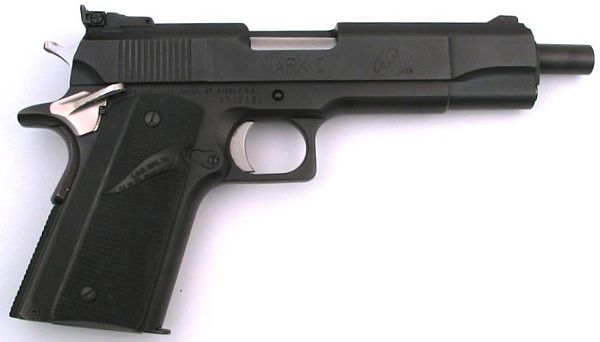
LAR Grizzly Mark I pistol, caliber .45 Winchester Magnum
 
LAR Grizzly Mark I pistol, caliber .45 Winchester Magnum
 
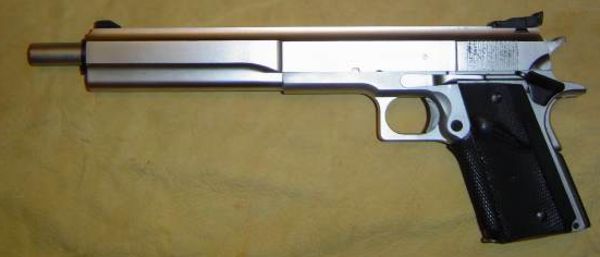
LAR Grizzly Mark I pistol, caliber .45 Winchester Magnum with long slide and 10 inch barrel


Type Single Action semiautomatic
Caliber(s) .45 Win Mag; also .45ACP, 10mm Auto, .357 Mag, 9mm Win Mag, .38 Super
Weight unloaded ~ 1380 g
Length 267 mm (with 6 1/2" barrel)
Barrel length 165 mm (6 1/2") or 254 mm (10")
Magazine capacity 7 rounds

The Grizzly Win Mag pistol has been developed during early 1980s by L.A.R. Manufacturing Inc (USA; L.A.R. stands for names of company founders - Larisch, Augat and Robinson). This pistol has been designed around the very powerful .45 Winchester Magnum (.45 Win Mag, metric designation 11.43x30mm) ammunition, which generates muzzle energies in the 1100 Joules (810 ft-lbs) region. The prime intended niches for that round and Grizzly pistol were hunting and silhouette shooting, as massive pistol was way too heavy for defensive carry, and .45 Win Mag ammunition was overpowered and generated plenty of recoil. Despite (or because of) merits of .45 Win Mag ammunition, the Grizzly pistol was designed as a multi-caliber platform. Standard Grizzly mark I pistols were sold in .45 Win Mag chambering, but patented factory conversion kits were available for conversion of said pistol into one of many popular calibers, including .45ACP, 10mm Auto, .357 Magnum and several others. Such kits included new barrels, barrel bushings, springs, magazines, as well as "multi-caliber" extractors and ejectors which replaced dedicated ".45 Win Mag only" extractor and ejector of the basic weapon. Later on, LAR manufacturing also introduced two slightly enlarged version of the Grizzly, known as Mark IV and Mark V. Mark IV pistols were chambered for popular .44 Magnum revolver round; Mark V were chambered for very powerful .50AE ammunition, in an obvious attempt to catch up with competitors such as IMI / Magnum Research Desert Eagle or AMT Automag. However, for various reasons manufacture of Grizzly pistols has ceased by the turn of 21st century, and today these pistols are no longer made. However, L.A.R. Manufacturing Inc is still in business and still offers spare parts and service for Grizzly Win Mag pistols.
Grizzly pistols were known for good accuracy, high quality and fierce recoil, especially in Mark V .50AE version; these pistols required replacement of return springs quite often, about every 1000 rounds or so (in more common calibers return springs can serve ten or twenty times more with not a single problem). Pistols were available with different barrel lengths (6 1/2 inch barrel being the standard), with optional muzzle brakes and/or compensators.
Technically, LAR Grizzly pistols were a scaled up copies of eternal Colt M1911 pistol, designed by John Browning. Grizzly used same locked breech, short recoil operated action with tilting barrel and swinging link. Trigger was of Single action type, with exposed hammer, automatic grip safety and frame-mounted manual safety. Magazines were single stack. Standard sights were of target type, with fully adjustable rear.

Coonan

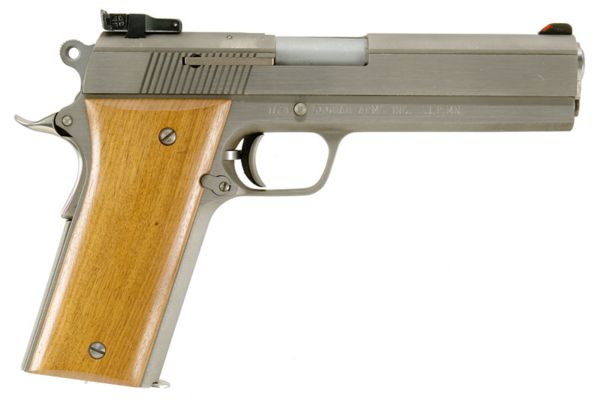
Coonan pistol, right side
 
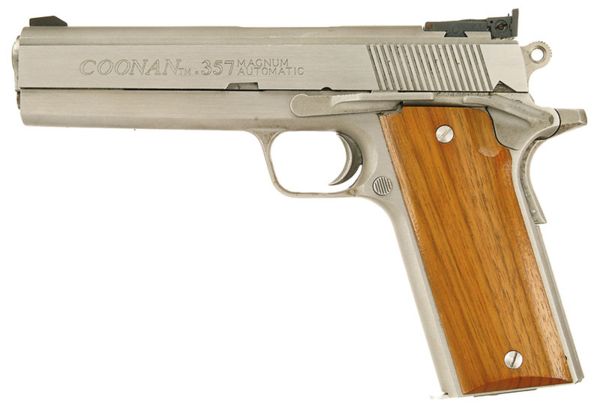
Coonan pistol, left side
 
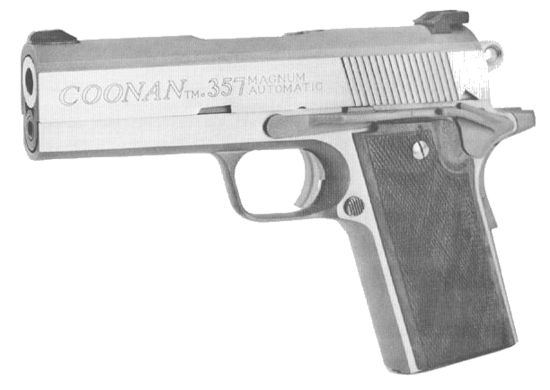
Coonan Cadet pistol
Coonan Cadet pistol


  Coonan standard model Coonan Cadet model
Type Single Action semiautomatic
Caliber(s) .357 Magnum, .38 Special +P .357 Magnum
Weight unloaded 1190 g 1100 g
Length 210 mm 182 mm
Barrel length 127 mm 99 mm
Magazine capacity 7 or 8 rounds 6 rounds

Dan Coonan, an American gun designer, started the development of a .357 Magnum caliber semiautomatic pistol in around 1977. He did so in the search of combat / defensive pistol that will provide same terminal effectiveness as .357 caliber revolvers, but with bigger capacity and faster reloading, specific to semiautomatic pistols. He first designed a working magazine (not a simple thing assuming the relatively large overall length and a rimmed case design of a .357 Magnum round). Once magazine was ready, Dan Coonan built his first forking prototype using standard M1911 parts; to be able to fit long .357 cartridges, he had cut the slide and the frame (in the grip area) and welded in steel inserts to increase length of parts. First Coonan .357 Mag barrel barrel was made from solid block of steel. Once prototype pistol was finished and successfully tested, Coonan established its own business, Coonan Arms Inc., and started to make pistols of his design. Through the time, basic design was upgraded to Model B, with major improvement being the introduction of the linkless barrel system. During early 1990's Coonan introduced a cut-down "Cadet" model with shortened barrel and grip; at about the same time he also worked on .41 Magnum caliber pistol, which apparently was never finished. Coonan arms also offered .38 Special +P caliber conversion kits, which included weaker return springs and magazines with spacers, which were necessary to firmly hold shorter rounds.
In the year 1994 Coonan Arms Inc went filed bankruptcy, and in the same year  it was reorganized and lived on until 1998, when it was dissolved. At the present time, parts and repair service for Coonan pistols are offered by Dan Coonan Inc. Coonan pistols are out of production and no longer made.
Overall, Coonan pistols were fine weapons, suitable for most applications like self-defence (including concealed carry), service use by police officers, hunting, target shooting. These pistols were made to rather high standard and thus were somewhat expensive.
Coonan Model A pistols were short recoil operated, locked breech pistols that employed Browning-type system with tilting barrel, connected to the frame with swinging link (system, borrowed from Colt M1911 pistol). Conan model B and smaller Cadet pistols were similar to Model A except for simplified linkless barrel tilting system. Single action trigger with exposed hammer, automated grip safety and frame-mounted manual safety also were copied from M1911. Magazines were single stack; early magazines held 7 rounds, late production magazines held 8 rounds; shorter Cadet magazines hold only 6 rounds. Coonan pistols were fitted either with Millet type adjustable or with combat type fixed sights; rear sight was dovetailed to the slide.
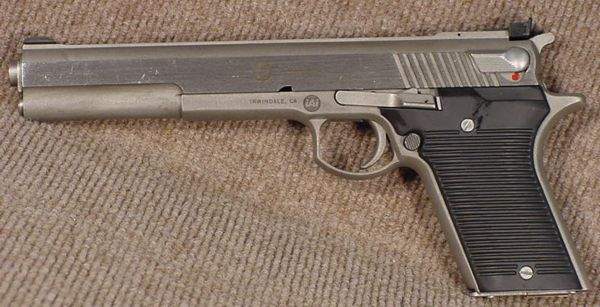
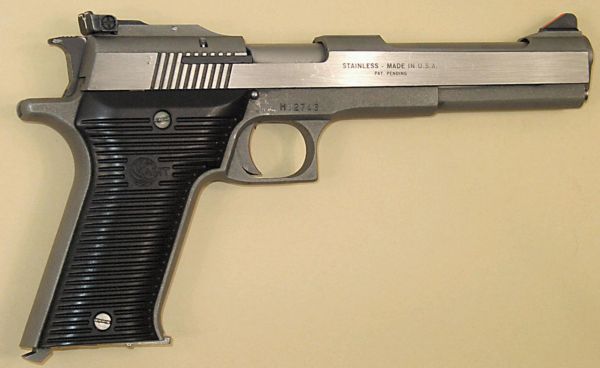
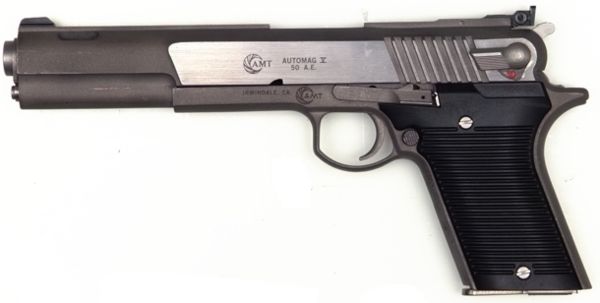
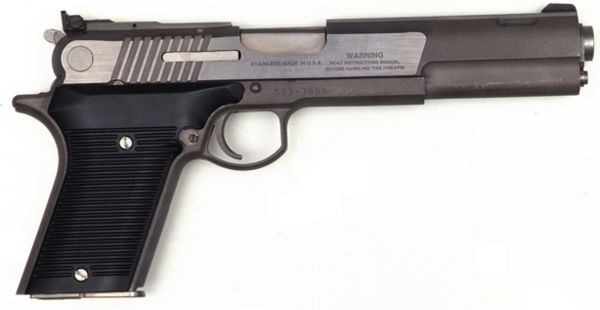
AMT Automag II III IV and V pistols

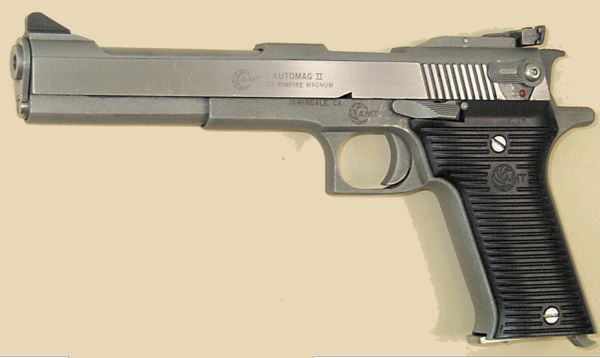
AMT Automag II pistol, caliber .22WMR, left side
 
AMT Automag II pistol, caliber .22WMR, right side
 
AMT Automag III pistol, caliber .30 M1 carbine
 
AMT Automag IV pistol, caliber .45 Winchester Magnum
 
AMT Automag V pistol, caliber .50AE, left side
 
AMT Automag V pistol, caliber .50AE, right side


  Automag II Automag III Automag IV Automag V
Type Single Action semiautomatic
Caliber(s) .22WMR  .30 Carbine, 9mm Win Mag .45 Win Mag  .50AE
Weight unloaded 910 g (152mm barrel) 1280 g 1300 g 1310 g
Length n/a n/a n/a n/a
Barrel length 86, 112 or 152 mm
(3 3/4, 4 1/2 or 6 inch)
165 mm (6 1/2 inch) 165 mm (6 1/2 inch) 165 mm (6 1/2 inch)
Magazine capacity 9 rounds 8 rounds 7 rounds 7 rounds

The "new" Automag pistols emerged during late 1980s from the same Harry Sanford who brought the original Auto Mag pistols about 15 years earlier. The "new" Automag pistols (note that they name is spelled in single word, unlike the name of 1971-vintage original .44 Auto Mag) were produced by the company, owned by Harry Sanford and known either as AMT (Arcadia Machine and Tool) or IAI (Irwindale Arms Inc). After some turbulences, AMT / IAI finally went out of business by late 1990s, and sold rights to Automag pistols to another company, Galena Industries, which also did not lasted long. However, in the 2004 the re-established High Standard Corporation announced that it will make Automag pistols; today (spring 2006) only .22WMR Automag II pistols are listed in High Standard price lists. Original AMT Automag II pistols were manufactured since 1987. AMT Automag III pistols were made between 1992 and late 1990s, and Automag IV and V were produced circa 1993-96.
It must be noted that original AMT / IAI pistols were not known for great reliability or durability; most models were "hit or miss" propositions, with some specimens being rather well made and providing good service, and some others being among the worst jam-o-matics available for the money.
The Automag pistols were never really intended for any serious defensive of security use; they key niches were plinking and hunting. The only pistols from Automag line that were more or less suitable for concealed carry were .22 caliber Automag II with 3 3/4 or 4 1/2 inch barrels. Also, all centerfire Automag pistols had rather large grips, necessary because of use of relatively big and long cartridges.
Automag pistols were single action semiautomatics with exposed hammer and manual, slide mounted safety that blocked the firing pin but not hammer, sear or trigger, thus not permitting the safe "cocked and locked" carry. Most parts were made from stainless steel. Basic actions were of two types - .22WMR (rimfire) Automag II pistol utilized simple blowback action with radially grooved chamber (to resist and delay initial extraction when pressure in the barrel still high); larger caliber (centerfire) models III through V utilized locked breech, short recoil action of Browning type. Locking was achieved by tilting barrel, with single lug engaging ejection window in the slide. Unlocking was controlled by cam-shaped slot in the lug below the chamber of the barrel, which interacted with the slide stop axis pin. Magazines are single stack on all models, magazine release is in the base of triggerguard on models III to V, and at the bottom of the grip on Automag II. Sights are of adjustable, target type on all Automag pistols.

 
Design by Free WordPress Themes | Bloggerized by Lasantha - Premium Blogger Themes | Online Project management