Jumat, 21 Juni 2013

EF88 / F90

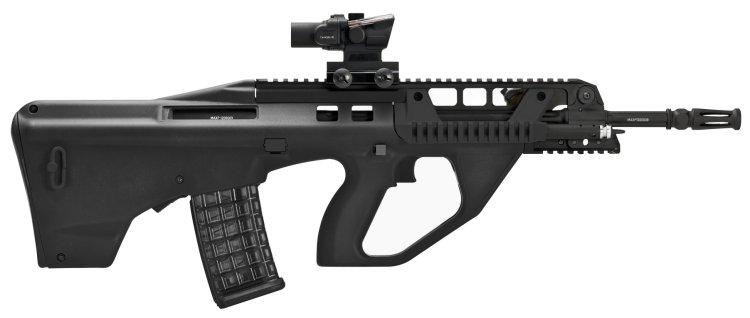
Thales EF88 / F90 assault rifle


Thales EF88 / F90 assault rifle with 40cm barrel
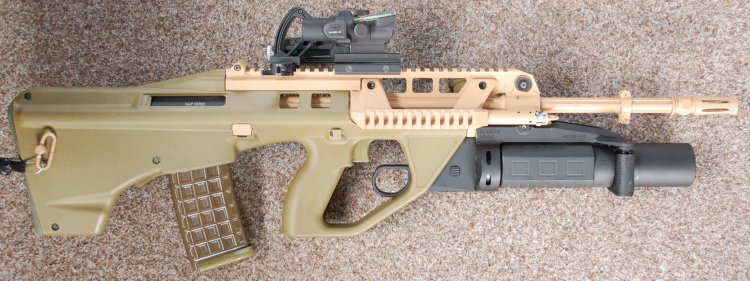

Thales EF88 / F90 assault rifle with 50cm barrel and underbarrel grenade launcher


F90 carbine
F90
Caliber
5.56x45 NATO
5.56x45 NATO
Length
700 mm
802 mm
Barrel length
407 mm
508 mm
Weight
3.25 kg
3.39 kg
Rate of fire
850 RPM
850 RPM
Magazine
30 rounds
30 rounds

F90 assault rifle, also known as EF88 (enhanced F88) is an evolution of the F88 assault rifle, which was adopted by Australian and New Zealand armed forces during late 1980s. The original F88 rifle is a licensed copy of the Austrian Steyr AUG rifle, and it was produced in Australia at Australian Defense Industries factory in Lithgow. Today this same factory is operated by the Thales Australia, which developed EF88 / F90 rifle as a next weapon for Australian army, as well as for export.
While internally and externally the F90 is still close to Steyr AUG, it has many distinctive upgrades and changes, developed by Thales to fulfill current and near-future requirements of Australian armed forces. The Thales F90 rifles were first displayed to the public in mid-2012, and initial production is scheduled for 2013.
The resulting weapon is said to be much more reliable and comfortable than original F88 / Steyr AUG rifle. It is also noticeably lighter: standard F90 with 50 cm / 20” barrel is about 0.5 kg / 1.1 lbs lighter than standard F88 rifle; with new 40mm underbarrel grenade launcher installed, resulting weapon is more than 1.6 kg / 3.5 lbs lighter than F88 rifle equipped with M203PI grenade launcher.


F90 / EF88 assault rifle is gas operated, selectively fired weapon of bullpup layout. It uses polymer housing with improved shape of buttstock (including the new buttpad and added comb for better cheek-weld). Gas operated, short-stroke, rotary bolt action is similar to that of original Steyr AUG, but the gas block is modified. Aluminum alloy receiver is also modified to improve reliability and reduce weight. Ejection ports and ejection covers also modified to ensure reliable extraction under all conditions.
Unlike all previous versions of the Steyr AUG, the F90 has non-removable barrels, cold-hammer forged and externally fluted. Standard F90 rifles are offered with 50 cm / 20” barrels; other versions include carbines with 40 cm / 16” barrel and CQB variants with 36 cm / 14.1” barrel. Other clearly visible changes include extended Mil-Std (Picatinny) rail at the top; bottom rail has replaced original folding forward grip of the Steyr AUG / F88. Third accessory rail is mounted on the right side of the weapon. Trigger guard is redesigned to accept new, specially designed 40mm Underbarrel Grenade Launcher. This lightweight add-on weapon can be quickly attached directly to the bottom rail of the host rifle, and then easily removed when not required. Less visible changes include addition of the bolt hold-open device to facilitate faster reloads. F90 will feed from the same proprietary translucent magazines, made from polymer as the original Steyr AUG / F88 rifles, although optional STANAG-compatible version is said to be available in the near future. Basic sighting is provided by Trijicon ACOG optical sights with 1.5X or 3.5X magnification, although sights can be easily changed, thanks to MilStd mounts.

AICW

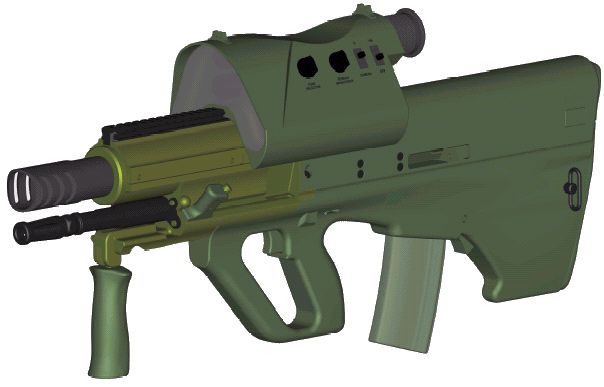
AICW - Advanced Infantry Combat Weapon

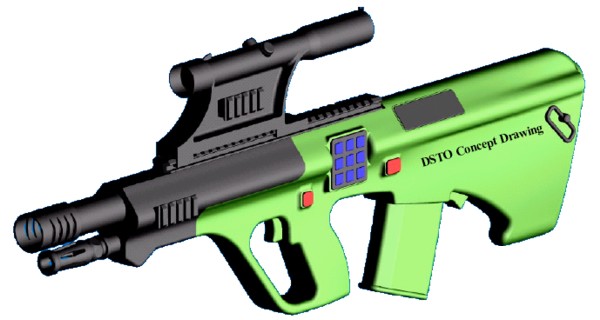
2001 concept of the AICW system

2003 concept of the AICW system

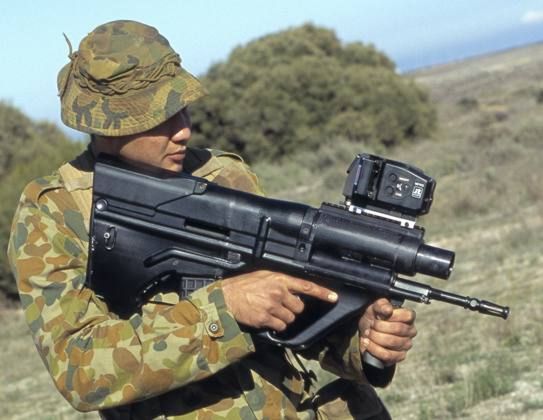
2005 testing prototype AICW VX3 weapon


Caliber: 5.56x45mm NATO + 40mm
Action: Gas operated, rotating bolt + Metal Storm patented stacked-projectile caseless
Overall length: 738 mm
Barrel length: n/a
Weigth: 6.48 kg unloaded, w/o sight; 7.85 kg loaded w/o sight (30 5.56mm + 3 40mm rounds); 9.9-9.9 kg loaded w. electronic sight
Rate of fire: 650 rounds per minute (for 5.56mm barrel)
Capacity: 30 rounds (5.56mm) magazine plus 3 40mm rounds in the G/L barrel

The AICW (Advanced Infantry Combat Weapon) is a joint development of the Australian DSTO (Government operated Defence Science and Technology Organisation), and private companies Metal Storm and Tenix Defence. This development has been carried out since the turn of 21st century, closely following the concept of the American XM29 OICW system. Overall, AICW represents the modular weapon system that combines the 5.56mm rifle/carbine copmponent as a host (basic) platform with 40mm multi-shot grenade launcher (G/L) module and multi-purpose electro-optical sighting system, which can be used to fire either rifle or G/L component, and also can provide recon data to external "consumers" such as tactical computers.
The host rifle component of the AICW is the updated Australian-made F88 rifle, which is a license-built Steyr AUG.However, the basic F88 rifle has been extensively modified to accept other elements of the system - for example, receiver has been upgraded to receive the G/L module at the top, and the buttstock has been enlarged to accomodate G/L electronic fire contol module. Other changes include modification to the safety and trigger arrangements - AICW system has a single trigger for both weapon components (5.56 and 40mm), and a three position (safe - rifle - G/L) safety/selector switch at the side of the pistol grip.
The most interesting part of the AICW weapon is the multi-shot Metal Storm 40mm grenade launcher, which looks like a single 40mm G/L barrel but contains three 40mm projectiles stacked one behind the another. These projectiles are launched using the electric ignition impulses, provided by the fire control module built into the buttstock of the host rifle. Since the muzzle velocity of these projectiles is slightly more than usual for 40mm handheld G/L (95m/s instead of 75m/s), host rifle incorporates the recoil reduction buffer, that allows the Metal Storm G/L barrel to recoil against the spring, decreasing the peak recoil impulse.
The top of the receiver hosts the multi-role sights of various type and make. At the AICW VX3 live fire demonstartions that took place in the summer of 2005, AICW prototypes were displayed with ITL Viper multi-purpose rifle sight (that incorporates laser range-finder and digital compas), or with Vinghog Vingsight Fire Control System. At the present time (late 2005) AICW prototypes have not yet fired 40mm grenades with live warheads, nor incorporated an airburst facility. However, it is stated that it is possible to easily adapt most of the existing 40mm grenade warheads to the Metal Storm technology, including air-bursting grenades that are now in development in several countries.
At the present time AICW weapons are available only as the "3rd generation technology demonstartors", that completed first live-fire trials (as a complete system) in the summer of 2005. Current Australian MOD plans state that ADF may start to purchase AICW systems in around 2010-2012.

Rifle model 1943 / puska 43M / G.98/40

G98/40 or 43M rifle.
 G98/40 or 43M rifle.

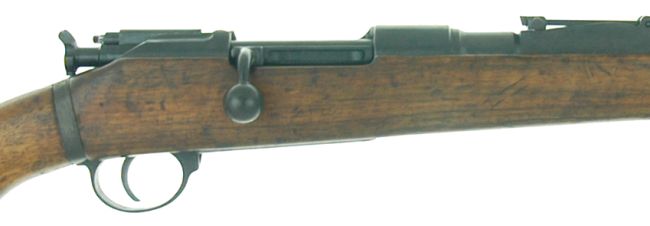
 G98/40 or 43M rifle, close-up view to receiver.
 G98/40 or 43M rifle, close-up view to receiver.

Caliber: 7.92x57 mm
Action: manually operated, rotating bolt
Overall length: 1092 mm
Barrel length: 605 mm
Weigth: 3.91 kg
Magazine capacity: 5 rounds

The Gew.98/40 rifle, also known as Puska 1943. Minta (Rifle, model of 1943, or 43M in short) was developed at Hungarian FEG arms factory in around 1941 under German contract. It was intended for German troops, as weel as for Hungarian troops that were serving along with German troops on Soviet front. In German service, this rifle was known as Infanterie Gewehr 98/40 or Gew.98/40 or G.98/40 in short. It was also adopted by Hungarian army in 1943, as rifle 43M, with minor cosmetic changes from German-contract rifles. Despite having significant external similarities to German Mauser K.98K rifle, the G.98/40 is not a 'Mauser' design, but an amalgam of the Mannlicher-type action (based on Hungarian 35M rifle) and Mauser-type integral box magazine. This rifle was produced by FEG between 1941 and 1945, with total production of German-contract G.98/40 rifles estimated at around 140 000; plus, some 90 thousands of 43M rifles were produced for Hungarian army.
The 43M / Gew.98/40 rifle is a manually operated rotary bolt action weapon. It uses Mannlicher-type rotating bolt with dual locking lugs, located at the front of the bolt body, and detachable bolt head which hosts extractor and ejector. The receiver has a split rear bridge. Feed is from integral Mauser-type box magazine, holding five cartridges in a two rows. Magazines are loaded usingMauser-type stripper clips. Manual safety is provided at the rear of the bolt body, just above the exposed cocking piece. Rifle was fitted with blade front sight and tangent type rear sight marked from 100 to 2000 meters range. Wooden stock is made of two separate parts - buttstock with semi-pistol grip and a forend. A carrying sling and a Mauser Kar.98K-type knife bayonet were provided as standard accessories.

35M

 Rifle model 1935 / puska 35M.
 Rifle model 1935 / puska 35M.

Rifle model 1935 / puska 35M, close-up view to receiver and magazine.
 Rifle model 1935 / puska 35M, close-up view to receiver and magazine.

Caliber: 8x56R mm
Action: Manually operated, rotating bolt
Overall length: 1105 mm
Barrel length: 610 mm
Weigth: 4.04 kg empty
Magazine capacity: 5 rounds

The Puska 1935. Minta (Rifle, model of 1935, or 35M in short) was developed at FEG arms factory in Budapest during early 1930s, with intent to replace obsolete Steyr Mannlicher M1895 rifles then in use by Hungarian army. The rifle was designed to accept newly developed 8x56R 31M ammunition, and was broadly based on design features, originated by famous Austrian arms designer Ferdinand Ritter Von Mannlicher. This rifle was adopted in 1935 and manufactured at FEG factory. It was used by Hungarian army before, during and shortly after the WW2, and to much lesser extent, by German army during WW2. Total production of 35M rifles is estimated at about 160 000 guns.
The 35M rifle is a manually operated rotary bolt action weapon. It uses Mannlicher-type rotating bolt with dual locking lugs, located at the front of the bolt body, and detachable bolt head which hosts extractor and ejector. The receiver has a split rear bridge. Feed is from integral box magazine, holding five cartridges in a single row. Magazines are loaded using Mannlicher type en-block clips that stay within the magazine until the last round is chambered, and then fall down freely through the opening in the base of magazine, and out of the gun. Manual safety is provided at the rear of the bolt body, just above the exposed cocking piece. Rifle was fitted with blade front sight and tangent type rear sight marked from 100 to 2000 meters range. Wooden stock is made of two separate parts - buttstock with semi-pistol grip and a forend. A carrying sling and a knife-type bayonet were provided as standard accessories.

Steyr Mannlicher M95

8x50R Steyr Mannlicher M95 long rifle.
 8x50R Steyr Mannlicher M95 long rifle.

Steyr Mannlicher 8x56R M95/30 short rifle (upgraded and shortened M95), left side.
 Steyr Mannlicher 8x56R M95/30 short rifle (upgraded and shortened M95), left side.
Image: Frank Rodyns, Belgium

same 8x56R Steyr Mannlicher M95/30 short rifle, right side, with the loaded en bloc clip shown in front of the gun.
 same 8x56R Steyr Mannlicher M95/30 short rifle, right side, with the loaded en bloc clip shown in front of the gun.
Image: Frank Rodyns, Belgium

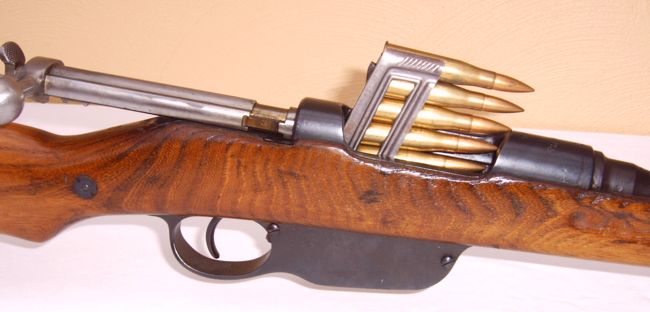
Steyr Mannlicher M95/30 rifle, with bolt open and loaded clip partially inserted into action; note how the bolt handle remains horizontal, as opposed to more common rotating bolt actions such as Mauser.
Steyr Mannlicher M95/30 rifle, with bolt open and loaded clip partially inserted into action; note how the bolt handle remains horizontal, as opposed to more common rotating bolt actions such as Mauser.
Image: Frank Rodyns, Belgium

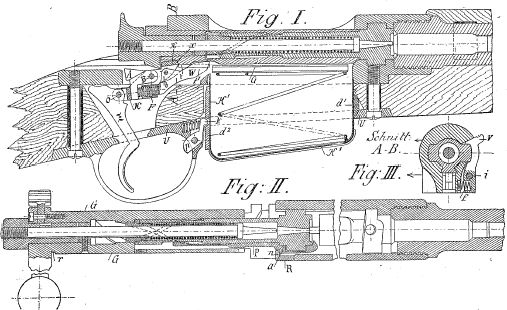
Drawing of the Mannlicher 1895 straight-pull bolt system; note the curved ribs and cuts marked with the dotted lines, which rotate the bolt head on bolt open/close action.

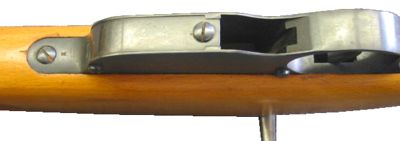
Bottom view on the Steyr Mannlicher M95 rifle, showing the large opening, through which the empty clip is ejected.
 Bottom view on the Steyr Mannlicher M95 rifle, showing the large opening, through which the empty clip is ejected.

  M95 long rifleM95/30 rifle
Caliber8x50R М938x56R M30
Overall length1272 mm1000 mm
Barrel length765 mm480 mm
Weight3,8 kg empty3,36 kg empty
Magazine capacity5 rounds in en bloc clip5 rounds in en bloc clip

The Steyr M1895 rifle, also known as Steyr-Mannlicher M95 straight pull rifle, was developed by famous Austrian arms designer Ferdinand Ritter Von Mannlicher. Based on his previous M1890 design, this rifle was manufactured in Austro-Hungarian Empire at state arms factories in Steyr (Austria) and Budapest (Hungary). More than 3 millions of M95 rifles were produced between 1895 and 1918. This rifle was issued to Austro-Hungarian army, and, after the fall of the Empire, to the Austrian and Hungarian armies. Originally produced in 8x50R caliber, in 1924 some of M95 rifles were converted to the German 7.92x57 Mauser (also known as 8x57 Mauser) ammunition. These converted rifles featured shorter 58 cm barrels, were designated as M95/24 and used in Yugoslavia and Bulgaria. This conversion gave away with original Mannlicher en bloc clip, and replaced it with Mauser stripper clips. Since 1930 Austria converted most of the M95 rifles to the more powerful 8x56R M30 ammunition, using the same Mannlicher en bloc clips. These rifles were designated as M95/30, and marked with the letter "S" on the receiver ring. Hungary started to convert their rifles to the same 8x56R ammunition in 1931, with the upgraded rifles being marked with the letter "H" on the receiver ring. Many of the M95 rifles were used during the Word War 2 by the Hungarian, Bulgarian and Italian armies, as well as by some German police forces.
Ferdinand Von Mannlicher developed his first straight-pull bolt action rifle by 1884, and by 1885 he developed the famous Mannlicher en block clip, which was inserted into the box magazine from the top, and automatically ejected through the opening at the bottom of the magazine as the last round was chambered. This significantly speed up the loading process, compared to the earlier designs with magazines loaded by single rounds; the problem was that such magazine could not be loaded with loose rounds without the clip. As a result, during the early part of the 20 century Mannlicher en bloc clip was generally replaced by the Mauser-type stripper clip. Earliest Mannlicher straight-pull rifles have had not so strong wedge-locking system, but in 1890 he introduced a straight pull bolt action with rotary bolt head with two lugs, which he latter used in M95 rifles.
Steyr Mannlicher M95 bolt has a separate head with two frontal locking lugs; bolt head was inserted into the bolt body from the front. Bolt body had internal spiral-shaped ribs, with matching spiral-shaped cuts in the tail of the bolt head. These ribs and cuts forced the bolt head to rotate on the pull of the bolt body, locking and unlocking the action. Box magazine contained five rounds in en bloc clips; as the magazine emptied, the clips were ejected from the opening at the bottom of the magazine. Non-empty clips could be removed from the top with the bolt open, by depressing the clip catch inside the triggerguard. One specific feature of this system was that the clip has specific "top" and "bottom" sides, and could not be loaded into the rifle upside down. The safety was located at the rear left side of the bolt. Large ear-shaped cocking handle at the rear of the bolt served as a manual cocking handle, to re-cock the action without operating the bolt. M95 rifles were issued with detachable knife bayonets. Other than basic rifle, M95 also was issued as Stutzen (short rifle or carbine, with bayonet lug), and slightly shorter cavalry carbine (without bayonet lug).
These rifles are generally considered as a reasonably strong and accurate, but somewhat sensitive to mud and dirt, as most others military straight pull bolt action rifles. There were several downsides, inherent to these rifles. The straight pull bolt lacked the powerful initial extraction, provided by most rotating bolt actions. Large opening at the bottom of the magazine easily collected the dirt and dust into the magazine. The en block clip loading system does not allow the partially full magazine to be refilled without removing the non-empty clip first. The use of rimmed ammunition resulted in the non-symmetric clip which could be inserted into the action only with one side down; upper side of the clip has stamped serrations to hold it while loading (this particular problem was cured in Italian Carcano rifles, which used rimless ammunition, and symmetric clips).

Steyr .50 HS

Steyr .50HS heavy sniperrifle, with folded bipod.

Caliber: .50BMG (12.7x99mm) or .460Steyr
Operation: manually operated rotating bolt action
Barrel: 833 mm (33")
Weight: 12.4 kg
Length: 1370 mm (54")
Feed Mechanism: single shot, no magazine

The Steyr .50 HS is the most recent development of the famous Austrian arms manufacturer, the SteyrMannlicher Gmbh & Co KG. First displayed at the ShotShow-2004 (February2004, Las-Vegas, USA), this single shot rifle is primary intended for anti-material applications and counter-sniping. The Steyr .50HS is available in two calibers, the old and venerable .50BMG and the apparently new .460Steyr (on which so far no data were obtained).
The Steyr .50 HS is a single shot rifle,with manually operated, rotating bolt with two large locking lugs at the front.The two-stage trigger is factory set to 4lbs (1.8kg). The buttstock is adjustable for length of pull, the cheekpiece is also adjustable. Heavy barrel is partially fluted and fitted with effective muzzle brake. Steyr .50 HS has no iron sights; the MilStd Picatinny rail is standard. Rifle is not intended to be fired off-hand; it is fitted with integral folding adjustable bipods.

 
Design by Free WordPress Themes | Bloggerized by Lasantha - Premium Blogger Themes | Online Project management