Tampilkan postingan dengan label Hungary. Tampilkan semua postingan

Jumat, 21 Juni 2013

Rifle model 1943 / puska 43M / G.98/40

G98/40 or 43M rifle.
 G98/40 or 43M rifle.

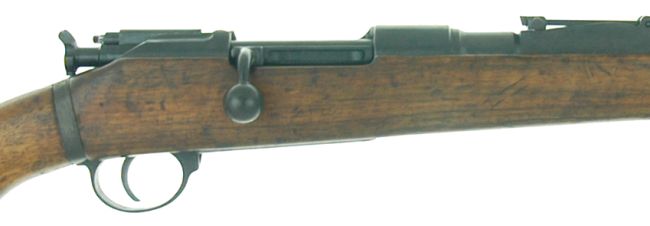
 G98/40 or 43M rifle, close-up view to receiver.
 G98/40 or 43M rifle, close-up view to receiver.

Caliber: 7.92x57 mm
Action: manually operated, rotating bolt
Overall length: 1092 mm
Barrel length: 605 mm
Weigth: 3.91 kg
Magazine capacity: 5 rounds

The Gew.98/40 rifle, also known as Puska 1943. Minta (Rifle, model of 1943, or 43M in short) was developed at Hungarian FEG arms factory in around 1941 under German contract. It was intended for German troops, as weel as for Hungarian troops that were serving along with German troops on Soviet front. In German service, this rifle was known as Infanterie Gewehr 98/40 or Gew.98/40 or G.98/40 in short. It was also adopted by Hungarian army in 1943, as rifle 43M, with minor cosmetic changes from German-contract rifles. Despite having significant external similarities to German Mauser K.98K rifle, the G.98/40 is not a 'Mauser' design, but an amalgam of the Mannlicher-type action (based on Hungarian 35M rifle) and Mauser-type integral box magazine. This rifle was produced by FEG between 1941 and 1945, with total production of German-contract G.98/40 rifles estimated at around 140 000; plus, some 90 thousands of 43M rifles were produced for Hungarian army.
The 43M / Gew.98/40 rifle is a manually operated rotary bolt action weapon. It uses Mannlicher-type rotating bolt with dual locking lugs, located at the front of the bolt body, and detachable bolt head which hosts extractor and ejector. The receiver has a split rear bridge. Feed is from integral Mauser-type box magazine, holding five cartridges in a two rows. Magazines are loaded usingMauser-type stripper clips. Manual safety is provided at the rear of the bolt body, just above the exposed cocking piece. Rifle was fitted with blade front sight and tangent type rear sight marked from 100 to 2000 meters range. Wooden stock is made of two separate parts - buttstock with semi-pistol grip and a forend. A carrying sling and a Mauser Kar.98K-type knife bayonet were provided as standard accessories.

35M

 Rifle model 1935 / puska 35M.
 Rifle model 1935 / puska 35M.

Rifle model 1935 / puska 35M, close-up view to receiver and magazine.
 Rifle model 1935 / puska 35M, close-up view to receiver and magazine.

Caliber: 8x56R mm
Action: Manually operated, rotating bolt
Overall length: 1105 mm
Barrel length: 610 mm
Weigth: 4.04 kg empty
Magazine capacity: 5 rounds

The Puska 1935. Minta (Rifle, model of 1935, or 35M in short) was developed at FEG arms factory in Budapest during early 1930s, with intent to replace obsolete Steyr Mannlicher M1895 rifles then in use by Hungarian army. The rifle was designed to accept newly developed 8x56R 31M ammunition, and was broadly based on design features, originated by famous Austrian arms designer Ferdinand Ritter Von Mannlicher. This rifle was adopted in 1935 and manufactured at FEG factory. It was used by Hungarian army before, during and shortly after the WW2, and to much lesser extent, by German army during WW2. Total production of 35M rifles is estimated at about 160 000 guns.
The 35M rifle is a manually operated rotary bolt action weapon. It uses Mannlicher-type rotating bolt with dual locking lugs, located at the front of the bolt body, and detachable bolt head which hosts extractor and ejector. The receiver has a split rear bridge. Feed is from integral box magazine, holding five cartridges in a single row. Magazines are loaded using Mannlicher type en-block clips that stay within the magazine until the last round is chambered, and then fall down freely through the opening in the base of magazine, and out of the gun. Manual safety is provided at the rear of the bolt body, just above the exposed cocking piece. Rifle was fitted with blade front sight and tangent type rear sight marked from 100 to 2000 meters range. Wooden stock is made of two separate parts - buttstock with semi-pistol grip and a forend. A carrying sling and a knife-type bayonet were provided as standard accessories.

Steyr Mannlicher M95

8x50R Steyr Mannlicher M95 long rifle.
 8x50R Steyr Mannlicher M95 long rifle.

Steyr Mannlicher 8x56R M95/30 short rifle (upgraded and shortened M95), left side.
 Steyr Mannlicher 8x56R M95/30 short rifle (upgraded and shortened M95), left side.
Image: Frank Rodyns, Belgium

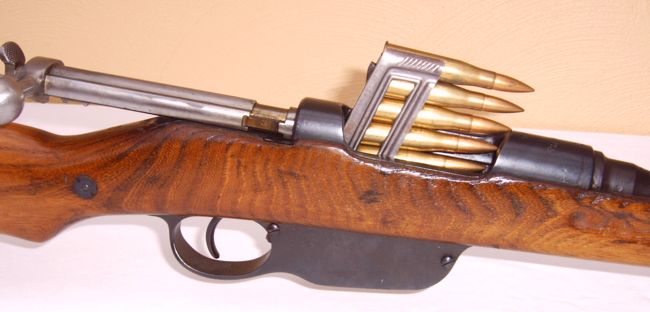
same 8x56R Steyr Mannlicher M95/30 short rifle, right side, with the loaded en bloc clip shown in front of the gun.
 same 8x56R Steyr Mannlicher M95/30 short rifle, right side, with the loaded en bloc clip shown in front of the gun.
Image: Frank Rodyns, Belgium

Steyr Mannlicher M95/30 rifle, with bolt open and loaded clip partially inserted into action; note how the bolt handle remains horizontal, as opposed to more common rotating bolt actions such as Mauser.
Steyr Mannlicher M95/30 rifle, with bolt open and loaded clip partially inserted into action; note how the bolt handle remains horizontal, as opposed to more common rotating bolt actions such as Mauser.
Image: Frank Rodyns, Belgium

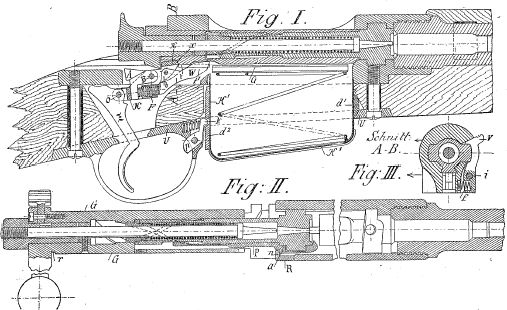
Drawing of the Mannlicher 1895 straight-pull bolt system; note the curved ribs and cuts marked with the dotted lines, which rotate the bolt head on bolt open/close action.

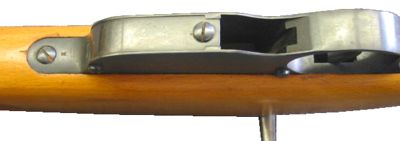
Bottom view on the Steyr Mannlicher M95 rifle, showing the large opening, through which the empty clip is ejected.
 Bottom view on the Steyr Mannlicher M95 rifle, showing the large opening, through which the empty clip is ejected.

  M95 long rifleM95/30 rifle
Caliber8x50R М938x56R M30
Overall length1272 mm1000 mm
Barrel length765 mm480 mm
Weight3,8 kg empty3,36 kg empty
Magazine capacity5 rounds in en bloc clip5 rounds in en bloc clip

The Steyr M1895 rifle, also known as Steyr-Mannlicher M95 straight pull rifle, was developed by famous Austrian arms designer Ferdinand Ritter Von Mannlicher. Based on his previous M1890 design, this rifle was manufactured in Austro-Hungarian Empire at state arms factories in Steyr (Austria) and Budapest (Hungary). More than 3 millions of M95 rifles were produced between 1895 and 1918. This rifle was issued to Austro-Hungarian army, and, after the fall of the Empire, to the Austrian and Hungarian armies. Originally produced in 8x50R caliber, in 1924 some of M95 rifles were converted to the German 7.92x57 Mauser (also known as 8x57 Mauser) ammunition. These converted rifles featured shorter 58 cm barrels, were designated as M95/24 and used in Yugoslavia and Bulgaria. This conversion gave away with original Mannlicher en bloc clip, and replaced it with Mauser stripper clips. Since 1930 Austria converted most of the M95 rifles to the more powerful 8x56R M30 ammunition, using the same Mannlicher en bloc clips. These rifles were designated as M95/30, and marked with the letter "S" on the receiver ring. Hungary started to convert their rifles to the same 8x56R ammunition in 1931, with the upgraded rifles being marked with the letter "H" on the receiver ring. Many of the M95 rifles were used during the Word War 2 by the Hungarian, Bulgarian and Italian armies, as well as by some German police forces.
Ferdinand Von Mannlicher developed his first straight-pull bolt action rifle by 1884, and by 1885 he developed the famous Mannlicher en block clip, which was inserted into the box magazine from the top, and automatically ejected through the opening at the bottom of the magazine as the last round was chambered. This significantly speed up the loading process, compared to the earlier designs with magazines loaded by single rounds; the problem was that such magazine could not be loaded with loose rounds without the clip. As a result, during the early part of the 20 century Mannlicher en bloc clip was generally replaced by the Mauser-type stripper clip. Earliest Mannlicher straight-pull rifles have had not so strong wedge-locking system, but in 1890 he introduced a straight pull bolt action with rotary bolt head with two lugs, which he latter used in M95 rifles.
Steyr Mannlicher M95 bolt has a separate head with two frontal locking lugs; bolt head was inserted into the bolt body from the front. Bolt body had internal spiral-shaped ribs, with matching spiral-shaped cuts in the tail of the bolt head. These ribs and cuts forced the bolt head to rotate on the pull of the bolt body, locking and unlocking the action. Box magazine contained five rounds in en bloc clips; as the magazine emptied, the clips were ejected from the opening at the bottom of the magazine. Non-empty clips could be removed from the top with the bolt open, by depressing the clip catch inside the triggerguard. One specific feature of this system was that the clip has specific "top" and "bottom" sides, and could not be loaded into the rifle upside down. The safety was located at the rear left side of the bolt. Large ear-shaped cocking handle at the rear of the bolt served as a manual cocking handle, to re-cock the action without operating the bolt. M95 rifles were issued with detachable knife bayonets. Other than basic rifle, M95 also was issued as Stutzen (short rifle or carbine, with bayonet lug), and slightly shorter cavalry carbine (without bayonet lug).
These rifles are generally considered as a reasonably strong and accurate, but somewhat sensitive to mud and dirt, as most others military straight pull bolt action rifles. There were several downsides, inherent to these rifles. The straight pull bolt lacked the powerful initial extraction, provided by most rotating bolt actions. Large opening at the bottom of the magazine easily collected the dirt and dust into the magazine. The en block clip loading system does not allow the partially full magazine to be refilled without removing the non-empty clip first. The use of rimmed ammunition resulted in the non-symmetric clip which could be inserted into the action only with one side down; upper side of the clip has stamped serrations to hold it while loading (this particular problem was cured in Italian Carcano rifles, which used rimless ammunition, and symmetric clips).

Sabtu, 02 Maret 2013

53M / K1

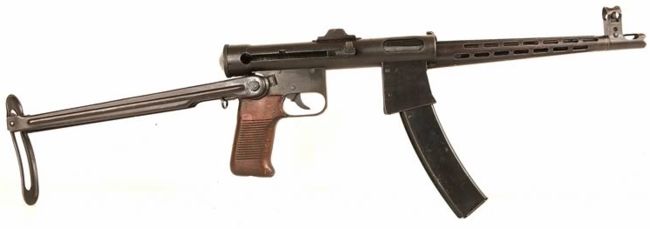
53M / K1 submachine gun.
 53M / K1 submachine gun.
 
Characteristics

Caliber 7.62x25
Weight 3.1 kg empty
Length (stock closed/open) 542 / 827 mm
Barrel length 280 mm
Rate of fire ? rounds per minute
Magazine capacity 35 rounds

The 53M / K1 submachine gun was an indigenous weapon, designed during early 1950s by Hungarian designer Jozsef Kucher (hence the K1 index). It was officially adopted in 1953, and procured in limited numbers for police, border guard and certain paramilitary units in Hungary (the Hungarian armed forces adopted a license-built copy of Soviet PPSh-41 instead). The weapon appears to be of simple, robust and workmanlike design, and it s believed that it failed to achieve a more widespread success because of political, rather than technical matters.
The 53M / K1 submachine gun is a simple blowback weapon, firing from open bolt in semi-automatic or full automatic modes. The fire mode selector is located on the left side of the trigger housing, above the trigger. Safety is built into the bolt handle and locks the bolt in forward or rearward positions. Gun is mostly made from stampings; barrel is enclosed into perforated barrel jacket, and is equipped with muzzle brake - compensator. Metallic buttstock folds down and forward. The flip-up rear sight is L-shaped and has settings for 100 and 200 meters range.

Kiraly 39M 43M

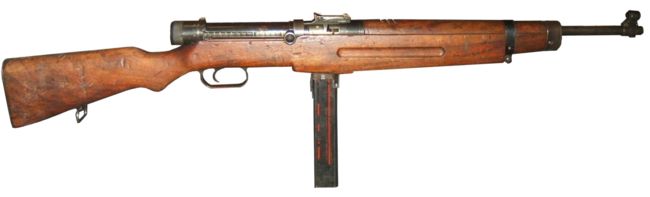
39M submachine gun.
  39M submachine gun.
 
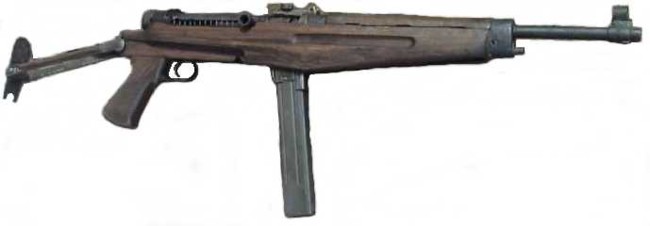
 43M submachine gun.
  43M submachine gun.
 
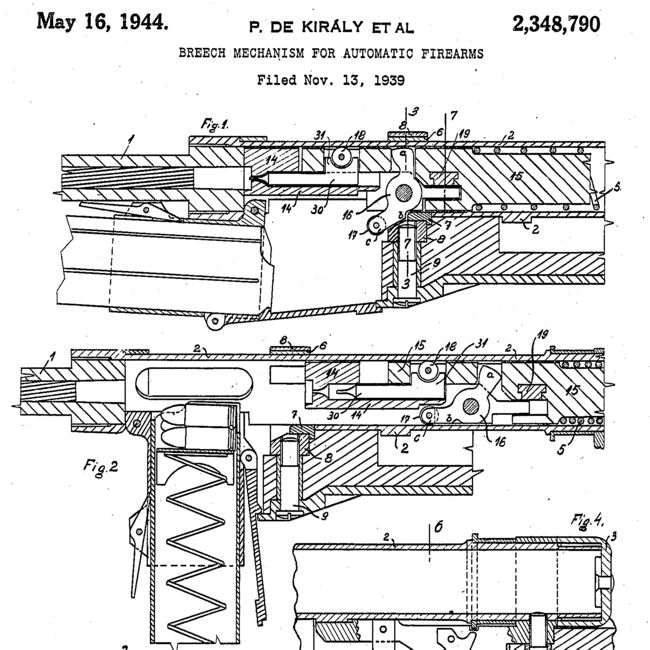
Kiraly's patent for his delayedblowback action used in 39M and 43M submachine guns.
 Kiraly's patent for his delayedblowback action used in 39M and 43M submachine guns.

Characteristics

  39M 43M
Caliber 9x25mm (9mm Mauser export)
Weight 4.15 kg 3.7kg
Length (stock closed/open) 1050 mm 745 / 950 mm
Barrel length 500 mm 425 mm
Rate offire 750 rounds per minute 650 rounds per minute
Magazine capacity 40 rounds 40 rounds
Effective range 300-400 meters 300 meters

The famous Hungarian arms designer Pal Kiraly developed his military-type 39M (39 Minta - model of [19]39) submachine gun at Hungarian Danuvia arms factory between 1937 and 1939. The 39M submachine gun bears more than passing resemblance to the Swiss-made SIG MKMS (M1934)submachine gun, which is not surprising, considering the fact that Kiraly worked in Switzerland at SIG factory during 1920s and 1930s, before returning to Hungary just prior to WW2. The 39M submachine gun represented a carbine-type weapon, being relatively large and heavy, so, in 1942-43 Kiraly also developed a more compact weapon along the same concept and delayed blowback action of his own design, known as 43M. Despite internal similarities and same caliber, the magazines of 39M and 43M were not interchangeable due to different feed angle on the 43M SMG. It must be noted that production of both submachine guns was somewhat limited, despite the fact that both were ranked among most powerful weapons in its class, thanks to long barrels and powerful 9x25 Mauser ammunition(muzzle velocity 450m/s, bullet weight 8.3 gram, muzzle energy 840 Joules)
The 39M submachine gun uses delayed blowback action designed by PalKiraly. In this system, bolt consists of two parts, with pivoting lever attached to the forward part (bolt head). When in battery, the bottom hand of the lever is resting against the receiver, and the upper rests against the rear part of the bolt (bolt body). Upon discharge, movement of the bolt head forces the lever to rotate back, thus speeding up the bolt body and slowing down the initial opening of the bolt head. Once the lever is fully pivoted, both parts of the bolt can recoil together freely against the return spring, to complete the firing and reloading cycle. Firing is from open bolt, in full automatic mode or single shots. Feed is from box magazines; magazine housing can be folded forward to save the space, with magazine resting inside the hollow stock,below the barrel. Stock is made of wood, the 43M submachine gun also having separate pistol grip and down-folding steel buttstock. sights are of open type,adjustable for range between 50 and 600 meters.

Rabu, 26 Januari 2011

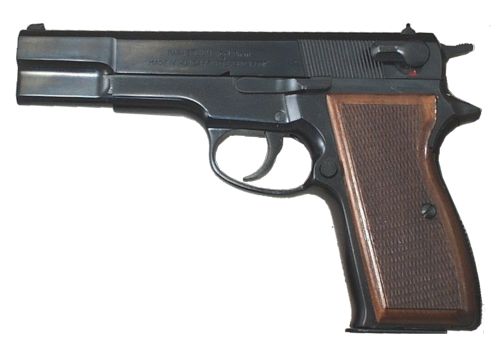
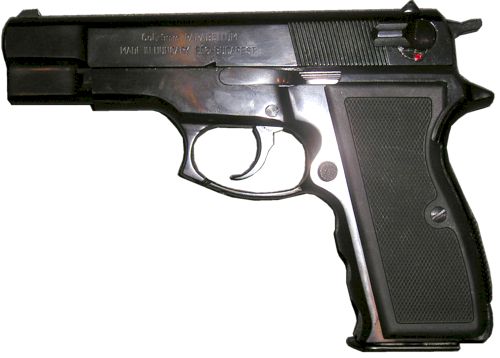
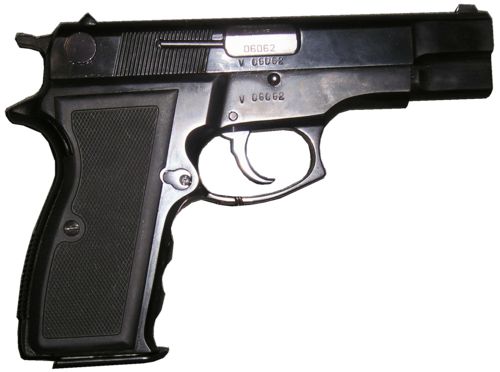
FEG P9R pistol

Early production FEG P9R pistol.

FEG P9RK (short barrel version), current manufacture, left side view.

FEG P9RK (short barrel version), current manufacture, right side view.

Characteristics

 P9RP9RKACK
Action typeDouble Action
Calibers9x19mm Luger/Parabellum.45ACP
Weight 1000 g empty, 
1170 g loaded
970 g empty, 
1140 g loaded
1080 g empty, 
1250 g loaded
Length203 mm190 mm197 mm
Barrel length118 mm105 mm105 mm
Capacity14 rounds8 rounds

The FEG P9R is the derivative of the earlier FEG P9 pistol. Both guns are made in Hungary by the FEGARMY Arms factory (formerly known as Fegyver es Gazkeszuelekgyara NV). The P9R uses the modified P9 frame and action, but the classic FN GP-35 Single Action trigger system is replaced with Smith&Wesson-style Double Action system. The P9R-series pistols are now available in two basic forms, the full-size P9R and short-barreled P9RK. Over the time, FEG also produced a lightweight,  aluminum-framed version of the P9R, called the P9RA, which apparently is no longer made. There is also a .45 caliber derivative of P9RK, which also have a single-stack magazine that holds only 8 rounds. The .45ACP version is designated as FEG ACK (export models of ACK were sometimes marked as GKK-45). In Europe the FEG P9R was also known as the Mauser 90DA, as it was imported and distributed through the famous German Mauser organization.
The P9R is a short recoil operated, locked breech pistol. The barrel is operated using a Browning cam system, and is locked to slide by three locking lugs on the top of the barrel, which fit into mated recesses on the inside of the slide, just ahead of the ejection port. Frame and slide are made from carbon steel and usually have blued finish. The Double Action trigger system with external hammer has a slide-mounted safety lever, which also works as a decocker when safety is engaged. The P9RK pistol differs from basic P9R by having a shorter barrel and slide, as well as finger grooves on the grip. The .45 caliber ACK pistol is slightly thinner, as it has a single stack magazine for rounds, instead of the double stack magazine for 14 rounds in P9R pistols. On all P9R series pistols the front sight is permanently fixed to the slide, while rear sight is dovetailed.

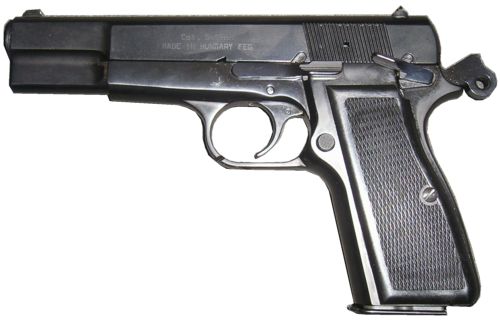
FEG P9M and FP9 pistol

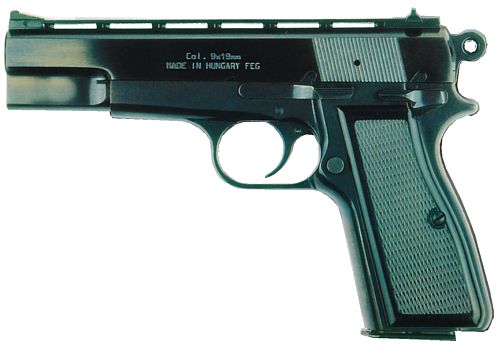
FEG P9M pistol, right side view.

FEG P9M pistol, left side view.

FEG FP9 pistol; the only difference from P9M is the ventilated rib at the top of the slide.

Characteristics

Type: Single Action
Calibers: 9x19 mm Luger/Parabellum
Weight unloaded: 910 g (950 g FP9)
Length: 198 mm
Barrel length: 118 mm
Capacity: 13 rounds

P9M and FP9 pistols are made by Hungarian FEG company (originally known as Fegyver es Gazkeszuelekgyara NV, now FEGARMY Arms factory, Ltd.). These pistols were also exported under designations of PJK-9HP. In Europe, FEG FP9 guns were also marketed under the name of Mauser, as the Mauser 80SA pistols. The only difference between the P9M and FP9 is the ventilated rib at the top of the slide on FP9, otherwise guns are identical. The P9M is almost exact copy of the famous Belgian High Power (also known as HP or GP-35) pistol. In fact, GP-35 and P9M are so similar that many parts are interchangeable between them. These pistols were not used as a service guns in the Hungary, and were intended for export. Some guns were used by the Lithuanian police, and probably these guns were used somewhere else.
The P9M is a short recoil operated, locked breech pistol. The barrel is operated using a Browning cam system, and is locked to slide by three locking lugs on the top of the barrel, which fit into mated recesses on the inside of the slide, just ahead of the ejection port. Frame and slide are made from carbon steel and usually have blued finish. Single Action trigger system with external hammer is copied from FN GP-35, the only difference is in the shape and dimensions of the frame mounted safety lever, which is longer than the original GP-35 safety lever. The magazines also are interchangeable between FN GP-35 and FEG P9M.

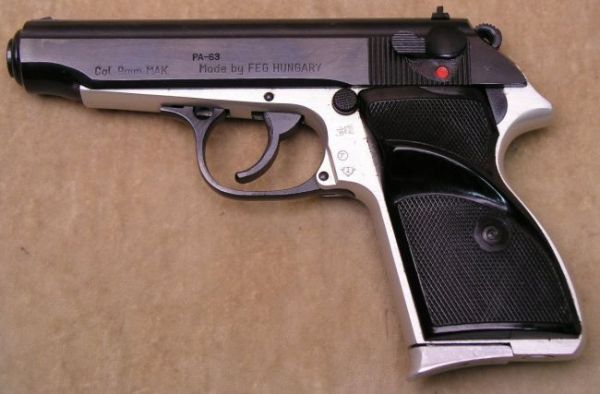
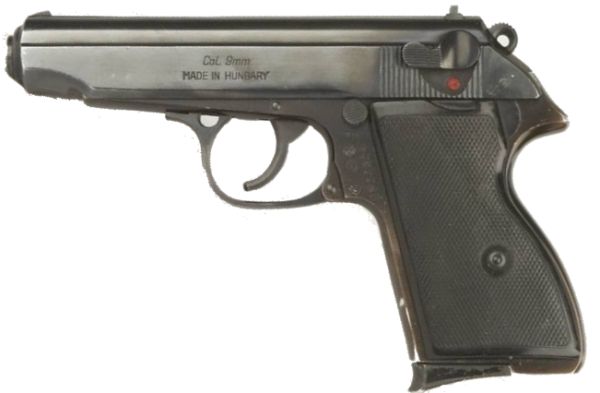
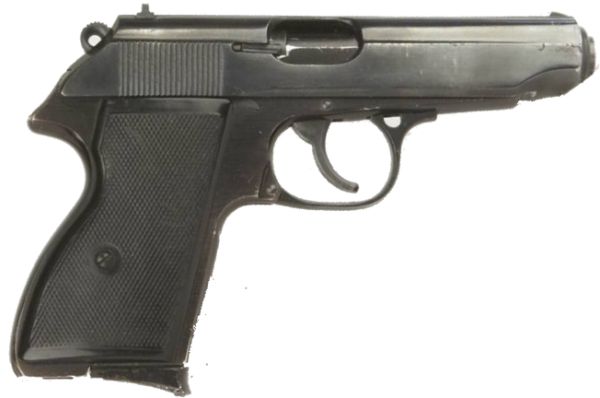
FEG AP-63 / PA-63 pistol

FEG PA-63 pistol, military version in 9mm Makarov caliber.

FEG AP-63 pistol, commercial version in 9mm Browning Short / .380 ACP caliber.

FEG AP-63 pistol, commercial version in 9mm Browning Short / .380 ACP caliber.

Characteristics

TypeDouble Action semiautomatic
Caliber(s)9x17 Browning / .380 ACP and 7.65 Browning / .32ACP in AP-63
9x18 Mak in PA-63
Weight unloaded595 g
Length175 mm
Barrel length100 mm
Magazine capacity7 rounds
The FEG PA-63 pistol was developed during early 1960s at the Hungarian FEG arms factory as a compact military sidearm, chambered for the Warsaw pact standard 9x18 Makarov ammunition of Soviet origin. The basic design of the FEG PA-63 pistol was heavily based on the German Walther PP pistol, a copy of which was produced by FEG shortly after the WW2. FEG also produced a number of derivatives of the PA-63, such as 'export commercial' model AP-63, chambered for widely available 9x17 Browning / .380 ACP and 7.65 Browning / .32ACP ammunition. Both PA-63 and AP-63 pistols were similar in design, and differed only in ammunition used and in frame finish - military-issue PA-63 pistols had their aluminum frames left 'in the white', while commercial AP-63 pistols have their aluminum frames finished in same black color as the rest of the gun.
The FEG PA-63 pistol is a simple blowback operated weapon. The return spring is located around the barrel, the trigger is of traditional double-action type with exposed hammer. Manual safety lever, which doubles as a decocker, is located at the left side of the slide. Gun is fed from single stack box magazines, magazine release button is located on the left side of the frame, above and behind the trigger.

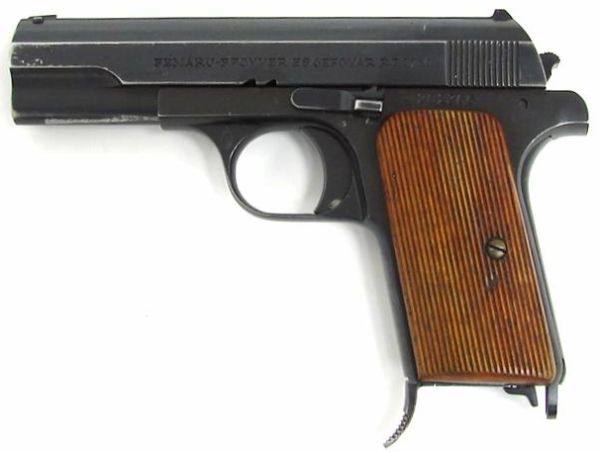
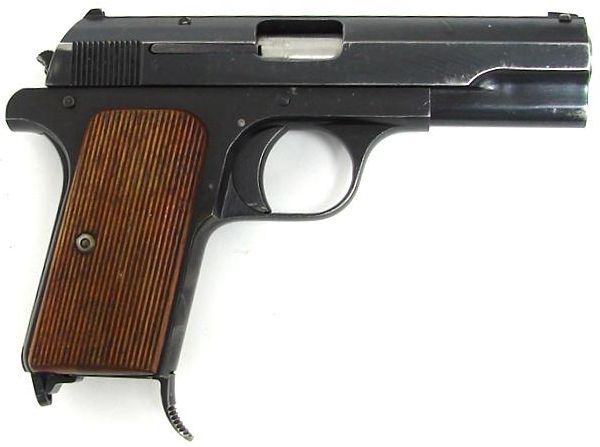
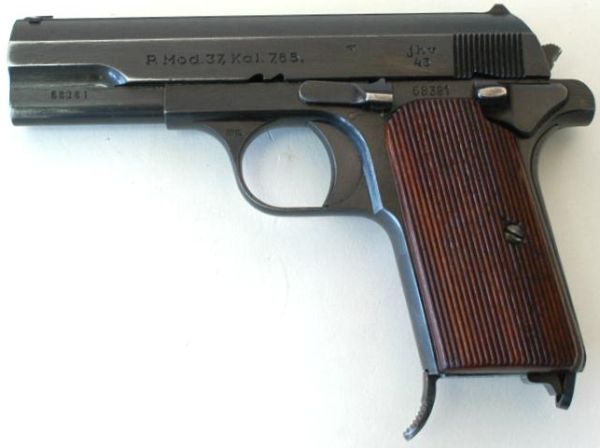
FEMARU Model 1937 37M P37 P37(u) pistol

FEMARU 37M pistol.
FEMARU 37M pistol.

FEMARU 37M pistol.
FEMARU 37M pistol.

FEMARU P37 / P37(u) pistol, as made for and used by German armed forces during WW2. Note that it has added manual safety lever and chambered for 7.65mm (.32ACP) ammunition.

Characteristics

TypeSingle Action semiautomatic
Caliber(s) 7.65x17 Browning / .32 ACP and 9x17 Browning Short / .380 ACP
Weight unloaded770 g
Length182 mm
Barrel length110 mm
Magazine capacity7 rounds

The FEMARU 37M pistol, wich is also known as Frommer 37M, was developed by 1937 at Hungarian arms factory FEMARU to replace Frommer-designed 29M pistol, made at the same facility. This pistol was of simpler design, when compared to its predecessor, and susequently it was less expensive to make. Hungarian army adopted this pistol in 1937 in 9mm Browning Short caliber (which is also known in USA as .380 ACP). After the start of WW2, Germany placed a contract for the 37M pistols, chambered for the 7.65x17 Browning (.32 ACP) cartridge, which was standard for German armed forces along with more powerful 9x19 Luger / Parabellum ammo. German authorities also requested some design changes, namely the addition of the manual safety. German contract pistols were marked with "P Mod 37" rollmark and  appropriate calibermarking "Kal 7,65" on the left side of the slide. The official designation of the these pistols within German military was P.37(u). Production of these pistols lasted between 1937 and 1944, with total production estimated at about 175 thousands.
The FEMARU Model 1937 / Frommer 37M / P.37(u) pistol is a simple blowback operated weapon.The return spring is located below the barrel and the barrel is attached to the frame with four lugs below the chamber area, and can be easily dismounted when gun is disassembled. When gun is fired, barrel remain stationary. 
The trigger is of single action type, with exposed hammer. No manual safety is available on the 37M, but the pistol is fitted with automatic grip safety at the rear of the grip. German contract P.37(u) pistols were fitted with additional manual safety on the left side of the frame, above the grip panel.
Feed is from detachable box magazines, with magazine release catch located at the base of the grip, behind the magazine well. Each magazine is fitted with characteristic forward-facing finger rest at the bottom. External slide stop lever is provided at the left side of the frame.

Frommer FEMARU Model 1929 29M pistol

FEMARU Model 1929 29M pistol.

Characteristics

TypeSingle Action semiautomatic
Caliber(s) 9x17 Browning Short / .380 ACP 
Weight unloaded750 g
Length172 mm
Barrel length100 mm
Magazine capacity7 rounds

The FEMARU Model 1929 (29M in short) pistol was developed by Hungarian arms designer Rudolf Frommer to replace the overly complicated and expensive Frommer Stop pistol in Hungarian military service, and adopted by Hungarian Army and Air Force in 1929. About 50 000 of Frommer 29M pistols were produced at FEMARU factory in Budapest prior to 1937, when it was replaced in production with an improved design from the same master, the Frommer 37M pistol.
The FEMARU Model 1929 / Frommer 29M pistol is a simple blowback operated weapon. It has a separate breech block, which is inserted into the slide rather than made integral with it, as done in most pistols. The cocking serrations are provided on the enlarged rear part of the breech block, which projects from the rear of the slide. When gun fires, the breech block cycles along with the slide as one unit. The return spring is located below the barrel and the barrel is attached to the frame with four lugs below the chamber area, and can be easily dismounted when gun is disassembled. When gun is fired, barrel remain stationary. 
The trigger is of single action type, with exposed hammer. No manual safety is available, but the Frommer 29M pistol is fitted with automatic grip safety at the rear of the grip.
Feed is from detachable box magazines, with magazine release catch located at the base of the grip, behind the magazine well. External slide stop lever is provided at the left side of the frame.

 
Design by Free WordPress Themes | Bloggerized by Lasantha - Premium Blogger Themes | Online Project management