Tampilkan postingan dengan label USA. Tampilkan semua postingan

Jumat, 21 Juni 2013

Browning Auto-5

Browning Auto-5 / A5 and Remington model 11 shotgun (Belgium, USA)

Browning Auto-5shotgun of early Belgian manufacture, left side.
 Browning Auto-5shotgun of early Belgian manufacture, left side.

 Browning Auto-5 shotgun of early Belgian manufacture, right side.
  Browning Auto-5 shotgun of early Belgian manufacture, right side.

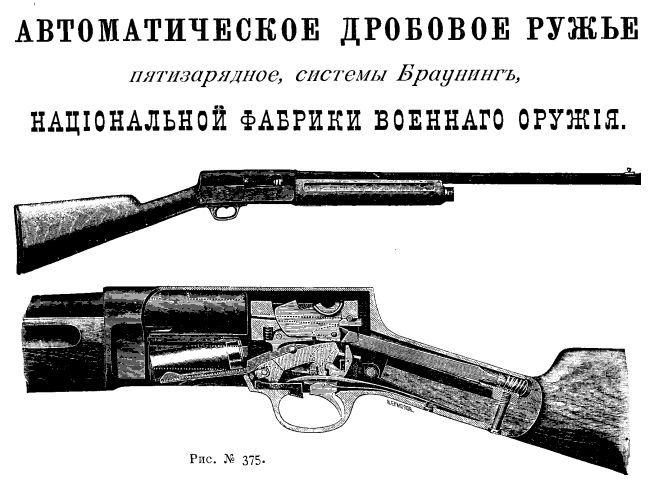
Advertising from pre-WW1 era Russian mail-order hunting supplies catalog that offered
  Advertising from pre-WW1 era Russian mail-order hunting supplies catalog that offered "New autoloading shotgun, five-shot, Browning system, made by Fabrique Nationale".


 BrowningAuto-5 "12 gauge Light model" shotgun of late Belgian manufacture.
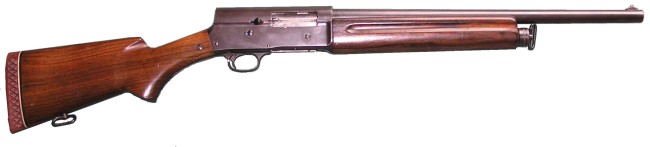
BrowningAuto-5 shotgun of Belgian manufacture in military configuration, as used by British forces under L32A1 designation.
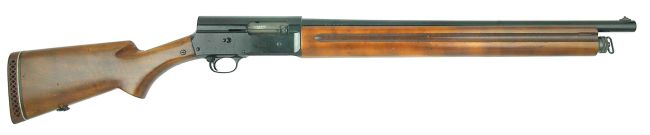
  BrowningAuto-5 shotgun of Belgian manufacture in military configuration, as used by British forces under L32A1 designation.

 BrowningAuto-5 shotgun of Belgian manufacture, special version for police use,with factory extended 8-round magazine.

 BrowningAuto-5 shotgun of Belgian manufacture, special version for police use,with factory extended 8-round magazine.

Early productionRemington model 11 shotgun, commercial model.
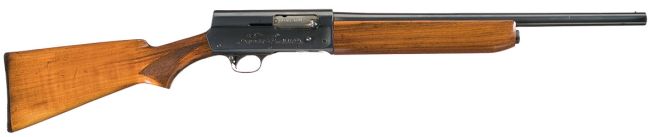
 Early productionRemington model 11 shotgun, commercial model.

Remington model 11shotgun in
 Remington model 11shotgun in "Riot" configuration, for police or guard use.

Remingtonmodel 11 shotgun with recoil pad and Cutts compensator, as used by USAFduring WW2 to train aircraft machine gunners.
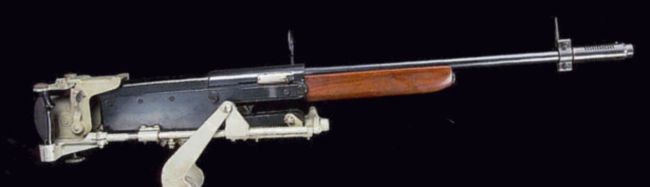

Remingtonmodel 11 shotgun set up into special mount to emulate aircraft machine gun. This setup was used by US Air Force during WW2 to train aircraft machine gunners on shooting at moving targets.
  Remingtonmodel 11 shotgun set up into special mount to emulate aircraft machine gun. This setup was used by US Air Force during WW2 to train aircraft machine gunners on shooting at moving targets.

Type:semi-automatic, recoil operated
Gauge:12, 16 and 20
Length: varies with model
Barrel length: varies with model
Weight varies with model
Capacity: 4 rounds in underbarrel tube magazine

John Moses Browning, the legendary American gun designer, invented thefirst practical self-loading shotgun in 1898. In fact, Browning designed and patented three different systems, but finally choose the last one to go ahead. It must be noted, that at the time the autoloading shotgun was something of absolute novelty, and the task of designing such gun was severely complicated by the fact that the switch over from black powder to smokeless ammunition was well under way, and general quality of shotgun ammunition was rather uneven,to say the least. Nevertheless, Browning managed to make hist prototype model work, and work well. He first offered this shotgun to Winchester,which was the sole buyer for his designs from 1886 on. However, severe technical conservatism on the part of the Winchester's boss,T.G.Bennett, and financial disagreements (Browning insisted on royalty-based payments, but Winchester at the time always bought new designs for fixed amount of money) resulted in break between the designer and the company. Browning then turned to Remington, but tragicdeath of the Remington's president from hear attack just minutes before scheduled meeting with Browning put an end to this route as well. Browning thenturned to the Belgian company Fabrique Nationale (FN), which at this time (1901) produced first Browning-designed self loading pistol (M1900)as fast as it could be made. FN management greeted Browning and his new gun with great enthusiasm, and in a short while FN produced the first FN Browning autoloading shotgun, known as Browning Auto 5, or A-5 inshort. Browning himself ordered 10,000 A-5 shotguns from the first batch for sales and distribution in USA, and sold all 10 thousands in about a year. Following the introduction of the new, increased custom tariffs by US government, Browning found that it was economically not reasonable to import more A-5 guns into USA, so he pursued FN to release rights tomake and sell Browning auto loading shotgun on US market to RemingtonArms Co (FN originally had worldwide rights for manufacture of Auto 5).In 1906 Remington offered the Browning-designed auto loading shotgun as Model 11, and manufactured it without interruption until 1947, with well over 800,000 guns made. Between 1949 and 1968 Remington also produced an updated (lightened and streamlined) version of the Browning's design, known as Remington Model 11-48. The FN produced Browning Auto 5 shotguns continuously (with interruptions for German occupation during both World Wars) until 1999, making Auto-5 probably the most successful and longest-producing sporting shotgun in the history. Overall output of Auto-5 shotguns made and sold by FN (During WW2, A-5 shotguns were made for Browning Arms Co by Remington, and since mid-1970s Auto-5 shotguns were also produced for FN in Japan by Miroku, under FN license) over the century well exceeds two million guns (2,000,000th Auto-5 was produced in 1970). Total estimate of worldwide production numbers for this legendary Browning design is well over three million guns.
 Copies and clones of the Auto-5 shotgun were also manufactured in Italy by Franchi and Breda, in USA by Savage and in USSR / Russia by TOZ, and by some other manufacturers around the world. Many Auto-5 guns, made many decades before, are still used for hunting and shooting today, but, as time goes, Browning Auto-5 shotguns increasingly become collector's pieces.
Over the time, both FN and Remington produced wide variety of versions of the basic design. Hunting guns were made with plain or ribbed barrels of various lengths and gauges(12, 16 and 20), with magazine capacities of 4 or 2 rounds, various stocks, finishes etc. For police and military applications, FN andRemington created shorter-barreled shotguns with plain barrels. Many Remington guns have seen extensive use by US police and securityservices; US military also used Remington shotguns to train AA and aircraft gunners in shooting at fast-moving flying targets (clay pigeons), usingtraditionally stocked guns or guns, mounted in special fixtures to emulate aircraft machine guns. Belgian-made guns have seen less military service, although British army issued more than few A-5 shotguns as L32A1 during Malay counter-insurgency operations and later.
BrowningAuto-5 shotgun uses recoiling barrel to operate its action. The system is of so-called long-recoil type, as barrel and bolt recoil together for entire length of the recoil stroke, being securely locked by pivoting piece, installed in the bolt. This piece, when pivoted up, engages the cut in the barrel extension with its large locking lug. Upon completion of the full recoil path, the bolt is arrested in the rearmost position,and the locking piece inside it is tipped down to release the barrel.Barrel, under pressure of its own return spring, located around the magazine tube, slams forward, leaving the empty shell on the bolt face.Once the empty shell is clear of the barrel, it is ejected out of the gun. When barrel comes to the rest in the forward position, it automatically releases bolt catch, allowing the bolt to run forward,picking the fresh cartridge from the raised cartridge lifter, and locking the to the barrel at the end of the forward run. Bolt return spring is located in the butt. To achieve reliable functioning with wide variety of loads, Browning used self-adjusting friction brake in the recoil system, which consisted of several (one or two, dependingon the exact model) friction rings, located around the magazine tube.The tubular magazine holds four rounds; fifth one can be loaded into the chamber, making the total capacity of five rounds. One importantdifference between FN Auto-5 and Remington Model 11 shotguns is that the FN guns had a magazine cut-off lever, located on the left side of the receiver. This lever, when turned to the rear, locks the cartridgesin the magazine, allowing for quick replacement of the loaded round with another (presumably, with different type of projectile(s), i.e.shot to slug or vice versa). Remington shotguns did not have this feature.

QSPR Silent Revolver

Smith & Wesson Model 29 revolver modified by AAI corporation into Quiet Special Purpose Revolver (QSPR) Image is a photoshopped modification of the original S&W M29 revolver photo to closely represent extremely rare QSPR weapon,
Smith & Wesson Model 29 revolver modified by AAI corporation into Quiet Special Purpose Revolver (QSPR)
Image is a photoshopped modification of the original S&W M29 revolver photo to closely represent extremely rare QSPR weapon, © 2008 Maxim Popenker

Cross-sectional drawing of the early version of AAI Corp Quiet Special Purpose Round, from 1971 US Army document
Cross-sectional drawing of the early version of AAI Corp Quiet Special Purpose Round, from 1971 US Army document 


TypeDouble Action revolver
Caliber(s) .40 smoothbore (.40 QSPR silenced ammunition)
Weight unloadedn/a
Length~ 170 mm / 6.7"
Barrel length35 mm / 1.375"
Cylinder capacity6 rounds

Quiet Special Purpose Revolver (QSPR; also known as 'tunnel revolver' or 'tunnel gun') evolved from 1967 US Army requirements for a silenced, multi-projectile hand weapon for use by 'tunnel exploration personnel' (so called 'tunnel rats'), which operated against Vietnamese communist forces in the numerous tunnels dug by NVA and VC personnel. The weapon concept was developed at US Army Land Warfare Laboratory at Aberdeen Proving Ground, in collaboration with AAI corporation, which was responsible for creation of the internally silenced ammunition, based on the "gas seal piston" concept (similar concept at the time was employed in a number of Soviet Spetsnaz weapons, firing PZ type internally silenced ammunition). The whole concept of the internally silenced ammunition is rather old and starts in the pre-WW1 era, but practical results were achieved only during 1950s and 1960s, when chemical and metallurgical technologies finally permitted manufacture of actual ammunition.
Quiet Special Purpose Revolvers (QSPR) were based on commercially available Smith & Wesson Model 29 .44 Magnum revolvers, rebuilt by AAI to handle their special integrally silenced ammunition. Earliest prototypes featured new, very short smoothbore barrels with .40" / 10mm bore, and with cylinder chambers reamed to accept QSPR ammunition which externally represented metal cased .410 gauge shotgun shells. Internally, however, the QSPR ammunition was quite different; it had a machined steel case with screw-in base. Primers were secured deeply in the cartridge base by screw-in bushing and additional anvil, which transferred the blow of the hammer to the primer (cartridges produced for tests in 1971 had no intermediate anvils). The small charge of gun powder was enclosed at the front and sides by the cup-shaped steel piston, which, upon discharge, was securely jammed at the mouth of the case by the internal thread. The QSPR ammunition fired fifteen tungsten balls (loaded into plastic sabot), each weighting about 7.5 grain / 0.5 gram, at muzzle velocity of about 730 fps / 222 m/s, which resulted in total muzzle energy of about 135 ft-lbs / 185 Joules. Due to the nature of the round (tungsten shot), the practical lethal range was estimated at about 30 feet / 10 meters, which was sufficient for extremely cramped tunnels of Vietnam war. The sound signature of QSPR round fired from QSPR revolver was about 110 dB, or similar to that of traditionally silenced .22LR pistol. It must be noted that QSPR revolvers had no sights, as these were intended for use at point-blank ranges and in very low visibility conditions of tunnels. The basic mechanism (double action trigger and swung-out cylinedr) were retained from standard S&W revolvers, although there were some modifications done to the hammer, and new short smoothbore barrel was installed.
First ten specimen of QSPR revolvers were delivered for field testing in Vietnam in mid-1969. Testing continued until late 1969, with several live fire encounters with NVA / VC personnel. It is interesting that most of these encounters were actually not in the tunnels but during the ambushes made by US special operation forces on NVA or VC trails. The field testing proved extreme usefulness of the QSPR revolver but also identified a number of issues which required further improvement of both the gun and the ammunition. QSPR improvement and testing program was initiated in 1970, and lasted through 1971. However, withdrawal of US forces in Vietnam caused the decline of interest in this and some other developments, and the QSPR program was quietly terminated in around 1972. Total number of QSPR revolvers built is not known, and various sources estimate that number between 25 and 250 guns in total.
Compared to the contemporary Soviet equipment of the similar nature, such as S4M silent pistol, the QSPR most probably provided somewhat more firepower at point-blank ranges (because of the higher muzzle velocity and bigger ammunition capacity), but it was also significantly heavier and bulkier. This is not surprising, as these guns filled different niches, theS4M being primarily a concealed-carry "spy gun", while QSPR was a holster-carry "short range ambush" weapon.

Ruger GP-100

Ruger GP-100 revolver, stainless steel model, caliber .357 Magnum, with full-lug 4 inch barrel

Ruger GP-100 revolver, stainless steel model, caliber .38 Special, with half-lug 4 inch barrel and fixed sights

Ruger GP-100 revolver, carbon steel model, caliber .357 Magnum, with half-lug 6 inch barrel
Ruger GP-100 revolver, carbon steel model, caliber .357 Magnum, with half-lug 6 inch barrel


Type: Double Action revolver
Caliber: .357 Magnum, .38 Special
Barrel length: 3" / 76 mm, 4" / 102 mm or 6" / 152 mm
Capacity: 6 rounds
Weight: ~ 41 oz /  1150 g  with 4" barrel

The Ruger GP-100 revolver was first introduced in 1985 as a 2nd-generation of the Ruger Double Action revolvers, with intent to replace successful Ruger Security / Service / Speed Six line of revolvers. The GP-100 was a serious improvement over previous Ruger guns. It was made even stronger, with intent to fire an unlimited number of full-power .357 Magnum rounds, and was produced in many variations, with three basic barrel lengths (3" / 76 mm, 4" / 102 mm or 6" / 152 mm), various barrel profiles, with fixed or adjustable sights etc. GP-100 revolvers also are offered in two finish/material variations - blued carbon steel or polished stainless steel. Like most other Ruger guns, GP-100 revolvers are exceptionally strong, reliable and durable, and are great self-defense, security or practice weapons.
The Ruger GP-100 revolvers are double-action guns with exposed hammers and swing-out cylinders. The trigger lockwork was assembled into the single unit along with detachable trigger guard, hammer was powered by durable coil spring. Revolvers have separate frame-mounted firing pin and automatic transfer-bar safety which permits the hammer to strike the firing pin only if trigger is fully depressed. Cylinder lock is operated by a push-button, located on the left side of the frame, behind the cylinder. Unlike its predecessors, GP-100 revolvers feature additional cylinder lock, located at the front of cylinder crane, which is disengaged automatically once shooter has pressed the cylinder release button. Cylinder holds 6 rounds of ammunition, and opens  to the left. Grip frame is of compact design, and standard grips are of single-piece wrap around type, made from synthetic rubber with wooden inserts. Revolvers are offered either with fixed sights or with adjustable sights.

Ruger Security Six, Police Service Six, Speed Six and GS32-N

Ruger Police Service Six revolver, caliber .357 Magnum

Ruger Speed Six revolver, caliber 357 Magnum

Ruger Security Six revolver, caliber .357 Magnum, stainless steel model

Ruger Security Six revolver, caliber .357 Magnum, carbon steel model

Ruger GS32-N military model revolver, a stainless-steel version of the "Speed Six" revolver


TypeDouble Action revolver
Caliber(s).357 Magnum, .38 Special, 9x19 Parabellum , .380 British service
Weight unloaded~ 33.5oz / 970g for 4inch-barreled model
Lengthdepends on barrel length
Barrel length2,75" / 70mm, 4" / 102mm and 6" / 152mm
Cylinder capacity6 rounds

The Security Six line of revolvers was introduced by American company Sturm, Ruger & Co in 1971, as the new, most modern revolvers for police, military and civilian use. The line included three basic models - "Security Six" revolver with adjustable sights and square butt frame, "Police Service Six" revolvers (also known simply as "Service Six") with fixed sights and square butt frame, and "Speed Six" revolvers with with fixed sights and round butt frame. The first model was offered with three barrel lengths - 2,75" / 70mm, 4" / 102mm and 6" / 152mm, two latter models were offered only in two lengths - 2,75" / 70mm and 4" / 102mm. There also was fourth model in this line-up, the GS32-N, which was initially offered for government buyers; it was basically a slightly modified Speed Six revolver. Standard chamberings for the family were .357 Magnum or .38 Special, with 9x19 Luger / Parabellum added later (this featured a modified cylinder with patented extractor that had a spring ring which entered ejector grooves on rimless 9mm cartridge cases). For export to British commonwealth countries Ruger also made Speed Six revolvers in .380 British Service chambering. In 1975, Ruger introduced stainless-steel versions of all three basic models, which were produced concurrently with carbon steel models. Production of the whole line was ceased in 1988, with introduction of the second-generation Ruger GP-100 revolvers. Well over 1,5 million of Ruger's first-generation double action revolvers were produced. These revolvers were issued by US Border guard, National Immigration service, US armed forces, many police departments. Many revolvers were also exported to other countries.
In general, these first-generation Ruger revolvers were considered an excellent guns, strongly built, reliable and simple to maintain -all that with relatively affordable price. Many Service Six, Security Six and Speed Six revolvers are still sold in USA on commercial 2nd-hand market.
Ruger Security / Service / Speed Six revolvers are double-action guns with exposed hammers and swing-out cylinders. The trigger lockwork was assembled into the single unit along with detachable trigger guard, hammer was powered by durable coil spring. Revolvers have separate frame-mounted firing pin and automatic transfer-bar safety which permits the hammer to strike the firing pin only if trigger is fully depressed. Cylinder lock is operated by a push-button, located on the left side of the frame, behind the cylinder. Cylinder held 6 rounds of ammunition, and swung open to the left. Standard grips were checkered wood.

Colt mk. V revolvers: Trooper, KingCobra, Anaconda

Colt Trooper mk.V with 8in barrel and mounted scope (also known as Colt Whitetailer)

Colt KingCobra with 6 inch barrel

Colt Anaconda in .45LC with 6 inch barrel

Colt mk. V revolvers: Trooper, KingCobra, Anaconda (USA)


Type: Double Action
Chamber: .357 magnum (Trooper mk.V, King Cobra); .44 Magnum and .45LC (Anaconda)
Weight unloaded: differs with models and barrel lenghts
Length: differs with models and barrel lenghts
Barrel length: from 2 to 8 inches (51 - 203 mm)
Capacity: 6 rounds

The Mk. V revolvers from Colt company, such as Trooper Mk.V, Lawman Mk.V, first appeared in 1982, as an improved versions of the earlier Mk.III revolvers with same names.The improvements were not that radical, with major attention done to the trigger group: the main spring became longer, while the hammer path beccame shorter. This resulted in shorter lock time and helped to improve accuracy. Other improvements were less significant and mostly regarded to the manufacturing process.
King Cobra revolver had been in production since 1986 and discontinued in late 1990s. It was technically similar to other mk.V revolvers, and can be described as direct sucessor to the Trooper Mk.V. King Cobra featured more modern design with full lenght underbarrel lug and solid top barrel rib. Sights were fully ajustable. All King Cobra revolvers were made from stainless steel. Like the earlier Trooper revolvers, the King Cobra is an all-around, versatile gun, suitable for sport, duty, self defence and even hunting.
Anaconda revolver first appeared in 1990, and had been officialy discontinued in 1999, along with many other Colt models, but brought back in 2001. Technically, the Anaconda is similar to the King Cobra, but has bigger frame and cylinder to accomodate more powerful cartridges, such as .44 Magnum and .45 Long Colt. The Anaconda revolvers featured 6 or 8 inch barrels with wented top ribs, full lenght underbarrel lugs and ajustable sights. Anaconda revolvers are made from stainless steel. Some Anaconda revolvers in .44 Magnum were manufactured with factory ported barrels, to improve the control over the recoil. The Anaconda revolvers are intended primary for sport shooting and hunting, being too big and heavy for regular duty carry.

Colt mk. III revolvers: Trooper, Lawman, Official Police

Colt Official Police mk. III

Colt Lawman mk. III
Colt Lawman mk. III

Colt Trooper mk. III

Colt mk. III revolvers exploded parts view


Type: Double Action
Chamber: .38 Special and .357 Magnum
Weight unloaded: varies with different models and barrel lenghts
Length: varies with different barrel lenghts
Barrel length: 2.5, 4 or 6 inches (64, 102 or 152 mm)
Capacity: 6 rounds

The Colt mk. III family of revolvers appeared in the late 1960s as the first major development in the Colts' swing-out cylinder revolver design since early 1900s. The mk. III family consisted of the following major members:
Official Police mk. III revolver - improved version of the famous Colt Official Police, rugged service firearm chambered for .38 Special only, with fixed sights.
Lawman mk. III revolver - heavy barreled service revolver chambered for powerful .357 Magnum ammunition, with fixed sights
Trooper mk. III revolver - service and target revolver, top-of-the line in the mk. III family. Chambered for .357 Magnum ammunition, with heavy, ribbed barrel and ejector rod shroud, removable front blade and ajustable rear sights.
The key features of all mk.III revolvers are:
  • the stainless steel firing pin is mounted inside the frame and is spring-loaded; it could be activated by the hammer only via the transfer bar, which is raised into the position only when trigger is pressed; othervise, hammer falls onto the frame and does not touch the firing pin
  • cylinder rotates clockwise (when looking from behind the gun); this helps to hold proper chamber-to-barrel position, as cylinder rotation hand pressed it aganst the frame;
  • all springs are made from stainless steel
  • main stpring is of coil type, instead of the old, flat V-shaped spring
  • all working surfaces are heat-treated to increase service life
  • the cylinder rotation mechanism is redesigned, so cylinder can be opened or closed only if the hammer is lowered; if hammer is cocked, the cylinder rotation hand protrudes from iside the frame and blocks cylinder open or close operations.

Colt "Python"

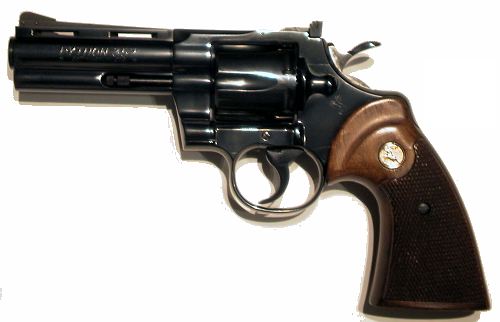
Colt 'Python' with 4 in (102mm) barrel

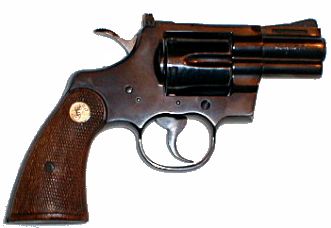
Colt 'Python' with 2.5 in barrel

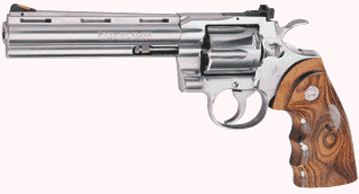
Colt 'Python Elite' with 6 in barrel

 
Type: Double Action
Chamber: .357 Magnum
Weight unloaded: ca. 1100 g (with 4 in barrel)
Length: 240 mm (with 4 in barrel)
Barrel length: 2.5, 4, 6 or 8 inches (64, 102, 153 or 203 mm)
Capacity: 6 rounds

The "Python" revolver was introduced by Colt company (USA) in 1955. It was awailable in different barrel lenghts, suitable for self-defence (2.5 and 4 in barels), service (4 and 6 in barrels), hunting and target shooting (4 - 8 in variants). Early "Pythons", especailly those without letters in the serial numbers (made from 1955 until mid-1960's) were indeed very accurate guns, often compared to Manurhin MR-73's or SIG P210's. Some time ago Colt discontinued the "Python" series in favor of the more modern "Kingcobra" revolver, but it is (probably) still available through Colt Custom Shop.
All Pythons were double-action, swing-out cylinder revolvers. Sights: blade post fron sight with polymer insert; rear sights with removable sight blade are screw ajustable for both windage and elevation. Barrel is screwed into the frame and featured vented upper rib and full-lenght bottom rib that houses full lenght extractor rod. Internal safety consist of Colt's patented transfer bar and cylinder stop (fixes cylinder when hammer is cocked).

Colt Detective Special

Colt Detective Special 1st issue

Colt Detective Special 3rd issue

 
Data, Colt Detective Special 3rd issue (1st issue data in parenthesises, where differs from 3rd issue)
Type: Double Action
Chamber: .38 Special
Weight unloaded: ?
Length: 178 mm (171 mm 1st issue)
Barrel length: 51 mm (2 in)
Capacity: 6 rounds

Colt Detective Special is one of famous Colt sixguns. Very popular among plain-cloth cops, security men and others, who needed a compact, reliable handgun. Colt Detective Special was introduced in 1927 and manufactured until 1936. Lately, Colt at least twice reintroduced this popular revolver, last time in 1973 as the Colt Detective Special 3rd issue (now discontinued).
The Colt Detective Special is a classic-style, swing out cylinder, double action compact revolver with fixed blade front sight and notch-style rear sights and full lenght ejector rod.

Smith & Wesson N-frame

S&W "New Century" or "Triple Lock" model of 1908, caliber .44 S&W Special

S&W M1917 - second model N-frame revolver, chambered for .45ACP

S&W 38-44 "Heavy Duty" - a third model N-frame, caliber .38 High Velocity, father of the .357 magnums

S&W model 27, classic N-frame revolver in .357 magnum

S&W model 28 "Highway Patrolman". A budget version of the model 27, great police gun in .357 magnum

S&W original .44 magnum revolver, later renamed into model 29

S&W model 610 "Classic", stainless steel revolver in 10mm auto

S&W 629 - stainless steel version of the Model 29

S&W Performance Center model 627 ("factory custom" model) with 8-shots cylinder

S&W Performance Center Model 25, a remake of the old revolver in the .45 Long Colt


Type: Double Action
Chamber: .38/44, .357 magnum, .41 magnum, 10mm auto, .44 SW Special, .44 Rem Magnum, .45ACP, .45Auto Rim, .45LC
Weight unloaded: wary with model, usually 1 kg plus
Length: wary with model
Barrel length: 2 1/2 to 8 3/4 inches (64 to 222 millimeters)
Capacity: 6 rounds (also some versions of M627 - 7 and 8 rounds in .357magnum)

A Brief overwief of the history and the present of the S&W "N" (large) frame revolvers
The N-frame revolvers are the biggest double action ones, that are manufactured by Smith & Wesson conpany. The history of the N-frames began in 1908, with the introduction of the New Century Hand Ejector revolver, chambered for then-new .44 S&W Special cartridge. The gun, also known as a "Triple Lock" model, featured additional cylinder lock at the cylinder crane, plus two standart locks at the front and rear ends of the cylinder axis/ejector rod. Another feature was the enclosed ejector rod (underbarrel lug). The frame was bigger and heavier than the K-frame Hand Ejector, allowing to use larger caliber ammunition. The trigger action was similar to .38 caliber Hand Ejectors, as well as the sights.
In the 1915 the S&W got rid off the Triple Lock feature, as a time-consuming and cost-adding. The underbarrel lug also was removed. After the beginning of the World War One, folowing the demand of the US Army in the sidearms, the S&W rechambered its N-framed second model for US GI .45ACP cartridge. As the .45ACP was rimmles round, the gun should be loaded with ammunition in half-moon clips for proper case extraction. each clip can hold 3 rounds and also speed up loading. These guns were issued to US troops as S&W Model of 1917 revolvers, along with the Colts (issued under the same designation of M1917).
In the mid-1920s came the third model of the N-frame, that brought back the underbarrel lug. In the 1929 S&W developed new round, .38 High Velocity (.38HV) - a heated-up version of the .38 S&W Special. Since this round was unsafe to fire in the K-framed M&P revolvers, S&W team rebarreled the N-framed revolver for .38-caliber (actually, .355in), and installed a heat-treated cylinder that could hold 6 rounds of either .38HV or .38Spl rounds. The gun was named 38/44 Heavy Duty (Model 20, since 1956). Similar model with ajustable sights was called the .38/44 Outdoorsman (model 22).
The development of the .38HV cartridge (also known as .38/44) and the Heavy Duty revolver led to the invention of the .357 magnum round - a lenghtened version of the .38HV. The only reason for case lenghtening was to avoid chambering hot amunition into guns that were not designed for such ammo. The first revolvers in the .357magnum by S&W were similar to .38/44's, except for the longer cylinder. Since the 1956, this model received the designation Model 27. During 1980's, the Model 27 was replaced by its stainless steel version, model 627. Currently, model 627 is offered in limited numbers from S&W Performance Shop, with standart 6 round cylinders or with "high capacity" 8 rounds unfluted cylinders. A "budget" version of the Model 27, model 28, originally known as "Highway Patrolman", was very popular police sidearm in the USA during the 1950's-60's. The Model 28 difered form the Model 27 mostly by having less "luxury" finish, while maitaining almost the same strenght, reliability and accuracy.
During 1920's-50's S&W also developed some target models in .44spl, that differed from standart ones by having ajustable sights (post-1956 guns also known as Model 24's), and in 1950s S&W introduced target revolvers chamvered in .45ACP, using same half-moon clips as M1917's. These models are known as Model 25's, and currently are in limited production by S&W Performance Shop.
In the mid-1950s, folllowing the demand from the hunters and shooters in the more powerful cartridge/gun, S&W and Remington developed the pair that for couple of decades became the most powerful handgun/cartridge combo in the world. namely, these were .44 remington Magnum cartridge and S&W .44 Magnum revolver, later renamed in the model 29. Back in the 1980's the model 29 was replaced by its stainless steel version, the Model 629, that is still in production. Most common versions are model 629 standart with old-style, short underbarrel lugs, or 629 "Classic" models with full-lenght, heavier underbarrel lugs. All variant of the model 629 featured ajustable sights.
In the 1967, the S&W and Remington decided to introducea gun/ammo combination that will fill the gap between .357mag and .44mag guns. The result was the .41 remington magnum cartridge and the S&W Models 57 and 58 revolvers. Model 58 featured standart N-frame with fixed sights, and was intended for police and state troopers use. Model 57 featured fixed sights. However, these guns did not catch the market well, mostly because these were still too powerful (with too big recoil and muzzle blast) for many law officers. The stainless steel of the model 57, the Model 657, is still being manufactured by S&W.
With the introduction of the new, powerful pistol cartridge, 10 mm auto, S&W began to manufacture the Model 610 - 6-round revolver, that should be loaded with ammunition in full- or half-moon clips. As with other 6xx serties revolvers, Model 610 featured stainless steel construction and ajustable sights.

Smith & Wesson "Military and Police" M10 and other K-frame

S&W Hand Ejector .38spl - model of 1905

S&W Military and Police revolver with 5 inch barrel - circa 1941

S&W model Victory - military WW2 production with 5 inch barrel

S&W Military and Police revolver with 2 inch barrel - circa 1949

S&W Model 10 Heavy Barrel with 4 inch barrel

S&W K-38 Masterpiece Model 14 target revolver with 6 inch barrel

S&W Combat Masterpiece Model 15 revolver with 4 inch barrel

S&W Model 64 .38Spl - stainless steel version of the Model 10HB (Model 65 in .357Magnum looks almost the same)

S&W Model 66 .38Spl - stainless steel version of the Model 15 (Model 67 in .357Magnum looks almost the same)


Data for current manufacture M10 revolver with 4 in (102mm) barrel

Type: Double Action
Chamber: .38 Special; some other models also .357 magnum
Weight unloaded: ca. 1000 g
Length: 236 mm
Barrel length: 102 mm
Capacity: 6 rounds

The history of one of the most successful revolver designs of all times, the Smith & Wesson's "Military And Police", began in 1899, when S&W began to manufacture its "Hand Ejector" model in .38 Long Colt caliber. In 1902, S&W introduced the .38 hand Ejector revolver in its new chambering, the .38 Special, and during the following years continued to slightly improve the design. The 38 Hand Ejector took its shape in 1915. In 1920s, Smith & Wesson renamed the 38 Hand Ejector into Military and Police model, and in 1958, after introduction of the model numbering system, S&W assigned to the Military & Police revolver a model number 10. During the century, the total numbers of the M&Ps manufactured by S&W could be estimated at rough six millions plus, give or take. This included some 1 million or so revolvers, delivered to the US Government during the WW 2, and a large numbers of revolvers, manufactured for export into British Commonwealth countries.
In general, the M&P was one of the most popular police revolvers in the USA. Some sources said, that at some time period, some 80% of ALL US Police departments were armed with M&P revolvers! These guns were also used by US Military, especially in US Air Force and US Navy. The M&P's were widely copied by numerous manufacturers in Spain, France and other countries.
Technically, all M&P revolvers are double action, swing-out cylinder revolvers. All M&P family revolvers featured similar medium sized frame (S&W nomenclature code: K-frame); All M&Ps featured dual-locked 6 chamber cylinders (one lock is manually operated by the latch, located at the left side of the frame behind the cylinder and locks the rear part of the cylinder axis; another lock is a spring-loaded one that locks the front part of the cylinder axis/ejector rod under the barrel). Standart M&Ps featured fixed front sight and fixed rear sight, in the form of the groove, cut in the top of the frame. Some target versions (sse below) featured ramp front sight with ajustable rear sights. Original material of the frame was the carbon steel, blued or parkerised; later, lightweight alluminium alloy frames and stainless teeel frames were introduced. Original barrels were from 2 to 8 1/2 inches long, of thin profile, with exposed ejector rod. Later, "heavy barrel" models were introduced. Some later models also featured barrels with upper rib and / or enclosed ejector rod.
Here is the list of the most common M&P models, manufactured during the last 100 or so years.

  • 38 Hand Ejector - opriginal model. In 1899, introduced in 38 Long; in 1902 in .38 Special.
  • Military & Police - Hand Ejector .38 Spl, renamed somewhere in 1920s.
  • Victory model - WW2, military issue M&P's with rough finish, plain wood grip panels and lanyard ring. manufactured for US Military in .38Spl and for British Commonwealth in .38/200, with 4 or 5 inch barrels.
  • Military and Police, Model 10 - M&P, numbered in 1958. Curently in production.
  • Military and Police, Model 11 - M&P, chambered for British service .38/200 cartridge. In production since 1936, discontinued in 1965
  • Military and Police Airweight, Model 12 - similar to Model 10, but with alluminium alloy frame. In production since 1953, discontinued in 1986
  • Military and Police Magnum, Model 13 - M&P with thick, heavy barrel, chambered in .357 magnum cartridge. In production since 1973, discontinued.
  • K-38 Masterpiece, Model 14 - Target version of the M&P, with 6 or 8 inch barrel and ajustable sights. In production since 1947, discontinued in 1982
  • K-38 Combat Masterpiece, Model 15 - Version of the Model 14, with ribbed barrels of 2, 4 or 6 inches long and ajustable sights. In production since 1949, discontinued.
  • K-32 Masterpiece, Model 16 - Target version of the M&P, chambered for .32 S&W Long, otherwiose similar to K-38 model 14. In production since 1947, discontinued in 1973
  • K-22 Masterpiece, Model 17 - Target version of the M&P, chambered for .22LR. In production since 1946, discontinued
  • K-22 Combat Masterpiece, Model 18 - Version of the Model 15, chambered for .22LR. In production since 1949, discontinued in 1986
  • Combat Magnum, Model 19 - M&P with heavy barrel, chambered for .357 Magnum, with ajustable sights. In production since 1955, discontinued
  • Military and Police Stainless, Models 64, 65, 66, 67 - M&Ps with heavy barrels (2, 4 or 6 inches long) and stainless steel frames; Models 64 and 67 are chambered in .38 Special, models 65 and 66 - in .357 Magnum. Models 64 and 65 featured original, model 10-like fixed sights, models 66 and 67 - ajustable sights. Currently in production.
    These stailess steel models replaced previous, similar carbon steel models in the following order:
    Model 13 - replaced by Model 65.
    Model 19 - replaced by Model 66.
    Model 15 - replaced by Model 67.
    Model 10 - complemented by Model 64.

 
Design by Free WordPress Themes | Bloggerized by Lasantha - Premium Blogger Themes | Online Project management