Jumat, 28 Januari 2011

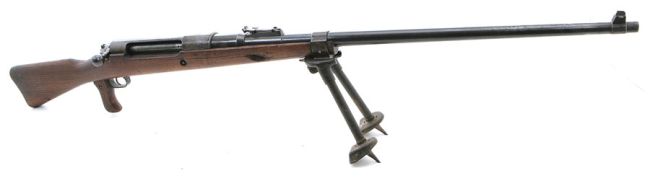
Mauser T-gewehr anti-tank rifle

Mauser T-gewehr anti-tank rifle.

Type / action manually operated bolt cation, single shot
Caliber  13x92SR
Weight unloaded 17.7 kg
Length 1680 mm
Barrel length 984 mm
Magazine capacity -
Armor penetration (Range / Angle / Penetration) 100 m / 90o / 20 mm; 300 m / 90o / 15 mm

  Mauser T-Gewehr (Tank abwehr Gewehr M1918 = anti-tank rifle, model 1918) weapon is the first of its kind ever to be adopted and see the combat. It was designed in Germany during the closing stages of World War 1, to provide German infantry with inexpensive and man-portable weapon, capable to defeat the armor of the newest British invention, the battle tank. It was adopted in 1918 and manufactured by Mauser Werke arms factory until the Armistice, with total production estimated at about 15 thousands of rifles. The Mauser T-gewehr anti-tank rifle proved to be effective enough against earliest British tanks, as their armor was designed to withstand only rifle-caliber ammunition and shrapnel, and the T-Gewehr fired purpose-designed large caliber cartridge loaded with steel-core AP bullet (52 g at 770 m/s). The major drawbacks of the T-gewehr were heavy recoil, heavy weight and huge size - features, later inherited by most weapons of similar class and purpose. It is rumored that normally T-gewehr crew members fired only about 2 or 3 rounds before passing the gun to the team-mate, as they suffered heavily from excessive recoil - the rifle had no recoil mitigation means, such as buffered buttstocks, soft buttpads and muzzle brakes, which became the must for latter weapons of the same class.
Mauser T-gewehr anti-tank rifle is a manually operated, single shot bolt action rifle. It uses more or less traditional Mauser-type rotary bolt with frontal locking lugs. Cartridges are loaded manually directly into the chamber. Rifle is fitted into the wooden stock with pistol grip, and an MG-08/15-type bipod is fitted to the front of the stock. The iron sights consisted of the blade front and tangent-type rear, with settings from 100 to 500 meters.

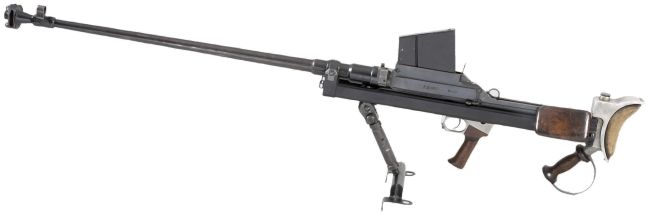
Boys Mk.I, Mk.I* and Mk.II anti-tank rifle

Boys Mk.I anti-tank rifle, with circular muzzle brake and "inverted T" shaped bipod, as made by BSA in england.
 
Boys Mk.I* anti-tank rifle, with flat muzzle brake and "inverted V" shaped bipod, as made by Inglis in Canada.

Data for Boys Mk.I anti-tank rifle

Type / action manually operated bolt action
Caliber  .55 Boys (13.9x99B)
Weight unloaded 16.3 kg
Length 1626 mm
Barrel length 910 mm
Magazine capacity 5 rounds
Armor penetration (Range / Angle / Penetration) W Mk.1 bullet: 100 m / 90o / 16 mm
W Mk.2 bullet: 100 m / 70o / 20 mm

 The Boys anti-tank rifle was named after its designer, captain H Boys at RSAF Enfield, who died shortly before the adoption of this weapon late in 1937. This weapon was in service with British forces until about 1943, although its effectiveness against German tanks became insufficient on much earlier stages of war. This rifle was produced by BSA Ltd in three basic versions, Mk.I, Mk.I* and Mk.II, with total production reaching 62 thousands of rifles. The Boys Mk.I was original British-made version, with round muzzle brake and T-shaped bipod. The Boys Mk.I* rifles were produced in Canada by John Inglis co, and were distinguished primary by flat muzzle brake and V-shaped bipod. The Boys Mk.II version was rarest of the three, as it was designed especially for airborne troops and had shortened barrel. Boys rifles were normally used from its own bipods, and also were fitted to "Universal carrier" armored tracked vehicles. The ammunition used in the Boys antitank rifle was peculiar to this weapon, using belted case 99mm long, loaded with AP bullets with steel core (W Mk.1, 60 g, 747 m/s) or tungsten core (W Mk.2, 47.6 g, 884 m/s). Boys anti-tank rifles saw some action against Soviet tanks during the Winter war in Finland (1940), and later against German armor in Europe and Japanese armor in Pacific theater. Generally, this weapon appeared to be less than popular due to complex design of certain parts, heavy weight and recoil, and insufficient armor penetration.
The Boys anti-tank rifle is a manually operated bolt cation rifle. It uses rotary bolt with frontal locking lugs. Feed is from top-mounted detachable box magazine with 5-round capacity. To mitigate the heavy recoil, the barreled action is allowed to recoil against the buffer in the stock, and the barrel is equipped with muzzle brake. Shoulder stock is fitted with additional cushioned pad. Rifle was normally fired from folding bipod, and it was equipped with open sights, which were offset to the left to clear top-mounted magazine. The rear sight was of aperture type, either fixed one (set for 300 yards / 271 meters range), or with two range settings (up to 300 yards and 300-500 yards).

Rabu, 26 Januari 2011

Safir arms T15 rifle and carbine

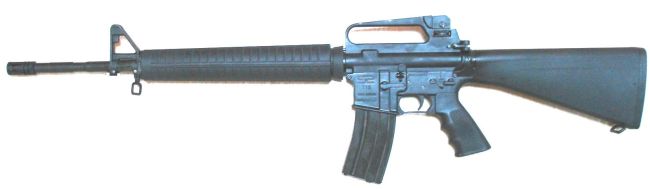
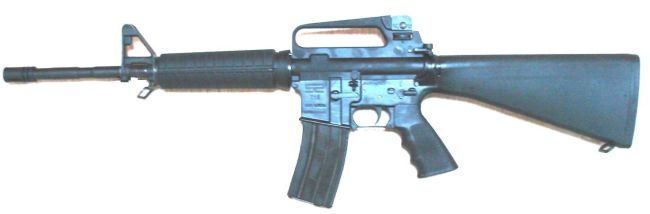
T15 'Classic' semi-automatic rifle.
Image: Safir Arms

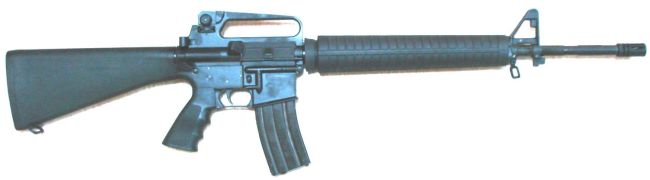
T16 'Classic' selective-fire rifle.
 T16 'Classic' selective-fire rifle.
Image: Safir Arms

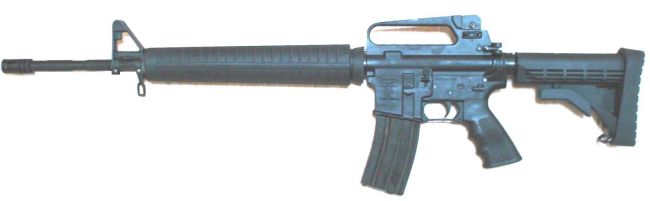
T15 'Classic S' rifle.
 T15 'Classic S' rifle.
Image: Safir Arms

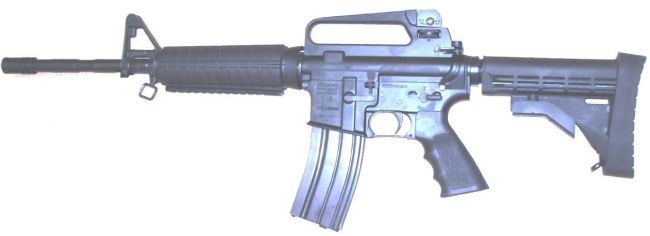
 T15 'Compact' carbine.
 T15 'Compact' carbine.
Image: Safir Arms

 T15 'Compact S' carbine.
 T15 'Compact S' carbine.
Image: Safir Arms

Data for T15 'Classic' rifle

Type / actiongas operated, direct impingement, rotating bolt
Caliber(s) 5.56x45 mm / .223 Remington
Weight unloaded3.4 kg
Length1000 mm
Barrel length500 mm
Magazine capacity30 rounds

The T15 rifle, as made in Turkey by Safir arms company, is a copy of the famous American Ar-15 rifle in its semi-automatic version. The T15 is intended for civilian and police use, but Safir arms also makes selective-fire version of the same design, known as T16, which is intended for military use. For countries that prohibit civilian ownership of semi-automatic firearms, a manually-operated version of T15 is also manufactured. Both T15 and T16 rifles are available in different configurations, with fixed or telescoping buttstock, and with fixed "M16A2-style" carrying handle or flat-top "M16A3-style" upper receivers. Carbine versions of both rifles also available with same modifications, and with any reasonable barrel lengths according to customer preferences.
Another interesting feature of the T15 is that it can be easily converted to 36 gauge semi-automatic shotgun with installation of the T14 shotgun upper receiver, made by the same company.
The T15 rifle is gas-operated weapon that uses Stoner direct impingement gas system, in which hot powder gases are fed from the barrel and via steel tube into the bolt carrier body, where they expand to operate the action. The bolt group is also of Stoner design, with 8-lug rotary bolt that engages the barrel extension. Receiver is made from two halves, upper and lower, both manufactured from aircraft-grade aluminum alloy and connected by two cross-pins. Barrels are manufactured using cold hammer forging process, which ensures long service life and good accuracy, yet maintaining affordable price of the entire gun. Manual safety (which also works as a fire mode selector in T16 rifle) is located on the left side of the receiver. Overall, controls and design of the trigger unit are similar to that of Ar-15 rifle, and include bolt stop release button and T-shaped cocking handle above the buttstock. In standard configuration, T15 and T16 rifles feature M16A2-style adjustable sights, with diopter-type rear sight built into the carrying handle, although 'flat-top' models with Picatinny rail instead of the carrying handle can be produced upon request. Standard furniture is black polymer, with fixed or telescoping buttstock (the latter also features no-slip rubber buttplate). Magazines are same as used in Ar-15 / M16 rifles, and a number of other accessories, compatible with Ar-15 / M16 rifles also can be fitted to T-15 and T-16 rifles.

TPD AXR rifle

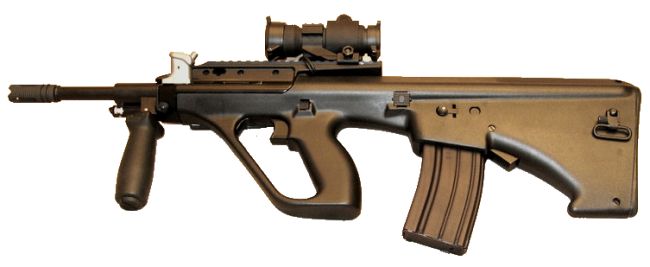
TPD Inc. AXR rifle,left side.

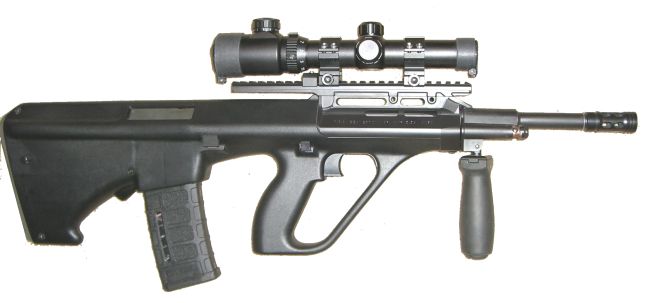
TPD Inc. AXR rifle,right side.

Type / actiongas operated, rotating bolt
Caliber(s)5.56x45mm / .223 Rem, also 6.8x43 mm Rem SPC
Weightunloaded3.2 kg
Length667 mm / 26.25" (with 406mm / 16" barrel)
Barrel length406 mm/ 16" or 457 mm / 18"
Magazinecapacity30 rounds standard, any M16/Ar15 compatiblemagazine will fit

The AXR (Advanced eXtensible Rifle) weapon was developed by US-based company Tactical Product Design (TPD) Inc. The AXR is based on the famous Austrian SteyrAUGassault rifle. Manufacture of this clone became possible because original patents for  SteyrAUG have expired, and the demand for civilian version of this weapon in USA was not covered by import of original Austrian-made rifles. TPD designers created a faithful copy of Steyr AUG,so most parts are interchangeable between the AXR and AUG.Prime differences between AXR and its prototype are in materials (TPD claims to use most modern metals and polymers in its design, which are superior to those available 30 years ago in original Steyr rifle) and use of STANAG / M16 type magazines rather than proprietary magazines.Optional caliber conversion kit allows to upgrade the AXR from 5.56mm /.223 to more potent 6.8mm Rem SPC caliber. At the present time AXR is offered only in semi-automatic version, for civilian and police use.
TPDAXR rifle is gas-operated semi-automatic weapon of bullpup configuration. The receiver is made from aluminum alloy, the stock / housing is made from impact-resistant polymer. Barrels are quick-detachable, with barrel lock incorporated into the gas block /forward grip base. Adjustable gas system features short-stroke gaspiston, located to the right of the barrel. Bolt group rides on dual guide rods, and different user-replaceable multi-lug rotary bolts are available for right- or left-hand ejection. It must be noted that current polymer stocks of AXR rifle does not permit easy change of the ejection direction, as ejection port is made only on one side of the stock. AXR is equipped with bolt hold-opendevice; bolt catch can be deactivated by pulling the charging handle.The originalSteyrAUG-type bolt closure device is incorporated into the design,in the form of the button on the charging handle. Normally non-reciprocating charging handle is located also on the left side, in front of the receiver; push on the button locks the handle to the bolt group, allowing to use it for manual bolt closing. AXR rifle accepts any M16 / Ar15-type magazines; magazine release buttons are located below the stock, behind the magazine housing, and on the left side of the stock, above the magazine. Manual safety is of cross-boltbutton style, located above the pistol grip. No sights are installed by default on AXR rifle; instated, each rifle is equipped with Picatinny-type rail on the top of receiver, which permits installation of any type of sighting equipment using appropriate mountings.

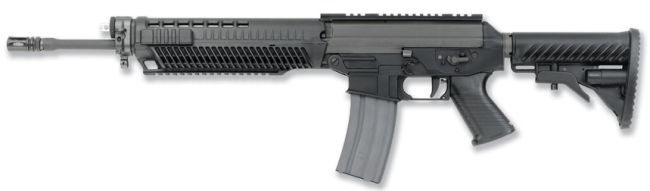
SIG 556 semi-automatic rifle

SIG 556 semi-automatic rifle,left side; buttstock collapsed.
 SIG 556 semi-automatic rifle,left side; buttstock collapsed.

SIG 556 semi-automatic rifle,right side.
 SIG 556 semi-automatic rifle,right side.

Type / actionsemi-automatic rifle,gas-operated
Caliber(s) .223Remington (5.56x45)
Weightunloaded3.54 kg/ 7.8 lbs
Length940 mm / 37"
Barrel length406 mm/ 16"
Magazinecapacity30 rounds

The SIG 556 semi-automatic rifle was announced in 2006 as a rifle for civilian and law-enforcement use.It is produced by international SIGARMS (now SIG Sauer) arms corporation and intended primary for US market. SIG 556 is based on SIG SG 550 assaul trifle, which is in use by Swiss army, and is limited to semi-automatic fire only, thus being legal in most countries that permit civilians to own rifles. SIG Sauer also produces a SIG 556 SWAT semi-automatic rifle which has a different butt stock and a 4-rail forend.
The SIG 556 semi-automatic rifle is gas operated, using short-stroke gaspiston located above the barrel. Gas system has manual gas regulator with two settings for normal and harsh conditions. The barrel is locked using rotary bolt with two massive lugs. Receiver is redesigned from original SIG SG 550 rifle, and features stamped steel upper part matedto aluminum alloy  lower part which houses a trigger unit and a redesigned magazine housing which accepts all M16 / Ar-15 type magazines.A bolt stop device is incorportaed into design. Manual safety is ambidextrous and located above the pistolgrip. As a standard, rifle is shipped with 30-round magazine. In basic configuration SIG 556 has no iron sights (adjustable folding ironsights are optional). Top of receiver is fitted with Picatinny rail foreasy installation of various optical or red-dot sights; additional rails are installed on the forend, at 3-, 6- and 9-o'clock positions.Buttstock is of non-folding, telescoped adjustable type.

Ruger SR-556 semi-automatic rifle

 Ruger SR-556 semi-automatic rifle.
 Ruger SR-556 semi-automatic rifle.

 Ruger SR-556 semi-automatic rifle.
 Ruger SR-556 semi-automatic rifle.

Type / actiongas operated, semi-automatic
Caliber(s) .223 Remington / 5.56x45 mm
Weight unloaded3.6 kg / 7.92 lbs
Length832 - 914 mm / 32.75" - 36"
Barrel length410 mm / 16.125"
Magazine capacity30 rounds

Ruger SR-556 semi-automatic rifle is the most recent product of the famous American arms-making company Sturm, Ruger & Co. Ruger company previously manufactured 5.56mm / .223 caliber semi-automatic Mini-14 rifles, which were known for excellent durability and reliability, but the SR-556 is the first step of this company into the one of most lucrative segments of American rifle market, the "Ar-15 niche". Following the general trend, Ruger, however, developed an improved version of the basic weapon that has many factory-standard features which, otherwise, are considered as expensive aftermarket options. Most important of these features are short-stroke piston-operated gas action (as opposed to original direct impingement gas action of the classic Ar-15 rifles), cold-hammer forged barrel with flash hider, as well as quad-rail forend, folding detachable iron sights and quality 30-round magazines. This rifle is obviously intended for civilian and law enforcement markets.
Ruger SR-556 semi-automatic rifle utilizes gas-operated action with short-stroke gas piston, located in the gas block above the barrel. The piston is linked to the bolt group through the separate push rod that runs inside the handguards and has its own return spring. Gas system features manual gas regulator with 4 positions, from "0" (gas system shut off for manual cycling) through "3" (for firing when rifle is heavily fouled up or when using relatively low-power ammunition). Normal gas regulator position is "2". Gas piston and gas regulator plug are chrome-lined. Bolt group is similar in design to the standard Ar-15 bolt group except that instead of the gas key it has a lug which interacts with the pusher rod. The bolt, bolt carrier ad barrel bore are chrome lined as well. Combined with gas-piston system that keeps powder residue out of the bolt group and receiver, this will result in enhanced reliability over prolonged firing sessions. The upper and lower receivers are made from aluminum alloy and connected via traditional cross-pins. All controls (manual safety, bolt stop release, magazine release, cocking handle, bolt forward assist) are of typical Ar-15 pattern. Feed is from standard M16 / Ar-15 type magazines, and as of now each rifle is shipped from factory with three 30-round polymer PMag magazines. Standard furniture includes quad-rail forend (supplied by Troy Industries), Hogue pistol grip and M4-type collapsible buttstock with 6 positions. Standard sights, as shipped by factory, include Troy industries iron sights on folding bases, with flip-up diopter type rear sight, adjustable for windage, and protected front sight, adjustable for height. Top of receiver features integral Picatinny rail, so any type of red-dot or telescopic sight can be fitted using appropriate mountings.

 
Design by Free WordPress Themes | Bloggerized by Lasantha - Premium Blogger Themes | Online Project management