Senin, 21 Februari 2011

Mauser HSc

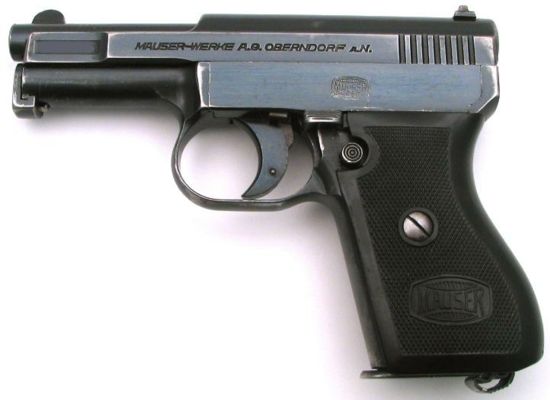
Mauser HSc - pre-war manufacture in 7.65mm (.32ACP).

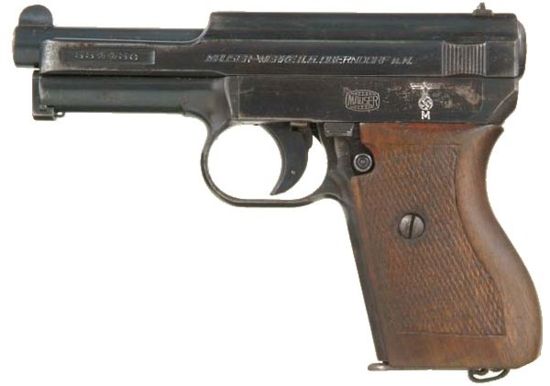
Mauser HSc - post-war manufacture with US import markings.

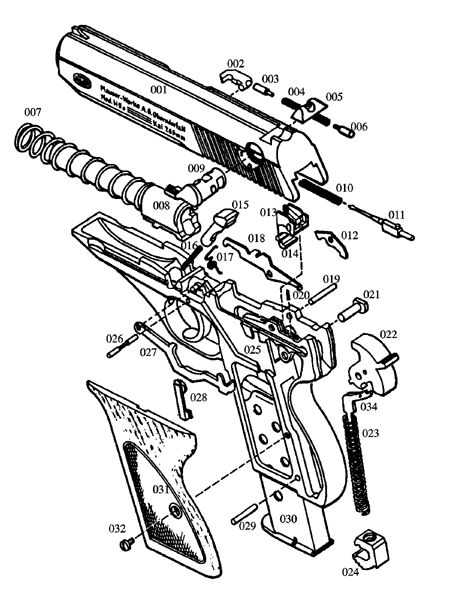
Mauser HSc parts diagram.

Characteristics

Type: Double Action
Chamber: 7.65x17mm Browning (.32ACP); also 9x17mm Browning Short (.380ACP)
Weight unloaded: 600 g
Length: 152 mm
Barrel length: 86 mm
Capacity: 8 rounds (7.65mm) or 7 rounds (9mm)

The Mauser HSc pistol was developed by famous Germany arms company Mauser circa 1937. HSc is an acronym of Hahn-lSelbstlspanner pistole ausfurung C, or selfcocking-hammer pistol, model C (models HSa and HSb were prototypes only). This compact pistol was intended for civilian and police market and has some features, that made it more suitable for concealed carry, than other contemporary compact pistols. But with outbreak of Second World War, german military, especially KriegsMarine (Navy) and Luftwaffe (Air Forces) consumed all production of HSc. Original HSc pistol was manufactured in 7.65mm Browning (.32ACP), but after WW2, when Mauser company resumed its operations, this gun also apeared in 9mm Browning Short (.380ACP) during period of 1970 - 1977. In the late 1970s Mauser ceased the production of HSc and sold licence to it to Italian company.
Mauser HSc is a blowback operated, compact pistol. The barrel can be detached from the frame by the release of the lock, located inside of the triggerguard. The hammer is concealed within the slide except for the small lip that protrudes from under the slide and allows for manual cocking. The safety switch is mounted on the slide and when engaged (lowered), moves the rear part of the firing pin out of the reach of hammer and locks it. The overall shape of the gun is streamlined and allows for easy concealment, even a front sight blade is concealed within longitudinal groove on the top of the slide. Magazine release catch is located at the bottom of the butt, magazine fllorplates featured a finger lip for more comfortable grip.

Mauser 1910 1914 and 1934 pistols

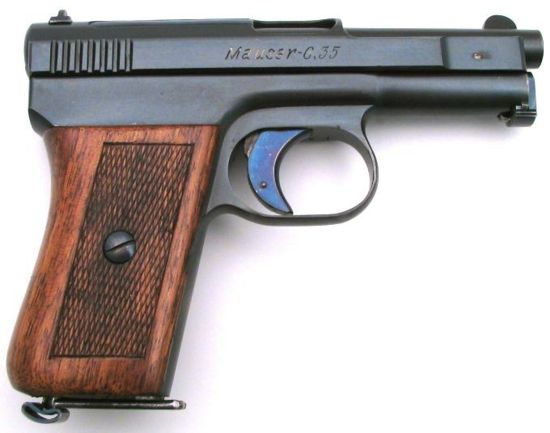
Mauser 1910 pistol, caliber 6.35mm (.25ACP), left side.
 
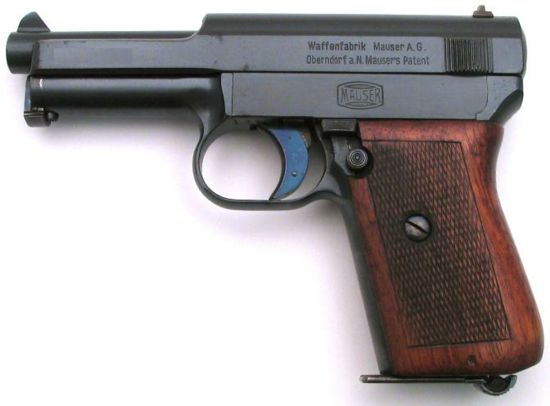
Mauser 1910 pistol, caliber 6.35mm (.25ACP), right side.
 
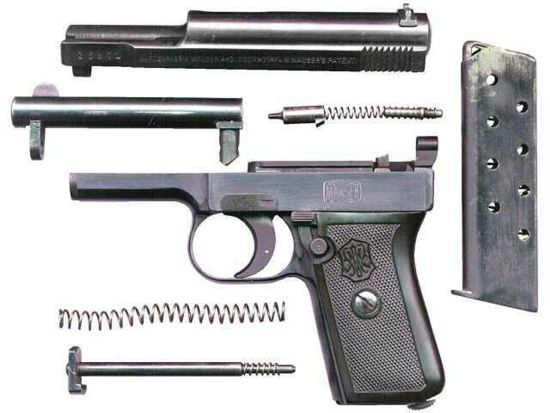
Mauser 1910 pistol, partially disassembled.
 
Mauser 1914 (or 1910-14) pistol, caliber 7.65mm (.32ACP).
 
Mauser 1934 (or 1910-34) pistol, caliber 7.65mm (.32ACP); commercial version.
 
Mauser 1934 (or 1910-34) pistol, caliber 7.65mm (.32ACP); military version, issued to Kriegsmarine (German Navy) during WW2.
 
Characteristics
 
  Mauser 1910 Mauser 1914, 1934
Type Single Action semiautomatic
Caliber(s)  6.35x16mmSR (.25ACP) 7.65x17mmSR (.32ACP)
Weight unloaded 425 g 600 g
Length 116 mm 152 mm
Barrel length 80 mm 86 mm
Magazine capacity 9 rounds 8 rounds
 
German designers from famous Mauser Werke worked on various semi-automatic pistols since about 1893. In the year of 1909 they set to develop a new, relatively simple semiautomatic pistol, chambered for 9x19mm Luger ammunition with reduced load. This weapon, known as Mauser Model 1910, was not a great success; its updated version, known as Model 1910/12, was manufactured in small numbers under contract with Brazilian navy. In the mean time, it was decided that a new design is more suitable for ammunition, less powerful than a "military" 9mm Luger, so, in the 1910, the basic design was scaled down to relatively new 6.35mm Browning ammunition (known in USA as .25ACP, first introduced in 1906 in Europe and in 1908 in USA). Known as Mauser Model 1910, this became a rather successful pocket pistol. Just before the start of World War One Mauser turned out a slightly bigger version of the same gun, chambered for another Browning-designed cartridge, the 7.65mm (also known as .32ACP). Limited numbers of these 7.65mm pistols were used by German Army during World war 1. Guns, manufactured since 1914 (both smaller 6.35mm and bigger 7.65mm) were slightly different from original design in appearance and minor details, such as design of the barrel retaining pin lock. Over the following two decades, Mauser produced several minor variations of these pistols, which differed in the markings, shape of slide serrations etc etc, but basic design remained basically unchanged. In the year of 1934, Mauser introduced a final version of this line, Model 1934. Its major change from model 1914 was the shape of the grip panels, with curved, rather than straight backstrap. Model 1934 was adopted by German armed forces as a substitute standard, and also was used by various police and security forces. Key military buyers for Mauser 1934 pistols were Kriegsmarine (Navy) and Luftwaffe (Air force). 
Mauser 1910 type pistols are simple blowback operated weapons with stationary, but easily removable barrel. barrel is held to the frame by the long pin, which passes through two underbarrel lugs below the barrel (one at the front and one below the breech). For disassembly, slide of the pistol is locked back, and pin is unlocked and rotated sideways, then pulled out to the front, so the barrel can be pulled up from the frame. Slide of this pistol has a characteristic open-top appearance, with a separate ejection window on the right side. Trigger is of single action type, striker fired. pistol is fitted with manual safety, located in the cut of the left grip panel, just behind the trigger, and with automatic magazine disconnect safety. Slide hold-open device is installed in pistol, but once slide is caught open, it can be released only by insertion of a fresh magazine. Magazine release is located at the base of the pistol grip. Sights are fixed. Grip panels are usually made from wood, but also can be made of plastic on late production guns.
How to field-strip (disassemble) Mauser 1910: 1) insert an empty magazine into grip 2) pull the slide back until it is locked open; inspect the chamber for remaining round 3) remove magazine 4) depress the small retaining latch located on dustcover below the barrel to release retaining rod 5) rotate barrel retaining rod until it is free from frame 6) pull the barrel retaining rod forward and out of the gun 7) pull the barrel up and out of the frame 8) while holding the slide against the frame, insert empty magazine into grip 9) press the trigger and carefully slip the slide forward and out of the frame
Reassemble in reverse order

Mauser C-96

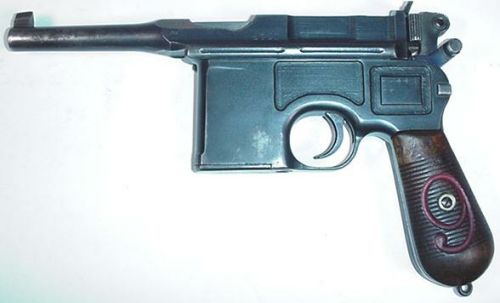
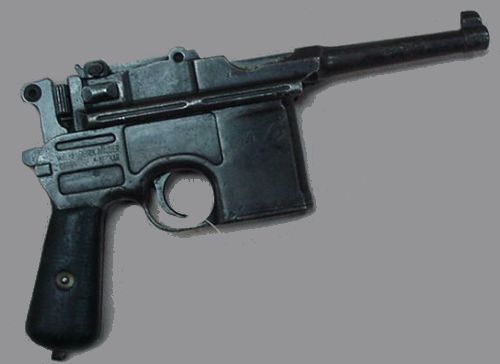
Mauser C-96 - early version with
Mauser C-96 - early version with "coned" hammer.
 
Mauser C-96 - early 20 rounds and 6 rounds non-removable magazines.
 
Mauser C-96
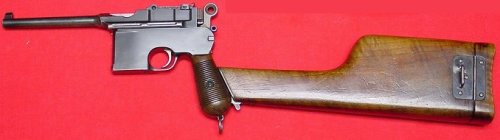
Mauser C-96 "flatside" model of 1908 with shoulder stock / holster attached.
 
Mauser C-96 in 9mm for German Army (World War One).
 
Mauser C-96
Mauser C-96 "Bolo" - short-barreled version, manufactured in 1920s.
 
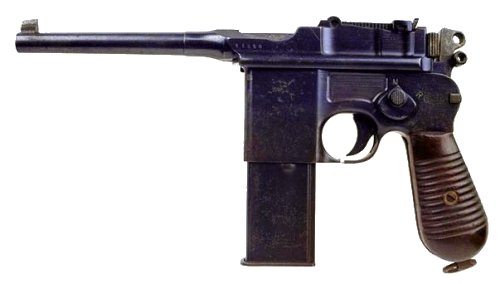
Mauser C-96 model 712 - select-fire with removable 20 rd magazine.
 
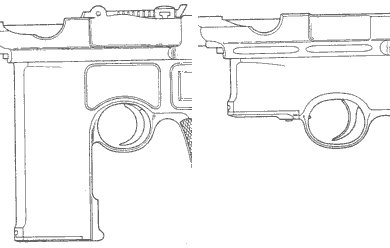
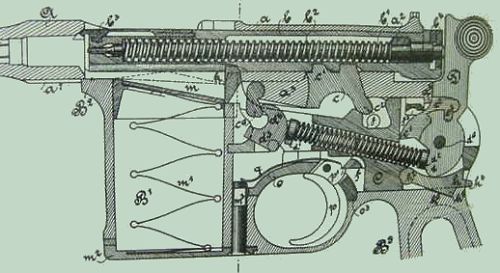
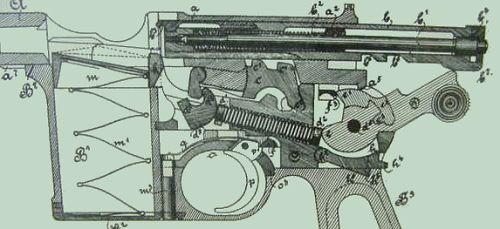
Mauser C-96 - early german drawing, showing internal action (bolt closed).
 
Mauser C-96 - same drawing, but bolt opened.
 
Characteristics
 
Type: Single Action
Chamber: 7.63x25mm Mauser (.30 Mauser); also 9x19mm Luger/Parabellum and 9x25mm Mauser (rare)
Weight unloaded: 1250
Length: 312 mm (with 140 mm barrel)
Barrel length: 140 mm (also 99 mm and other lenghts)
Capacity: 10 rounds in non-detachable box magazine (also 6 and 20 rounds) 
 
The development of the C-96 began in 1893 or 1894. Most work had been done by the Federle brothers, who worked for the Mauser company. Final design appeared early in 1895 and had been patented by Paul Mauser. Production began in 1896. The C-96 had been offered for the German Military but failed. However, C-96 has a long and sucessfull story on the civilian market - being offered as a pistol-carbine, it outperformed in effective range most of contemorary pistols and revolvers, being especially popular with travelers and hunters in the areas where big animals are rare or absent at all. C-96 first saw military action during the Boer war in South Africa (1899-1902). During the First World War C-96 had been aquired by the German Army due to the lack of the stantart issue Luger P-08 pistols. It also had been used during the World War Two, by some second line troops of the Reichswehr (German Army). C-96 also had beeen widely exported - in the 1920s Soviet Russia purchased large quantities of the short-barreled (99 mm barrels) C-96s in 7.63mm, givint the name "Bolo-mauser" (from Bolsheviks' Mauser) to all short-barreled C-96s. In 1930s China also purchased lots of the C-96s in 7.63mm, and also manufactured copies of the C-96 but chambered for .45ACP cartridge. Surprisingly, these copies were of quite good quality. Many C-96 clones were manufactured in Spain, mostly withouth any license, and mostly by the Astra. In the early 1930s Mauser engineers developed a select-fire version of the C-96, which had been used in limited numbers during WW2.
Technically, the C-96 is a recoil operated, locked breech, semi-automatic pistol. It uses short recoiling barrel with bolt, located inside the large barrel extension. The bolt and barrel are locked by the vertically tilting locking piece with two lugs, that locked into the recesses on the bottom of the bolt. The gun is hammer fired. Early guns had hammers with large, round shaped hammer headss with coned sides. The safety is located at the left side of the hammer and locks the hammer when engaged. The most recognisable feature of C-96 is a non-removable, fixed box magazine, located ahead of the triggerguard. Early models were made with 20, 10 or 6 round magazines, but soon 20 and 6 round models were dropped, and since 1905 or so only 10 round models werere manufactured. C-96 can be loaded with single rounds or from 10-rounds sripper clips. The only way to unoad the magazine was to work the slide all the way back and forward for each cartridge in the magazine. Two other notable features were the distinguishable shaped handle (which give the name "broomhandle" to all C-96s) and removable wooden shoulder stock/holster. Finally, most of the C-96 were fitted with ajustable rear sights, graduated up to 1000 meters. This, obviusly, was more of marketing feature, since at 1000 meters distance the average bullets spread was about 4 meters, but, due to high velocity ammunition (the 7.63mm Mauser round produced muzzle velocities of about 440 meters per second, or 1450 feets per second), the effective range was about 150 or 200 meters, especially with shoulder stock atached.
The C-96 took its final shape in 1912, when new type of safety (marked NS - "Neue Sicherung") was adopted, along with shorter and wider extractor and smaler and lighter hammer. In 1915, due to World War, German Army purchased from the Mauser some 150.000 C-96s, chamberd for the army standart issue 9x19mm Luger/Parabellum round. These guns were marked with large red "9" digits on the both sides of the grip. In the 1931-32 Mauser engineers developed two latest versions of the C-96 - models 711 and 712. Main difference of these models was the adoption of the removable box magazines for 10 or 20 rounds. The Model 712 also featured a fire selector mechanism with the fire mode switch on the left side of the frame. Due to the high rate of fire in full auto (1000 rounds/minute) and light barrel, the full auto could be used with any practical effect only for short time and only with shoulder stock attached. These guns were used in limited quantities by German Army in Second World War.
In general, the C-96 is one of the most distinguishable semi-auto pistols in the history, also one of the first practical designs in its class. It was too heavy and too bulky, and slow to reload, but offered great effective range and firepower, along with good reliability. In short - it is what we usually call CLASSIC.

Selasa, 15 Februari 2011

F1 submachine gun


The F1 submachine.
The F1 submachine.

Characteristics

Caliber: 9x19mm Luger/Para 
Weight: 3.26 kg unloaded
Length: 715 mm
Barrel length: 203 mm
Rate of fire: 600 rounds per minute
Magazine capacity: 34 rounds
Effective range: 100-200 meters

The F1 submachine gun has been designed at the Australian Lithgow Small Arms Factory by 1962. Originally known as X-3 prototype, it appeared in 1962 as possible replacement for obsolete and aging Owen submachine guns. It was adopted as F1 by mid-sixties, and served well until late eighties, when it was officially replaced by the 5.56mm F88 assault rifle, a license-made version of Steyr AUG. F1 was simple, reliable and popular weapon.
F1 submachine gun is blowback operated, selective fired weapon which fires from open bolt. It uses tubular receiver with top-mounted magazine. Cocking handle is set at the left side of weapon, and does not reciprocate when gun is fired. Its slot is covered by sliding dust cover. Weapon is made in so-called in-line layout, and the front of the buttstock slides over the rear of the receiver, and is fixed there by special catch. For disassembly, gun is unloaded, then catch is pressed and buttstock pulled off the receiver toward the rear; then, bolt and return spring are removed. Sights are of fixed type, and due to top-mounted magazine are offset to the left. Rear sight is made folding for more comfortable carry. Unlike many other submachine guns, F1 can be fitted with standard rifle bayonet, which is attached to the right of the perforated barrel jacket.

Owen machine carbine


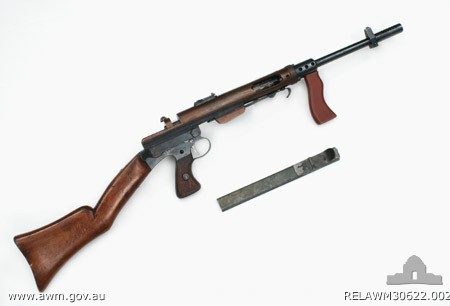
Owen 32ACP prototype submachine gun (1940)

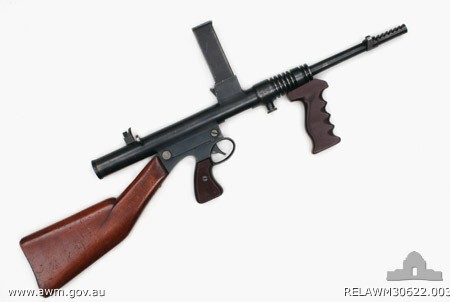
Owen .45ACP prototype submachine gun (1941)

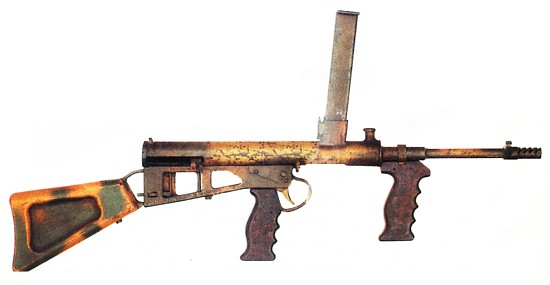
Owen Mk.1-43 submachine gun in camouflage paint

Owen Mk.1-42 submachine gun, field stripped

Characteristics

Caliber: 9x19mm Luger/Para 
Weight: 4.22 kg unloaded
Length: 813 mm
Barrel length: 247 mm
Rate of fire: 700 rounds per minute
Magazine capacity: 32 rounds
Effective range: 100-200 meters

Evelyn Owen, an Australian, developed his first automatic weapon, chambered for .22LR cartridge, by 1939, and offered it to Australian army. This weapon was a strange-looking revolver-type contraption with fixed "cylinder" instead of magazine, and thumb-operated trigger. However, by 1940 Owen produced its next design, in somewhat more potent (but still relatively mild) .32ACP / 7.65x17 Browning cartridge. This was more "usual" weapon, with traditional trigger, dual pistol grips and detachable box magazine, inserted under the receiver and inclined rearward and to the left. By 1941, Owen produced several more prototypes, chambered in .45ACP, 9mm Luger and even .38 Special revolver cartridges; this work was done at Lysaghts Newcastle Works in New South Wales, Australia. 9mm prototype, made by Lysaghts, was tested against Thompson and Sten submachine guns, and found superior to both. Adopted in 1942, this gun was manufactured until 1945 in three basic versions, Mark 1-42, Mark 1-43 (or Mark 1 Wood butt), and Mark 2. About 45 000 Owen SMGs were made by Lysaghts, and these remained in service with Australian forces until 1960s, through World War 2, Korean and Vietnam wars. In general, these weapons were well liked by soldiers due to their robustness, reliability and simplicity. The only downside of Owen SMG was its somewhat heavy weight.
Owen submachine guns are blowback operated, top-fed weapons that fired from open bolt. Receiver is of tubular shape, with the bolt body separated from the cocking handle by the small bulkhead inside. This precluded the dirt to enter the receiver area through the cocking handle slot, but also required the barrel to be made removable, as the bolt and return spring were pulled forward out of receiver. Barrel was held in place by simple latch, located at the front of the receiver, ahead of the magazine housing. Muzzle was equipped with recoil compensator. Pistol grips were made from wood, detachable buttstock was made of steel wire on Mk.1-42 Owens and from wood on later models. Due to the top mounted magazine, fixed sights were offset to the left.

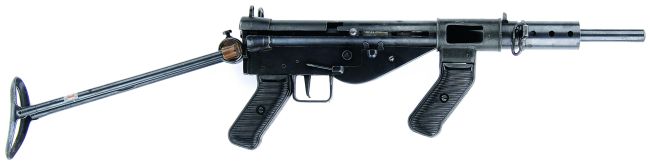
AUSTEN submachine gun


AUSTEN submachine gun.

Characteristics

Caliber9x19mm Luger / Parabellum
Weight3.98 kg
Length (stock closed/open)552 / 732 mm
Barrel length198 mm
Rate of fire500 rounds per minute
Magazine capacity30 rounds

AUSTEN submachine gun (machine carbine in contemporary terminology) was an urgent development, carried in Australia during earlier stages of World War 2 in the anticipation of possible Japanese invasion. It was based on British STEN submachine gun (the AUSTEN means Australian STEN), although some features (i.e. return spring guide, pistol grip and underfolding stock) were copied from the German MP40. About 20 thousands of AUSTEN Mk.1 submachine guns were manufactured during the WW2, but it was unable to achieve popularity of its main domestic rival, the Owen submachine gun, as the Owen was much more reliable, especially under the extreme environmental conditions of jungle warfare.
The AUSTEN submachine gun is a simple blowback weapon, firing from open bolt in semi-automatic or full automatic modes. The return spring is located insite the telescoping tubular guide, as in the German MP40. The fire mode selector is located on the right side of the trigger housing, above the trigger guard. The STEN-type box magazine is inserted horizontally from the left, ejection is to the right. AUSTEN submachine gun is equipped with two pistol grips and an underfolding metallic buttstock. The struts of the buttstock are hollow and hold inside a small screwdriver and a cleaning rod. The sights are of simple design, and not adjustable for range.

 
Design by Free WordPress Themes | Bloggerized by Lasantha - Premium Blogger Themes | Online Project management