Senin, 21 Februari 2011

Heckler Koch HK P11 underwater pistol

Heckler-Koch HK P11 underwater pistol, left side.

Front view on the five-shot barrel cluster of the HK P11 underwater pistol. Note that all barrels are fired and seals penetrated.

Front view on the five-shot barrel cluster of the HK P11 underwater pistol. Note that all barrels are fired and seals penetrated.
 
Characteristics

Type Single Action multi-barrel
Caliber(s)  7.62mm underwater
Weight unloaded about 1200 g
Length 200 mm
Barrel length n/a
Magazine capacity 5 rounds in disposable barrel cluster

The HK P11 is one of the least known weapons to emerge from the Heckler & Koch factory. Developed during the early 1970s to arm frogmen (combat divers), this weapon is apparently in use with the Navies of Germany, Italy, France, Norway, the UK and the USA. This highly unusual weapon is probably the only serious rival to the Soviet underwater pistol, which appeared in late 1960s. The P11 and its ammunition is somewhat bulkier than its Soviet counterparts (the SPP-1M), but, on the other hand, the P11 has one round more capacity and a larger caliber, probably resulting in better lethality.
The HK P11 pistol is mainly unusual in the fact that it is not self-loading. Instead, it uses a quick-detachable cluster of five barrels, each factory-loaded with a powder charge and long, needle-like, drag-stabilized projectile. The pistol is reloaded by the replacement of an entire barrel cluster. In combat, the empty clusters are discarded, in training these are collected and later sent back to factory for reloading. Loaded barrels are protected from salt water by thin diaphragms, which are destroyed by the fired bullet at the instant of firing. Powder charges in each barrel are ignited using electricity, provided by two 9-Volt batteries, stored in a sealed container in the grip of the pistol. The effective range underwater depends on the depth, and is about 15 metres near to the surface. Above the water, the effective range is quoted as being around 30 metres, and while long and relatively heavy bullets can be lethal at longer ranges, the chances of hitting any target beyond the given range is minimal. This is because the barrels are not rifled, and bullets are not stabilized in the air, thus tumbling and yawing in flight through the air.

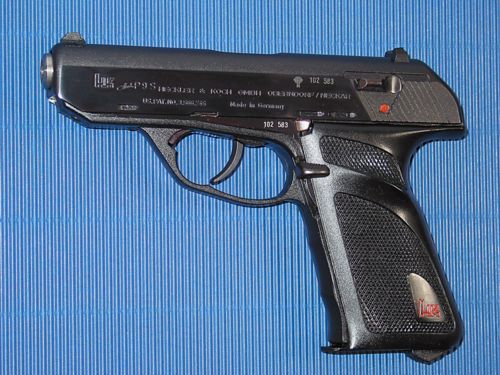
Heckler-Koch P9S pistol

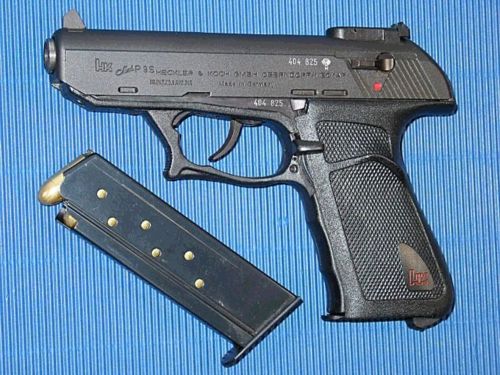
HK P9S pistol. Note the heel magazine release and a cocking/decoking lever behind the triggerguard.

HK P9S Sport, with adjustable sights and reshaped trigger guard.

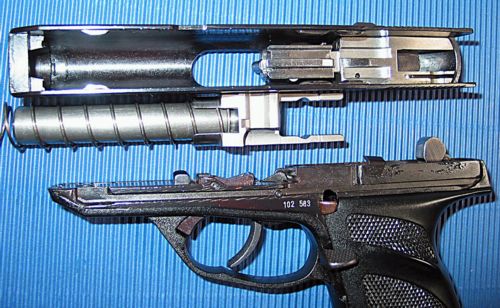
HK P9S partially disassembled. clearly seen are the barrel with its extension and cuts for rollers; and a separate two-part breechblock, inserted into the thin-walled slide.

Characteristics

Type: Double Action (P9S); Single action (P9)
Chamber: 9x19mm Luger/Para, .45ACP
Weight: 880 g empty
Length: 192 mm
Barrel length: 102 mm
Capacity: 9 (9mm) or 7 (.45) rounds

The P9 pistol was designed by the famous Heckler-Koch company during the first half of the 1960s. After much testing and prototyping, which even included a selective-fire pistol with detachable shoulder-stock, the mass production of semi-automatic P9 began in 1969. Not many of single action P9 pistols were produced, and during the early 1970s the P9 gave its way to the double-action P9S, which remained in production until 1978. The licensed version of P9S is still manufactured in Greece as EP9S (9mm only). The P9 was and probably still used by various police forces in Germany, as well as in several other countries. The .45 caliber version of P9S, fitted with longer barrel which accepted the detachable silencer, was used in limited numbers by US Navy SEALs.
The P9S is an interesting design, which is based on H-K experience, gained with production of famous G3 rifle. First, the P9 and P9S use the stamped steel frames and slides, with machined steel inserts and polymer triggerguard and front part of the grip, as well as polymer grip panels. This accounted for fast and inexpensive production. Second, the P9 and P9S featured a roller retarded (delayed) blowback action, also derived from G3 rifle. This action required a two-part breech block, machined from steel, which was inserted into stamped slide, and a machined barrel extension, with roller grooves. The stationary barrel accounted for consistent accuracy, and allowed for easy and reliable silencing of the pistol. Another interesting feature of P9 pistols was the internal (concealed) hammer, which operated in single action mode in P9 and in double action mode in P9S. The special lever, located at the left side of the grip frame, just behind the triggerguard, was used to manually cock and decock the hammer. The manual safety was located at the left side of the slide.
P9S pistols were fitted either with fixed or adjustable sights (P9S Sport model). The later also could be had with longer barrel and special target grips.
Single stack magazine of P9S held 9 9mm or 7 .45 caliber rounds, magazine release was located at the heel of the grip. Slide stop lever was located above the cock/decock lever.

Heckler und Koch VP 70

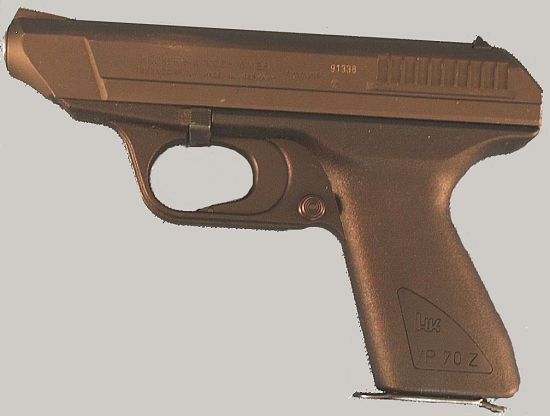
VP 70Z - Civilian version.

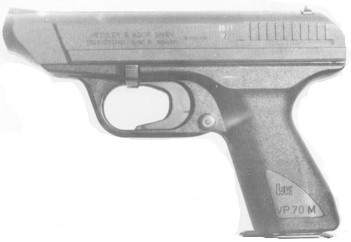
VP 70M - Military version.

VP 70M with holster-stock attached.

Сlose view on fire selector built into holster-stock of the VP 70M.

Characteristics

Type: Double Action Only
Chamber: 9x19mm Luger/Parabellum
Weight unloaded: 820 g
Length: 204 mm
Barrel length: 116 mm
Capacity: 18 rounds

The VP 70 pistol is quite unique, being well ahead of its time in some respects, and while it did not catch the military or civilian market, it set the marks for the many more sucessful followers. The VP-70 (Volks Pistole model 70) had been developed by HK around 1968, and the production began in 1970. Production of the military / law enforcement version, VP-70M, had been ceased fithin few years. Civilian version, VP-70Z, had been manufactured untill 1989.
The VP-70 is a blowback operated, striker fired, double action only pistol. In military version, VP-70M, it can be used along with detachable shoulder stock - holster, which has built in fire selector device, that allows to fire single shots or three rounds bursts. Withouth the stock attached, only single shots can be fired. Another then-unique feature was the polymer frame. In fact, the VP-70 was the FIRST EVER productional pisol with polymer frame. The DAO trigger with no manual safeties was alo not so common in the early 1970s. Despite the simply blowback operation, not so common in 9mm Luger/Para handguns, the VP-70 had modest felt recoil, but heavy and long trigger pull does not helped to improve accuracy.

Heckler-Koch HK-4 pistol

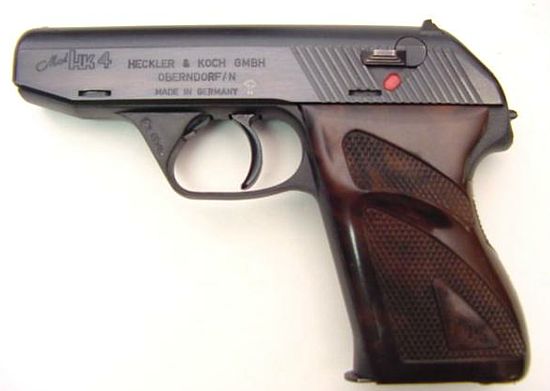
HK-4 pistol, left side.

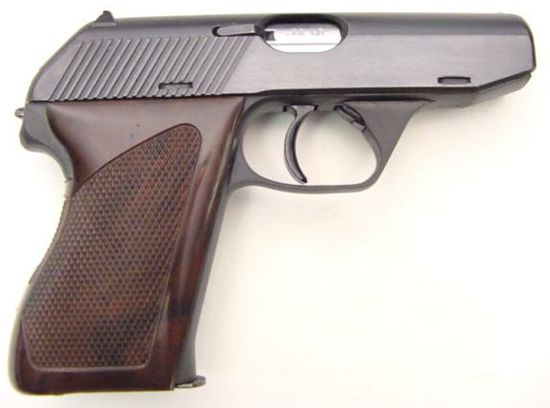
Same pistol, right side.

Same pistol, right side.

Characteristics

Type: Double Action
Calibers: 5.6mm rimfire/.22LR; 6.35x16SR/.25ACP; 7.65x17SR/.32ACP; 9x17/.380ACP interchangeable
Weight unloaded: 520 g
Length: 157 mm
Barrel length: 85 mm
Capacity: 7 rounds in 9mm/380 and 8 rounds all other calibers

The HK-4 was the first pistol to emerge from the now famous German company Heckler & Koch. HK-4 was the brain child of the Alex Seidel, one of co-founders and master minds of Heckler-Koch, and a former Mauser employee. During his years at Mauser Seidel participated in development of several pistols, including the famous Mauser HSc. In 1952 Seidel at HK developed a prototype .22LR caliber pistol, based on Mauser HSc, but the legal problems with Mauser precluded its production. In 1964, Seidel started the development of the multi-caliber pocket-size pistol of civilian and police use. This pistol, designated as HK-4 (Heckler-Koch, four calibers), had some features, based on Mauser HSc, but in severely modified form. Mass production of the new pistol started in 1968, and continued until 1984, with about thirty eight thousands pistols being made. Of those, about 12 thousands HK-4 pistol were bought by German police and other government agencies, the rest has been sold on domestic and foreign civilian markets.  
HK-4 pistol was one of the first handguns to employ idea of modularity. Each pistol can be accommodated for one of the four basic calibers, with just replacement of the barrel, return spring, and the magazine. Many HK-4 pistols were sold with caliber change kits, which included three additional barrels with springs and appropriate magazines. The frame of HK-4 pistols were made from aluminum alloy, slides were formed from sheet steel. Double action trigger and, especially, the partially exposed hammer were somewhat similar in design to Mauser HSc pistol. Manual safety has been located at the left side of the slide, and, when engaged, moved the rear part of the firing pin out of the reach of the hammer and locked the firing pin against the movement toward the cartridge in the chamber. Additional automatic safeties included magazine safety, which blocked the trigger when magazine has not been properly inserted, and a disconnector safety. Return spring was located around the stationary barrel. Barrel was easily detachable from the frame, and the barrel lock lever has been located inside the trigger guard, at its front. To accommodate either centerfire or rimfire ammunition, HK-4 featured a removable breech plate with two channels for firing pin - one for centerfire ammunition and another for rimfire ammunition. To convert between those types of ammunition, one must disassemble the pistol, remove the breech plate from the slide and set it so the side marked with "R" will face the barrel breech for rimfire ammunition, or the side marked with "Z" must face the barrel breech for centerfire ammunition. HK-4 has internal slide stop mechanism, which locks the slide open after last shot from magazine has been fired. The slide stop is automatically disengaged when a new magazine is inserted. To close the slide on the empty chamber, slide stop is disengaged by the trigger pull.

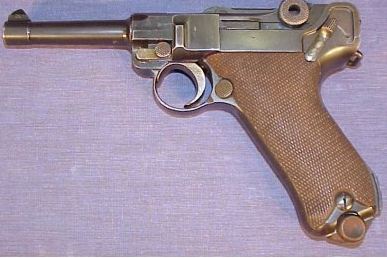
Luger 'Parabellum'

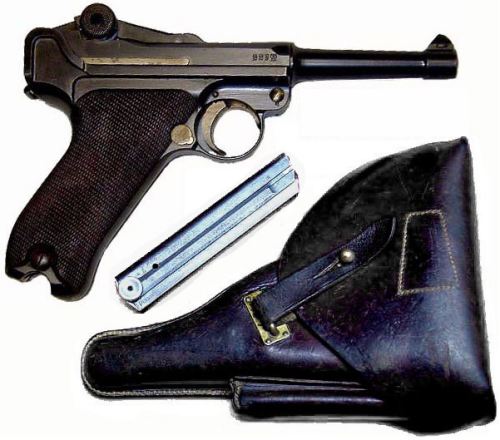
P-08 - standart sidearm of German Military during WW I and WW II.

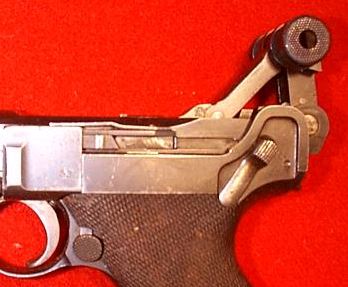
A view to proprietary Lugers' locking mechanism - the breechblock is at the rearmost position.

Commercial Parabellum in 7.65mm Luger/Para.

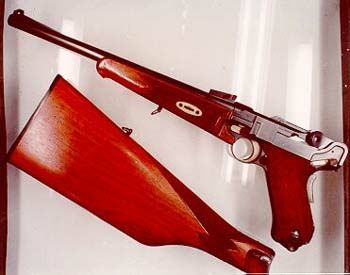
Commercial Parabellum carbine in 7.65mm Luger/Para with additional grip safety.

Characteristics

Type: Single Action
Chamber: 7.65mm Luger/Para, 9x19mm Luger/Para
Weight unloaded: 
Length: 230 mm (with 102 mm barrel)
Barrel length: 98 mm, 102 mm, 152 mm, 203 mm and others
Capacity: 8 rounds

The Parabellum pistole was developed by Georg Luger in Germany, ca. in 1898. The Parabellum name comes from ancient Latin saying Si vis Pacem, Para bellum - if you want Peace, prepare for War. The Lugers' design is based on earlier Hugo Borchard idea, but Luger re-designed the Borchards' locking system into much smaller package. Most pre-WW II Parabellums were developed by DWM company in Germany, with some being manufactured under license in other countries. During WW II, many companies, such as Mauser werke and others, also produced Lugers.
The first country to adopt Lugers was Switzerland - they adopted the model 1900 Lugers, chambered in 7.65mm Luger/Para[bellum] round. In 1902 the DWM, along with Luger, by request of German Navy developed new round, 9x19mm Luger/Para[bellum], one of the most common pistol cartridges of the world, by re-necking the case of the 7.65mm Luger round. The Luger model 1904, in 9mm, was adopted by German Navy, following the German army (Reichswehr) in 1908. Since then, the Lugers were adopted by many countries and servred untill probably the 1950's or so.
All Parabellums are recoil-operated, locked breech, semi-automatic, striker fired handguns. All Lugers featured unique locking system, consisting of two tilting-up bars and short moving barrel. Some early Lugers featured automatic grip safety at the rear side of the grip. All lugers also featured frame-mounted manual safety at the left side of the gun. Lugers were manufactured with different barrel lenghts - standart german army Pistole 08 (Luger M1908) had 102 mm barrels; Navy models featured 152 mm (6 in) barrels, and Artillery models featured 203 mm (8 in) barrels. Commercial models were manufactured with barrels ranging from 98 mm up to 350 mm (14 in), some in 'carbine' versions, with additional forward handguard and detachable buttstock.
All lugers were very erconomical and accurate pistols, especially for the period those were developed in. However, all Lugers were too sensitive to fouling and for loose manufacturing tolerances, as well as too pricey, when compared to more modern designs, such as Browning High Popwer or Walther P38.

Mauser M2 (USA)

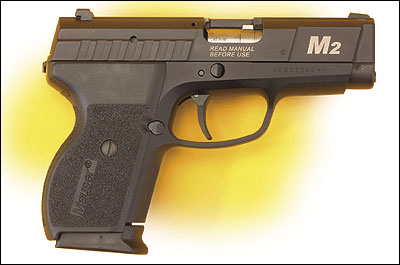
Mauser M2.
Mauser M2.

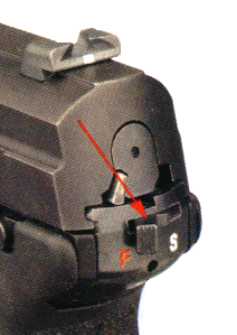
Mauser M2 safety, located at the back side of the frame.

Characteristics

Type: Double Action Only
Chamber: .45ACP, .40SW or .357SIG
Weight unloaded: ca. 900 gramm
Length: 174 mm
Barrel length: 90 mm
Capacity: 8 rounds (.45), 10 rounds (.40 and .357)

I was somewhat curious on to what country this firearm should relate to? As everybody knows, Mauser is german name and german firearms company. Howewer, this particular gun was developed and manufactured in USA by international company SIGARMS, which purchased the right to use Mauser name for handguns from its original owner, Mauser werke in Germany. So, let it be American Mauser :)
The Mauser M2 is a recoil operated, locked breech semi-automatic firearm. It uses short barrel recoil with rotating barrel locking. The handgun has DAO trigger with striker firing (no hammer). Mauser M2 features numerous safeties: automatic firing pin safety, trigger bar disconnector, loaded chamber indicator. Moreower, the manual safety is available as option. The manual safety is located in unusual place - at the rear side of the frame, under the place where the hammer usually may be found. Also, M2 features aluminium alloy frame with steel slide and replaceable slide rails.
M2 is reported as a comfortable, compact sidearm. The only minor drawback of M2 is its rotating barrel sheme, that requires good lubrication of the rotating barrel to operate properly.

 
Design by Free WordPress Themes | Bloggerized by Lasantha - Premium Blogger Themes | Online Project management