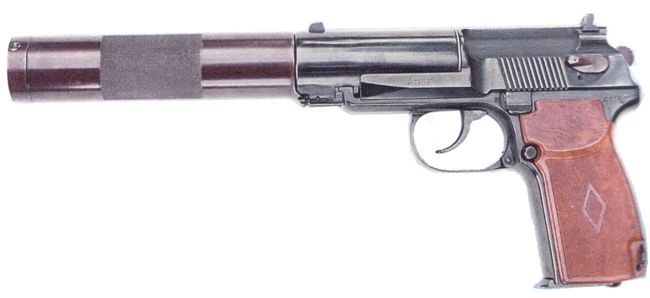
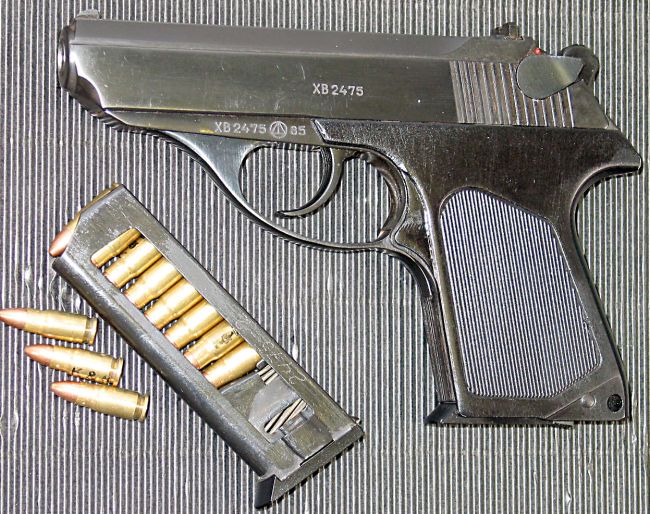
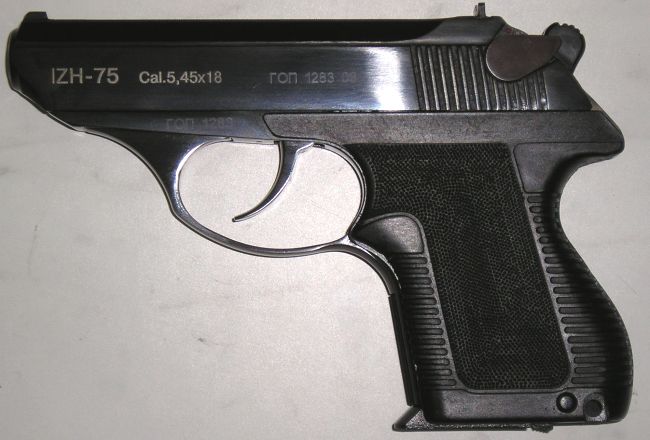
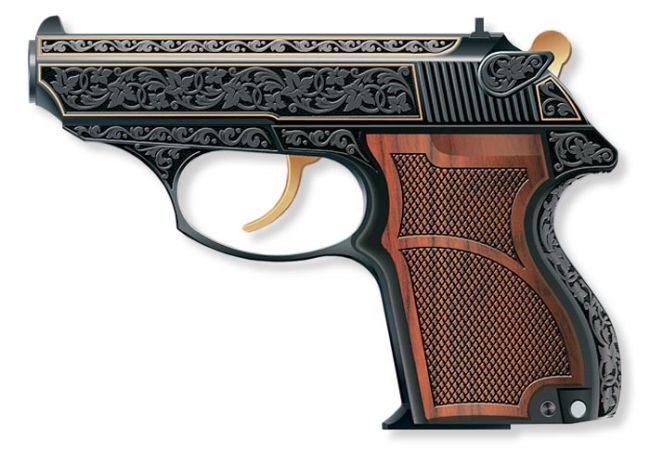
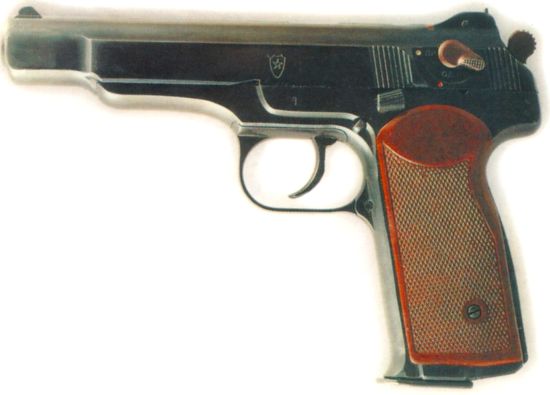
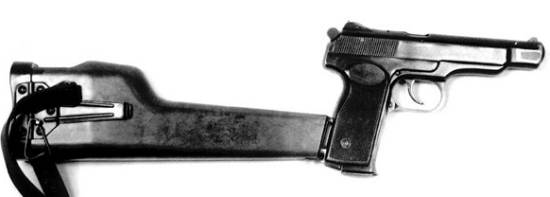
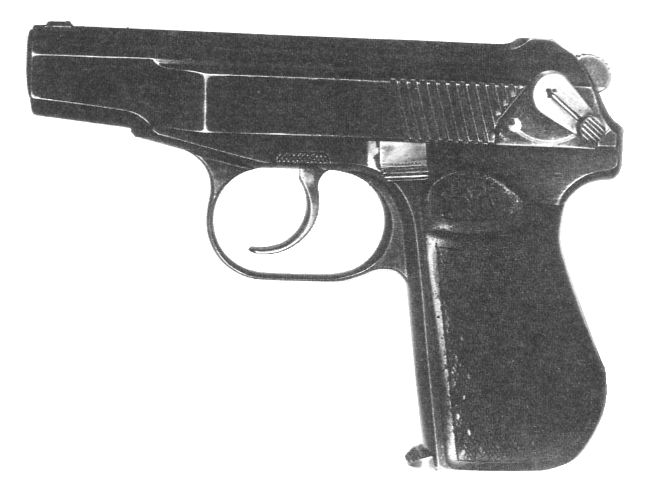
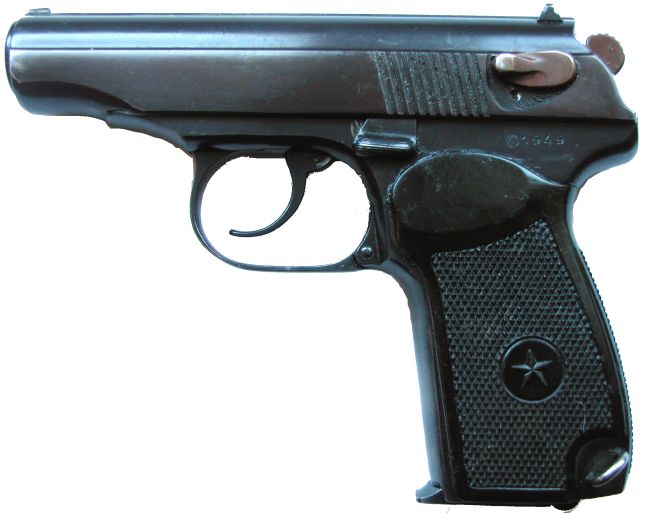
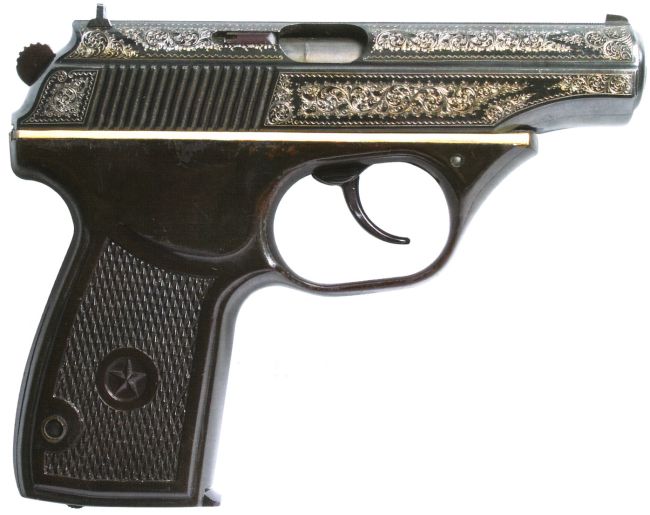
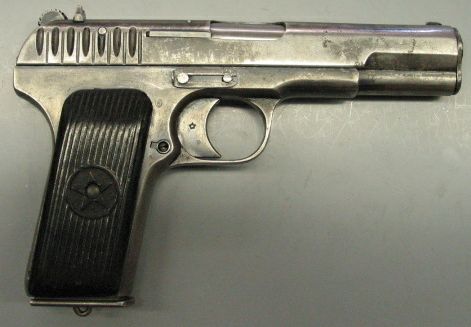
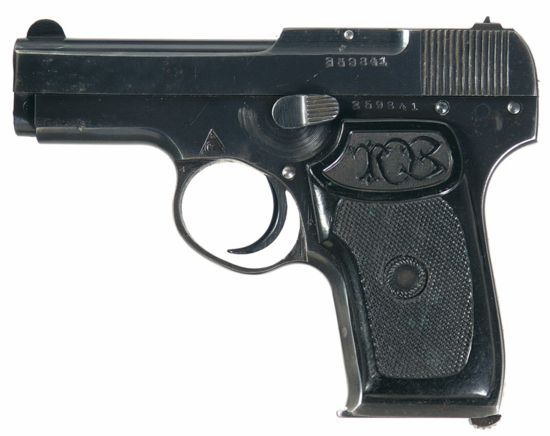
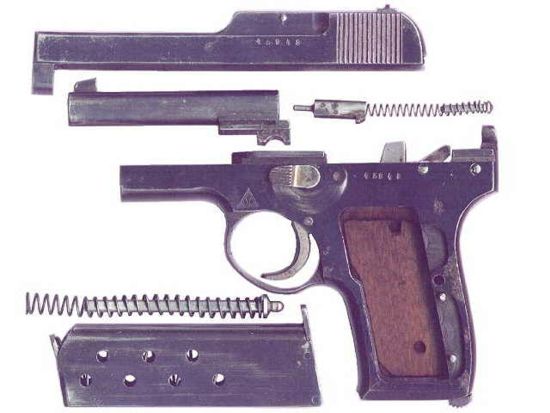
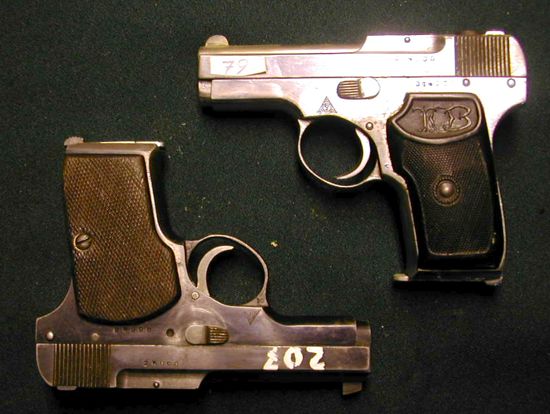
prototype Makarov pistol, circa 1947
Makarov PM pistol, first year production (1949)
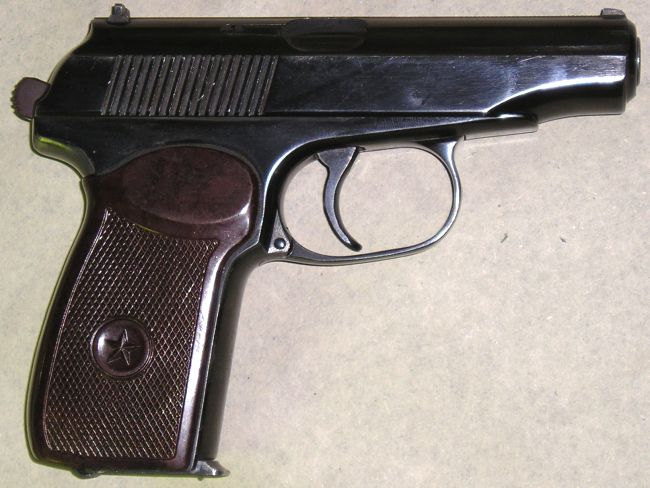
Makarov PM pistol, standard military issue sidearm of Soviet army. 1971 production gun, left side
Makarov PM pistol, 1971 production gun, left side
Makarov PM pistol, heavily engraved presentation 'Russian government' version, current manufacture
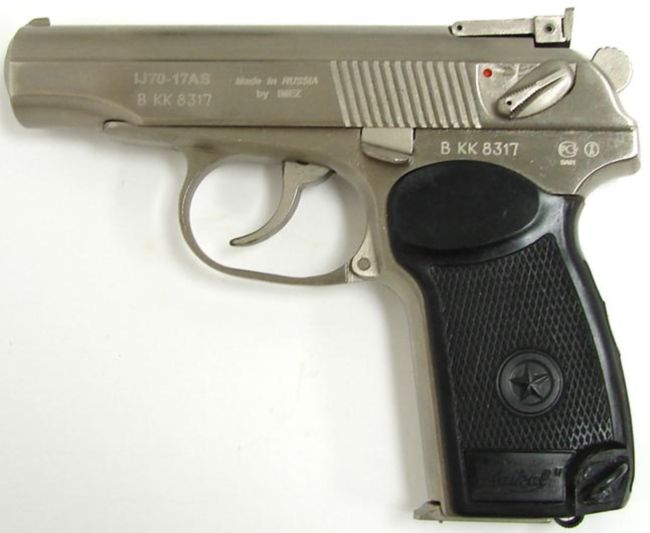
IJ70-17AS pistol, a commercial export-only version of Makarov PM
pistol, caliber 9x17 (.380ACP); note adjustable rear sight necessary to
pass US qualification for import.
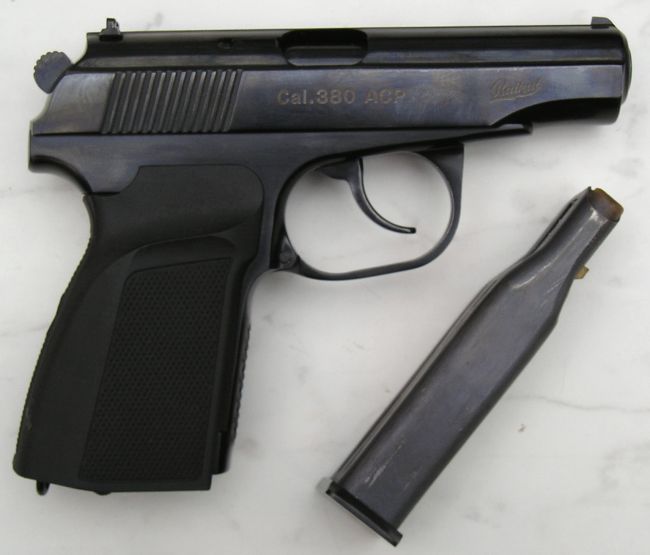
IJ71H pistol, a commercial export-only version of Makarov PMM pistol with 12-round magazine, caliber 9x17 (.380ACP)
Makarov / Shigapov PMM pistol with 12-round magazine capacity and improved grip panels
Experimantal TKB-023 pistol with polymer frame, a prototype based on Makarov PM pistol (circa 1965)
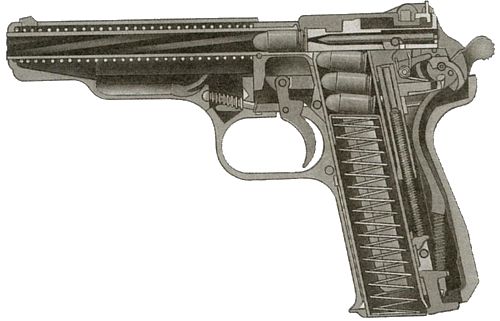
Pistolet Makarova (PM) cut out drawing
Caliber 9x18mm PM; 9x18mm improved (PMM)
Type: Double action
Overall length 161mm (165mm PMM)
Weight unloaded 730g (760g PMM)
Barrel length 93,5 mm
Magazine capacity 8 rounds (12 rounds PMM)
The Red Army fought the Great Patriotic War of 1941-45 with both the semi-automatic Tokarev TT pistols and the obsolete Nagant M1895
revolvers. Despite the fact that more potent pistols were designed just
before and during the war, the TT remained the mainstream weapon.
Wartime experience, which included a close (and sometimes very personal)
familiarity with German pistols, resulted in a major change of thinking
about the role and necessary features of a military pistol for the
Soviet army. Another factor that played a major role in the development
of new requirements for the next military pistol, was the realistic
prospect of a Third World War, with massive nuclear bombing and other
such large-scale actions; as a result, pistols played a very minor role
in both strategic and tactical doctrines of the Soviet Army.
Furthermore, Tokarev pistols, despite being relatively simple and
powerful, showed significant deficiencies, some of them quite serious,
such as the lack of positive safety, so almost immediately after the war
the GAU (Glavnoye Artillerijskoe Upravlenie – General Artillery
Department of General Staff) issued a new set of requirements for a
military and police pistol.
These requirements asked for a compact, double action pistol of the “Walther PP
type”. New pistols were to be submitted in three calibres – 7.65x17SR
Browning (proposed police round), 9x17 Browning, and a new 9x18. The
last of these had been initially developed just prior to the war and
refined after the war by the designer Syomin. Apparently, this round was
inspired by the German 9x18 Ultra, which was designed in the mid-1930s
to provide “acceptable maximum power” in simple, pocket-sized blowback
pistols. The key reason for the increase in calibre when compared with
the West 9mm rounds is unknown (the 9x18 Soviet has bullet diameter of
9.2mm, while most Western 9mm rounds have a bullet diameter of 9.02mm; Note that use of 9x18 Ultra / Police ammunition in any Makarov pistol is unsafe!).
Also, while the Soviet Army was ahead of many others in the request for
a double action pistol, it regressed somewhat in adopting an only
marginally powerful round in a weapon that in essence was a pocket-type
pistol. At the same period of time, many other armies, looking for an
increase in power, starting to change their “weak” 7.65x17 Browning,
9x17 Browning or 7.65x20 Longue pistols to the more potent 9x19
Luger/Parabellum/NATO weapons. The explanation for this fact, however,
is rather simple – while most Western countries relied on full-power
rifles (bolt action or semi-automatic) and a sub-machine guns as a
primary individual armament for the infantry, the new Soviet concept had
no place for sub-machine guns, as the only primary arm of the infantry
was the newly developed assault rifle. Most Western pistols were
required to fire 9mm NATO ammunition just to have commonality in
ammunition with the standard issue sub-machine guns; Soviet designers
had no such requirements, and by the late forties 9x18 looked as if it
was good enough for a military pistol.
Trials for a new pistol started in 1947. Many designs were submitted
and tested, such as pistols by Baryshev, Rakov, Voevodin, Simonov, and
Makarov. Some designs were submitted in only one of the desired
calibres, some, such as the Makarov design, in two, and a few in all
three. In 1948, the trials resulted in a selection of the Makarov pistol
in 9x18 as a next military sidearm for Soviet armed forces. However, it
took three more years to refine its design, before it was officially
adopted in 1951 as the “9mm Pistolet Makarova” or PM in short.
The following decades saw the gradual evolution of Makarov pistols, in
continuing attempts to produce new pistols with fewer rejects and at
lower cost. Most efforts concentrated on production technologies, and by
the eighties many parts which were initially made with machining and
hand-fitting, became precision-castings that required minimal, if any,
fitting. The early sixties also saw attempts to make PM pistols lighter
by the introduction of an aluminium/titanium alloy or polymer frames.
The lightweight alloy frames turned to be excessively expensive, but
polymer-framed pistol, developed in Tula as TKB-023, has passed most of
the trials with flying colors. Despite that fact, it was rejected by the
military on the grounds of unknown stability of the polymer frame
during the long-term (10-20 years) storage and use.
During the last decades of 20th century there were numerous attempts o
improve some of deficiencies of PM, most specifically its relatively low
stopping power and lethality, and low magazine capacity. First, an
improved version of the cartridge, with lighter bullet and hotter powder
charge, was developed as 9x18 PMM. This cartridge developed muzzle
velocity of 430 meters per second as compared to 315 meters per second
of original 9x18mm ammo. Large capacity version of the PM was developed
along with the new ammo, which included a slight grip frame redesign to
accommodate thicker magazine. Grip panels also were improved. The PMM
was offered for both military and law enforcement buyers, and eventually
at least few were ordered by Russian police forces, although in
standard 9x18 chambering. The 9x18 PMM ammunition was not issued on any
significant scale due to the danger of loading the new ammunition into
the old guns, which may result in damage to the old and worn-out guns.
Instead, Russian Army finally went for a new, more promising pistol,
developed at the same state-owned Izhevsk Mechanical Plant, the Yarygin PYa.
The Makarov PM is a simple and sound design, which is considered to be
one of the best compact self-defense pistols of its time. While not
extremely accurate and lethal at ranges beyond 15-20 meters, it is still
a formidable and reliable self-defense weapon.
Several versions of the PM were developed for export market and
domestic security use, including IZh-70 and IZh-71 pistols in 9x17mm
Browning Short (.380ACP), available in both standard and high capacity
variations, as well as Baikal-442, a commercial PM in 9x18mm, also
available in standard and high capacity versions, with fixed or
adjustable sights.
The Makarov PM is a blowback operated, double action pistol of
all-steel construction. Manual safety is located on the left side of the
slide, and, when engaged, safely brings hammer down from cocked
position, and then locks the hammer, sear and slide. External hammer can
be cocked manually for the accurate first shot in Single action mode,
or can be cocked automatically by the longer and heavier trigger pull in
Double action mode. All-steel magazine holds 8 rounds (12 rounds for
PMM pistols), and when last shot is fired, slide remains in the open
position, thanks to the slide stop. To disengage slide stop, one must
pull the lever on the left side of the frame down. Magazine catch is
located at the bottom of the grip, but some export versions of
Baikal-442 are available with button magazine release at the base of the
triggerguard. PM is fitted with fixed open sights as a standard, with
click-adjustable open sights available as an option on export models.
How to disassemble / field-strip Makarov PM pistol:
1) remove the magazine by pressing the magazine release at the base of
the grip and pulling the magazine out; 2) check that the chamber is
empty; 3) pull the trigger-guard downwards, then swing it to one side to
lock in the open position; 4) pull the slide all the way back, then
raise the rear of the slide to the top, and off the frame rails; 5)
carefully ease the slide forward and off the barrel; 6) remove the
return spring from the barrel.
Reassemble in reverse order.


 13.43
13.43
 Jack The Ripper