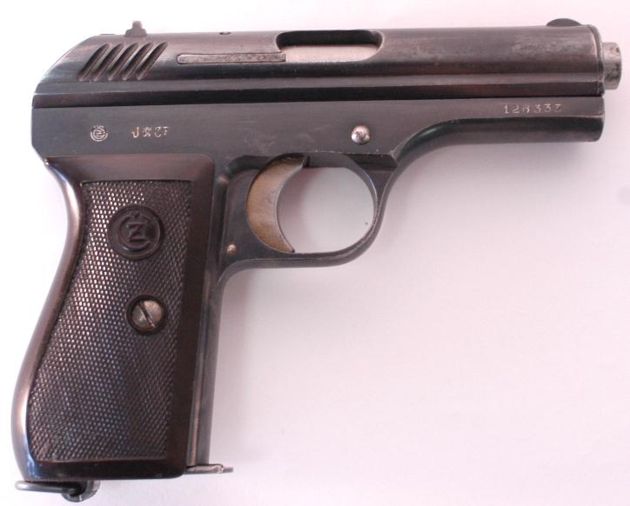
Jumat, 05 April 2013

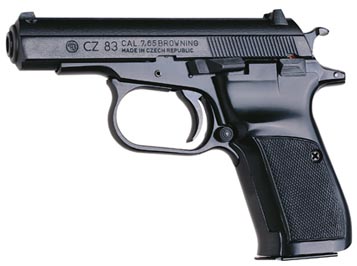
Vz.82 / CZ-83


CZ 83 - commercial version of the CZ 82 in 7.65x17mm (.32 ACP)
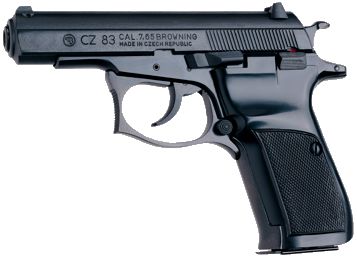
 
Another variation of CZ-83, with reshaped trigger guard
 
Cz-83 diagram
Cz-83 diagram

Type: Double Action
Caliber 9x18 mm Makarov, 9x17 mm (.380ACP), 7.65x17 mm (.32ACP)
Overall length 172 mm
Weight 920 g loaded
Barrel length 96 mm
Magazine capacity 12 rounds (9mm), 15 rounds (7.65mm)

The Vz.82 pistol is a standard sidearm of the Czech army since 1982. Vz.82 was manufactured from 1983 to 1992, when it was merged with similar commercial design CZ-83 (originally offered in 7.65 Browning and 9mm Browning Short). Since 1992 and until now, only CZ-83 is manufactured in all three chamberings, to save the costs. Vz.82 was developed to replace the obsolete 7.62mm Vz.52 pistols then in service with Czechoslovak army. During early 1980s Czechoslovak army, under pressure from USSR, replaced the older 7.62x25mm ammunition with Soviet 9x18mm Makarov ammunition, which also required a new pistol. Instead of simply taking the Soviet design (Makarov PM) along with its cartridge, Czechs developed their own pistol, which, in some respects, is superior to the "gun of the big brother" (Makarov PM). They also produced their own 9x18 ammunition as "pistolovy naboj Vz.82", which they claimed to be 20% more powerful than standard Soviet 9x18 PM ammunition. The Vz.82 pistol, developed at the CZ factory in Uhersky Brod, has greater magazine capacity (12 rounds vs. 8), better fit and finish, and much better ergonomics. On the other hands, Vz.82 is more complicated and, thus, is more expensive to make. Still, it is an excellent and reliable pistol, one of the best defensive pistols on the market today. It is somewhat heavy by modern standards, but the all-steel construction makes it almost indestructible, and additional weigh helps to control pistol in rapid fire.
Seeing the commercial potential of this pistol, Czechs brought it to the international market under the designation of CZ-83. It is now available in its original chambering, 9x18mm Makarov, as well as in 9x17mm Browning Short (.380ACP) and 7.65x17mm Browning (.32ACP).
The CZ-83 is a blowback-operated pistol with fixed barrel. Return spring is located around the barrel. Double action trigger with exposed hammer has a very smooth pull in both SA and DA modes. Ambidextrous frame-mounted safety locks the slide and sear when engaged, allowing for "cocked and locked" carry. Frame and slide are made of high grade steel. Magazine capacity is 12 rounds, sights are of fixed type and dovetailed into the slide.

CZ-52 / vz.52

Cz-52 pistol
Cz-52 pistol

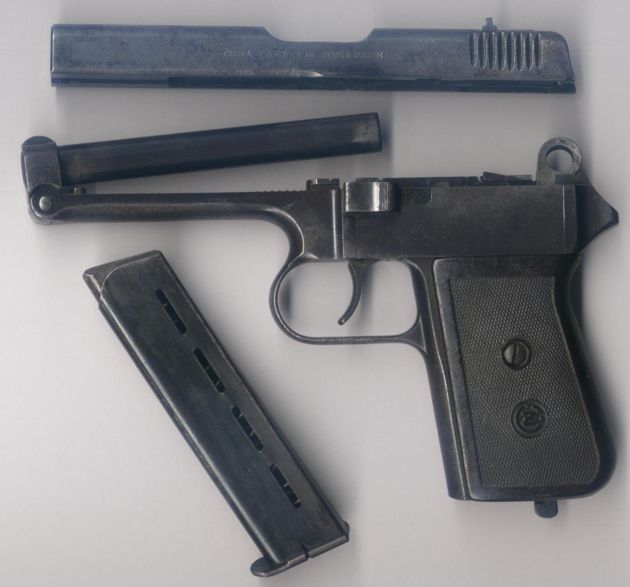
CZ-52 pistol, partially disassembled. Note locking rollers visible at the sides of the barrel.

Type: Single Action
Chamber: 7.62x25mm TT
Weight: 950 g
Length: 209mm
Barrel length: 120 mm
Capacity: 8 rounds

CZ-52 pistol (known in Czechoslovak service as 7,62mm Pistol vzor 52, or Vz.52 in short) was born from Czechoslovak army trials for a new military pistol, conducted between 1947 and 1951. Early trials requested pistol to be made in 9x19mm Luger / Parabellum. The basic design of the CZ-52 is attributed to Jan Kratochvil, who worked at CZ-Strakonice arms factory. This was a double-action, locked-breech pistol with an unusual roller-locking system, borrowed from the German MG-42 machine gun. Under pressure from the USSR Czechoslovakia standardized the 7.65x25 round of Soviet origin as its pistol and sub-machine gun ammunition, and the new pistol was redesigned for the “new” cartridge by Jiri Cermák, who worked at CZ-Uhersky Brod (CZ-UB) arms factory. During the redesign this pistol also lost its double-action capability (but retained decocking feature of its safety).
Introduced into Czechoslovak army service in 1952, this pistol was declared obsolete in 1982 with adoption of the 9mm vz.82 pistol, and most retired pistols were sold as surplus after 1987. The Vz.52 was not a popular weapon among its users, but mostly because of over-powered standard issue ammunition intended for sub-machine guns and loaded to higher pressures. With the standard, “pistol grade” 7.62x25 or 9mm ammunition it more manageable and may show good accuracy and an adequate life cycle.
The Vz.52 pistol is a short-recoil operated, locked-breech pistol of somewhat unusual construction. The barrel recoils linearly, without any tilting, which increases the accuracy potential (at least, in theory). Two rollers, located below the breech part of the barrel, are used to interlock the slide and barrel in the early stages of recoil. The rollers allowed to move laterally toward the axis of the gun, and this movement is controlled by cam-shaped cuts in the frame. When the barrel and slide are in battery, the rollers are extended from the barrel sideways and engaged in the respective cuts in the slide. Upon recoil, the rollers are withdrawn from the slide cuts following the cam-shaped tracks in the frame, thus unlocking the side from the barrel and allowing it to resume the reloading cycle. Another unusual feature is that return spring is located around the barrel, and its rear end is resting against special part, which is integral to the barrel unit but does not move upon recoil, being locked to the frame. The trigger is of the single action type, with an external hammer and a frame mounted, decocking safety. Yet another unusual feature (at least for a full-size service gun) is that while it has a slide stop, which holds the slide open when the last cartridge has been fired, the slide stop does not have a manual release lever. The only sure way to release the slide from being held open is to remove the empty magazine, pull the slide all the way back, then release it and let it slam home. One could try to push the slide stop lever (located above the trigger guard at the left side of the frame) with a finger, but this may or may not work, especially with wet or oiled hands. The grip panels are made from bakelite or plastic and held in place by a U-shaped spring clip. The sights are fixed, with the rear being dovetailed to the slide. Magazines are of single stack type, and the magazine release is located at the heel of the grip.
Manual safety: Lever at left side of the frame, behind grip panel. To set on safe: push the lever up; to disengage safety: pull the lever down; a red dot will appear on the frame. The safety blocks the action regardless of the hammer position, cocked or not. To decock the hammer: push the safety lever up from "safe" position, and hammer will fall. NOTE: do it with an empty chamber to avoid accidental discharges if parts in the safety mechanism are worn.
How to field-strip (disassemble) Cz-52 pistol 1) remove the magazine by pressing the magazine release button; 2) check that the chamber is empty; 3) push the safety lever up to decock the hammer; 4) pull down the serrated take-down knobs (located at the top of the frame, above the front parts of trigger-guard); 5) holding the knobs down, push the slide slightly forward and remove up and out of the frame; 6) while holding the slide upside down, use the front tip of magazine bottom plate (or a flat screwdriver) to move the roller cam (located below the barrel breech) forward, so the rollers will be retracted from the slide; 7) tilt the rear part of the barrel slightly up and pull it out of the slide; 8) remove the return spring from the barrel.
Reassemble in reverse order.

Cz-50 / vz.50 and Cz-70 / vz.70

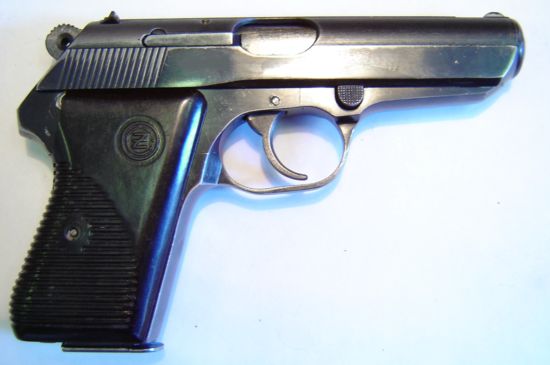
Pistol Vzor 50, also known as vz.50 or Cz-50

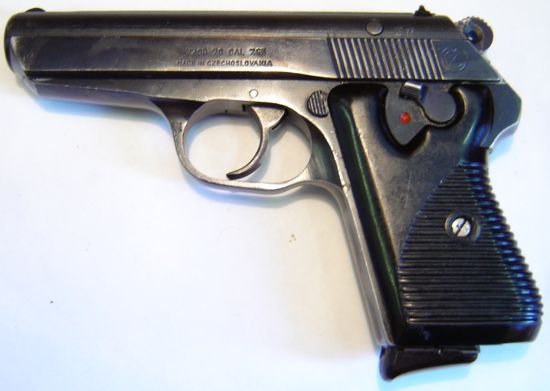
Another view on Vz.50 / cz-50 pistol

Vzor 70 (Vz.70) pistol, also known as Cz-70


Type Double Action semiautomatic
Caliber(s) 7.65x17mmSR (.32ACP)
Weight unloaded 710 g
Length 167 mm
Barrel length 96 mm
Magazine capacity 8 rounds

The small, pocket-sized Vz.50 was developed during late 1940s for police use and it was chambered for the marginally powerful 7.65x17 Browning ammunition. Apparently influenced by the Walther PP in design, the Vz.50 had several differences in safety and disassembly. In the early 1970s the basic design went through minor face-lift, and the “new” design received the designation of Vz.70. Many Vz.50 pistols were refurbished to Vz.70 standard, with different finish, grip panels and a slightly different safety lever. New Vz.70 pistols were also manufactured between 1970 and 1983. After the replacement in service of the older Vz.50 and Vz.70 by more modern 9mm Vz.82 pistol, most were sold as surplus, as Cz-50 and Cz-70, respectively.
The Vz.50 (commercially sold as Cz-50) is a compact pistol of all-steel construction, firing the relatively weak 7.65mm ammunition. It has a simple blowback action with a fixed barrel. The trigger is double-action, with an exposed hammer and a frame-mounted decocking safety lever. The sights are fixed. Magazines are single stack. The magazine release button is located relatively high on the left side of the frame, behind the trigger. Vz.70 (Cz-70) pistols are similar, with minor differences in the finish, shape of the safety lever and grips. Manual safety is a lever at left side of the frame, behind the trigger guard. To set on safe: pull the lever down; if the hammer was cocked, it will be automatically brought down to rest. To disengage safety: push the lever up; a red dot will appear on the frame.
How to field-strip (disassemble) Cz-50 and Cz-70 pistol: 1) remove the magazine by pressing the magazine release button; 2) check that the chamber is empty; 3) push the disassembly button, located at the right side of the frame, above the front of the trigger-guard; 4) while holding the disassembly button, retract the slide all the way back, raise the rear part of the slide off the rails, then slowly release it forward and off the barrel; 5) remove the return spring from the barrel
Reassemble in reverse order

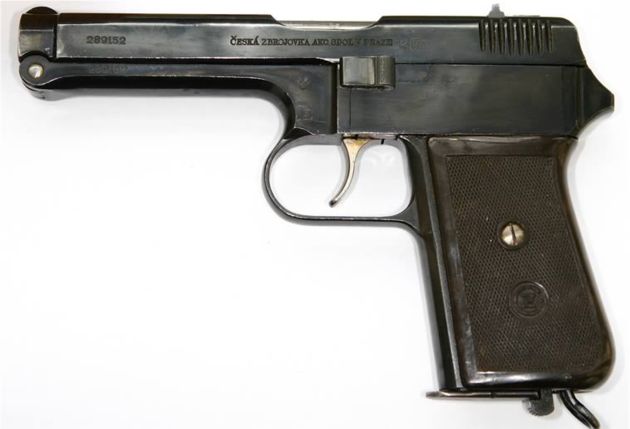
CZ Vz.38

CZ Vz.38 pistol, left side

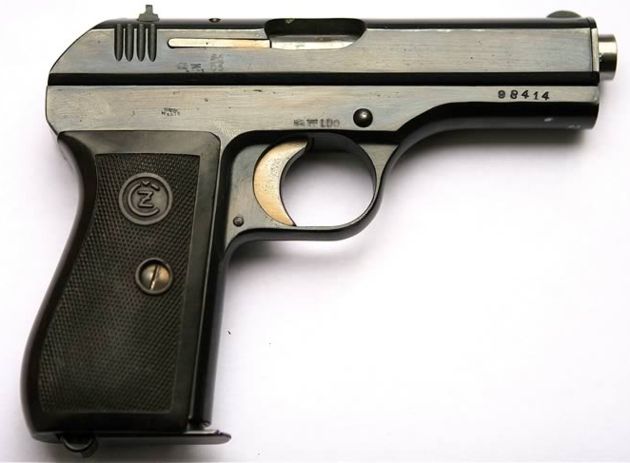
CZ Vz.38 pistol, right side

CZ Vz.38 pistol, partially disassembled


Type Double Action Only semiautomatic
Caliber(s)  9x17 Browning Short
Weight unloaded 980 g
Length 190 mm
Barrel length 118 mm
Magazine capacity 9 rounds

The CZ Vz.38 pistol, also sometimes referred to simply as CZ-38, was developed in 1937 in an attempt to fullfil requirements, issued by Czechoslovak army, for a sidearm which would be more safe and simple  to handle than previously used CZ Vz.24. New gun was designed by Frantisek Myska, and submitted to military trials early in 1938. After trials, which were consdered sucessful, Czechoslovak army ordered significant numbers of these pistols, but Germans took over the Czechoslovakia before any guns could be delivered. A few guns were delivered to Bulgaria in 1939, but  the rest of the production (about 10 000 guns) was consumed by German police and security forces. Production of this gun has ceased by the end of WW2, and was never resumed later. This is not surprising, as the gun was overly big and heavy for the cartridge it used (9mm Browning Short, also known as 9mm Kurz or .380 ACP). Also, the double action only trigger was too heavy, severely impairing accuracy of fire.
The CZ Vz.38 pistol is a simple blowback operated weapon. It is unusual as its barrel at the muzzle is mounted in the special bushing, which in turn is hinged to the frame. Upon the disassembly, operator pulls back the dismounting slide, located on the left side of the frame, then pulls the rear of the slide up. This causes the barrel and slide to rotate up around the axis, located below the muzzle, and also disengages the slide from return spring, which is located in the frame below the barrel. Once the rear part of the slide is clear off the frame, slide can be bulled back and slid off the barrel. This allows for easy diassembly, cleaning and examination of the barrel bore. The trigger is of double action only type, with external hammer. No manual safeties are provided by default (export Bulgarian version had additional manual safety on the left side of the frame). Magazine is of single stack type, magazine release catch is located at the base of the grip.

CZ 27 / P.27(t) pistol

CZ 27 pistol made under German occupation, bearing typical German designations

CZ 27 / P.27(t) pistol (Czhechoslovakia)
 

Type Single Action semiautomatic
Caliber(s)  7.65x17 SR Browning
Weight unloaded 655 g
Length 158 mm
Barrel length 91 mm
Magazine capacity 8 or 9 rounds

The CZ-27 pistol was developed in around 1926 by Czech arms designer Frantisek Myska in an attempt to produce simplified version of the CZ Vz.24 pistol, chambered for less powerful 7.65x17 SR Browning ammunition (also known as .32 ACP) and suited for police and security use. It was put into production in 1927, at arms factory in Praha. Until the appearance of the famous CZ-75 pistol, the CZ-27 was one of the most sucessfult handguns produced in Czechoslovakia, with well over 500 000 guns of this type produced between 1927 and 1951. During the German occupation of Czechoslovakia it was manufactured for German armed forces and police as Pistole modell 27, or P.27(t) in short. It was extensively used by Czechoslovak police and security forces, and widely exported to many parts of the world.
The CZ-27 pistol is a simple blowback weapon. The barrel remains stationary when gun is fired, but can be easily detached from the frame during disassembly. To unlock the barrel, one has to pull the slide back and then rotate the barrel until it is free to move forward. The return spring is located below the barrel, around its own full-length guide rod. The firing mechanism utilizes an exposed hammer and a single action trigger. Manual safety is located on the left side of the grip frame, behind the trigger. To engage the safety (turn it On, set gun on safe) operator has to push the lever down until it locks there, blocking the trigger and the sear linkage. To disengage the safety (turn it Off, make gun ready to fire) operator has to push the small button, which is located just below the lever.Feed is from detachable box magazines, holding 8 or 9 (depending on the period of manufacture) rounds of ammunition in a single stack.

CZ Vz.22 and Vz.24 Nickl self-loading

CZ Vz.22 system Nickl self-loading pistol

CZ Vz.24 self-loading pistol

CZ Vz.24 self-loading pistol

CZ Vz.24 self-loading pistol


  CZ vz.22 CZ vz.24
Type Single Action semiautomatic Single Action semiautomatic
Caliber(s) 9x17 Browning Short  9x17 Browning Short
Weight unloaded 640 g 680 g
Length 155 mm 160 mm
Barrel length 87 mm 90 mm
Magazine capacity 8 rounds 8 rounds

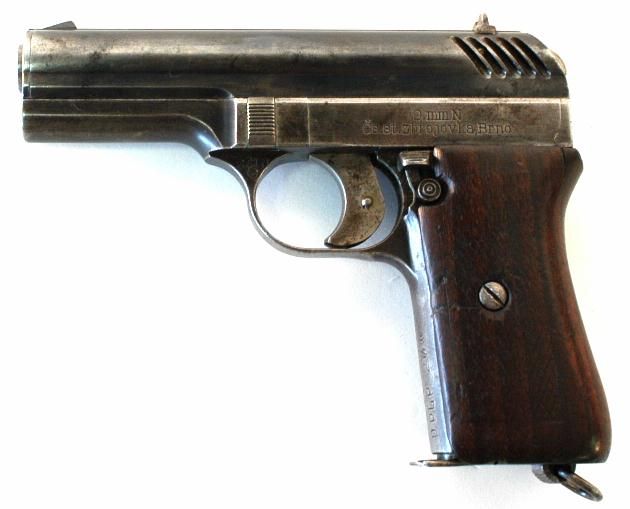
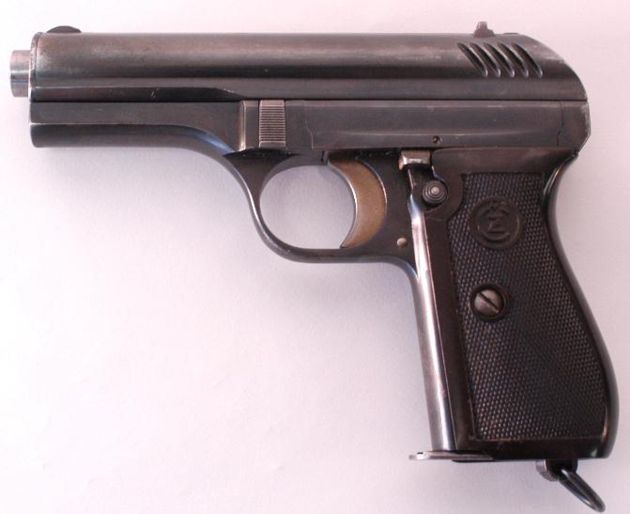
The Armádni pistole Vz.22, or Army pistol model 22 was produced in Czechoslovakia between 1922 and 1924, based on patents and experimental 9mm pistols developed in Germany by arms designer Nickl. His early guns were developed at famous Mauser factory, but in early 1920s Czechoslovakia bought his patents and Nickl scaled his gun slightly down from 9x19 Luger to 9x17 Browning Short (also known as 9mm Kurz or .380ACP) ammunition. After few years of production and use, the basic design was noticeably improved by Czech arms designer Frantisek Myska. In this improved form the new pistol was adopted by Czechoslovak army as Armádni pistole Vz.24, or Army pistol model 24. It was produced in significant numbers between 1925 and 1944. Deliveries were made to Czechoslovak government, to German government (during occupation of Czechoslovakia by Hitler's Germany), and also to a number of other European and South American countries.
It must be noted that both Vz.22 and Vz.24 pistols were too complicated and somehow insufficiently reliable, due to the fact that rotary barrel locking system, which was originally devised to fire 9x19 Luger ammunition, was not really necessary to fire noticeably less powerful 9x17 Browning Short ammunition, which at the time was standard for Czechoslovak army.
The Vz.22 and Vz.24 pistols both based on the same operating principles, using same short recoil operated, rotary barrel action locking. Barrel of the gun has two sets of lugs. Two lugs on its opposite sides are used to lock into the cuts made on the inner walls of the slide. The bottom lugs are used to rotate the barrel upon recoil (when following diagonal cut in the frame insert, attached to the return spring guide) and to limit the length of the recoil.  The firing mechanism utilizes an exposed hammer and a single action trigger. Manual safety is located on the left side of the grip frame, behind the trigger, and consists of a lever and a button. To engage the safety (turn it On, set gun on safe) operator has to push the lever down until it locks there, blocking the trigger and the sear linkage. To disengage the safety (turn it Off, make gun ready to fire) operator has to push the small button, which is located just below the lever. Feed is from detachable box magazines, holding 8 rounds of ammunition in a single stack.

 
Design by Free WordPress Themes | Bloggerized by Lasantha - Premium Blogger Themes | Online Project management