Tampilkan postingan dengan label Australia. Tampilkan semua postingan

Jumat, 21 Juni 2013

Metal Storm

Metal Storm multi-shot grenade launcher (Australia)
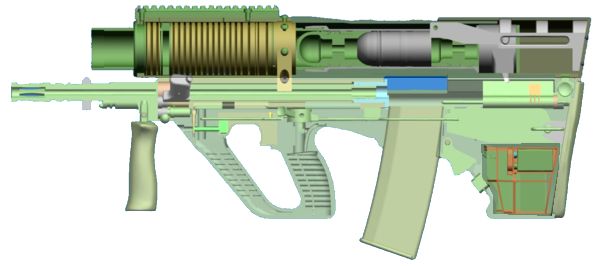
 Diagram of the Metal Storm 40mm 3-shot grenade launcher, mounted above the F88 (Steyr AUG) rifle. Note the electronic fire control module, loaced in the butt of the rifle.
 Diagram of the Metal Storm 40mm 3-shot grenade launcher, mounted above the F88 (Steyr AUG) rifle.
 Note the electronic fire control module, loaced in the butt of the rifle.

Caliber: 40mm (others possible)
Type: stacked-projectile, caseless multishot system
Overall length: n/a
Weight: n/a
Effective range: up to 400 m
Capacity: 3 shots (current 40mm model, single barrel)

The Metal Storm grenade launching system is a radical step from most conventional firearms. Using the ancient principle of an "Roman candle", Metal Storm weapon systems currently are promoted in a variety of calibers and applications. One of such applications is the 40mm, multi-shot grenade launcher, that could be either mounted on the infantry rifle to create an enchanced-capability infantry weapon like the Australian AICW system, or to be mounted on stationary or vehicle platforms in multi-barrel configurations.
Key advantage of Metal Storm system is its mechanic simplicity. In fact, the standard Metal Storm grenade launching unit is no more than a single rifled barrel, loaded with several projectiles, stacked one upon the another. There are no loading mechanisms, no feed units nor magazines or belts - each barrel is a magazine itself. Projectiles are fired using powder charges, located in the hollow hase of each projectile, and there's no case left to extract and eject after each shot;Powder is ignited by the electric ignition system, wired to the electrinic fire control module through small ports in the wall of the barrel. When user press the firing button or trigger, electronic fire control module sends the ignition impulse to the charge of the foremost projectile in the stack; when trigger is pressed for the second time, module ignites the second charge and then next, until barrel is empty. Once all the rounds in the barrel are shoot out, it can be removed from the host and then either collected and later sent to factory for reloading, or simply discarded.
Current 40mm grenade launching module, developed for the AICW rifle/GL system, contains three grenades stacked one in front of another in single barrel. Each barrel has an electronic interface which is connected to the fire control unit, built into the host platform. This is about the simplest systems, at least from the operator's point of view (from developer's point of view, there's plenty of complications and difficulties, most of which seems to be already overcome).However, there is one drawback when Metal Storm system is compared to existing mechanically or manually reloaded systems - latter systems still can be fired once batteries are dry; Metal Storm always require some sort of electric power to operate. This problem may seem critical, especially for military purposes, but, actually, it is not. For example, several Soviet/Russian anti-tank grenade launchers (like RPG-16 orRPG-29) are built using electric rocket ingnition; necessary electricity is provided by the magneto-impulse generators, powered by the pull of the trigger. Same idea also could be possibly applied to the Metal Storm system.

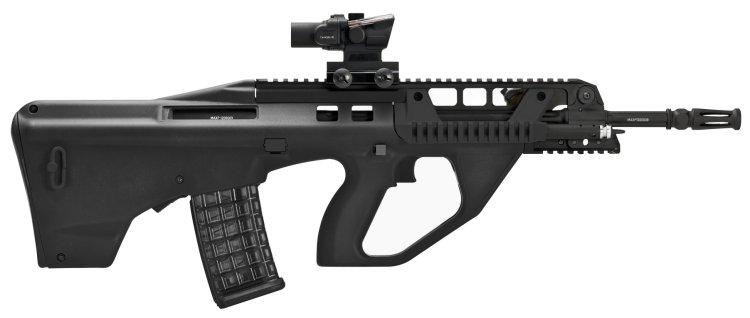
EF88 / F90

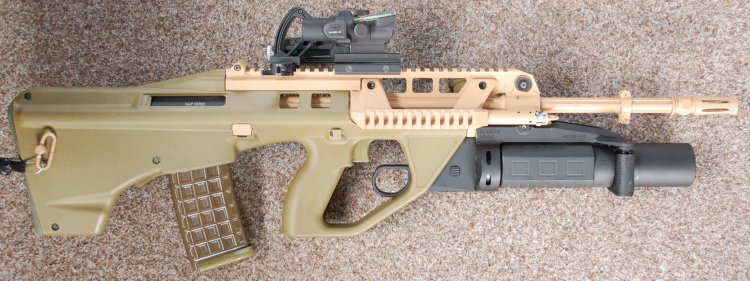
Thales EF88 / F90 assault rifle


Thales EF88 / F90 assault rifle with 40cm barrel


Thales EF88 / F90 assault rifle with 50cm barrel and underbarrel grenade launcher


F90 carbine
F90
Caliber
5.56x45 NATO
5.56x45 NATO
Length
700 mm
802 mm
Barrel length
407 mm
508 mm
Weight
3.25 kg
3.39 kg
Rate of fire
850 RPM
850 RPM
Magazine
30 rounds
30 rounds

F90 assault rifle, also known as EF88 (enhanced F88) is an evolution of the F88 assault rifle, which was adopted by Australian and New Zealand armed forces during late 1980s. The original F88 rifle is a licensed copy of the Austrian Steyr AUG rifle, and it was produced in Australia at Australian Defense Industries factory in Lithgow. Today this same factory is operated by the Thales Australia, which developed EF88 / F90 rifle as a next weapon for Australian army, as well as for export.
While internally and externally the F90 is still close to Steyr AUG, it has many distinctive upgrades and changes, developed by Thales to fulfill current and near-future requirements of Australian armed forces. The Thales F90 rifles were first displayed to the public in mid-2012, and initial production is scheduled for 2013.
The resulting weapon is said to be much more reliable and comfortable than original F88 / Steyr AUG rifle. It is also noticeably lighter: standard F90 with 50 cm / 20” barrel is about 0.5 kg / 1.1 lbs lighter than standard F88 rifle; with new 40mm underbarrel grenade launcher installed, resulting weapon is more than 1.6 kg / 3.5 lbs lighter than F88 rifle equipped with M203PI grenade launcher.


F90 / EF88 assault rifle is gas operated, selectively fired weapon of bullpup layout. It uses polymer housing with improved shape of buttstock (including the new buttpad and added comb for better cheek-weld). Gas operated, short-stroke, rotary bolt action is similar to that of original Steyr AUG, but the gas block is modified. Aluminum alloy receiver is also modified to improve reliability and reduce weight. Ejection ports and ejection covers also modified to ensure reliable extraction under all conditions.
Unlike all previous versions of the Steyr AUG, the F90 has non-removable barrels, cold-hammer forged and externally fluted. Standard F90 rifles are offered with 50 cm / 20” barrels; other versions include carbines with 40 cm / 16” barrel and CQB variants with 36 cm / 14.1” barrel. Other clearly visible changes include extended Mil-Std (Picatinny) rail at the top; bottom rail has replaced original folding forward grip of the Steyr AUG / F88. Third accessory rail is mounted on the right side of the weapon. Trigger guard is redesigned to accept new, specially designed 40mm Underbarrel Grenade Launcher. This lightweight add-on weapon can be quickly attached directly to the bottom rail of the host rifle, and then easily removed when not required. Less visible changes include addition of the bolt hold-open device to facilitate faster reloads. F90 will feed from the same proprietary translucent magazines, made from polymer as the original Steyr AUG / F88 rifles, although optional STANAG-compatible version is said to be available in the near future. Basic sighting is provided by Trijicon ACOG optical sights with 1.5X or 3.5X magnification, although sights can be easily changed, thanks to MilStd mounts.

AICW

AICW - Advanced Infantry Combat Weapon

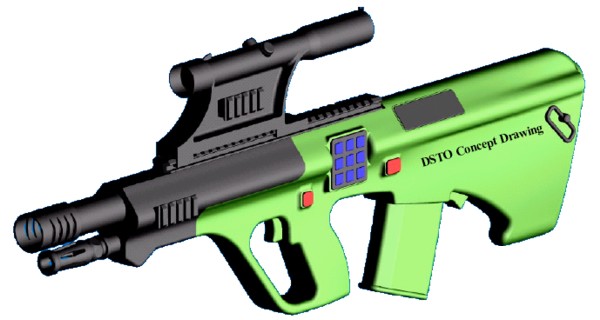
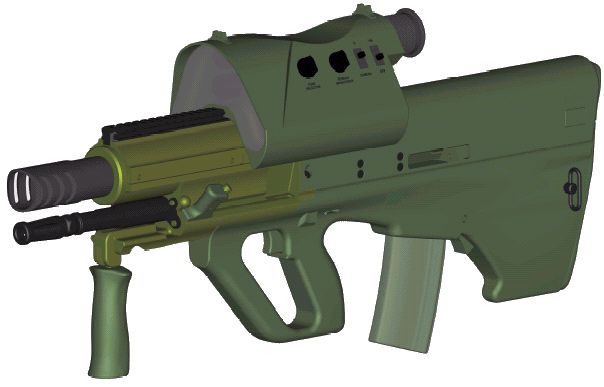
2001 concept of the AICW system

2003 concept of the AICW system

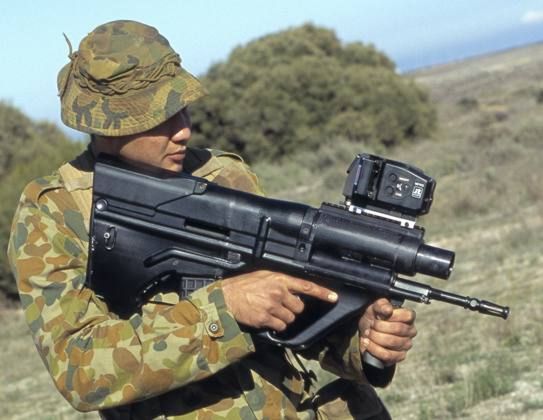
2005 testing prototype AICW VX3 weapon


Caliber: 5.56x45mm NATO + 40mm
Action: Gas operated, rotating bolt + Metal Storm patented stacked-projectile caseless
Overall length: 738 mm
Barrel length: n/a
Weigth: 6.48 kg unloaded, w/o sight; 7.85 kg loaded w/o sight (30 5.56mm + 3 40mm rounds); 9.9-9.9 kg loaded w. electronic sight
Rate of fire: 650 rounds per minute (for 5.56mm barrel)
Capacity: 30 rounds (5.56mm) magazine plus 3 40mm rounds in the G/L barrel

The AICW (Advanced Infantry Combat Weapon) is a joint development of the Australian DSTO (Government operated Defence Science and Technology Organisation), and private companies Metal Storm and Tenix Defence. This development has been carried out since the turn of 21st century, closely following the concept of the American XM29 OICW system. Overall, AICW represents the modular weapon system that combines the 5.56mm rifle/carbine copmponent as a host (basic) platform with 40mm multi-shot grenade launcher (G/L) module and multi-purpose electro-optical sighting system, which can be used to fire either rifle or G/L component, and also can provide recon data to external "consumers" such as tactical computers.
The host rifle component of the AICW is the updated Australian-made F88 rifle, which is a license-built Steyr AUG.However, the basic F88 rifle has been extensively modified to accept other elements of the system - for example, receiver has been upgraded to receive the G/L module at the top, and the buttstock has been enlarged to accomodate G/L electronic fire contol module. Other changes include modification to the safety and trigger arrangements - AICW system has a single trigger for both weapon components (5.56 and 40mm), and a three position (safe - rifle - G/L) safety/selector switch at the side of the pistol grip.
The most interesting part of the AICW weapon is the multi-shot Metal Storm 40mm grenade launcher, which looks like a single 40mm G/L barrel but contains three 40mm projectiles stacked one behind the another. These projectiles are launched using the electric ignition impulses, provided by the fire control module built into the buttstock of the host rifle. Since the muzzle velocity of these projectiles is slightly more than usual for 40mm handheld G/L (95m/s instead of 75m/s), host rifle incorporates the recoil reduction buffer, that allows the Metal Storm G/L barrel to recoil against the spring, decreasing the peak recoil impulse.
The top of the receiver hosts the multi-role sights of various type and make. At the AICW VX3 live fire demonstartions that took place in the summer of 2005, AICW prototypes were displayed with ITL Viper multi-purpose rifle sight (that incorporates laser range-finder and digital compas), or with Vinghog Vingsight Fire Control System. At the present time (late 2005) AICW prototypes have not yet fired 40mm grenades with live warheads, nor incorporated an airburst facility. However, it is stated that it is possible to easily adapt most of the existing 40mm grenade warheads to the Metal Storm technology, including air-bursting grenades that are now in development in several countries.
At the present time AICW weapons are available only as the "3rd generation technology demonstartors", that completed first live-fire trials (as a complete system) in the summer of 2005. Current Australian MOD plans state that ADF may start to purchase AICW systems in around 2010-2012.

Selasa, 15 Februari 2011

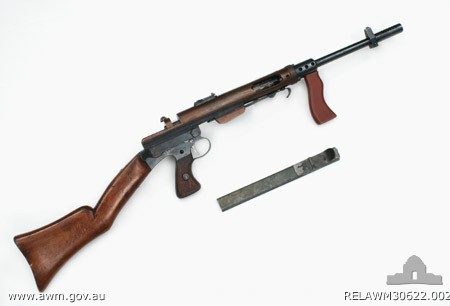
F1 submachine gun


The F1 submachine.
The F1 submachine.

Characteristics

Caliber: 9x19mm Luger/Para 
Weight: 3.26 kg unloaded
Length: 715 mm
Barrel length: 203 mm
Rate of fire: 600 rounds per minute
Magazine capacity: 34 rounds
Effective range: 100-200 meters

The F1 submachine gun has been designed at the Australian Lithgow Small Arms Factory by 1962. Originally known as X-3 prototype, it appeared in 1962 as possible replacement for obsolete and aging Owen submachine guns. It was adopted as F1 by mid-sixties, and served well until late eighties, when it was officially replaced by the 5.56mm F88 assault rifle, a license-made version of Steyr AUG. F1 was simple, reliable and popular weapon.
F1 submachine gun is blowback operated, selective fired weapon which fires from open bolt. It uses tubular receiver with top-mounted magazine. Cocking handle is set at the left side of weapon, and does not reciprocate when gun is fired. Its slot is covered by sliding dust cover. Weapon is made in so-called in-line layout, and the front of the buttstock slides over the rear of the receiver, and is fixed there by special catch. For disassembly, gun is unloaded, then catch is pressed and buttstock pulled off the receiver toward the rear; then, bolt and return spring are removed. Sights are of fixed type, and due to top-mounted magazine are offset to the left. Rear sight is made folding for more comfortable carry. Unlike many other submachine guns, F1 can be fitted with standard rifle bayonet, which is attached to the right of the perforated barrel jacket.

Owen machine carbine


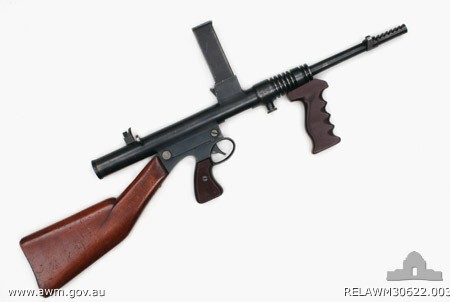
Owen 32ACP prototype submachine gun (1940)

Owen .45ACP prototype submachine gun (1941)

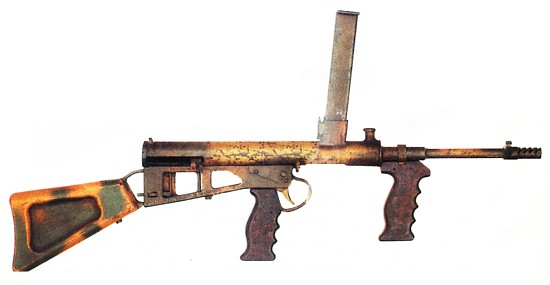
Owen Mk.1-43 submachine gun in camouflage paint

Owen Mk.1-42 submachine gun, field stripped

Characteristics

Caliber: 9x19mm Luger/Para 
Weight: 4.22 kg unloaded
Length: 813 mm
Barrel length: 247 mm
Rate of fire: 700 rounds per minute
Magazine capacity: 32 rounds
Effective range: 100-200 meters

Evelyn Owen, an Australian, developed his first automatic weapon, chambered for .22LR cartridge, by 1939, and offered it to Australian army. This weapon was a strange-looking revolver-type contraption with fixed "cylinder" instead of magazine, and thumb-operated trigger. However, by 1940 Owen produced its next design, in somewhat more potent (but still relatively mild) .32ACP / 7.65x17 Browning cartridge. This was more "usual" weapon, with traditional trigger, dual pistol grips and detachable box magazine, inserted under the receiver and inclined rearward and to the left. By 1941, Owen produced several more prototypes, chambered in .45ACP, 9mm Luger and even .38 Special revolver cartridges; this work was done at Lysaghts Newcastle Works in New South Wales, Australia. 9mm prototype, made by Lysaghts, was tested against Thompson and Sten submachine guns, and found superior to both. Adopted in 1942, this gun was manufactured until 1945 in three basic versions, Mark 1-42, Mark 1-43 (or Mark 1 Wood butt), and Mark 2. About 45 000 Owen SMGs were made by Lysaghts, and these remained in service with Australian forces until 1960s, through World War 2, Korean and Vietnam wars. In general, these weapons were well liked by soldiers due to their robustness, reliability and simplicity. The only downside of Owen SMG was its somewhat heavy weight.
Owen submachine guns are blowback operated, top-fed weapons that fired from open bolt. Receiver is of tubular shape, with the bolt body separated from the cocking handle by the small bulkhead inside. This precluded the dirt to enter the receiver area through the cocking handle slot, but also required the barrel to be made removable, as the bolt and return spring were pulled forward out of receiver. Barrel was held in place by simple latch, located at the front of the receiver, ahead of the magazine housing. Muzzle was equipped with recoil compensator. Pistol grips were made from wood, detachable buttstock was made of steel wire on Mk.1-42 Owens and from wood on later models. Due to the top mounted magazine, fixed sights were offset to the left.

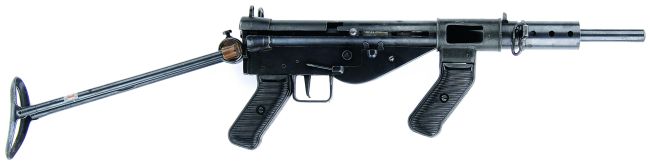
AUSTEN submachine gun


AUSTEN submachine gun.

Characteristics

Caliber9x19mm Luger / Parabellum
Weight3.98 kg
Length (stock closed/open)552 / 732 mm
Barrel length198 mm
Rate of fire500 rounds per minute
Magazine capacity30 rounds

AUSTEN submachine gun (machine carbine in contemporary terminology) was an urgent development, carried in Australia during earlier stages of World War 2 in the anticipation of possible Japanese invasion. It was based on British STEN submachine gun (the AUSTEN means Australian STEN), although some features (i.e. return spring guide, pistol grip and underfolding stock) were copied from the German MP40. About 20 thousands of AUSTEN Mk.1 submachine guns were manufactured during the WW2, but it was unable to achieve popularity of its main domestic rival, the Owen submachine gun, as the Owen was much more reliable, especially under the extreme environmental conditions of jungle warfare.
The AUSTEN submachine gun is a simple blowback weapon, firing from open bolt in semi-automatic or full automatic modes. The return spring is located insite the telescoping tubular guide, as in the German MP40. The fire mode selector is located on the right side of the trigger housing, above the trigger guard. The STEN-type box magazine is inserted horizontally from the left, ejection is to the right. AUSTEN submachine gun is equipped with two pistol grips and an underfolding metallic buttstock. The struts of the buttstock are hollow and hold inside a small screwdriver and a cleaning rod. The sights are of simple design, and not adjustable for range.

Rabu, 26 Januari 2011

Australian International Arms M10 rifles

 AIA M10A1 rifle, 7.62x39 caliber.
 AIA M10A1 rifle, 7.62x39 caliber.

AIA M10A2 rifle, 7.62x39 caliber.
 AIA M10A2 rifle, 7.62x39 caliber.

AIA M10B1 rifle, 7.62x51 / .308 Win caliber.
 AIA M10B1 rifle, 7.62x51 / .308 Win caliber.

AIA M10B2 rifle, 7.62x51 / .308 Win caliber with optional bipod and Picatinny rail.
 AIA M10B2 rifle, 7.62x51 / .308 Win caliber with optional bipod and Picatinny rail.

 M10A1M10A2M10B1M10B2
Type / actionmanually operated bolt cation
Caliber7.62x39 mm Russian7.62x51 / .308 Win
Weight unloaded3.8 kg3.5 kg4.1 kg4.97 kg
Length1048 mm950 mm1125 mm1200 mm
Barrel length508 mm410 mm560 mm640 mm
Magazine capacity10 rounds10 rounds10 rounds10 rounds

The M10 line of bolt action rifles was developed in Australia by Australian International Arms Pty, a small company dedicated to produce quality rifles for civilian use. Initial intent was to produce bolt-action rifle with high capacity, detachable magazines. Starting with time-proven design of the famous SMLE No.4 Mk.2 rifles of British origin, AIA engineers developed new and improved version of the venerable "Rifle, Short, Magazine, Lee-Enfield". The AIA rifles feature all-new components machined from modern steel and quality wood. First prototypes of the AIA improved No.4 mk.2 rifles appeared in 1998-99, and since then company has produced several versions of the basic design, of which most notable are M10 rifles and carbines, chambered for popular 7.62x39 M43 Russian and 7.62x51 NATO / .308 Win ammunition. The 5.56x45mm / .223 Rem version of the same design was planned but apparently is still not in production at this time.
AIA M10 rifles are manually operated, bolt action rifles with rotary bolt of Lee-Enfield type. Bolt design is improved by utilizing only one size of non-rotating bolt head (as opposed to original design that relied on several sizes of bolt heads to maintain proper headspace on different rifles). Bolt is locked into newly manufactured receiver using dual locking lugs at the rear of the bolt. Feed is from detachable box magazines, and, in 7.62x39 version, M10A1 / M10A2 rifles will accept high capacity AK / AKM type magazines holding 20, 30 or even 40 (RPK-type) rounds. Manual safety is of lee-Enfield type, located on the left side of the receiver. Standard sights include L-shaped flip-up diopter rear sight, adjustable for windage and set for 100 / 300 (M10A 7.62x39) or 200 / 400 (M10B 7.62x51) meters range.  Receivers are pre-machined to accept Picatinny type rail which is used to install various telescope sights. Stocks are made from teak timber, in variety of shapes and sizes.

 
Design by Free WordPress Themes | Bloggerized by Lasantha - Premium Blogger Themes | Online Project management