Tampilkan postingan dengan label Great Britain. Tampilkan semua postingan

Jumat, 21 Juni 2013

Greener police gun

Greener police gun Mark III

diagram of the Greener-improved Martiny action, as used in Greener police guns
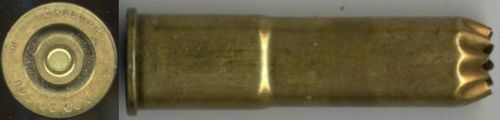
special 14 gauge shot shell for Greener police gun Mark III


Caliber
12 Gauge or 14 Gauge Greener
Type
Single shot
Overall length
1060 mm
Barrel length
610 mm
Weight, empty
3,5 kg
Magazine capacity
-

The Greener police shotgun is one of most unusual fighting shotguns which were employed by law enforcement organizations throughout former British empire. Despite its obsolete design (which traces its roots as far back as 1860s) Greener police gun can be still encountered in hands of police officers in some more remote parts of the world, mostly in Asia and Africa.
Story of the Greener police gun began shortly after the WW1, when British colonial police forces requested a weapon, suitable for riot control and prison guard duty. Another request was that the gun should use proprietary ammunition, not available through commercial channels. This was requested to made illegal use of guns, stolen or taken away from police more complicated for criminals. This request was fullfilled by famous British gunmaker W.W. Greener, who developed a single-shot shotgun, based on the long-obsolete but rugged Martiny single-shot action. This new gun fired proprietary 14 gauge shells, loaded with shot, and featured very rugged wooden full stock with steel nose cap and buttplate, so it can be safely and routinely used not only as a gun, but also as a club, banging doors and occasional hot heads in the course of upkeeping the law and order.
Greener police gun mark I appeared in around 1921, and tens of thousands were delivered to organisations like Egyptean colonial police etc. However, it was soon discovered that criminals, who managed to get hold on Greener guns, used standard 16 gauge shells, tightly wrapped into paper or tape to fire from Greener guns. To made commercial ammunition completely unusable, Greener responded with improved design, Greener police gun mark III. This gun used proprietary ammunition with bottlenecked case made of brass, with thick rim. Base of the case was roughly same as standard 12 gauge case, but toward the forward end of the shell it has reduced diameter equivalent to 14 gauge shell size. To further complicate illegal use of its police shotgun, Greener provided its Mark III guns with trident-shaped strikers. Greener police shells had grooved base and recessed primers, and attempt to fire any commercially available shell from Greener gun would fail every time as the side projections of the striker would hit the flat base of the shell, stopping the central part (the firing pin itself) before it can reach the primer. Some Greener Mark III police guns were also made to fire standard, commercially available 12 gauge ammunition or Mark I 14 gauge straight case ammunition.
Typical 14 Gauge cartridges available for Greener police gun were usually loaded by Kynoch with 30-36 gram of lead shot of small or medium size.

The Greener police shot gun Mark III is a single shot weapon. It uses Martiny type hinged block action, controleld by a lever located below the stock. Pulling the lever down and forward will rotate (drop) the front of breechblock down, exposing the chamber and extracting the fired shell. Fresh round then can be chambered and breech block raised by pulling the lever up. Gun is striker fired, and internal striker is cocked automatically as the breech block is opened. Manual safety is provided on the right side of the receiver. Greener police shot gun is fitted into two-piece wooden stock of solid construction, with steel nose cap and steel buttplate. On some Greener guns, nose cap was provided with bayonet mount, to achieve more intimidating effect on rioters or prisoners.

Kamis, 20 Juni 2013

Webley-Fosbery automatic revolver

.455 caliber Webley-Fosbery revolver, left side


.455 caliber Webley-Fosbery revolver, right side

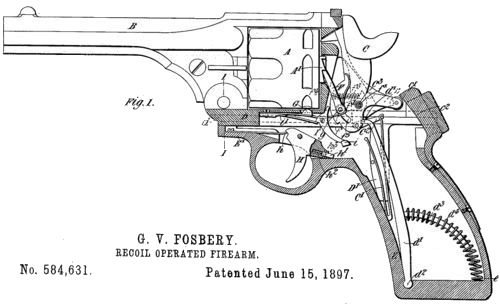
Diagram from original US patent granted to Col. Fosbery for design of his automatic revolver; Upper frame is in forwardmost position.

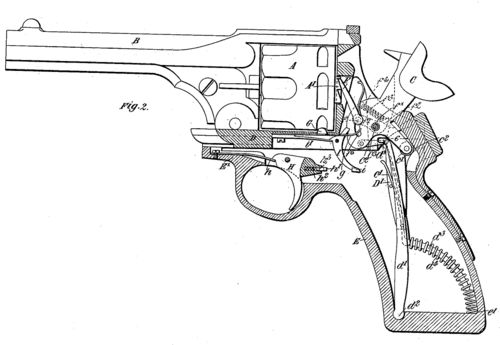
Diagram from the same patent, showing upper frame in recoiling position. Note that the gun in the picture uses different cylinder rotation mechanism when compared to production Webley-Fosbery guns.


Data for Model 1902 Webley-Fosbery revolver with 6 inch barrel

TypeDouble Action semiautomatic revolver
Caliber(s).455 British Service or .38ACP
Weight unloaded1065 g
Length267 mm (10.5")
Barrel length152 mm (6")
Magazine capacity6 rounds (.455) or 8 rounds (.38)

This unusual weapon, which combined features (either good and bad) of both revolver and a self-loading pistol was a brainchild of British Colonel G. V. Fosbery. The basic design was conceived during last years of 19th century, and first production guns appeared from noted British gun-making company Webley & Scott in 1901. The Webley-Fosbery revolvers were widely tested by various armed forces, but never adopted because of over-complicated design and insufficient advantages over either a double-action revolver (like contemporary Webley & Scott revolvers) or early self-loading pistols. Webley-Fosbery revolvers were produced in several modifications up until start of World War One, and it saw limited action in Boer wars, as well as in WW1 in the hands of few British officers who purchased it privately.
Webley-Fosbery revolver, in fact, had few advantages over contemporary revolvers of same caliber - mostly those were reduced recoil (because of recoiling action and heavier weight) and somewhat improved accuracy in rapid fire (because of self-cocking action and reduced recoil). Its mechanism was quite sensitive for dirt and fouling, and gun must be held tight during the fire, or otherwise the recoil movement of the upper frame will be insufficient for cycling the action. Its reloading was not much faster than of contemporary revolvers, despite the fact that special flat clips were developed for this weapon, holding either 6 .445 or 8 .38 caliber rounds at once.
Webley-Fosbery revolver used recoil energy generated by each discharge, to rotate the cylinder and cock the hammer for next shot. To be able to do so, it had a two-part frame. Bottom part consisted of a grip with trigger unit, and has rails on its upper surface. The upper frame, which held the cylinder and tip-down barrel, as well as hammer unit, as able to recoil on the lower frame rails against a spring. Upon recoil, a special stud, fixed on the lower frame, followed the zig-zag tracks in the cylinder to rotate it and index next loaded chamber with the barrel. At the same moment, hammer was cocked. Once all ammunition in the cylinder was expended, revolver was reloaded by pushing on the barrel lock release and swinging the barrel down on its hinge, thus tipping the rear of the cylinder up. This movement activated the automatic extractor which pulled empty cases out of cylinder chambers simultaneously. Once cylinder was emptied, fresh cartridges were loaded (either one by one or all at once, by using a flat steel clip), then barrel was swung up and locked. After reloading, revolver could be fired either by double action pull on the trigger, or by manual cocking of the hammer with subsequent single-action trigger pull. Webley-Fosbery revolvers were also fitted with manual safety levers, located on the left side of the grip frame.

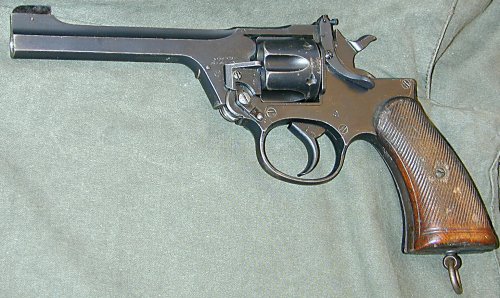
Enfield No 2 Mark 1

Enfield No 2 Mark 1
Enfield No 2 Mark 1

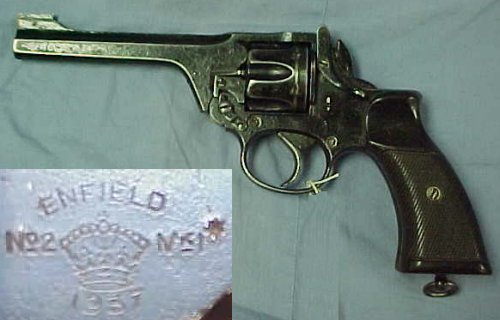
Enfield No 2 Mark 1*

 
Type: Double Action (Mark 1) or Double Action Only (Mark 1* and Mark 1**)
Chamber: .38/200 (.38S&W)
Weight unloaded: 765 g
Length: 260 mm
Barrel length: 127 mm
Capacity: 6 rounds

This revolver was developed at the Royal Small Arms Factory in Enfield in 1926 - 1927. The design is based on scaled downWebley Mark 6 "break-top" frame, with cylinder chambered for 6 .38/200 rounds. The hammer/trigger group was redesigned, with manual hammer safety lock added, and with separate cylinder lock. This revolver was adopted for British Military service in 1932 as Enfield revolver, .38 caliber, No.2 Mark 1. After 1938, almost all No.2 Mk1s were converted into No.2 Mark 1* configuration.
Enfield No.2 Mark 1* were developed in the late 1930s for British Tank Corps, and are distinguished from early Mark 1 by spurless, Double Action Only hammers, lighter mainsprings, and re-shaped grip side plates. The spurless DAO hammers were required by Tank Corps command to avoid snagging the hammers on tank internals.
Enfield No.2 Mark 1** appeared in the 1942 as a simplified, wartime design. These guns were similar to No.2 Mark 1*, but withouth the hammer stop. After the 1945, all those revolvers were recalled and converted into No.2 Mark 1* configuration.

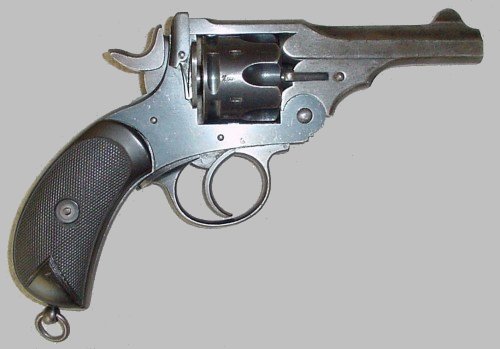
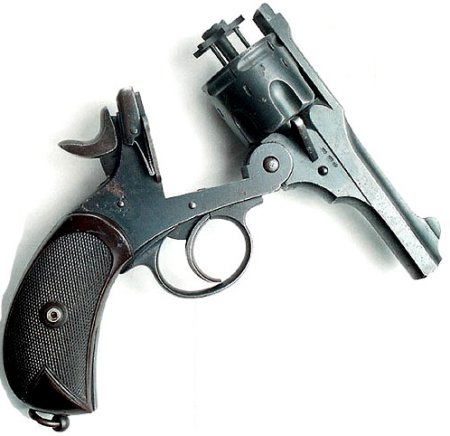
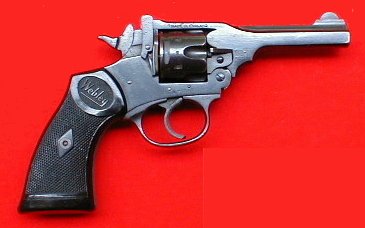
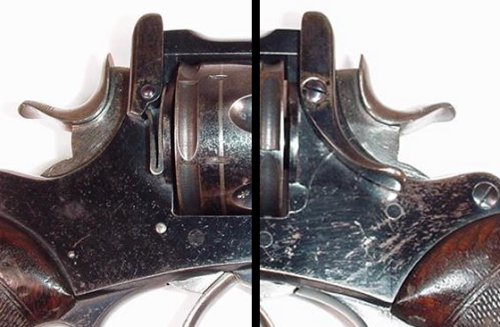
Webley top-break revolvers

Webley .455 caliber MK. I (Mark 1, 1887)

Webley .455 caliber MK. II (Mark 2, 1894)

Webley .455 caliber MK. IV (Mark 4, 1899), frame broken open and extractor exposed from the cylinder

Webley .455 caliber MK. VI (Mark 6, 1915)

Webley .38 caliber MK. IV (Mark 4, 1942)

Right and left side views on Webley frame lock

 
Type: Revolver, Double Action
Chamber: .455 British service; .38/200 (.38S&W)
Weight unloaded: 995 g (Mark 1 - Mark 5 with 4 inch barrel); 1100 g (Mark 6)
Length: 260 mm (Mark 1 - Mark 5 with 4 inch barrel); 286 mm (Mark 6 with 6 inch barrel)
Barrel length: 4 inch (101 mm) Mark 1 - Mark 5; 125 mm (some Mark 3 and Mark 4); 152 mm (Mark 6)
Capacity: 6 rounds

The first top-break revolvers were developed by the Webley & Son company (Webley & Scott Co. since 1897) of Great Britain in the 1870s. First Webley revolver had been officially adopted for Royal Army & navy service in 1887, as a Webley Revolver, .455, Mark I. It was a break-top, six shoot, double action revolver, chambered for blackpowder .455 British Service cartridge, officially known as Cartridge .455 revolver, Mark I. This cartridge launched heavy, 18 gramms (265 grains) lead bullet at relatively slow muzzle velocity of 180 meters/second (ca. 600 fps). Later, smokeless version of this cartridge had been adopted, but since it also could be fired in early revolvers, the gain in the velocity or muzzle energy was very minor.
All Webley top-beak revolvers featured two piece frame, which hinges ("breaks") down at the forward low end for ejection and loading. The ejector is actuated automaticayy when the frame is broken open, simulateonusly removing all six cases from the cylinder. The cartridges then can be inserted by hand. In the case of revolver being rechambered for .45ACP round, half-moon clips are used to load the gun (two clips, each for 3 rounds). All Webley revolvers were Double Action or Double Action Only, with very distinguishable shape of the barrel and frame lock with lock lever on the left side of the frame and V-shaped lock spring at the right side. Below is the list of all Webley revolvers, officially adopted in Great Britain. Many other variations were also manufactured for civilian and police use.
Webley revolver, .455, Mark 1. Adopted in 1887, chambered for blackpowder cartridge. 4 inch (101 mm) barrel, "bird head" shaped grip.
Webley revolver, .455, Mark 2. Adopted in 1894, almost the same as Mark 1, but hardened removable steel blate was added at the back of the frame breech, hammer was strenghtened, grip was slightly rounded.
Webley revolver, .455, Mark 3. Adopted in 1897, this was Mark 2 with improved cylinder to frame lock. Cylinder can be removed for cleaning. Since 1905, some Mark 3 revolvers were also made with 5 inch (125 mm) barrels.
Webley revolver, .455, Mark 4. Adopted in 1899, this was an improved Mark 3, made from different steel, with smaller and lighter hammer and wider cylinder slots. Since 1905, some Mark 4 revolvers were also made with 5 inch (125 mm) barrels.
Webley revolver, .455, Mark 5. Adopted in 1913. Mark 5 was designed to accept smokeless (cordite) ammunition, and thus, had larger and stronger cylinder, and accordingly redesigned frame.
Webley revolver, .455, Mark 6. Adopted in 1915, it was the "ultimate" Webley .455 six-shooter. Mark 6 featured redesigned, more squared grip, 6 inch (152 mm) barrels, removable front sights. Mark 6 revolvers were manufactured by Webley & Scott until 1921, later these were manufactured by Royal Small Arms Factory at Enfield Lock. Oficially rendered obsolete in 1932 with the adoption of the Enfield No.2 .38 caliber revolvers, but widely used by British troops during the World War Two.
Webley revolver, .38, Mark 4. Oficially adopted for military service in 1942, this was initially a scaled-down version of the .455 Mark 6 revolver, chambered for .38 S&W cartridge, and developed by Webley & Scott in 1923 for police use. These guns were oficially regarded obsolete as late as in 1963. It should be noted, that oficial british .38/200 ammunition was based on early, blackpowder .38 Smith & Wesson cartridge, and was used with heavy 200 grains (13.4 gramms) bullet, leaving the muzzle at relatively slow velocities of about 198 meters/sec (650 fps).

Sabtu, 02 Maret 2013

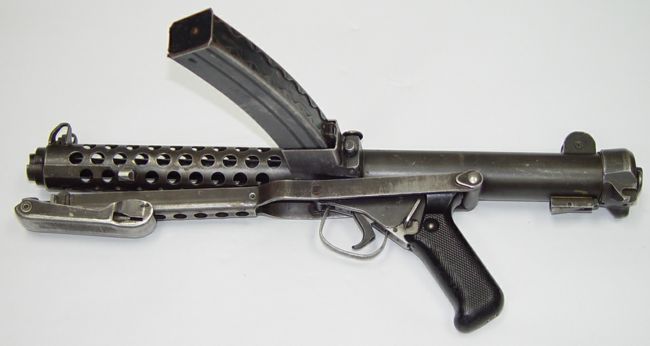
Sterling - Patchett L2A1 (Mk.1) - L2A3 (Mk.4), L34A1 (Mk.5)

 Sterling L2A3 / Mk.4 submachine gun, left side, butt folded.
 Sterling L2A3 / Mk.4 submachine gun, left side, butt folded.
Image: Frank Rodyns, Belgium
 
Sterling L2A3 / Mk.4 submachine gun, left side, butt retracted.
 Sterling L2A3 / Mk.4 submachine gun, left side, butt retracted.
Image: Frank Rodyns, Belgium
 
 Sterling L2A3 / Mk.4 submachine gun, right side.
 Sterling L2A3 / Mk.4 submachine gun, right side.
Image: Frank Rodyns, Belgium
 
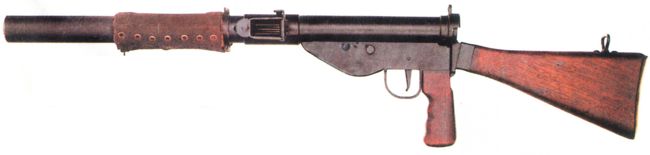
Sterling L34A1 / Mk.5 silenced submachine gun.
 Sterling L34A1 / Mk.5 silenced submachine gun.
 
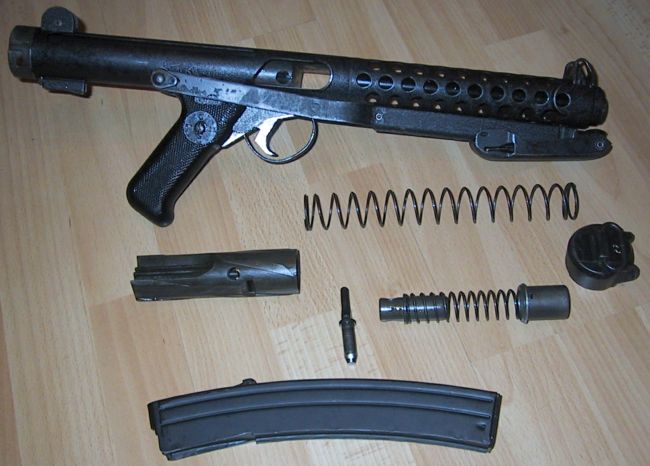
Sterling L2A3 / Mk.4 submachine gun, partially disassembled.
 Sterling L2A3 / Mk.4 submachine gun, partially disassembled.
Image: Frank Rodyns, Belgium

Characteristics

  Sterling L2A3 Sterling L34A1 silenced
Caliber 9x19mm Luger/Parabellum/NATO
Weight, empty 2,7 kg 3,6 kg
Length (stock closed/open) 481 / 686 mm 660 / 864 mm
Barrel length 196 mm 196 mm
Rate of fire 550 rounds per minute  550 rounds per minute
Magazine capacity 34 rounds 34 rounds
Effective range 200 meters 50-100 meters
 
The famous Sterling submachine gun was born in around 1942 as "Patchettmachine carbine" - a prototype submachine gun, developed by George W.Patchett and originally produced by Sterling Engineering Co in England. Several prototypes were built before the end of the war, and the Sterling-Patchett submachine gun participated in extensive trials, held in UK between 1945 and 1953, when it was finally announced as a winner of trials, and adopted as"9mm Sterling submachine gun L2A1" (factory designation was"Patchett Mk.1"). Sterling submachine guns were produced for British armed forces by Sterling company and Royal Ordnance Arsenalin Fazakerly, England; Long Branch Arsenal in Canada made a slightly modified Sterling under license for Canadian army as C1. In a slightly modified form,known in British service as L2A3 submachine gun or as "Sterling submachine gun, Mark 4" or Sterling Mk.4 in short, it served with British army until early 1990s, when it was finally replaced by troublesome L85A1 assault rifle. Nearly 400 000 of Sterling submachine guns were produced until late 1980s. In 1967, British army adopted the L34A1 /Sterling Mk.5 silenced submachine gun, which is apparently still in limited use with certain special operations elements in British army.
 Sterling submachine guns also were widely sold for export, more than 70 countries had purchased various quantities of Sterling submachine guns.
 It must be noted that Sterling submachine guns were rather popular among British troops, because of relatively compact size, adequate firepower and acuracy andgood reliability.
L2A3 /Sterling Mk.4 submachine gun is blowback operated, selective fired weapons that fires from open bolt. The fire mode selector / manual safety lever is located on the left side of trigger unit, above the grip panel. Tubular receiver, which also serves as a barrel jacket at the front, contains a cylindrical bolt with fixed firing pin. Bolt body has several spiral grooves on its outside surface which collect the dust and fouling from inside the receiver, and thus greatly improve reliability of the gun under field conditions. Feeding is from the left side;magazines are inserted horizontally, and ejection is to the right. Magazines are of slightly curved shape for improved feeding reliability. Buttstock is made from stamped steel and folds down and below the receiver to save space. Standard sights include protected front blade and flip-up rear aperture sight, marked for100 and 200 yards range, and also protected from sides by sturdy"ears".
 Special "high power, submachine-gun only" ammunition was procured by British army for Sterling submachine guns. This ammunition was absolutely safe in Sterling submachine guns, but can cause extensive wear to many 9mm pistols designed for commercial 9x19 ammunition.
 L34A1 /Sterling Mk.5 silenced submachine gun differed in the barrel section, as its barrel has some 72 small holes used to vent powder gases into the rear expansion chamber of the integral silencer. This was necessary to decrease the muzzle velocity of the bullet so it would be below the speed of sound. Like its predecessor, the STEN Mk.IIS, the silenced Sterling gun was intended to be fired mostly in semi-automatic mode; the full-automatic fire was for emergency purposes only.

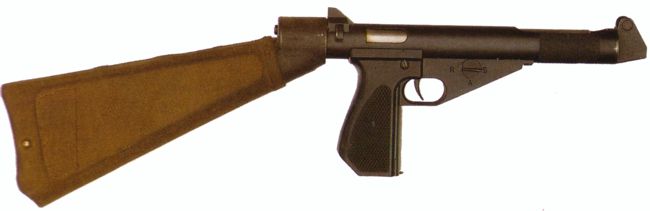
MCEM-2 experimental

MCEM-2 experimental submachine gun, with shoulder stock / holster attached.
 MCEM-2 experimental submachine gun, with shoulder stock / holster attached.

Characteristics

Caliber 9x19mm Luger / Parabellum
Weight 2,7 kg empty
Length (stock closed/open) n/a
Barrel length n/a
Rate of fire ~ 1000 rounds per minute
Magazine capacity 18 rounds
Effective range ~50-100 meters

MCEM-2 (Machine Carbine Experimental Model 2) submachine gun was produced only in prototype form, but it is worth to mention by the simple fact that it is one of the very first submachine guns to combine wrap-around bolt and magazine in pistol grip - features, later copied in Czechoslovak SA23, Israeli Uzi and a great number of other submachine guns. MCEM-2 was the second prototype in a line of experimental submachine guns, designed in Britain in 1944. It was envisioned as a possible replacement for the STEN submachine gun then inservice. The MCEM-2 was developed by polish immigrant, someone called Podsenkowski. It is believed that prototypes of MCEM-2 were made before the endof WW2, and its derivatives MCEM-4 and MCEM-6 were tested soon after the war.The latter modifications differed mostly in adoption of the rate-reducing mechanism, incorporated into trigger unit; the rate of fire therefore was decreased from 1000 to more realistic 700 rounds per minute. Nevertheless,neither prototype was found suitable for adoption, and several years later British army adopted a more conventional submachine gun, the Sterling-Patchett.
MCEM-2is blowback-operated, selective fired weapon which fires from open bolt. Thebolt is of "telescoped", or "wrap-around" type, with most of its mass being in front of the breech face. The receiver is made from steel tube, and pistol grip with trigger unit is attached below. magazine is inserted into the pistol grip. safety and fire mode selector are incorporated into one three-position switch, located in front of the trigger on the left side of the trigger unit housing. The guns was developed along with large semi-rigid holster, which can be attached to the receiver of the gun to form the shoulder stock.

Lanchester Mk.1

Left side view on Lanchester Mk.1 submachine gun, with 50-round magazine inplace.
 Left side view on Lanchester Mk.1 submachine gun, with 50-round magazine inplace.
 
 Right side view on Lanchester Mk.1* submachine gun, without fire mode selectorand with simplified rear sight. Bayonet lugs are clearly visible near the muzzle.
 Right side view on Lanchester Mk.1* submachine gun, without fire mode selectorand with simplified rear sight. Bayonet lugs are clearly visible near the muzzle.

Characteristics

Caliber 9x19mm Luger / Parabellum
Weight 4,3 kg empty
Length 751 mm
Barrel length 200 mm
Rate of fire 600 rounds per minute
Magazine capacity 50 rounds
Effective range 150-200 meters

The Lanchester Mk.1 submachine gun, or Lanchester Mk.1 machine carbine incontemporary British nomenclature, was a very close copy of German SchmeisserMP-28 submachine gun. It was developed by George H. Lanchester andmanufactured by Sterling Engineering Co between 1941 and 1945. This weapon wasmade in two versions, Mk.1 and Mk.1* (Mark 1, star). The latter was a simplifiedversion of the original Mark 1, with omitted fire mode selector, and thus firing in full automatic mode only. Most Lanchester submachine guns went for BritishNavy.
The Lanchester Mk.1 submachine gun  is blowback operated, selective-fire weapon that firedfrom open bolt. Tubular receiver was attached to the front of the wooden stock,and could be pivoted barrel down for maintenance and disassembly. Magazines areinserted from the left side, ejection is to the right. Magazine housing was made from brass. Manual safety is made in the form of locking cut, made in the receiver, which engages the bolt handle to lock bolt in open (cocked) position. Fire mode selector was located in front of the trigger, and was not present on Mk.1* weapons. Standard sights consisted of blade front and tangent rear sight, marked from 100 and up to 600 yards (approx 550meters). Some Mk.1* guns had simplified, flip-up rear sights marked for 100 and200 yards. The wooden stock was patterned after that of Lee-Enfield rifle, and gun accepted 1907-pattern knife-bayonet, originally developed for the above mentioned rifle.

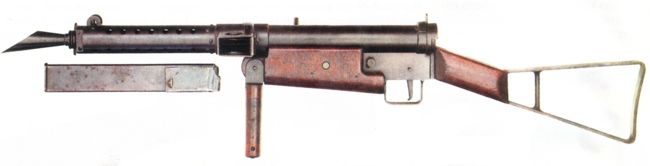
STEN submachine guns

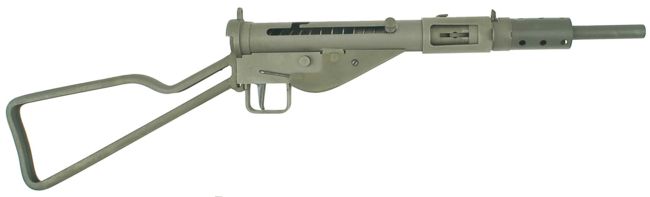
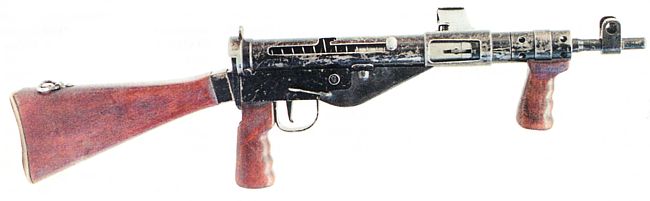
STEN Mk.I (STEN Mark 1) submachine gun, with magazine removed.
 
STEN Mk.II (STEN Mark 2) submachine gun.
 
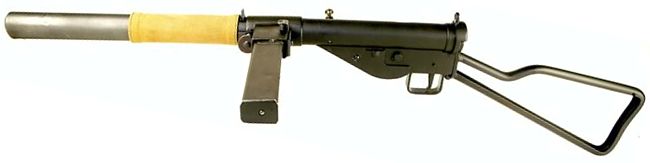
STEN Mk.IIS (STEN Mark 2 Silenced) submachine gun.
 
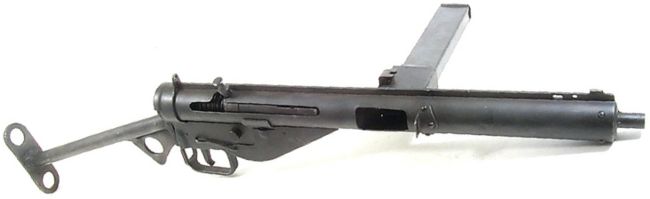
STEN Mk.III (STEN Mark 3) submachine gun.
 
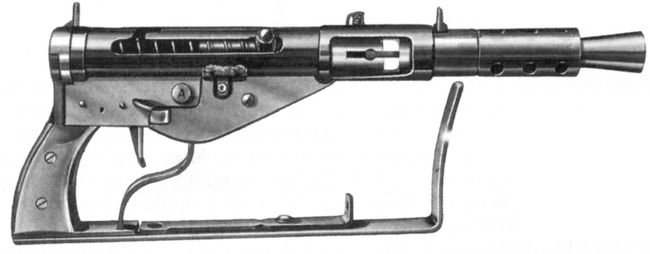
STEN Mk.IV (STEN Mark 4) submachine gun.
 
STEN Mk.V (STEN Mark 5) submachine gun.
 
STEN Mk.VI (STEN Mark 6 silenced) submachine gun.

Characteristics

  STEN Mk.II STEN Mk.IIS STEN Mk.III STEN Mk.V
Caliber 9x19mm 9x19mm 9x19mm 9x19mm
Weight, empty  3,26 kg  3,48 kg  3,18 kg 3,86 kg
Length 895 mm 900 mm 762 mm 762 mm
Barrel length 196 mm 90 mm 196 mm 196 mm
Rate of fire 550 rounds per minute 450 rounds per minute 550 rounds per minute 600 rounds per minute
Magazine capacity 32 rounds 32 rounds 32 rounds 32 rounds
Effective range 150-200 meters 50-100 meters 150-200 meters  150-200 meters

The STEN name came out of names of the designers (R. V. Shepard and H. J. Turpin) and from the factory where they worked (Enfield arsenal). It was one of the most crude and ugly and simply, but effective submachine guns of the WW2. Almost 4 millions of STEN guns of different versions were made between 1941 and 1945. STEN guns were made not only in Royal Small Arms factory in Enfield; other makers included famous British gunmaking company of the time BSA Ltd, as well as Royal Ordnance Arsenal in Fazakerly, England, and Long Branch Arsenal in Canada.
The first STEN, STEN Mk.I (full official name was 9mm STEN Machine Carbine, Mark 1), was developed in mid-1941. It was blowback operated, automatic weapon that fired from the open bolt. Trigger unit permitted for sigle shots and full automatic fire, controlled by the cross-bolt type button, located in front and above trigger. The tubular receiver and the barrel shroud were made from rolled steel. The gun was fed from left side mounted box magazines. The stock was of skeleton type, made from steel. Sights were fixed, pre-adjusted for 100 yards distance, peep hole rear and blade front. The Mk.1 featured spoon-like muzzle compensator. Some guns featured small folding forward grip. Total production of Mark 1 and slightly modified Mark 1* STEN machine guns was about 100 000.
The STEN Mk.II submachine gun was most widely made gun in entire STEN series, with about 2 millions of Mark 2 being made during the war. It was slightly smaller and lighter than Mk.I. Basic design was the same as Mark 1, with omission of all wooden parts of Mk.I and shorter barrel jacket, which made the Mk.II lighter than its predecessor. Magazine housing could be rotated for about 90 degrees down to close feed and ejection apertures during transportation and off-battle carry (this feature caused much troubles as the rotary unit was not very durable and magazine could be misaligned during combat, what led to feed malfunctions and jams). Another source of problems was magazine spring, so magazines were routinely loaded with 28-30 rounds instead of "full capacity" 32 rounds to reduce strain on the magazine spring.
Some Mk.II STEN guns were manufactured with integral silencers for undercover operations and were marked as Mk.II(S). These guns had shortened barrels enclosed into integral silencer. The silencer was rather effective so most audible sound when firing Mk.IIS was the clattering of the bolt moving back and forth in the receiver. Contemporary manuals advised that Mk.IIS submachine gun was to be fired in semi-automatic mode; the ful-automatic fire was reserved for emergency situations, as it decreased the service life of  silencer significantly.
The STEN Mk.III was modification of Mk.I. The major change was that the receiver and the barrel shroud were made from single tube (wrapped from sheet-steel and welded at the top) that extended almost to the muzzle. Another changes included fixed magazine housing for improved reliability and small finger guard in the front of the ejection port. Internally, Mk.III was similar to Mk.I and has same variety of skeleton stocks. Mk.III first appeared in 1943.
The STEN Mk.IV was made in experimental form only, and did not entered the production. It was originally intended for airborne troops.
The STEN Mk.V submachine gun was an attempt to made Mk.II a more "good looking'" gun. Being internally the same as Mk.II, the "STEN Mk.V machine carbine" featured wooden buttstock and rear pistol grip, new front sight and bayonet mount. Early Mk.V's also featured wooden front grips, but these were prone to breakage and thus were removed soon. STEN Mk.V appeared in 1944 and remained in service until the early 1960s', and then replaced by Sterling submachine guns.

Jumat, 28 Januari 2011

Boys Mk.I, Mk.I* and Mk.II anti-tank rifle

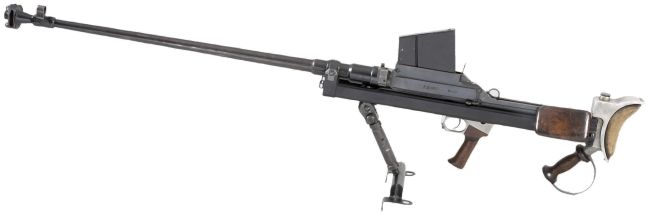
Boys Mk.I anti-tank rifle, with circular muzzle brake and "inverted T" shaped bipod, as made by BSA in england.
 
Boys Mk.I* anti-tank rifle, with flat muzzle brake and "inverted V" shaped bipod, as made by Inglis in Canada.

Data for Boys Mk.I anti-tank rifle

Type / action manually operated bolt action
Caliber  .55 Boys (13.9x99B)
Weight unloaded 16.3 kg
Length 1626 mm
Barrel length 910 mm
Magazine capacity 5 rounds
Armor penetration (Range / Angle / Penetration) W Mk.1 bullet: 100 m / 90o / 16 mm
W Mk.2 bullet: 100 m / 70o / 20 mm

 The Boys anti-tank rifle was named after its designer, captain H Boys at RSAF Enfield, who died shortly before the adoption of this weapon late in 1937. This weapon was in service with British forces until about 1943, although its effectiveness against German tanks became insufficient on much earlier stages of war. This rifle was produced by BSA Ltd in three basic versions, Mk.I, Mk.I* and Mk.II, with total production reaching 62 thousands of rifles. The Boys Mk.I was original British-made version, with round muzzle brake and T-shaped bipod. The Boys Mk.I* rifles were produced in Canada by John Inglis co, and were distinguished primary by flat muzzle brake and V-shaped bipod. The Boys Mk.II version was rarest of the three, as it was designed especially for airborne troops and had shortened barrel. Boys rifles were normally used from its own bipods, and also were fitted to "Universal carrier" armored tracked vehicles. The ammunition used in the Boys antitank rifle was peculiar to this weapon, using belted case 99mm long, loaded with AP bullets with steel core (W Mk.1, 60 g, 747 m/s) or tungsten core (W Mk.2, 47.6 g, 884 m/s). Boys anti-tank rifles saw some action against Soviet tanks during the Winter war in Finland (1940), and later against German armor in Europe and Japanese armor in Pacific theater. Generally, this weapon appeared to be less than popular due to complex design of certain parts, heavy weight and recoil, and insufficient armor penetration.
The Boys anti-tank rifle is a manually operated bolt cation rifle. It uses rotary bolt with frontal locking lugs. Feed is from top-mounted detachable box magazine with 5-round capacity. To mitigate the heavy recoil, the barreled action is allowed to recoil against the buffer in the stock, and the barrel is equipped with muzzle brake. Shoulder stock is fitted with additional cushioned pad. Rifle was normally fired from folding bipod, and it was equipped with open sights, which were offset to the left to clear top-mounted magazine. The rear sight was of aperture type, either fixed one (set for 300 yards / 271 meters range), or with two range settings (up to 300 yards and 300-500 yards).

Rabu, 26 Januari 2011

Armalon pistol carbine

ArmalonPC carbine with iron sights.
Image: Armalon Ltd

ArmalonPC carbine with polymer stock and optical sights.
Image: Armalon Ltd

Type / actionbolt action repeatingcarbine
Caliber(s)9mm,.38 Super, .40 S&W, 10mm Auto, .45 ACP; also .357 Mag, .44 Mag,.50 AE 
Weightunloaded3,7 kg / 7,6 lbs
Lengthmm
Barrel length406 mm/ 16"
Magazinecapacity7 - 15 rounds, depending on caliber

Armalon PC carbine,developed in around 1997 by British company Armalon Ltd, follows the general idea of the Spanish "Destroyer" carbine, which was developed between two World wars for use by Spanish Guarda Civil.Basically, it was a shortened and lightened conversion of the standard bolt-action rifle to significantly less powerful pistol ammunition, which resulted in much shorter effective (and dangerous) range, as well as in decreased recoil and noise. Armalon carbines also produced with idea of short-range weapon which can befired accurately at ranges beyond capabilities of most pistols. these carbines are suitable for security, training and self-defense purposes. Being manually operated, such weapons are more tolerant to variations in power of ammunition used, but practical rate of fire will be of cause slower, compared to semi-automatic carbines in same caliber, such as RugerPC9 or others like that. On the other hand, in some countries civilian ownership of semi-automatic weapons can be limited by law, and bolt-operated pistol caliber carbine might be a good choice there.
Armalon PC carbine is based on famous Short,Magazine, Lee-Enfield No.4 (SMLE No.4) rifle action, with manually operated rotary bolt. The basic action and bolt are highly redesigned for better work with short pistol cartridges. Original barrel is replaced with shorter one, in appropriate caliber. Original magazine is also discarded and a magazine adapter is installed,which will then accept pistol magazines in appropriate caliber. In"semiautomatic pistol" calibers, such as 9mm, 10mm or .45ACP, Armalon carbines use Tanfoglio pistol magazines in respective calibers. In"revolver" calibers (.357, .44) and in .50AE, these carbines use modified IMI Desert Eagle pistol magazines. Armalon carbines are produced in two basic versions, with adjustable iron sights or with noir on sights and with proprietary scope rail, which is removably attached to the top of receiver. Standard stock is three-part walnut,although an alternative polymer stock is also available.

Welrod silenced pistol

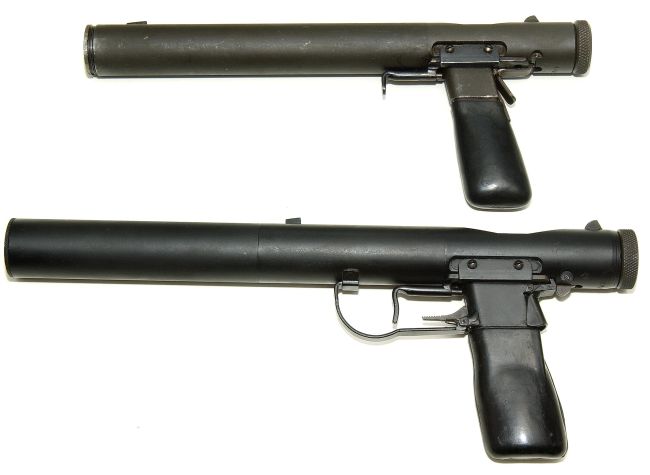
two Welrod pistols, top earlier .32 caliber Mark II and bottom later 9mm Mark I.

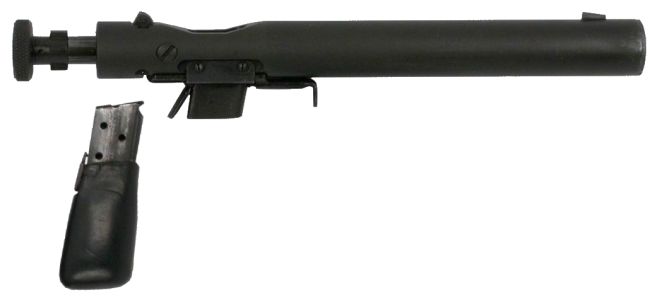
.32 caliber Welrod Mk.II pistol with magazine removed abd bolt opened.

Characteristics

 Welrod Mk.IIWelrod Mk.I
TypeSingle Action manually operated
Caliber(s) 7.65x17 / .32 ACP9x19
Weight unloaded1090 g1500 g
Length310 mm360 mm
Barrel length95 mm (less silencer) 
Magazine capacity8 rounds6 rounds

Welrod pistol was developed in UK by Special Operations Executive (S.O.E.), a government organisation which was tasked with intellegence, diversions and other special operations as well as support of the various anti-Hitler resistance movements in occupied Europe. Most of such operations were clandestine by nature and required special equipment, including special weapons. The ordinary silencers for semi-automatic pistols were well known and well developed by the WW2, but there still was the sound of the reciprocating slide during the discharge of the pistol, which was quite audible at night or in other 'quiet' environments. To solve this problem, British engineers decided to use manually operated action for the proposed gun. Early prototypes of the new silenced weapon were developed during second half of the 1942, with first prototypes tested in early 1943, in 9x19 Luger and 7.65x17 Browning calibers. Mass production of the 7.65mm Welrod pistol, officially known as Welrod pistol, Mark II, commenced in late 1943, and Birmingham Smal Arms Co, Ltd (BSA). Total number produced is unknown, but some sources stated that at about 14 000 of Welrod Mk.II pistols were produced. Production of the larger, more powerful and more effective 9mm Welrod Mk.I commenced in 1944, on request of the British Special operations forces. The latter model survived for a quite long time, and some 9mm Welrod Mk.I pistols were apparently still in operational use by British Special Operations forces as late as in 1991, during the operation Desert Storm.
During WW2, some Welrod pistols were also air-dropped to european resistance groups, most notable to Denmark. During the same period, Welrod pistols in .32 / 7.65mm were also purchased and later manufactured in USA, apparently to complement more fast-firing but certainly more noisy and less effective Hi-Standard HDM silenced pistols.
The Welrod pistol is manually operated firearm that uses rotary bolt locking with dual locking lugs. Bolt rotation and pull / push actions are controlled by user's hand through the large round knob located at the rear of the tubular receiver. Trigger is of single action type, striker-fired. A simple automated grip safety is provided at the rear of the magazine housing / grip base. On 9mm Mark I pistols, a conventional trigger guard and a manual safety were added for improved user safety. The detachable single stack magazine also served as a pistol grip, and its bottom part was enclosed into the rubber cover to provide more or less comfortable hold of the gun. The integral silencer was located in the front part of the tube, which also served as a receiver. Barrel was ported at the front, with its ported part wrapped by layers of fine mesh. Ahead of the muzzle, there were several baffles and three rubber washers, all separated by spacers. Before use, whashers had no holes to provide bullet passage, and were penetrated during the first shot. The idea of the rubber washers was to capture as much powder gases ias possible within the silencer body, and service life of these washers was no more than 10-15 rounds, after which silencer effectiveness detoriated quickly. Worn washers were replaced during disassembly of the silencer. The 9mm Mark I Welrod pistol was different in the fact that it has its frontal silencer part made as a separate unit, which was screwed onto the receiver before use. This made the gun better suited for carry and concealment during transportation through enemy territory - an useful feature for a gun that was 36 cm / 14.2 " long when ready to use.

 
Design by Free WordPress Themes | Bloggerized by Lasantha - Premium Blogger Themes | Online Project management