Sabtu, 02 Maret 2013

Sterling - Patchett L2A1 (Mk.1) - L2A3 (Mk.4), L34A1 (Mk.5)

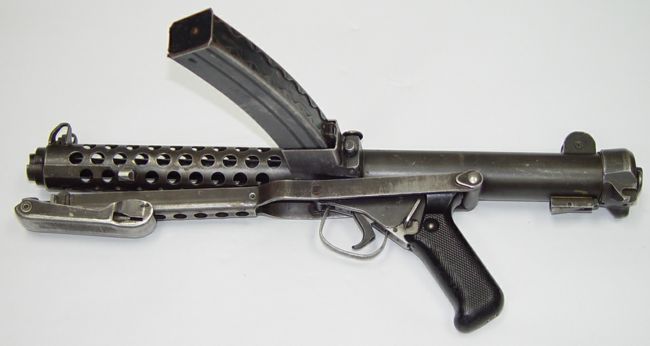
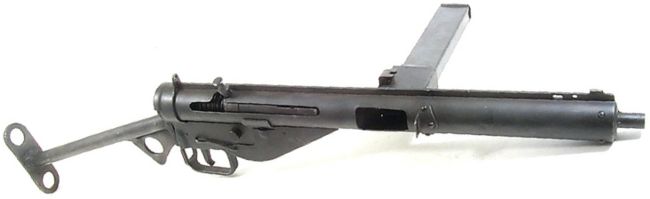
 Sterling L2A3 / Mk.4 submachine gun, left side, butt folded.
 Sterling L2A3 / Mk.4 submachine gun, left side, butt folded.
Image: Frank Rodyns, Belgium
 
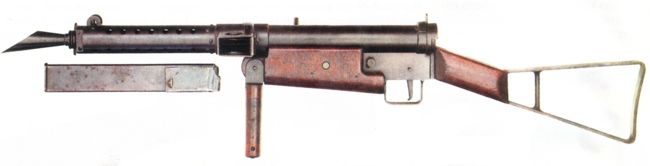
Sterling L2A3 / Mk.4 submachine gun, left side, butt retracted.
 Sterling L2A3 / Mk.4 submachine gun, left side, butt retracted.
Image: Frank Rodyns, Belgium
 
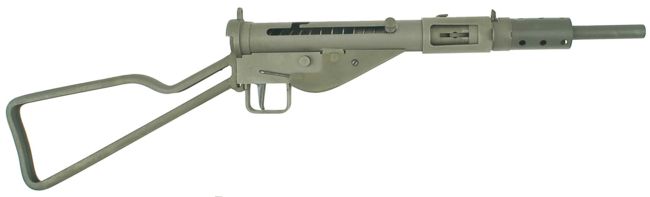
 Sterling L2A3 / Mk.4 submachine gun, right side.
 Sterling L2A3 / Mk.4 submachine gun, right side.
Image: Frank Rodyns, Belgium
 
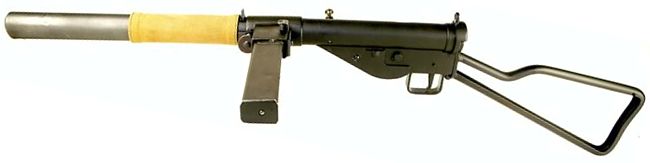
Sterling L34A1 / Mk.5 silenced submachine gun.
 Sterling L34A1 / Mk.5 silenced submachine gun.
 
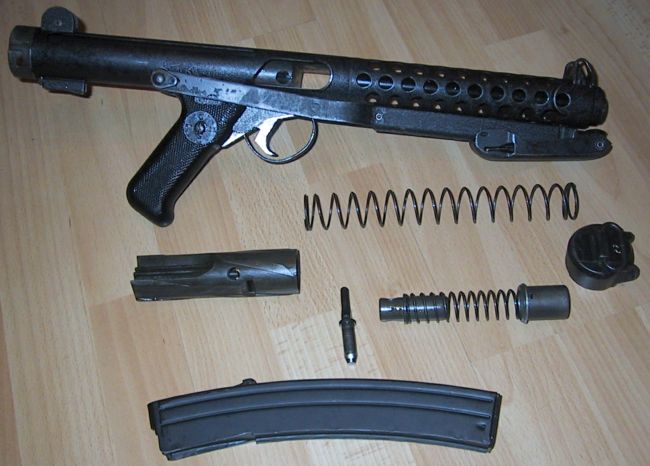
Sterling L2A3 / Mk.4 submachine gun, partially disassembled.
 Sterling L2A3 / Mk.4 submachine gun, partially disassembled.
Image: Frank Rodyns, Belgium

Characteristics

  Sterling L2A3 Sterling L34A1 silenced
Caliber 9x19mm Luger/Parabellum/NATO
Weight, empty 2,7 kg 3,6 kg
Length (stock closed/open) 481 / 686 mm 660 / 864 mm
Barrel length 196 mm 196 mm
Rate of fire 550 rounds per minute  550 rounds per minute
Magazine capacity 34 rounds 34 rounds
Effective range 200 meters 50-100 meters
 
The famous Sterling submachine gun was born in around 1942 as "Patchettmachine carbine" - a prototype submachine gun, developed by George W.Patchett and originally produced by Sterling Engineering Co in England. Several prototypes were built before the end of the war, and the Sterling-Patchett submachine gun participated in extensive trials, held in UK between 1945 and 1953, when it was finally announced as a winner of trials, and adopted as"9mm Sterling submachine gun L2A1" (factory designation was"Patchett Mk.1"). Sterling submachine guns were produced for British armed forces by Sterling company and Royal Ordnance Arsenalin Fazakerly, England; Long Branch Arsenal in Canada made a slightly modified Sterling under license for Canadian army as C1. In a slightly modified form,known in British service as L2A3 submachine gun or as "Sterling submachine gun, Mark 4" or Sterling Mk.4 in short, it served with British army until early 1990s, when it was finally replaced by troublesome L85A1 assault rifle. Nearly 400 000 of Sterling submachine guns were produced until late 1980s. In 1967, British army adopted the L34A1 /Sterling Mk.5 silenced submachine gun, which is apparently still in limited use with certain special operations elements in British army.
 Sterling submachine guns also were widely sold for export, more than 70 countries had purchased various quantities of Sterling submachine guns.
 It must be noted that Sterling submachine guns were rather popular among British troops, because of relatively compact size, adequate firepower and acuracy andgood reliability.
L2A3 /Sterling Mk.4 submachine gun is blowback operated, selective fired weapons that fires from open bolt. The fire mode selector / manual safety lever is located on the left side of trigger unit, above the grip panel. Tubular receiver, which also serves as a barrel jacket at the front, contains a cylindrical bolt with fixed firing pin. Bolt body has several spiral grooves on its outside surface which collect the dust and fouling from inside the receiver, and thus greatly improve reliability of the gun under field conditions. Feeding is from the left side;magazines are inserted horizontally, and ejection is to the right. Magazines are of slightly curved shape for improved feeding reliability. Buttstock is made from stamped steel and folds down and below the receiver to save space. Standard sights include protected front blade and flip-up rear aperture sight, marked for100 and 200 yards range, and also protected from sides by sturdy"ears".
 Special "high power, submachine-gun only" ammunition was procured by British army for Sterling submachine guns. This ammunition was absolutely safe in Sterling submachine guns, but can cause extensive wear to many 9mm pistols designed for commercial 9x19 ammunition.
 L34A1 /Sterling Mk.5 silenced submachine gun differed in the barrel section, as its barrel has some 72 small holes used to vent powder gases into the rear expansion chamber of the integral silencer. This was necessary to decrease the muzzle velocity of the bullet so it would be below the speed of sound. Like its predecessor, the STEN Mk.IIS, the silenced Sterling gun was intended to be fired mostly in semi-automatic mode; the full-automatic fire was for emergency purposes only.

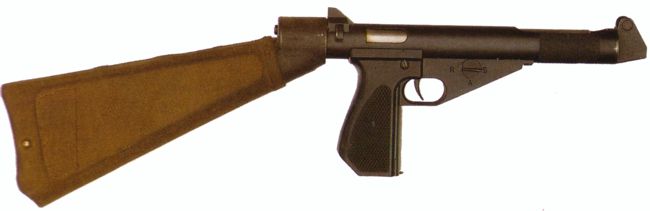
MCEM-2 experimental

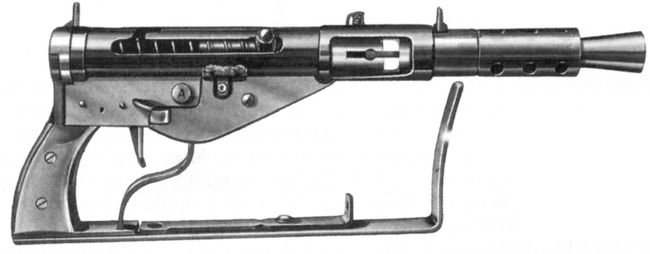
MCEM-2 experimental submachine gun, with shoulder stock / holster attached.
 MCEM-2 experimental submachine gun, with shoulder stock / holster attached.

Characteristics

Caliber 9x19mm Luger / Parabellum
Weight 2,7 kg empty
Length (stock closed/open) n/a
Barrel length n/a
Rate of fire ~ 1000 rounds per minute
Magazine capacity 18 rounds
Effective range ~50-100 meters

MCEM-2 (Machine Carbine Experimental Model 2) submachine gun was produced only in prototype form, but it is worth to mention by the simple fact that it is one of the very first submachine guns to combine wrap-around bolt and magazine in pistol grip - features, later copied in Czechoslovak SA23, Israeli Uzi and a great number of other submachine guns. MCEM-2 was the second prototype in a line of experimental submachine guns, designed in Britain in 1944. It was envisioned as a possible replacement for the STEN submachine gun then inservice. The MCEM-2 was developed by polish immigrant, someone called Podsenkowski. It is believed that prototypes of MCEM-2 were made before the endof WW2, and its derivatives MCEM-4 and MCEM-6 were tested soon after the war.The latter modifications differed mostly in adoption of the rate-reducing mechanism, incorporated into trigger unit; the rate of fire therefore was decreased from 1000 to more realistic 700 rounds per minute. Nevertheless,neither prototype was found suitable for adoption, and several years later British army adopted a more conventional submachine gun, the Sterling-Patchett.
MCEM-2is blowback-operated, selective fired weapon which fires from open bolt. Thebolt is of "telescoped", or "wrap-around" type, with most of its mass being in front of the breech face. The receiver is made from steel tube, and pistol grip with trigger unit is attached below. magazine is inserted into the pistol grip. safety and fire mode selector are incorporated into one three-position switch, located in front of the trigger on the left side of the trigger unit housing. The guns was developed along with large semi-rigid holster, which can be attached to the receiver of the gun to form the shoulder stock.

Lanchester Mk.1

Left side view on Lanchester Mk.1 submachine gun, with 50-round magazine inplace.
 Left side view on Lanchester Mk.1 submachine gun, with 50-round magazine inplace.
 
 Right side view on Lanchester Mk.1* submachine gun, without fire mode selectorand with simplified rear sight. Bayonet lugs are clearly visible near the muzzle.
 Right side view on Lanchester Mk.1* submachine gun, without fire mode selectorand with simplified rear sight. Bayonet lugs are clearly visible near the muzzle.

Characteristics

Caliber 9x19mm Luger / Parabellum
Weight 4,3 kg empty
Length 751 mm
Barrel length 200 mm
Rate of fire 600 rounds per minute
Magazine capacity 50 rounds
Effective range 150-200 meters

The Lanchester Mk.1 submachine gun, or Lanchester Mk.1 machine carbine incontemporary British nomenclature, was a very close copy of German SchmeisserMP-28 submachine gun. It was developed by George H. Lanchester andmanufactured by Sterling Engineering Co between 1941 and 1945. This weapon wasmade in two versions, Mk.1 and Mk.1* (Mark 1, star). The latter was a simplifiedversion of the original Mark 1, with omitted fire mode selector, and thus firing in full automatic mode only. Most Lanchester submachine guns went for BritishNavy.
The Lanchester Mk.1 submachine gun  is blowback operated, selective-fire weapon that firedfrom open bolt. Tubular receiver was attached to the front of the wooden stock,and could be pivoted barrel down for maintenance and disassembly. Magazines areinserted from the left side, ejection is to the right. Magazine housing was made from brass. Manual safety is made in the form of locking cut, made in the receiver, which engages the bolt handle to lock bolt in open (cocked) position. Fire mode selector was located in front of the trigger, and was not present on Mk.1* weapons. Standard sights consisted of blade front and tangent rear sight, marked from 100 and up to 600 yards (approx 550meters). Some Mk.1* guns had simplified, flip-up rear sights marked for 100 and200 yards. The wooden stock was patterned after that of Lee-Enfield rifle, and gun accepted 1907-pattern knife-bayonet, originally developed for the above mentioned rifle.

STEN submachine guns

STEN Mk.I (STEN Mark 1) submachine gun, with magazine removed.
 
STEN Mk.II (STEN Mark 2) submachine gun.
 
STEN Mk.IIS (STEN Mark 2 Silenced) submachine gun.
 
STEN Mk.III (STEN Mark 3) submachine gun.
 
STEN Mk.IV (STEN Mark 4) submachine gun.
 
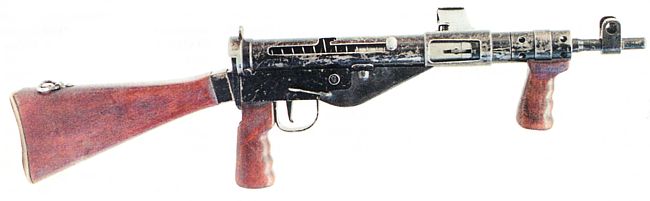
STEN Mk.V (STEN Mark 5) submachine gun.
 
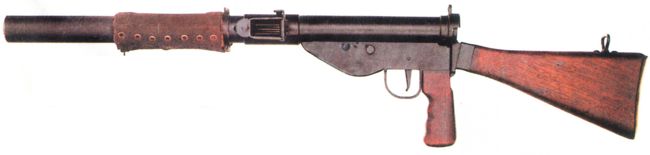
STEN Mk.VI (STEN Mark 6 silenced) submachine gun.

Characteristics

  STEN Mk.II STEN Mk.IIS STEN Mk.III STEN Mk.V
Caliber 9x19mm 9x19mm 9x19mm 9x19mm
Weight, empty  3,26 kg  3,48 kg  3,18 kg 3,86 kg
Length 895 mm 900 mm 762 mm 762 mm
Barrel length 196 mm 90 mm 196 mm 196 mm
Rate of fire 550 rounds per minute 450 rounds per minute 550 rounds per minute 600 rounds per minute
Magazine capacity 32 rounds 32 rounds 32 rounds 32 rounds
Effective range 150-200 meters 50-100 meters 150-200 meters  150-200 meters

The STEN name came out of names of the designers (R. V. Shepard and H. J. Turpin) and from the factory where they worked (Enfield arsenal). It was one of the most crude and ugly and simply, but effective submachine guns of the WW2. Almost 4 millions of STEN guns of different versions were made between 1941 and 1945. STEN guns were made not only in Royal Small Arms factory in Enfield; other makers included famous British gunmaking company of the time BSA Ltd, as well as Royal Ordnance Arsenal in Fazakerly, England, and Long Branch Arsenal in Canada.
The first STEN, STEN Mk.I (full official name was 9mm STEN Machine Carbine, Mark 1), was developed in mid-1941. It was blowback operated, automatic weapon that fired from the open bolt. Trigger unit permitted for sigle shots and full automatic fire, controlled by the cross-bolt type button, located in front and above trigger. The tubular receiver and the barrel shroud were made from rolled steel. The gun was fed from left side mounted box magazines. The stock was of skeleton type, made from steel. Sights were fixed, pre-adjusted for 100 yards distance, peep hole rear and blade front. The Mk.1 featured spoon-like muzzle compensator. Some guns featured small folding forward grip. Total production of Mark 1 and slightly modified Mark 1* STEN machine guns was about 100 000.
The STEN Mk.II submachine gun was most widely made gun in entire STEN series, with about 2 millions of Mark 2 being made during the war. It was slightly smaller and lighter than Mk.I. Basic design was the same as Mark 1, with omission of all wooden parts of Mk.I and shorter barrel jacket, which made the Mk.II lighter than its predecessor. Magazine housing could be rotated for about 90 degrees down to close feed and ejection apertures during transportation and off-battle carry (this feature caused much troubles as the rotary unit was not very durable and magazine could be misaligned during combat, what led to feed malfunctions and jams). Another source of problems was magazine spring, so magazines were routinely loaded with 28-30 rounds instead of "full capacity" 32 rounds to reduce strain on the magazine spring.
Some Mk.II STEN guns were manufactured with integral silencers for undercover operations and were marked as Mk.II(S). These guns had shortened barrels enclosed into integral silencer. The silencer was rather effective so most audible sound when firing Mk.IIS was the clattering of the bolt moving back and forth in the receiver. Contemporary manuals advised that Mk.IIS submachine gun was to be fired in semi-automatic mode; the ful-automatic fire was reserved for emergency situations, as it decreased the service life of  silencer significantly.
The STEN Mk.III was modification of Mk.I. The major change was that the receiver and the barrel shroud were made from single tube (wrapped from sheet-steel and welded at the top) that extended almost to the muzzle. Another changes included fixed magazine housing for improved reliability and small finger guard in the front of the ejection port. Internally, Mk.III was similar to Mk.I and has same variety of skeleton stocks. Mk.III first appeared in 1943.
The STEN Mk.IV was made in experimental form only, and did not entered the production. It was originally intended for airborne troops.
The STEN Mk.V submachine gun was an attempt to made Mk.II a more "good looking'" gun. Being internally the same as Mk.II, the "STEN Mk.V machine carbine" featured wooden buttstock and rear pistol grip, new front sight and bayonet mount. Early Mk.V's also featured wooden front grips, but these were prone to breakage and thus were removed soon. STEN Mk.V appeared in 1944 and remained in service until the early 1960s', and then replaced by Sterling submachine guns.

Taurus MT-9 G2 and MT-40 G2

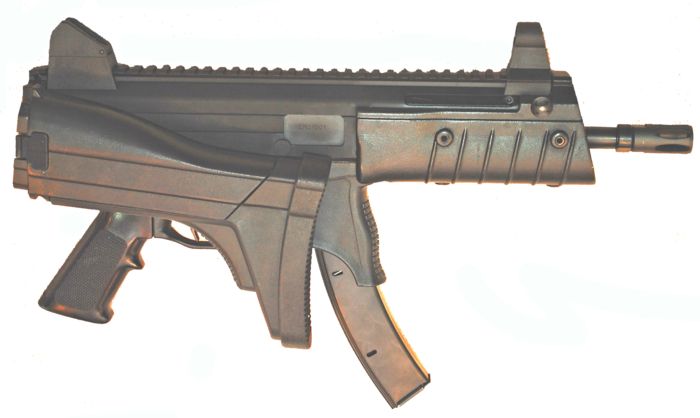
Taurus MT 9 G2
Taurus MT G2 submachine gun
 
Taurus MT 9 G2
Taurus MT G2 submachine gun with shoulder stock folded


MT9 G2
MT40 G2
Caliber, mm
9x19 mm
.40 SW
Length, overall, mm
466 / 753
466 / 753
Weight, kg
3,29
3,29
Barrel length, mm
200
200
Magazine capacity, rounds
34
15 and 30
Rate of fire, rounds per minute
700-800
700-800
 
The Taurus MT G2 line of submachine guns first appeared in early 2011, apparently to replace older Taurus MT submachine guns in same calibers. These weapons represent 2nd generation of Taurus submachine guns, hence the apparent G2 addition to the name. Compared to 1st generation weapons, new Taurus MT G2 submachine guns offer more noticeably lower and controllable rate of fire, better ergonomics and probably more economical production, thanks to use of more modern manufacturing techniques. It is yet to be seen if these weapons will be adopted by any major force, though. Taurus also offers a semi-automatic version of the G2 line, known as CT G2, which is intended primarily to civilian and security markets.
 
The Taurus MT9 G2 and MT40 G2 sub-machine guns differ only in caliber. Both weapons are built using simple blowback action and firing from closed bolt for enhanced accuracy. Upper receiver is an extruded aluminum unit, while lower receiver is made from polymer with steel reinforcements where necessary. Weapon is fitted with ambidextrous safety / fire mode selectors which allow for semi-automatic fire, 2-round burst mode and full-automatic fire. Bolt catch is provided to hold the bolt open once the magazine is empty. Feed is from proprietary double stack box magazines, holding 34 rounds of 9mm ammunition of 30 or 15 rounds of .40SW ammunition. Furniture includes AR-15 type pistol grip and side-folding buttstock, made of plastic and adjustable for length of pull. Top of upper receiver is provided with integral Picatinny rail, and the MT G2 submachine guns are normally fitted with iron sights; rear sight has two range settings, for 25 and 50 meters. Additional mounting points for more Picatinny rails are provided on the sides and on the bottom of the polymer forend.

Taurus MT-9 and MT-40

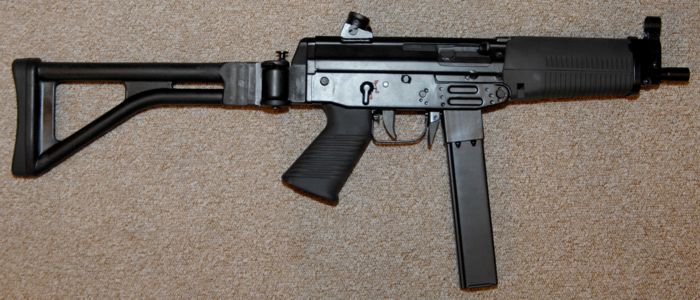
Taurus MT-9
Taurus MT-9 submachine gun
 
 
MT-9
MT-40
Caliber, mm
9x19 mm
.40 SW
Length, overall, mm
421 / 677
421 / 677
Weight, kg
3.06
3.0
Barrel length, mm
200
200
Magazine capacity, rounds
30
30
Rate of fire, rounds per minute
1300
1200
 
During the 1990s Taurus replaced in production its MT-12A submachine gun (licensed copy of the Beretta PM-12) with another foreign design, this time purchased from Chile. Originally known as the FAMAE SAF, in Brazil it is made in a slightly modified form as the Taurus MT-9 (in 9mm Luger) and MT-40 (in .40SW, especially for the Brazilian police forces that favour this caliber). In this case, the MT index stands for Metralhadora Taurus – Taurus Submachine gun, and the digits denote a caliber. Taurus also makes an interesting offshoot of the MT-40, the CT-40 semi-automatic carbine, which is also intended for police and security use but is restricted to semi-automatic fire and has somewhat longer barrel.
 
The Taurus MT-9 and MT-40 sub-machine guns differ only in caliber. The MT-9 is based on the receiver and trigger group of the 5.56mm SG-540 assault rifle, made in Chile by FAMAE under license from the Swiss SIG company. The basic rifle receiver is shortened in the magazine area to accommodate the more compact pistol caliber rounds, and the gas operated action is replaced by a simple unlocked bolt (blowback action). The rifle trigger group with an internal hammer and three modes of fire (single shots, 3-round bursts or full-automatic) is retained, and the gun is fired from a closed bolt. A bolt hold-open device is provided, with a bolt release button located on the left side of the receiver, above the magazine catch. Fire mode selector levers are located on both sides of the receiver and also work as manual safeties. The receiver itself is made from two halves, upper and lower, both manufactured from stamped steel and connected at the front by a hinge. the pistol grip and forend are made from polymer. The gun is equipped with a side-folding skeletonized butstock. Standard sights include a protected front post and a combination drum-type rear, which has a V-type notch for 50 meters range and apertures for 100 and 150 meters.

 
Design by Free WordPress Themes | Bloggerized by Lasantha - Premium Blogger Themes | Online Project management