Tampilkan postingan dengan label Belgium. Tampilkan semua postingan

Jumat, 21 Juni 2013

Browning Auto-5

Browning Auto-5 / A5 and Remington model 11 shotgun (Belgium, USA)

Browning Auto-5shotgun of early Belgian manufacture, left side.
 Browning Auto-5shotgun of early Belgian manufacture, left side.

 Browning Auto-5 shotgun of early Belgian manufacture, right side.
  Browning Auto-5 shotgun of early Belgian manufacture, right side.

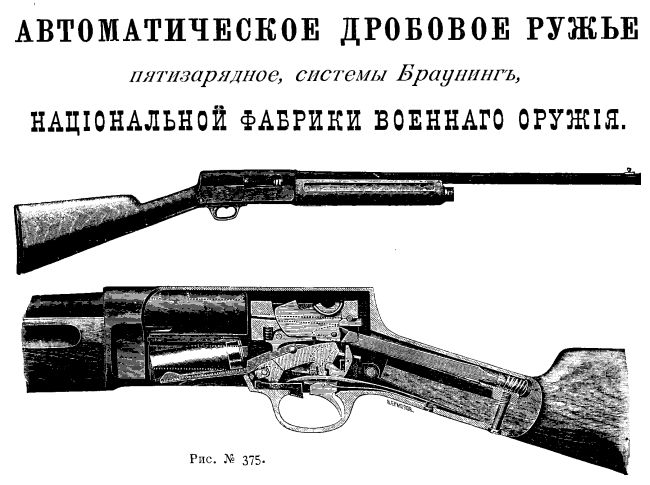
Advertising from pre-WW1 era Russian mail-order hunting supplies catalog that offered
  Advertising from pre-WW1 era Russian mail-order hunting supplies catalog that offered "New autoloading shotgun, five-shot, Browning system, made by Fabrique Nationale".


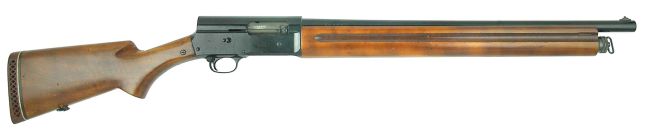
 BrowningAuto-5 "12 gauge Light model" shotgun of late Belgian manufacture.
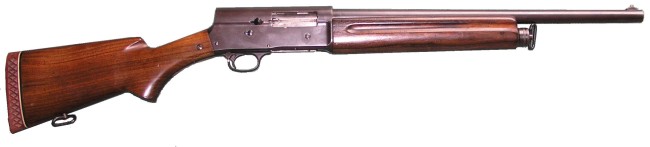
BrowningAuto-5 shotgun of Belgian manufacture in military configuration, as used by British forces under L32A1 designation.
  BrowningAuto-5 shotgun of Belgian manufacture in military configuration, as used by British forces under L32A1 designation.

 BrowningAuto-5 shotgun of Belgian manufacture, special version for police use,with factory extended 8-round magazine.

 BrowningAuto-5 shotgun of Belgian manufacture, special version for police use,with factory extended 8-round magazine.

Early productionRemington model 11 shotgun, commercial model.
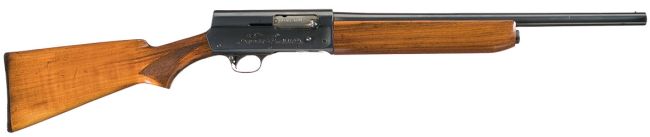
 Early productionRemington model 11 shotgun, commercial model.

Remington model 11shotgun in
 Remington model 11shotgun in "Riot" configuration, for police or guard use.

Remingtonmodel 11 shotgun with recoil pad and Cutts compensator, as used by USAFduring WW2 to train aircraft machine gunners.
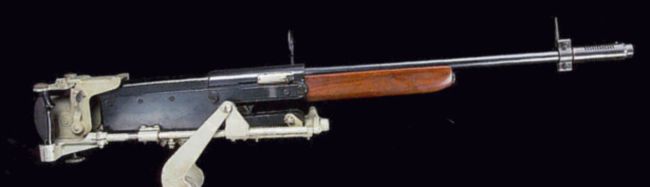

Remingtonmodel 11 shotgun set up into special mount to emulate aircraft machine gun. This setup was used by US Air Force during WW2 to train aircraft machine gunners on shooting at moving targets.
  Remingtonmodel 11 shotgun set up into special mount to emulate aircraft machine gun. This setup was used by US Air Force during WW2 to train aircraft machine gunners on shooting at moving targets.

Type:semi-automatic, recoil operated
Gauge:12, 16 and 20
Length: varies with model
Barrel length: varies with model
Weight varies with model
Capacity: 4 rounds in underbarrel tube magazine

John Moses Browning, the legendary American gun designer, invented thefirst practical self-loading shotgun in 1898. In fact, Browning designed and patented three different systems, but finally choose the last one to go ahead. It must be noted, that at the time the autoloading shotgun was something of absolute novelty, and the task of designing such gun was severely complicated by the fact that the switch over from black powder to smokeless ammunition was well under way, and general quality of shotgun ammunition was rather uneven,to say the least. Nevertheless, Browning managed to make hist prototype model work, and work well. He first offered this shotgun to Winchester,which was the sole buyer for his designs from 1886 on. However, severe technical conservatism on the part of the Winchester's boss,T.G.Bennett, and financial disagreements (Browning insisted on royalty-based payments, but Winchester at the time always bought new designs for fixed amount of money) resulted in break between the designer and the company. Browning then turned to Remington, but tragicdeath of the Remington's president from hear attack just minutes before scheduled meeting with Browning put an end to this route as well. Browning thenturned to the Belgian company Fabrique Nationale (FN), which at this time (1901) produced first Browning-designed self loading pistol (M1900)as fast as it could be made. FN management greeted Browning and his new gun with great enthusiasm, and in a short while FN produced the first FN Browning autoloading shotgun, known as Browning Auto 5, or A-5 inshort. Browning himself ordered 10,000 A-5 shotguns from the first batch for sales and distribution in USA, and sold all 10 thousands in about a year. Following the introduction of the new, increased custom tariffs by US government, Browning found that it was economically not reasonable to import more A-5 guns into USA, so he pursued FN to release rights tomake and sell Browning auto loading shotgun on US market to RemingtonArms Co (FN originally had worldwide rights for manufacture of Auto 5).In 1906 Remington offered the Browning-designed auto loading shotgun as Model 11, and manufactured it without interruption until 1947, with well over 800,000 guns made. Between 1949 and 1968 Remington also produced an updated (lightened and streamlined) version of the Browning's design, known as Remington Model 11-48. The FN produced Browning Auto 5 shotguns continuously (with interruptions for German occupation during both World Wars) until 1999, making Auto-5 probably the most successful and longest-producing sporting shotgun in the history. Overall output of Auto-5 shotguns made and sold by FN (During WW2, A-5 shotguns were made for Browning Arms Co by Remington, and since mid-1970s Auto-5 shotguns were also produced for FN in Japan by Miroku, under FN license) over the century well exceeds two million guns (2,000,000th Auto-5 was produced in 1970). Total estimate of worldwide production numbers for this legendary Browning design is well over three million guns.
 Copies and clones of the Auto-5 shotgun were also manufactured in Italy by Franchi and Breda, in USA by Savage and in USSR / Russia by TOZ, and by some other manufacturers around the world. Many Auto-5 guns, made many decades before, are still used for hunting and shooting today, but, as time goes, Browning Auto-5 shotguns increasingly become collector's pieces.
Over the time, both FN and Remington produced wide variety of versions of the basic design. Hunting guns were made with plain or ribbed barrels of various lengths and gauges(12, 16 and 20), with magazine capacities of 4 or 2 rounds, various stocks, finishes etc. For police and military applications, FN andRemington created shorter-barreled shotguns with plain barrels. Many Remington guns have seen extensive use by US police and securityservices; US military also used Remington shotguns to train AA and aircraft gunners in shooting at fast-moving flying targets (clay pigeons), usingtraditionally stocked guns or guns, mounted in special fixtures to emulate aircraft machine guns. Belgian-made guns have seen less military service, although British army issued more than few A-5 shotguns as L32A1 during Malay counter-insurgency operations and later.
BrowningAuto-5 shotgun uses recoiling barrel to operate its action. The system is of so-called long-recoil type, as barrel and bolt recoil together for entire length of the recoil stroke, being securely locked by pivoting piece, installed in the bolt. This piece, when pivoted up, engages the cut in the barrel extension with its large locking lug. Upon completion of the full recoil path, the bolt is arrested in the rearmost position,and the locking piece inside it is tipped down to release the barrel.Barrel, under pressure of its own return spring, located around the magazine tube, slams forward, leaving the empty shell on the bolt face.Once the empty shell is clear of the barrel, it is ejected out of the gun. When barrel comes to the rest in the forward position, it automatically releases bolt catch, allowing the bolt to run forward,picking the fresh cartridge from the raised cartridge lifter, and locking the to the barrel at the end of the forward run. Bolt return spring is located in the butt. To achieve reliable functioning with wide variety of loads, Browning used self-adjusting friction brake in the recoil system, which consisted of several (one or two, dependingon the exact model) friction rings, located around the magazine tube.The tubular magazine holds four rounds; fifth one can be loaded into the chamber, making the total capacity of five rounds. One importantdifference between FN Auto-5 and Remington Model 11 shotguns is that the FN guns had a magazine cut-off lever, located on the left side of the receiver. This lever, when turned to the rear, locks the cartridgesin the magazine, allowing for quick replacement of the loaded round with another (presumably, with different type of projectile(s), i.e.shot to slug or vice versa). Remington shotguns did not have this feature.

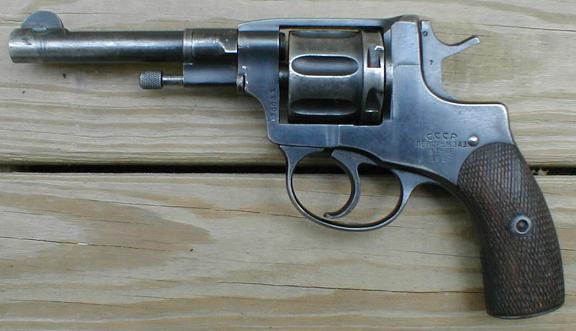
Nagant model of 1895

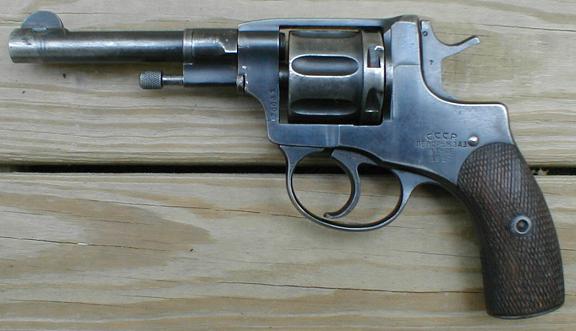
Russian-made Nagant revolver (circa 1925)

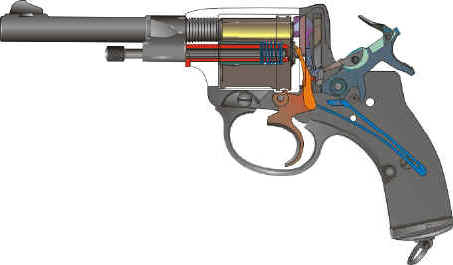
Cut-out view of the M1895 Nagant revolver

 
Type: Double Action
Chamber: 7.62mm Nagant
Weight unloaded: 750 g
Length: 230 mm
Barrel length: 114 mm
Capacity: 7 rounds

This revolver was designed in Belgium by Nagant brothers (Emile and Leon) in the late 1880s - early 1890s, and was adopted by numerous countries, including Sweden and Poland, but the major user and manufacturer was undoubtfully Russia (and later Soviet Union). Russian government adopted Nagant revolver in 1895, and local production began in 1898 (first shipments were from Belgium). It was a standard russian sidearm until 1930, when M1895 Nagant was declared obsolete, but it was widely used and manufactured during World War 2, and manufacture was finally ceased circa 1950.
Later, some sporting revolvers, both in 7.62mm and in .22LR were developed on Nagant platform. Intertestingly enough, the M1895 revolvers still can be seen carried by some security personnel in Russia, especially by Railroad Security and by some armed guards. Usually, those revolvers are 2 to 4 times older than men who carry these guns.
From technical point of view, Nagant revolvers were already almost outdated at the moment of its adoption in 1895, since newest revolvers like S&W Hand Ejectors or Colts with side-opened cylinders were much faster to reload. On the other hand, M1895 had some unusual and interesting features, one of which was gas sealed cylinder, which made the Nagant a rare example of revolver suitable for mounting a silencer. Such a practice was known by NKVD and some Red Army special forces (recon and scouts) during WW2. Special silencer, called "Bramit device" was designed by Mitin brothers and could be mounted on the barrel.
M1895 Nagand was a solid frame, seven shot revolver with non-removable cylinder. The loading and unloading was committed wia the loading gate at the right side of the frame, one cartridge by one. Spent cases were ejected by the ejector rod, which, when not in use, was concealed within the cylinder axis and swung to the side on the ejector rod link to be used. Original guns were double action ones, but Tsarists government ordered that some of M1895 should be retrofitted with Single Action triggers and issued to enlisted men, and DA guns should be issued only to the Officers and Police. In Red (Soviet) army only Double Action Nagants were issued.
The gas sealed cylinder, mentioned above, was made to use all of powder gases to propel the bullet (in most revolvers some gases escape from the gap between the cylinder face and barrel breech). To achieve that, the cylinder moves ahead a bit when hammer is cocked, enclosing a barrel breech area with recess in the front of each chamber. The cartridge, unique to that design, had long case with tapered mouth and a bullet totally enclosed inside the case. When cylinder moves forward, the cartridge case mouth entered the barrel breech and was used as additional seal. This was a complicated mechanism, useful mostly when guns were used with silencer.
Being somewhat complicated and relatively slow to reload, with ammunition of marginal power, Nagants were otherwise good guns, reliable, acurate and quite popular among the troops.

Kamis, 20 Juni 2013

Revolver FN Barracuda

FN Barracuda revolver with .357 magnum cylinder installed

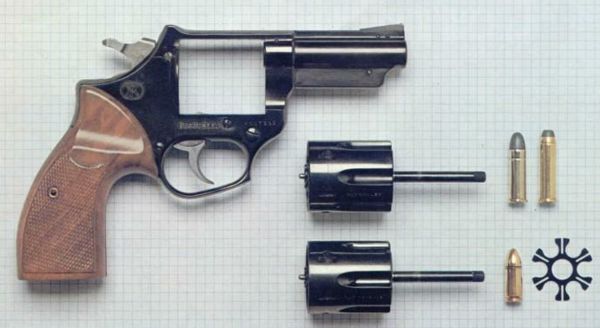
FN barracuda revolver with both cylinders removed (.357 / .38 top, 9x19 bottom). Also shown are cartridges of respective caliber and steel clip for 9x19 ammunition
Image: FN Herstal - promotion pamphlet

TypeDouble Action revolver
Caliber(s) .357 Magnum / .38 Special and 9x19 Luger, interchangeable
Weight unloaded1050 g
Length211 mm
Barrel length76 mm (3")
Capacity6 rounds

The "Barracuda" revolver was the only known attempt of famous company FN Herstal to produce a revolver. It was developed during early 1970s and offered for police sales in 1974. This weapon was developed as a versatile police sidearm, suitable for both European and American markets. At the time, US police market was dominated by .38 Special and .357 magnum revolvers, and European police market was mostly dominated by pocket-type automatic pistols with trends mowing toward 9x19 Luger caliber. Considering all that, as well as a very close similarity in bullet diameter of all those rounds, FN decided to produce a revolver that could interchangeably fire all those rounds. To change between "American" .357 / .38 calibers and "European" 9mm Luger / Parabellum, one must simply install an appropriate cylinder to a basic gun frame. As the 9mm ammo is rimless, to achieve reliable extraction and fast loading, 9mm rounds are loaded using special star-shaped flat clips that hold 6 rounds together. Rimmed revolver rounds are extracted using their rims, and can be loaded one by one or 6 rounds at once using speedloaders developed for Smith&Wesson K-frame revolvers. 9mm rounds also can be loaded one by one without clip, but extraction would be problematic.
FN revolvers were of good quality, but somewhat heavy and came to the market a bit too late to sell well. It is believed that FN manufactured several thousands of those guns during mid-seventies.
The FN "Barracuda" revolver is more or less traditional double-action revolver with swing-out cylinder. Firing pin is installed in the frame of the gun for better safety. It is of all-steel construction, with solid frame and heavy, lugged barrel. Only one barrel length of 3 inches (76mm) was available. Sights were fixed, with the front sight blade pinned to the barrel. 
Barracuda revolvers were promoted as multi-caliber and thus ought to have two removable cylinders, one for .38 and .357 caliber rimmed revolver ammunition, and another for rimless 9x19 pistol ammunition. each cylinder was marked with its respective caliber. It must be noted, however, that 9mm cylinders seem to be quite rare, and most available guns are in .38 / .357 caliber only. 
It is NOT advisable to load 9x19 cartridges into cylinders NOT marked for this ammunition.

Nagant model of 1895

Russian-made Nagant revolver (circa 1925)

Cut-out view of the M1895 Nagant revolver

 
Type: Double Action
Chamber: 7.62mm Nagant
Weight unloaded: 750 g
Length: 230 mm
Barrel length: 114 mm
Capacity: 7 rounds

This revolver was designed in Belgium by Nagant brothers (Emile and Leon) in the late 1880s - early 1890s, and was adopted by numerous countries, including Sweden and Poland, but the major user and manufacturer was undoubtfully Russia (and later Soviet Union). Russian government adopted Nagant revolver in 1895, and local production began in 1898 (first shipments were from Belgium). It was a standard russian sidearm until 1930, when M1895 Nagant was declared obsolete, but it was widely used and manufactured during World War 2, and manufacture was finally ceased circa 1950.
Later, some sporting revolvers, both in 7.62mm and in .22LR were developed on Nagant platform. Intertestingly enough, the M1895 revolvers still can be seen carried by some security personnel in Russia, especially by Railroad Security and by some armed guards. Usually, those revolvers are 2 to 4 times older than men who carry these guns.
From technical point of view, Nagant revolvers were already almost outdated at the moment of its adoption in 1895, since newest revolvers like S&W Hand Ejectors or Colts with side-opened cylinders were much faster to reload. On the other hand, M1895 had some unusual and interesting features, one of which was gas sealed cylinder, which made the Nagant a rare example of revolver suitable for mounting a silencer. Such a practice was known by NKVD and some Red Army special forces (recon and scouts) during WW2. Special silencer, called "Bramit device" was designed by Mitin brothers and could be mounted on the barrel.
M1895 Nagand was a solid frame, seven shot revolver with non-removable cylinder. The loading and unloading was committed wia the loading gate at the right side of the frame, one cartridge by one. Spent cases were ejected by the ejector rod, which, when not in use, was concealed within the cylinder axis and swung to the side on the ejector rod link to be used. Original guns were double action ones, but Tsarists government ordered that some of M1895 should be retrofitted with Single Action triggers and issued to enlisted men, and DA guns should be issued only to the Officers and Police. In Red (Soviet) army only Double Action Nagants were issued.
The gas sealed cylinder, mentioned above, was made to use all of powder gases to propel the bullet (in most revolvers some gases escape from the gap between the cylinder face and barrel breech). To achieve that, the cylinder moves ahead a bit when hammer is cocked, enclosing a barrel breech area with recess in the front of each chamber. The cartridge, unique to that design, had long case with tapered mouth and a bullet totally enclosed inside the case. When cylinder moves forward, the cartridge case mouth entered the barrel breech and was used as additional seal. This was a complicated mechanism, useful mostly when guns were used with silencer.
Being somewhat complicated and relatively slow to reload, with ammunition of marginal power, Nagants were otherwise good guns, reliable, acurate and quite popular among the troops.

Sabtu, 26 Januari 2013

FN P90 personal defense weapon

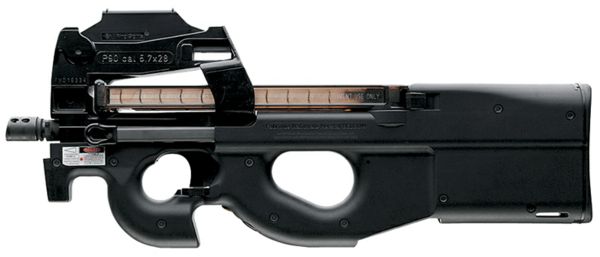
FN P90 personal defense weapon / submachine gun in basic configuration, left side.
 
FN P90 personal defense weapon / submachine gun in basic configuration, right side.
 
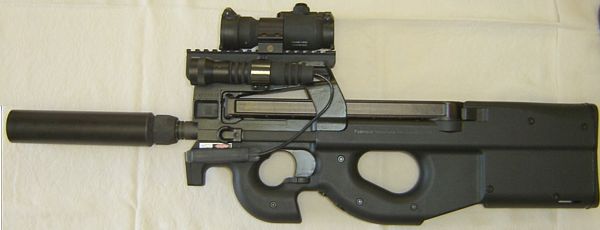
FN P90 TR (triple rail version) personal defense weapon / submachine gun, with installed accessories including optical sight on top rail, flashlight on left rail, and silencer on the barrel.
 
FN PS90 - a civilian semi-automatic only version of P90 with long barrel.
 
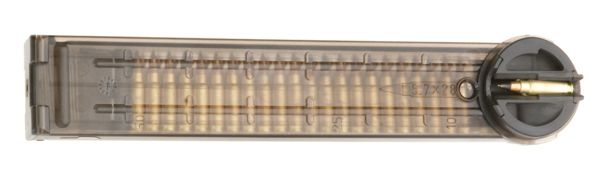
Bottom view on the filed FN P90 magazine, showing position of the stored cartridges and cartridge in feed position.
 
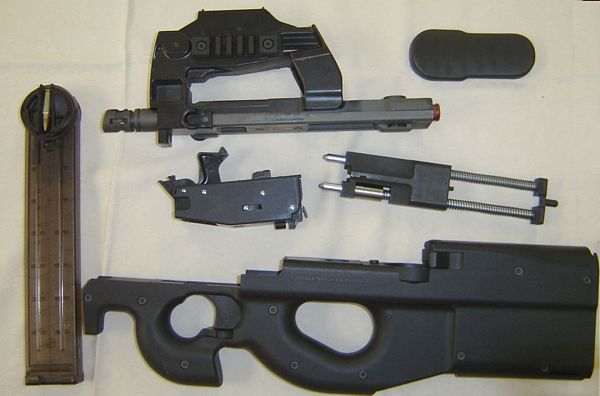
FN P90 partially disassembled.

Characteristics

Caliber: 5.7x28mm SS190
Weight: 2.54 kg empty; 3 kg loaded with magazine with 50 rounds
Length: 500 mm
Barrel length: 263 mm
Rate of fire: 900 rounds per minute
Magazine capacity: 50 rounds
Effective range: 200 meters

The FN P90 submachine gun (SMG) was developed in the late 1980s as a personal defense weapon for the troops whose primary activities does not include small arms, such as vehicle and tank crew members, artillery crews etc. Standard pistols and submachine guns chambered for pistol rounds were proved ineffective against enemy soldiers, wearing body armor; Therefore FN designers first developed a new round with enhanced penetration, initially known as SS90. To achieve necessary high penetration while keeping recoil impulse low, FN used a small-bore approach, creating a round that looked much like the scaled down 5,56NATO round. It must be noted that similar concepts were tried in other countries, most notably in USA, several decades before FN; for example, US Army tested M1 carbines chambered for .221 Johnson Spitfire round back in late 1950s; later on, Colt produced its .22 SCAMP and 5,6x30 MARS ammunition for special SCAMP machine pistol and MARS "mini assault rifle" (a scaled-down M16 rifle) respectively. It must be noted that 5,6x30 MARS round was in a sense a direct predecessor to 5,7x28 FN SS90 round, although the latter featured slightly lighter and faster bullet. By late 1980s a concept of a small-bore, low-impulse "personal defense weapon" (PDW) with good accuracy and lethality at ranges of up to 200-250 meters was well established, although there were no weapons adopted for service yet. FN decided to follow this concept and to create its own PDW using clean sheet approach. Basic ideas used for this development, designated as "Project 9.0", included the following: minimal size and weight of weapon; large magazine capacity; complete ambidexterity; ease of use and maintenance.
To save on size and weight, FN designers put new weapon into compact and lightweight stock of bullpup layout, made of impact-resistant polymer. The high-capacity magazine also was made from semi-translucent polymer, and holds 50 rounds in two rows. To made loaded weapon as compact as possible, FN designers followed the idea of American designer Hall, and placed the magazine above the barrels, with cartridges stored in horizontal position with bullets pointing to the left. While Hall system employed a rotary feed unit, operated by the bolt, to put new cartridge in line with the barrel, FN designers incorporated a stationary helical ramp into each magazine, which rotates cartridge for 90 degrees prior to placing it into feed lips. Complete ambidexterity was achieved by using ambidextrous controls (including dual charging handles and dual back-up open sights), and bottom ejection. Finally, simplicity of aiming was achieved by use of integral reflex type collimating sight and integral laser aiming module (LAM).
Resulting weapon appeared in around 1990 as FN P90 personal defense weapon, along with improved 5,7x28 SS190 ammunition, which replaced polymer-cored bullets with heavier dual-core (steel / aluminum) bullets with better penetration against body armor. Several other types of ammunition were developed for this weapon, including tracer, subsonic ball and soft-core training ball.
First sales of P90 were made to Saudi Arabia in early 1990s; today it is believed that FN sold more than 20 000 of P90's to a wide variety of law enforcement agencies and military special operation units worldwide, including US Secret Service, Austrian Army rangers, Dutch BBE special operations forces, Belgian Army and others. Most interesting fact about adoption of P90 is that so far it has been adopted for the role, directly opposite to its original niche of "personal defense weapon". In fact, most services and agencies that adopted P90 use it for offensive roles, as a specialist or even a primary weapon for various assault teams, and other "professional small-arms users", as opposed to military personnel which primary functions do not include use of small arms.
In around 1995 FN supplemented the P90 with pistol, firing the same 5,7x28 ammunition, designated as FN Five-seveN. Recently, FN also introduced a civilian version of P90, designated as PS90 carbine. This is a self-loading weapon with longer barrel (408 mm / 16").
FN P90 personal defense weapon is blowback operated, selective-fired weapon which fires from closed bolt. The firing is controlled by a removable trigger unit with conventional hammer. A manual safety is located directly below the trigger. Magazine lies at the top of the weapon, feeding from front-to-back, with spiral ramp built into the "rear" part of the magazine. Spent cartridges are ejected straight down through the chute, which exits just behind the pistol grip. The standard sighting equipment includes a non-magnifying collimating sight with "ring and dot" illuminated aiming reticule. Back-up open sights are provided at either side of the primary collimating sight. The so-called P90 USG version is provided with two additional Picatinny rails at either side of the collimating sight base; FN also offers a version with no standard sighting equipment; user has to make its own choice of day and/or night sights and additional equipment, which can be installed on three Picatinny rails - top, left and right. This version is designated as P90 TR (triple rail). The front part of the forward handgrip on P90 is shaped as hand protector, and it can contain integral laser aiming module, which sends either visible or IR laser beam to mark the intended target. For special missions P90 can be fitted with a special silencer, which is used in conjunction with special subsonic ammunition.

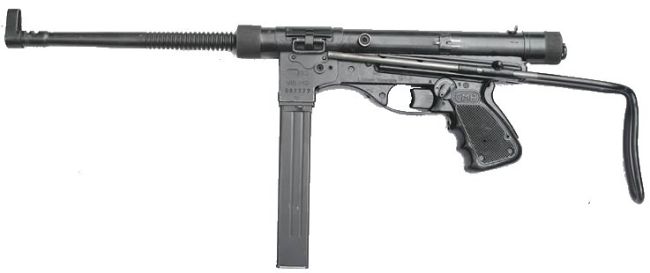
Vigneron M2

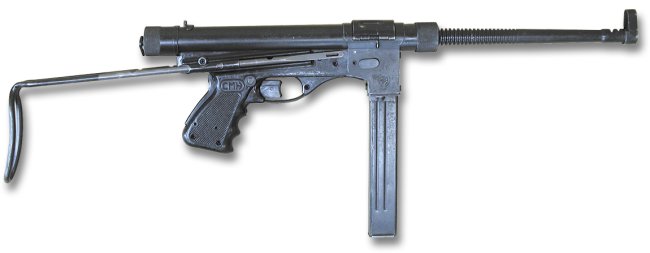
Vigneron M2 submachine gun, right side.
 
Vigneron M2 submachine gun, left side.

Characteristics

Caliber 9x19mm Luger / Parabellum
Weight 3,28 kg empty
Length (stock closed/open) 695 / 872 mm
Barrel length 300 mm
Rate of fire 620 rounds per minute
Magazine capacity 32 rounds
Effective range 100 meters

The Vigneron submachine gun was developed during early fifties by the officer of the Belgian army and produced by Belgian company Precision Liegoise SA. It was adopted by Belgian army in 1953, and saw some combat in then-Belgian Congo. Vigneron submachine gun was quite conventional in design and appearance, and not much more can be told about this weapon.
Vigneron submachine gun is blowback operated, selective fired weapon which fires from open bolt. Fire mode selector / safety switch is located on the left side of the grip, just behind the trigger. It is interesting that in full automatic mode short pull on the trigger will still, produce single shots, and only a long pull will produce full automatic fire. Additional automated safety is built into the backstrap of the pistol grip. Cocking handle is located on the left side of the receiver, and is stationary when gun is fired. Ejection port has a spring-loaded dust cover. Barrel is relatively long and has two ports just behind the front sight base, which serve as a muzzle rise compensator. Sights are fixed, with rear aperture set for 50 meters range. Stock is made from steel wire and is retractable, with several positions so shooter can adjust it to his own preferences.

Jumat, 25 Januari 2013

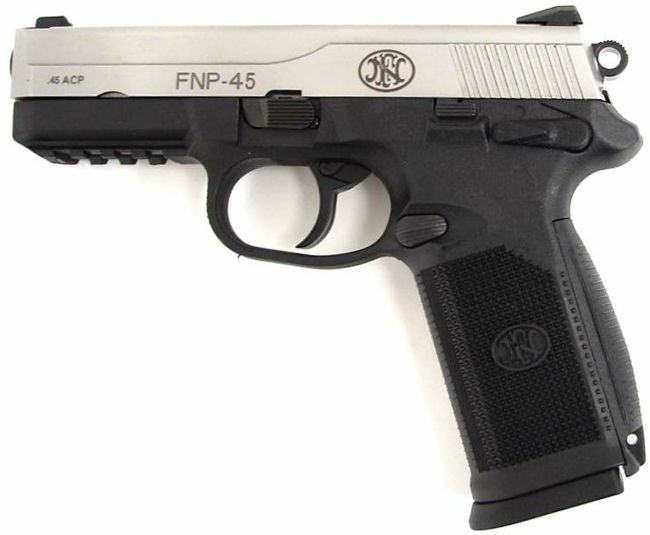
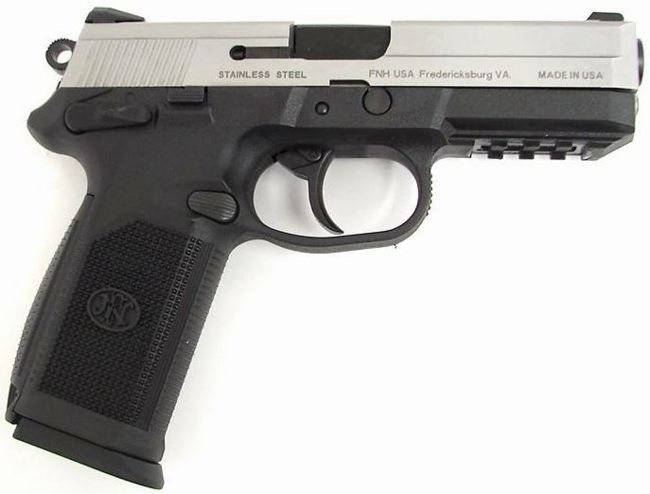
FNP-45

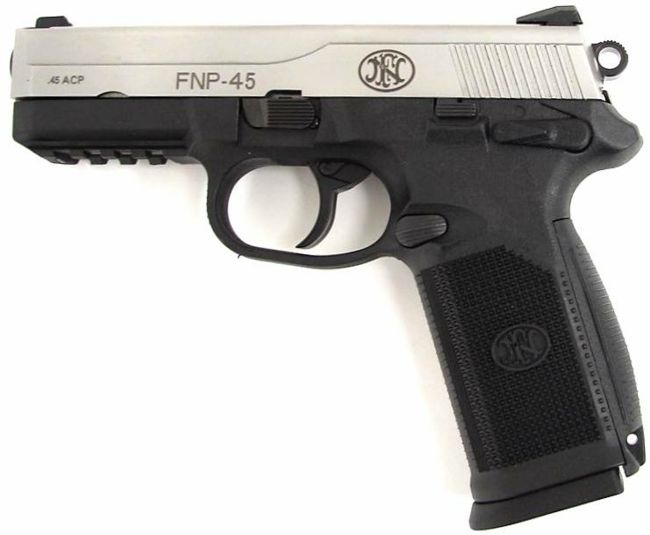
FNP 45 pistol, left side
 
FNP 45 pistol, right side


Type Double Action semiautomatic
Caliber(s) .45ACP (11.43x25)
Weight unloaded 930 g / 32.4oz
Length 200 mm / 7.85"
Barrel length 114 mm / 4.5"
Magazine capacity 14 rounds (10 where required by law)

FNP 45 pistol is the next step in evolution of the FNP 9 / FNP 40 pistols line. First announced in 2007, the FNP 45 is just one of the many new, modern .45 caliber pistols which recently hit the civilian and law enforcement markets in USA. The increased interest in full-size, high capacity .45ACP pistols can be in part attributed to the several unsuccessful attempts of US armed forces to re-adopt this cartridge over the 9x19 NATO in the search of better stopping power. The same reason (combat effectiveness / stopping power) causes many police organizations and civilian shooters to re-think the role of the century-old .45ACP round. FNH USA, the US-based subsidiary of the famous Belgian arms-making company FN Herstal, took this cartridge and developed this serious service-type pistol. Based on its predecessors, FNP 45 is somewhat bigger and heavier than its 9mm/.40 caliber 'older brothers', and is best suited for holster carry. It features improved ergonomics, with fully ambidextrous controls and modular grip backstrap. Front of the frame is shaped to form Picatinny rail which can accept a wide variety of accessories like laser sights or tactical lights. The modular hammer units for FNP 45 are available in two versions - with manual safety that permits "cocked and locked" carry or with decock-only function (gun shall be carried with hammer lowered over the loaded chamber).
The FNP 45 is short recoil operated, locked breech pistol. The barrel is operated using a Browning cam system, and it locks to slide with single lug engaging large ejection port. Frame is made from high impact-resistant polymer. Double Action trigger system with exposed hammer has internal firing pin safety, with decocking or safety levers located at the both sides of the frame. Firing pin safety is standard, and the magazine safety is optional. The trigger / hammer module is formed as a single unit, easily detachable from the frame for inspection, maintenance or replacement. Optional hammer units can be found in DAO variety or in standard DA version but with manual safety / decock levers instead of the basic decock-only levers. Other easily replaceable units include the barrel cradle / slide rail module and the grip backstraps. Grip backstraps are available in two variations, with straight or curved shape. Standard sights are provided with white inserts and are dovetailed into the slide.

Kamis, 24 Januari 2013

Browning BDM

Browning BDM
Browning BDM
 
Browning BDM, another view (total blue finished gun)
 
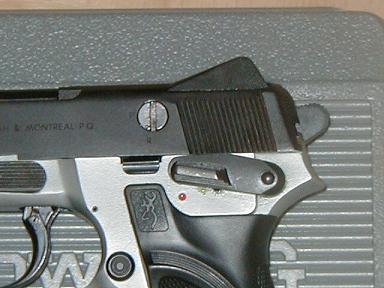
Browning BDM, view on DA / DAO ( P / R ) trigger mode selector


Type: Double Action or Double Action Only manually selective
Chamber: 9x19mm Luger / Parabellum
Weight unloaded: 870 g
Length:
Barrel length: 120 mm
Capacity: 15 rounds

The Browning BDM pistol is an interesting development, that first appeared in 1991 and was in production until late 1990s (maybe 1998 or 1999, not sure). While most of pistols that carry the John Browning name usually were originated from Belgium (models 1910, 1922, "Baby", "High Power", etc), some pistols were made in other countries. Not to mention Colt pistols, designed by Browning, the Browning Arms company of USA imported german-made SIG-Sauer P220 pistols under the name of Browning DA in 1970s. Then came the Browning Buckmark pistol, made in USA. And, finally - the Browning BDM. This gun was designed and produced in the USA by FN manufacturing Inc., an US subsidiary of the Belgian company FN Herstal, who also owned the Browning trade mark, and Browning name is linked to the Belgium (as well as to the USA) for ever, so i voluntary assign the BDM to both countries, with the USA first.
BDM stands for the Browning Double Mode (or Dual Mode), and it's mean that the pistol can be had in either traditional Double Action mode or in Double Action Only Mode ... in the same gun, and the change of mode can take a split a second, not more. It is done via the small slotted switch in the left side of the slide. The switch has two positions, marked "P" and "R". P stands for Pistol, or DA mode, R stands for revolver, or DAO mode. The switch can be turned from one position to another by any sharp-tipped tool such a knife, skrewdriver or even a coin. BDM is equipped with ambidextrous, frame-mounted safety / decocker levers. To engage safety (and decock the hammer in DA mode) one must pull the lever down, and the lever will stay in this position. To disengage safety the lever must be pulled up, so a red dot will show on the frame.
While being quite similar to the Browning BDA pistol, the BDM differs from it in the number of ways. First, being a recoil operated, locked breech pistol with Browning High-Power type (surprise, surprise) tipping barrel, the BDM has SIG-Sauer-like locking system, when barrel engages with single large lug into the ejection port on the slide. Another change from traditional "Browning" style is a disassembly lever on the left side of the frame, that must be turned down for removal of the slide and barrel, instead of the traditional HiPower method where you remove the slide catch lever. The slide stop is also of different pattern, without the usual Browning-ish long lever, and with only small lip protruding from inside the frame. Sights and grip panels are similar to Browning BDA or Browning High Power Mark III.
The BDM is one of the thinnest full-size, high capacity combat pistols. It is also reported as reliable and comfortable to carry and shoot, but unusual safety operations require some shooters' adaptation.
special thanks to James Richardson for pictures and other input

Rabu, 26 Januari 2011

Bergmann Bayard "Mars" M1903 M1905 M1910 M1910/21 pistol

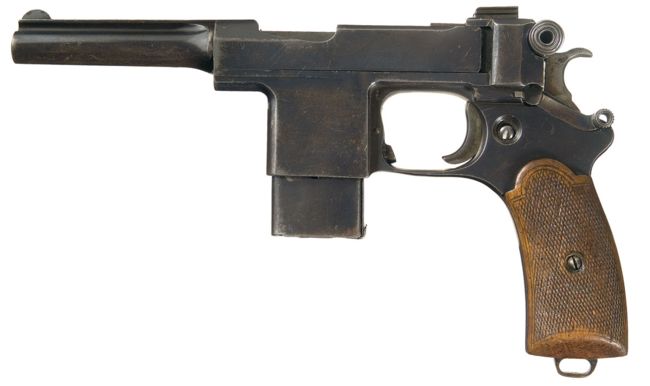
Bergmann "Mars" model 1903 pistol, made in Germany.

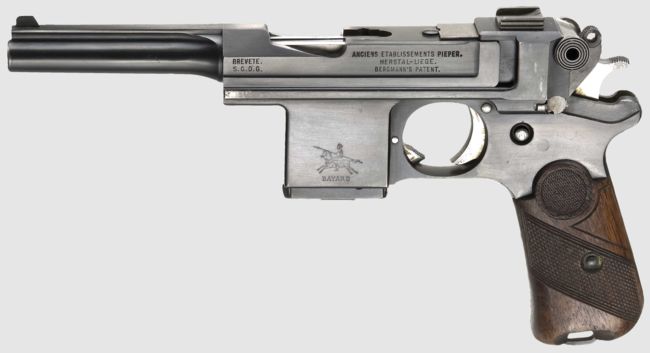
Bergmann Bayard model 1908 pistol, made in Belgium by Pieper.

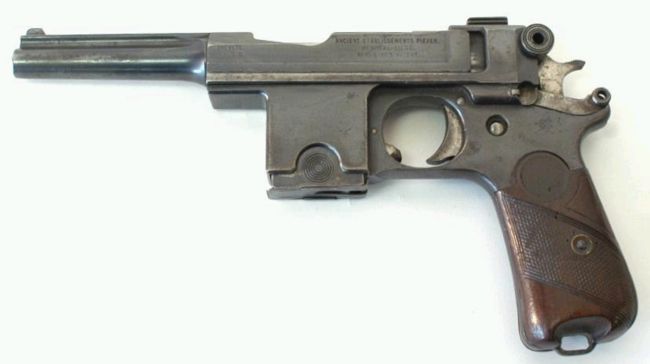
Bergmann Bayard model 1910 pistol, made in Belgium by Pieper.

Bergmann Bayard model 1910 pistol, with bolt locked open.

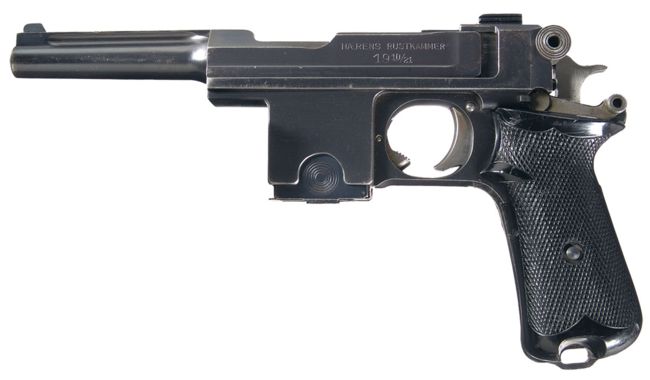
Bergmann model 1910/21 pistol, made in Belgium and later upgraded in Denmark.

Characteristics - data for Bergmann Bayard model 1910 pistol

TypeSingle Action semiautomatic
Caliber(s) 9x23 Bergmann (9mm Largo)
Weight unloaded1020 g
Length254 mm
Barrel length102 mm
Magazine capacity6 or 10 rounds

Theodor Bergmann was a German businessman, who eventually got himself involved in the development of the automatic arms early in the process. As early as in 1894 he brought up a semi-automatic pistol, designed for him by designer Louis Schmeisser. This pistol, along with a number of subsequent models, meet little success, but in around 1903 Bergmann brought to the market a completely new pistol, with recoil-operated action based on the machine gun, designed by the same Louis Schmeisser. The Bergmann Model 1903 pistol, also known as Bergmann "Mars", was chambered for a potent (by the standards of the time) cartridge, known as 9x23 Bergmann. Spanish military tested this pistol and ordered several thousands in 1905. In Spanish service the new 9x23 Bergmann cartridge became known as 9mm Largo, and the name stuck. Due to the very limited production capabilities of the Bergmann's own company, he subcontracted production to the Belgian company Societe Anonyme Anciens Establissments Pieper (AEP), which sold its guns under trade mark "Bayard". In 1908, Pieper produced an updated version of the pistol, known as Bergmann Bayard model 1908 pistol, and in 1910 came the definitive version of this gun, known as  Bergmann Bayard model 1910. The Model 1910 pistol was adopted by Danish government, and several thousands of these pistols were built by Pieper for Danish army prior to the outbreak of the WW1. After the start of WW1, production of this pistol has stopped due to the occupation of Belgium, and it was never resumed later there. After the war, Danish government ordered several thousands of these guns to be built at state arsenals, and in 1921 all Danish pistols still in service were updated to the Model 1910/21 standard, and served in this modification until 1946.
Bergmann Bayard model 1910 pistol is a short recoil operated weapon. It uses short recoil system in which the separate bolt rides inside the rectangular barrel extension. The bolt protrudes from the barrel extension at the rear, and has two round knobs for manual retraction. Bolt locking is achieved by a vertically sliding block, which is located in the barrel extension. In the forward position of the moving parts, the locking block is forced upwards by the step in the frame, and engages the cut made on the underside of the bolt, securely locking it to the barrel extension. Upon recoil, the slope in the frame allows the block to fall down slightly and to leave the recess in the bolt, thus unlocking the bolt. The feed is from detachable box magazines, which hold cartridges in two vertical staggered rows. Magazines can be reloaded either when detached from the gun, or while in-place, using the charger clips through the ejection opening at the top (with the bolt locked back). Magazine housing is located in front of the trigger guard. Magazine release is located inside the trigger guard, at its front. Trigger is of single action type, with exposed hammer and a manual safety lever, which is located to the left of the hammer. To engage the safety, this lever must be turned up and forward.

FNP-45 pistol

FNP 45 pistol, left side
FNP 45 pistol, left side.

FNP 45 pistol, right side.

Characteristics

TypeDouble Action semiautomatic
Caliber(s).45ACP (11.43x25)
Weight unloaded930 g / 32.4oz
Length200 mm / 7.85"
Barrel length114 mm / 4.5"
Magazine capacity14 rounds (10 where required by law)

FNP 45 pistol is the next step in evolution of the FNP 9 / FNP 40 pistols line. First announced in 2007, the FNP 45 is just one of the many new, modern .45 caliber pistols which recently hit the civilian and law enforcement markets in USA. The increased interest in full-size, high capacity .45ACP pistols can be in part attributed to the several unsuccessful attempts of US armed forces to re-adopt this cartridge over the 9x19 NATO in the search of better stopping power. The same reason (combat effectiveness / stopping power) causes many police organizations and civilian shooters to re-think the role of the century-old .45ACP round. FNH USA, the US-based subsidiary of the famous Belgian arms-making company FN Herstal, took this cartridge and developed this serious service-type pistol. Based on its predecessors, FNP 45 is somewhat bigger and heavier than its 9mm/.40 caliber 'older brothers', and is best suited for holster carry. It features improved ergonomics, with fully ambidextrous controls and modular grip backstrap. Front of the frame is shaped to form Picatinny rail which can accept a wide variety of accessories like laser sights or tactical lights. The modular hammer units for FNP 45 are available in two versions - with manual safety that permits "cocked and locked" carry or with decock-only function (gun shall be carried with hammer lowered over the loaded chamber).
The FNP 45 is short recoil operated, locked breech pistol. The barrel is operated using a Browning cam system, and it locks to slide with single lug engaging large ejection port. Frame is made from high impact-resistant polymer. Double Action trigger system with exposed hammer has internal firing pin safety, with decocking or safety levers located at the both sides of the frame. Firing pin safety is standard, and the magazine safety is optional. The trigger / hammer module is formed as a single unit, easily detachable from the frame for inspection, maintenance or replacement. Optional hammer units can be found in DAO variety or in standard DA version but with manual safety / decock levers instead of the basic decock-only levers. Other easily replaceable units include the barrel cradle / slide rail module and the grip backstraps. Grip backstraps are available in two variations, with straight or curved shape. Standard sights are provided with white inserts and are dovetailed into the slide.

 
Design by Free WordPress Themes | Bloggerized by Lasantha - Premium Blogger Themes | Online Project management