Tampilkan postingan dengan label Japan. Tampilkan semua postingan

Sabtu, 11 Mei 2013

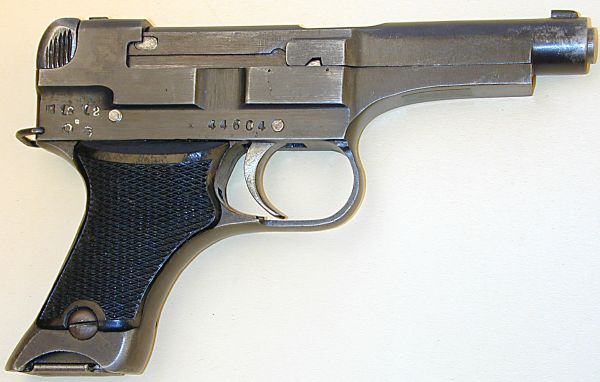
Nambu Type 94


Nambu Type 94 pistol.

Nambu Type 94 pistol with slide locked back.

Nambu Type 94 pistol, partially disassembled.

Characteristics

TypeSingle Action semiautomatic
Caliber(s) 8x22 Nambu
Weight unloaded580 g empty
Length181 mm
Barrel length87 mm
Magazine capacity6 rounds

Nambu Type 94 pistol was adopted by Imperial Japanese Army in 1934 (year 2594 of the contemporary Japanese calendar). It was developed to complement and eventually replace the older Type 14 Nambu pistol in military service, but limited industrial capabilities of the Imperial Japan didn't let it happen. Originally only a marginally adequate pistol, by the end of WW2 the Type 94 pistol evolved into the one of the worst military sidearms of the period, due to severely deteriorated quality of materials and workmanship, used in production of this gun. Late production examples of this gun can be simply unsafe to fire, and even the early production guns, which were made to more or less high standards of fit and finish, had some undesirable and unsafe features, such as exposed trigger bar, which can cause unintended discharges if the loaded and cocked gun is handled improperly or carelessly. Total production of these pistols between 1934 and 1945 is estimated at 65 - 70 thousands guns.
Nambu Type 94 pistol is short recoil operated, locked breech weapon. To lock the barrel and slide during early stages of recoil, it employs a vertically sliding locking block, which is installed below the breech part of the barrel and allowed to rise and fall for short distance within its guiding cut. The locking block projects to both sides from the barrel, to engage cuts made on the underside of the slide. When parts are in battery, the locking block is forced up by sloped surface on the frame, locking the slide to the barrel. Upon recoil, the sloped surface in the frame allows the locking block to slip down, disengaging from the slide and unlocking it. The breech block (bolt) is made as a separate item and removable attached to the slide by a cross-bolt. The trigger is of single action type, with internal (concealed) hammer. Manual safety lever is located at the left side of the frame, above and to the rear of the grip panel. The single stack box magazine has capacity of just 6 rounds, magazine release button is located at the base of the trigger guard.

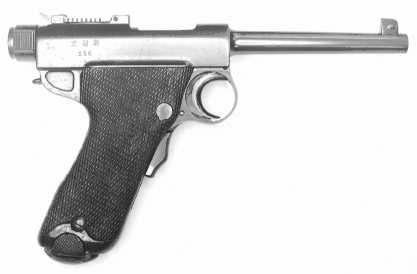
Namby type 14


Nambu Type "A" pistol, also known as Type 04. A predescessor to the Type 14. Note automated grip safety under the triggerguard and a range ajustable rear sights, which disappear from design in the Type 14.

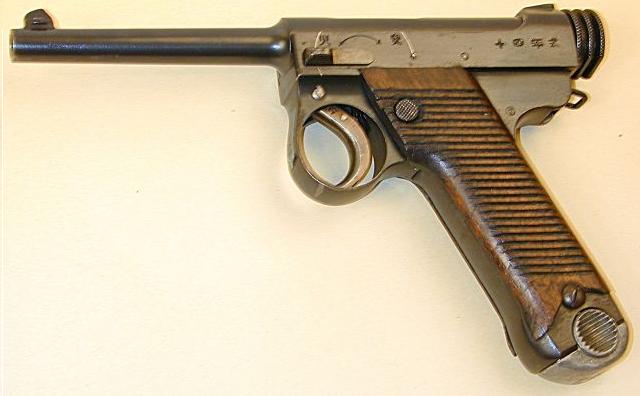
Nambu Type 14 pistol.

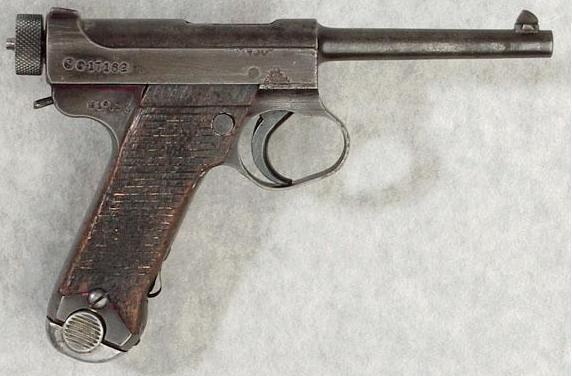
Nambu Type 14 pistol, with bolt fully retracted.

Nambu Type 14 pistol, late production, with enlarged triggerguard and magazine retention spring.

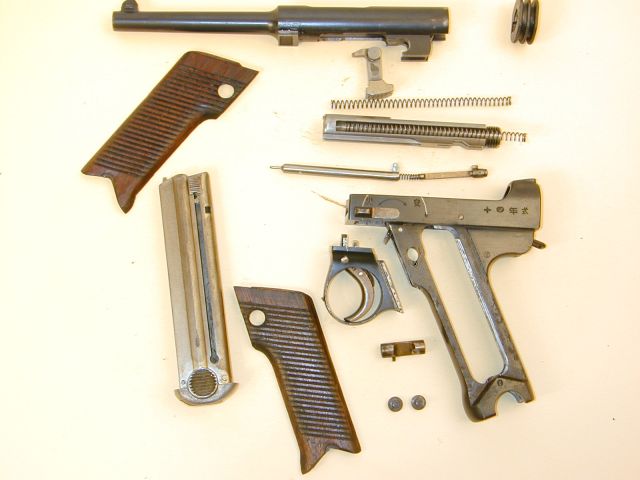
Nambu Type 14 pistol, field stripped; note detached triggerguard and a separate locking member under the barrel.

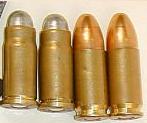
Nambu 8mm ammunition (left) shown next to 9mm Luger cartridges (right) for comparision.

Characteristics
 
Type: Single Action
Chamber: 8x22 mm Nambu
Weight unloaded: 900 g
Length: 230 mm
Barrel length: 117 mm
Capacity: 8 rounds

The type 14 pistol was designed by Japanese general Kijiro Nambu circa 1925 (14th year of the Taisho emperor, hence the official designation), as an iprovement over the earlier pistol of his design. This pistol was adopted by Imperial Japanese Army and widely used during all S-E Asia campaigns and through the World War 2 as a standard Army sidearm.
Type 14 is a recoil operated, locked breech pistol. It featured a short recoiling barrel with the bolt, moving inside the cylindrical barrel extension. The barrel to bolt lock is achieved by the vertically tilting locking member, which is cammed down after the short recoil of the barrel, stopping the barrel and releasing the bolt to complete the ejection and reloading cycyle. The bolt has two symmetrically located recoil springs and a knurled knob at the rear for manual operation. Pistol is striker fired, with single action trigger and manual safety on the left side of the frame, above the trigger. Interestingly enough, the triggerguard with the trigger can be removed from the fun for clearing and maintenance when gun is field stripped. Type 14 Nambu pistol uses single column magazine that holds 8 proprietary bottlenecked rounds of ammunition. Gun has fixed sights and a belt loop at the rear of the frame, above the grip. It can be said that the overall design of the Type 14 was inspired part by the P08 Luger (overall shape) and part by the C-96 Mauser (locking system), but owerall design is quite original. Late production pistols, made in the 1940s, can be distinguished by the enlarged triggerguard that allowed the pistol to be used in winter gloves. These pistols also featured additional magazine retention spring mounted in the front strap of the grip, to avoid magazine loss during the use of the pistol, ans simplified bolt knob.
8x22mm Nambu ammunition use a bottle-necked case with 103 grains (6.67 gramm) jacketed bullet ower the 3.5 grains (0.23 gramms) of smokeless powder, producing muzzle velocities of about 1065 fps (325 m/s) from the Type 14 pistol. In terms of energy this round is far inferior to other pistol cartridges, used by major powers in WW2, such as .45ACP, 9mm Luger and 7.62mm TT.

Jumat, 28 Januari 2011

Type 97 anti-tank rifle

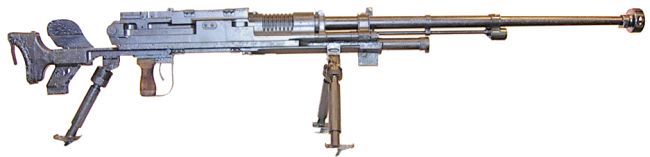
Type 97 anti-tank rifle, less magazine.
 
Type 97 anti-tank rifle, with magazine and carrying handles attached.

Type / action full automatic, gas operated
Caliber  20x125
Weight unloaded 50 kg
Length 2100 mm
Barrel length 1250 mm
Magazine capacity 7 rounds
Armor penetration (Range / Angle / Penetration) 250 m / 90o / 30 mm

 The Type 97 anti-tank rifle was adopted by Imperial Japanese army in 1937 (2597th year by contemporary Japanese calendar), as a dedicated anti-tank weapon. While not sufficiently effective against medium and heavy American tanks, it was good enough to deal with light tanks, landing crafts, small surface vessels and improvised pill-boxes, used by US and allied forces in Pacific theatre during WW2. It was one of the heaviest weapons in its class, especially when fitted with low-profile armor shield and dual carrying handles, which raised the weight of the system to some 68 kg (150 lbs).
The Type 97 anti-tank rifle is gas operated, full automatic only weapon (rate of fire - unknown). It used two gas pistons located below the barrel. The bolt locking is achieved by vertically sliding locking block, which is installed at the top of the bolt. When in battery, this locking block is forced up by cam surface in the bolt carrier to engage the slot cut in the receiver. After discharge, rearward movement of the gas piston and bolt carrier forces the locking block to fall down and unblock the bolt; after that, bolt is free to recoil along with bolt carrier. Firing is from open bolt position, in full automatic mode only. To reduce peak recoil forces, the receiver with barrel and action are allowed to recoil agains the cradle, compressing massive spring buffer. Barrel is equipped with muzzle brake to further decrease the recoil. Feed is from top-mounted detachable box magazines. Standard iron sights are graduated up to 1000 meters in range. To provide necessary stability when aiming and firing the gun, it is equipped with folding bipod and an adjustable monopod under the butt. Additional accesories include detachable armored shield which is installed in front of the magazine, and pair of detachable U-shaped carrying handles, so the gun can be carried over the batlefield by three of four men.

 
Design by Free WordPress Themes | Bloggerized by Lasantha - Premium Blogger Themes | Online Project management