Tampilkan postingan dengan label Germany. Tampilkan semua postingan

Jumat, 21 Juni 2013

Rifle model 1943 / puska 43M / G.98/40

G98/40 or 43M rifle.
 G98/40 or 43M rifle.

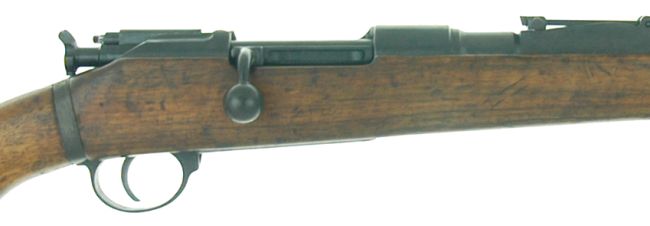
 G98/40 or 43M rifle, close-up view to receiver.
 G98/40 or 43M rifle, close-up view to receiver.

Caliber: 7.92x57 mm
Action: manually operated, rotating bolt
Overall length: 1092 mm
Barrel length: 605 mm
Weigth: 3.91 kg
Magazine capacity: 5 rounds

The Gew.98/40 rifle, also known as Puska 1943. Minta (Rifle, model of 1943, or 43M in short) was developed at Hungarian FEG arms factory in around 1941 under German contract. It was intended for German troops, as weel as for Hungarian troops that were serving along with German troops on Soviet front. In German service, this rifle was known as Infanterie Gewehr 98/40 or Gew.98/40 or G.98/40 in short. It was also adopted by Hungarian army in 1943, as rifle 43M, with minor cosmetic changes from German-contract rifles. Despite having significant external similarities to German Mauser K.98K rifle, the G.98/40 is not a 'Mauser' design, but an amalgam of the Mannlicher-type action (based on Hungarian 35M rifle) and Mauser-type integral box magazine. This rifle was produced by FEG between 1941 and 1945, with total production of German-contract G.98/40 rifles estimated at around 140 000; plus, some 90 thousands of 43M rifles were produced for Hungarian army.
The 43M / Gew.98/40 rifle is a manually operated rotary bolt action weapon. It uses Mannlicher-type rotating bolt with dual locking lugs, located at the front of the bolt body, and detachable bolt head which hosts extractor and ejector. The receiver has a split rear bridge. Feed is from integral Mauser-type box magazine, holding five cartridges in a two rows. Magazines are loaded usingMauser-type stripper clips. Manual safety is provided at the rear of the bolt body, just above the exposed cocking piece. Rifle was fitted with blade front sight and tangent type rear sight marked from 100 to 2000 meters range. Wooden stock is made of two separate parts - buttstock with semi-pistol grip and a forend. A carrying sling and a Mauser Kar.98K-type knife bayonet were provided as standard accessories.

Kamis, 20 Juni 2013

Korth revolver

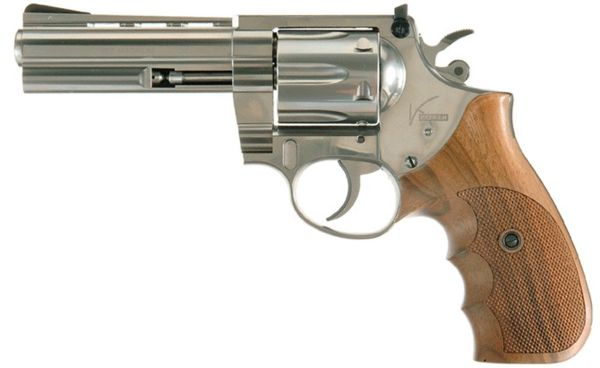
Korth Combat revolver, .357 magnum caliber

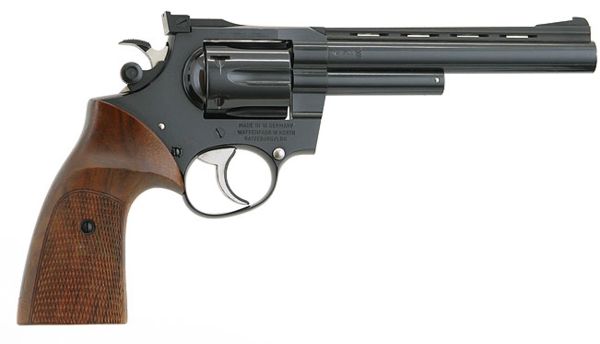
Korth target revolver, .22LR caliber


TypeDouble Action revolver
Caliber(s).22LR, .22WMR, .38 Special and .357 Magnum
Weight unloadedca. 1040 g with 4" / 102mm barrel
Lengthn/a
Barrel length3" (76mm), 4" (102mm), 5 1/4" (133mm), 6" (152mm) and 8" (205mm)
Cylinder capacity6 rounds

Korth revolvers are produced on semi-custom, limited basis by Korth Waffen company in Germany. Willie Korth designed his own revolver action during late 1950s, and started to manufacture centerfire revolvers of his own design circa 1965. Korth revolvers represent top grade of European guns; made in very limited numbers and with great deal of precision machining and hand fitting, these revolvers command prices of several thousands of US dollars or Euros. In reward, their users get excellent accuracy, great durability and luxurious finish.
Over the time, Korth revolvers were made in a number of calibers and versions. Basic versions are Korth "Combat" (usually chambered in .38 Spl or .357 Magnum, with optional 9x19 cylinders and barrels 3 or 4 inches long), Korth "Sport" (basically similar to Combat but with longer barrels, also available in .22LR and .22WMR) and Korth "Target" (with adjustable orthopedic grips and target type sights).
Korth revolvers are slid frame,  swing-open cylinder double action guns. Trigger is of proprietary design, with telescoped coil-type mainspring and complicated, precision made and tuned lockwork. Cylinder release lever is located next to the hammer, at the rear of the frame. Once opened, cylinders with crane could be easily removed from the frame by pressing an oval release button, located at the left side of the frame, below the cylinder. This allows for multiple cylinders for one gun, i.e. for shooting 9x19 Luger / Parabelum and .357 magnum ammunition from the same gun, with just the swap of the cylinder. Most Korth revolvers feature full-length ejector rod shroud and ventilated barrel rib. Sights are of adjustable type on al revolvers.

Jumat, 05 April 2013

SIG-Sauer SIG Pro

SIG-Sauer SIG Pro 2340 in .40SW caliber (9mm SP 2009 pistol looks exactly the same except for the markings)

SIG-Sauer SIG Pro SP 2022 pistol, developed for French police and gendarmerie forces.
 
Type: Double Action or Double Action Only
Chamber: 9x19mm Para, .357SIG, .40 S&W
Weight with empty magazine: 760 g (9mm); 790 g (.40 & .357)
Length: 187 mm
Barrel length: 99 mm
Capacity: 15 (9mm) or 12 (.40) rounds

The SIG Pro pistol is another joint effort between two famous European arms makers, the SAN Swiss Arms (formerly known as SIG Arms) and the J. P. Sauer & Sohn of Germany. Originally developed as a .40SW caliber service pistol with modular design, it was first announced in 1998 as the SIG Pro SP 2340. About one year later, the 9mm version, designated the SP 2009, was introduced and entered production. The SIG Pro is used by the US Drug Enforcement Administration (DEA), as well as by number of other law enforcement agencies worldwide. In the 2003, the French law enforcement agencies (including Gendarmerie and Police Nationale) adopted a slightly modified version of the SP 2009. New version of SIG Pro, designated as SP 2022,  is to replace Beretta 92G and some older pistols. Total of 250 000 SP 2022 pistols are ordered by France. 
The SIG Pro is a short recoil operated, locked breech pistol. It uses a fairy traditional browning cam-operated locking system. Barrel locks into the slide via enlarged ejection port. The frame is made from polymer, with detachable grip panels. Grip panels can be easily replaced and are available in several different sizes and shapes. The modular hammer unit can be installed in traditional DA or DAO versions. There's no manual safety on all SIG Pro pistols. Instead, SIG Pro pistols are fitted with typical SIG-Sauer frame mounted decocker lever, and with automated firing pin safety. The overall design is slightly different from earlier SIG-Sauer pistols such as P220 or P226, as there is no separate disassembly lever on the frame of SIG Pro, and the slide release lever looks quite different. The SP 2340 and 2009 pistols are fitted with proprietary accessory rail under the barrel, while SP 2022 is fitted with integral Picatinny rail. SP 2022 also can be equipped with detachable silencer. Fixed sights are dovetailed into the slide.

SIG-Sauer P250 DCc

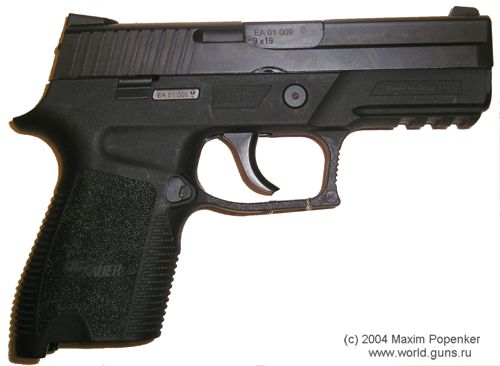
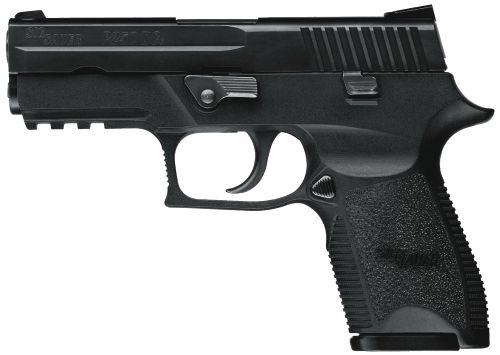
SIG-Sauer P250 DCc (compact) without magazine, left side view; version of 2004.

SIG-Sauer P250 DCc (compact) without magazine, right side view.

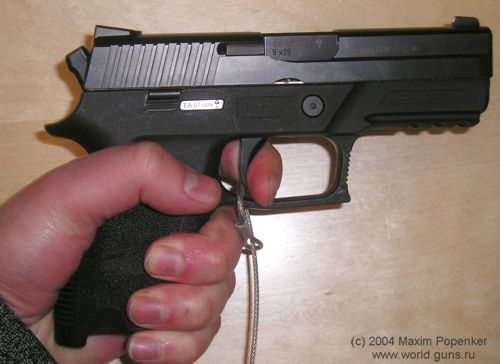
SIG-Sauer P250 DCc (compact) in the hand. Trigger is pulled partially, and the bobbed hammer is visible at the rear of the slide.
 
SIG-Sauer P250, version of 2008
image© SIG-Sauer

Three frame sizes for SIG-Sauer P250 Compact pistol, front to back: S (small), M (medium) and L (large) grip sizes.
image© SIG-Sauer

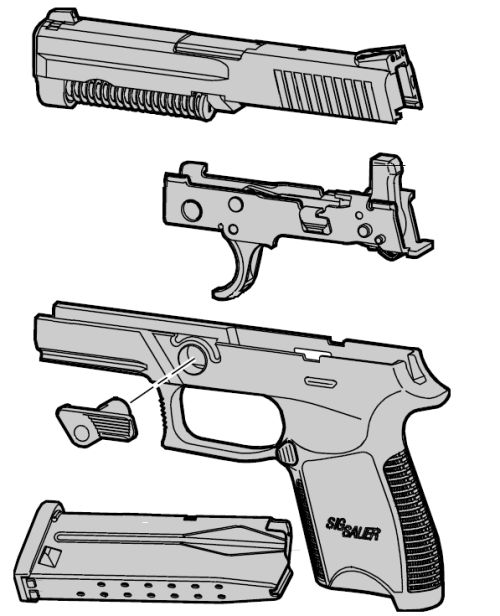
Diagram showing modular nature of the SIG-Sauer P250 pistol. The receiver unit in the center (with slide rails and trigger / hammer) is the main part of the design, which accepts all other interchangeable modules.
image© SIG-Sauer

Type: Double Action Only
Calibers: 9x19mm Parabellum; .357SIG, .40SW and .45ACP to be announced later
Weight unloaded: 700 g / 24.6 oz
Length: 183 mm / 7.2"
Barrel length: 98 mm / 3.9"
Capacity: 15 or 16 rounds (9mm)

The SIG-Sauer P250 DC is the most recent addition to the famous SIG-Sauer line of pistols. First announced at the IWA-2004 exhibition in Nurnberg, Germany (March 12-15, 2004), this pistol then faced almost 4 years of continued development, which was a combined effort of German engineers at J.P.Sauer and American engineers from SIGARMS. The gun was re-introduced in late 2007, and is now (February 2008) available in single caliber (9mm), single frame size (compact) and three grip sizes (S - small, M - medium and L - large). Other calibers and barrel / frame sizes are to be announced later. The key feature of the P250 is its complete modularity - using a variety of barrel / slide and frame combinations any user will be available to assemble any conceivable configuration, using the steel serialized receiver as the central assembling point. This will be most useful for large police departments of security companies which will be able to tailor their pistol inventory for various tactical needs (compact pistols for concealed carry, full size pistols for holster carry, various calibers) and for various shooters (variety of grip sizes for each frame configuration), yet have only one pistol type with unified training and maintenance procedures.
The SIG-Sauer P250 DC pistol was developed and is now produced by the famous German arms manufacturer, the J. P. Sauer & Sohn Ges.m.b.H., which is a part of the international SIGARMS corporation. Development of the pistol started circa 2001. The P250 was designed according to the latest official German guidelines for police pistol.
The SIG-Sauer P250 DC is a short recoil operated, locked breech pistol. It uses typical SIG-Sauer cam-operated barrel, which locks into the ejection port on the slide. The frame is made from high impact-resistant polymer. A steel receiver unit is inserted into the frame and held in place by the axis pin of the disassembly lever. The receiver is the only serialized part of the gun, and it contains frame rails and a fire control unit (trigger, hammer and all necessary linkage and springs). Single receiver unit will accept any frame size and any caliber kit (consisting of the barrel and slide). The slide stop levers are located on both sides of pistol. The SIG-Sauer P250 DC has a Double Action Only trigger with spurless hammer, and no manual safeties. The automated firing pin safety prevents the accidental discharges if gun is dropped or roughly handled. The trigger system has a very short trigger reset in DAO mode (about 3 mm or 1/8"), and the trigger pull is constant and consistent, with pull weight about 4 kg (9 lbs). SIG-Sauer P250 DC is fitted with combat-type sights with three white dots, and the frame has an integral Picatinny rail for flashlights or laser pointers.

SIG-Sauer P245

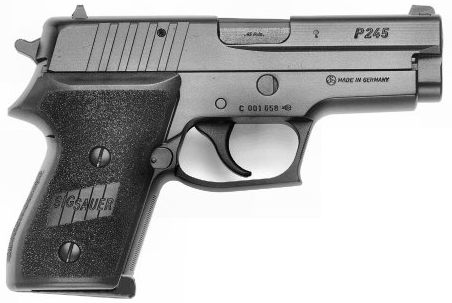
SIG-Sauer P245 pistol (Germany)
 
Type: Double Action
Caliber: .45ACP
Weight unloaded: 815 g
Length: 185 mm
Barrel length: 99 mm
Capacity: 6 rounds

First introduced in 1998, this compact pistol is a "cut-down" variant of the famous SIG-Sauer P220 pistol. Intended mostly for US market, this pistol is suitable for concealed carry and as a police backup weapon. The P245 has a traditional SIG-Sauer reliability, and, while somewhat heavy for a concealed gun, it offers a good recoil control. P245 is manufactured in Germany by the J. P. Sauer & Sohn company, which is a part of the international SIGARMS corporation.
P245 is a short recoil operated, locked breech pistol. It uses a typical Browning-style cam operated barrel, which locks into the ejection window in the slide. The slide is made from stamped steel, and has a separate breechblock held within the slide by the cross-pin. The frame is made from aluminum. The trigger is double action, with external hammer and a decocking lever on the left side of the frame. There's no manual safety, but P245 is provided with automatic firing pin safety.

SIG-Sauer P-230 and P-232

P-230 - early production 9mm model.

P-230 with aftermarket grip panels.

P-230 partially disassembled.

P-232 in 9mm - a currently produced pistol.


Data for P-232
Type: Double Action
Chamber: 7.65x17mm Browning (.32ACP) and 9x17 mm Browning Short (.380ACP) both models; also 9x18mm Police for P230
Weight unloaded: 500 g standard model; 600 g SL (stainless steel frame) models
Length: 168 mm
Barrel length: 92 mm
Capacity: 7 rounds (9mm) or 8 rounds (7.65mm)

The SIG-Sauer P-230 pistol was designed and produced in Germany by the joint venture of the J.P.Sauer (Germany) and a SIG Arms (Swiss) as a compact police and self-defence pistol. P-230 hit the market circa 1977 and was manufactured untill the 1996, when it was replaced by the P-232 pistol, which is no more than technologically and ergonomically improved P-230. Original P-230 was offered in variety of 3 calibers - 9mm Browning Short, 7.65mm Browning and a now discontinued 9mm Police, which was designed as a most powerful round suitable for simple blowback pistols. 9x18mm Police is rougly equal in terms of power to the Russian 9x18mm Makarov, but these two ARE NOT interchangeable! Attempt to fire 9x18mm Mak in the 9mm Police P-230 can result in serious damage to the pistol and injury to the shooter!
P-230 and P-232 are quite similar internally. Both are simple blowback operated, hammer fired pistols, with double action triggers and a manual decocker levers mounted on the left side of the frame, behind the trigger. P-232 also featured automated firing pin safety. Both pistols lack the slide stop. Both pistols can be found in standard form, with steel slide and aluminium alloy frame and blue finish, or in SL versions, with both slide and frame made from stainless steel. Latter models are slightly heavier and wear a polished steel finish. P-232 featured drift-ajustable rear sights, dovetailed into the slide. Feed is from single stack magazines for 7 9mm or 8 7.65mm rounds. It should be noted that both P-230 and P-232 feature magazine catch, located at the heel of the grip.
Both P-230 and P-232 are high quality, durable and reliable guns, as every other pistol, produced by the famous Swiss-German alliance. These guns are well suited for personal defence, concealed carry and as a backup guns, offering good accuracy and mild recoil.

Senin, 21 Februari 2011

Korriphila HSP-701 pistol

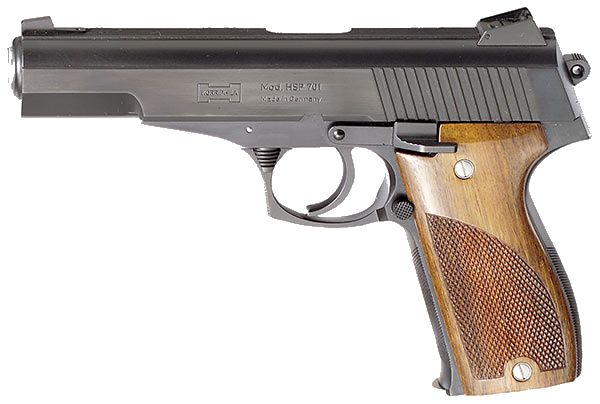
9mm Korriphila pistol with 127mm / 5
9mm Korriphila pistol with 127mm / 5.

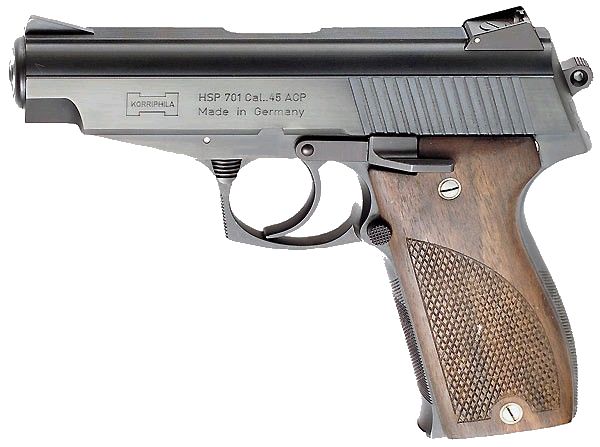
.45ACP Korriphila pistol with 102mm / 4
.45ACP Korriphila pistol with 102mm / 4.
 
Korriphila Odin's Eye pistol, made from Damascus steel, with custom grip panels
 
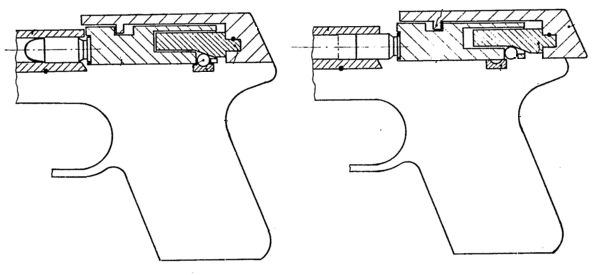
Diagram from original Budischowsky patent, explaining roller-delayed blowback action of Korriphila pistol.
 
Characteristics

Type Double Action semiautomatic
Caliber(s) 7.65x21 Luger, 9x19 Luger, .38 Super, .45ACP
Weight unloaded 1000 g (with 100 mm barrel), 1200 g (with 127mm barrel)
Length n/a
Barrel length 100 mm (4") or 127 mm (5")
Magazine capacity 9 (7.65 and 9mm) or 7 (.45) rounds 

Korriphila pistols, currently made in Germany by Intertech, represent the top line of European custom pistols. Basic design was a brainchild of the Edgar Budischowsky, who patented its delayed blowback action in 1979. The action is somewhat similar to older Vorgrimler roller-delayed system, developed during WW2 and later used in a number of firearms from Heckler und Koch, such as P9S pistol or MP5 submachine gun. Korriphila pistols are made on custom basis, and it is said that only few dozens of new pistols are produced each year. Made with very tight tolerances and luxurious finish, these pistols command prices in the US $ 4 000 region, and a special-order Odin's Eye versions, which had frames and slides milled from the solid blocks of Damascus steel, cost at least three times more. While these pistols can be used for personal self-defense, they certainly have more value as collectables and investment pieces.
Korriphila pistols are delayed blowback firearms that use a single roller, interposed between a separate breechblock and a slide. When slide is in battery, roller extends below into the cut in the frame. Upon recoil, breechblock forces the roller back and out of its recess, which causes the slide to open faster than the breechblock. This system is basically a half of the more common Vorgrimler system, turned 90 degrees. Trigger is of double action type. Magazines are single stack.

Korth pistol

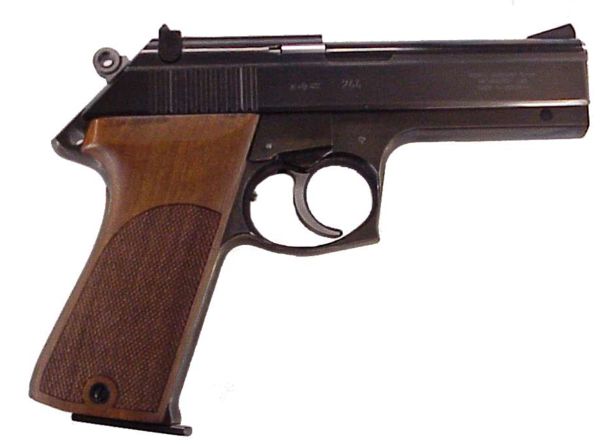
Korth pistol, left side.
 
Korth pistol with alternative shape of trigger guard and black polished coating.

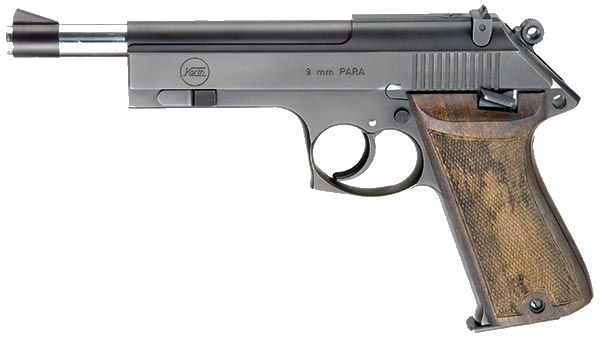
Korth pistol with long barrel.
Diagram from original patent, issued to Willie Korth in 1986. Locking piece is marked with orange color.

Characteristics

Type Double or Single Action semiautomatic
Caliber(s)  9x19 Luger, 9x21 IMI, .357SIG, .40SW
Weight unloaded 1240 g
Length n/a
Barrel length 100 or 127 mm (4" or 5")
Magazine capacity 10 (9mm) or 9 (.357, .40) rounds

Korth pistols were developed circa 1982 by renowned German gunmaker Willie Korth, who was known as a maker of fine custom revolvers since mid-1960s. First "production" Korth pistols appeared in 1985, and since then those are produced on very limited basis. These pistols represent high end, custom European guns, with as much as 70% of hand labour and hand fitting used in manufacture of each pistol. Korth pistols available in a variety of calibers and finishes; prices on these pistols usually start at several thousands of US Dollars or Euros.
Korth pistols are of all-steel construction, with al parts hand-fitted and heat-treated for maximum durability and accuracy. Korth pistol use proprietary locking breech, short recoil action patented by Willie Korth in 1986. This action uses vertically tilting locking piece, located below the barrel, which locks the barrel to slide when in battery. On recoil, the locking piece slides down, releasing itself from the locking notch in the barrel and allowing the slide to open while barrel is stopped. Trigger on Korth pistols could be either of DA/SA or SA (special order) type; standard safeties include automated firing pin block and loaded chamber indicator; manual safety is optional. Sights are adjustable, with target-type rear sight blade on most models.

Walther PPS pistol

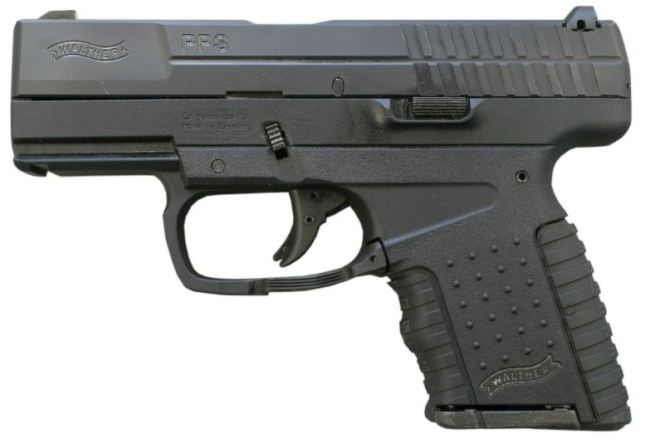
Walther PPS pistol in 9x19 caliber, with 6-round magazine.
image: Carl Walther GmbH
 
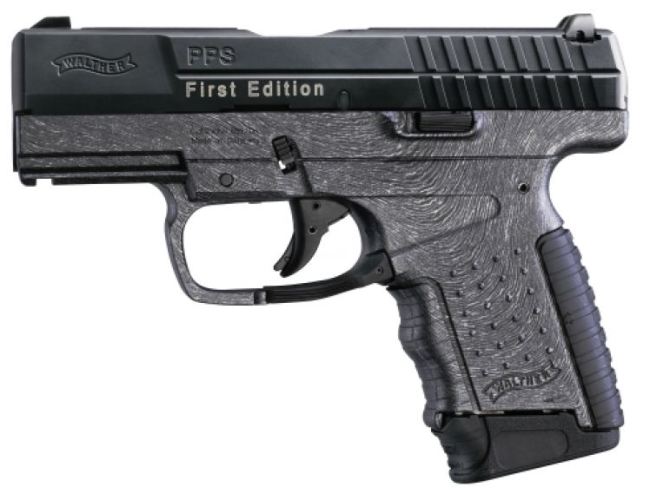
Walther PPS pistol, limited production "First edition" in 9x19 caliber, with 7-round magazine.

Walther PPS pistol, limited production "First edition" in 9x19 caliber, with 7-round magazine.
image: Carl Walther GmbH


Characteristics

Type pre-cocked Double Action Only, semiautomatic
Caliber(s)  9x19 Luger / Parabellum, .40SW proposed
Weight unloaded 549 g less magazine
Length 160 mm
Barrel length 81 mm
Magazine capacity 6, 7 or 8 rounds

Walther PPS (PolizeiPistole Schmal - Police Pistole Slim) is a most recent offering from the famous German gunmaking company Carl Walther GmbH. It was first shown publicly during IWA 2007 exhibition in Germany, and it is proposed as a more powerful replacement for a venerable Walther PPK pistol, which was designed more than 75 years ago. PPS pistol is based on the proven Walther P99 design, specially adapted for concealed carry. Thanks to its single-stack magazines, PPS is only 23mm (~0,9 inch) wide.
Walther PPS is short recoil operated, locked breech pistol that uses modified Browning-type locking with tilting barrel. Frame of the gun is made from impact-resistant polymer. Trigger is of Double Action Only type, striker-fired, with pre-cocked striker system, similar to QA system used in Walther P99 pistols. This system requires a manual re-cocking (by partial slide retraction) in the case of misfire. Gun is fitted with automated trigger safety and firing pin block; additional "storage-type" safety is provided by removable backstrap of the grip; once backstrap is removed, the firing pin is automatically decocked and gun is blocked until the backstrap is reinstalled. This patented system is called QuickSafe by Walther. Magazines for PPS pistol are single-stack, and will be available in three sizes - 6-round (flush-fit), 7-round and 8-round (extended). Sights are low-profile, with rear sight adjustable for windage.

Walther P99 pistol

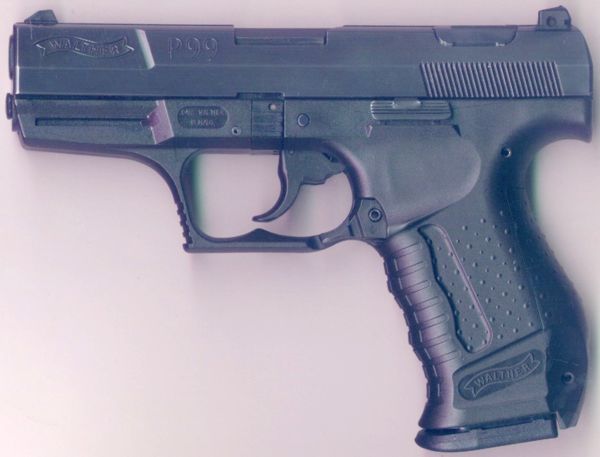
Walther P99 pistol (1st generation).

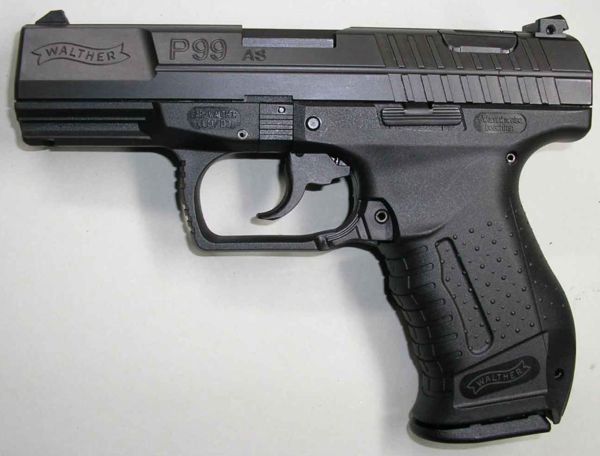
Walther P99 AS (Anti-Stress) pistol, 2nd generation.

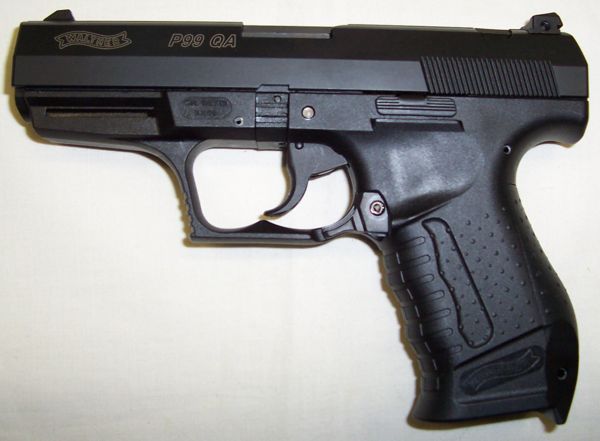
Walther P99 QA pistol.

Walther P99 Compact DAO pistol, 2nd generation (note extended slide release lever, which is also duplicated on right side of the gun).

Characteristics

Type: Double Action
Caliber:9x19mm Para, .40SW
Length overall: 180mm
Weight: 720g unloaded
Barrel length : 102mm
Capacity: 16 rounds (9mm), 12 rounds (.40SW)

The P99 pistol was a rather radical step forward for the Walther company, made under new management. The development of a new pistol started in 1994 and the first production pistols were shown to public in 1997. The earliest pistols were made in 9mm, and a .40 S&W version appeared in 1999. By 2004, the Carl Walther company presented the second generation of the P99 pistols. These new guns had even better ergonomics, and new model designations – the old P99 was renamed (and slightly redesigned) to P99AS (Anti-Stress), the double-action only P990 turned into the P99DAO, and only the P99QA (Quick Action) retained its name. The second generation also included the P99 Compact pistols, apparently made with input from American company Smith & Wesson, as the basically similar SW99 Compact pistol appeared on the US market a little earlier. Smith & Wesson makes a close copy of the P99 as the SW99, using Walther-made polymer frames and its own slides and barrels of slightly different shape. S&W also makes a .45-calibre version of this pistol. 9mm P99 pistols also are manufactured under Walther’s licence in Poland, and are standard police sidearms there.
The Walther P99 is short-recoil operated, locked-breech pistol. It uses a modified Browning locking system, with the barrel engaging the slide with a single large lug entering the ejection window. The frame is made from polymer and has interchangeable grip backstraps. Three backstraps of different shape are included with each pistol, so users can adjust the grip to their own preferences. The trigger is striker-fired, with an automated firing pin block safety, and varies with the model. The standard P99 is double / single action with a decocking button. Earlier P990s and current production P99DAOs are double action only, and the P99DAO also features a slightly different automated safety built into the trigger. The third variation of the P99 family is the P99QA, which features a partially pre-cocked trigger for a constant trigger pull from the first to the last shot. One feature, unique to the P99 series pistol triggers, is that despite being striker-fired, these pistols do not require the user to press the trigger during disassembly to disconnect the sear from the firing pin. This is done by using the decocking button, built into the top of the slide. This button is relatively large on the standard P99, as it is routinely used to decock the striker, and much smaller on the P99QA, as it is used only during disassembly to disconnect the firing pin from the sear. The P99DAO does not have such button, as its firing pin is always disconnected from the sear and at rest, except for the time the trigger is being pressed. The most recent Anti-Stress feature is, in fact, a modification to the trigger system which makes the trigger pull for the first shot in Single Action mode much longer than for subsequent shots. The Anti-Stress feature is activated each time the pistol is reloaded. Another safety feature is a striker cocking indicator, made in the form of a small pin, which protrudes from the back of the slide when the striker is cocked. First generation pistols had a slide release only at the left side of the frame, second generation guns may have optional ambidextrous slide stop release levers which, combined with ambidextrous magazine release levers built into the base of the trigger-guard, make these pistols truly left-hand friendly. All variations of the P99 use adjustable rear sights with white inserts. Magazines are of double-stack design.
How to field-strip (disassemble) Walther P99: 1) remove the magazine by pressing the magazine release button; 2) check that the chamber is empty; 3) on P99, P99AS and P99QA, press the decocking button; 4) press down and hold the disassembly sliders, located at either side of the frame, above the trigger; 5) push the slide forward and out of the frame; 6) remove the return spring assembly from below the barrel; 7) remove the barrel from the slide.
Reassemble in reverse order.

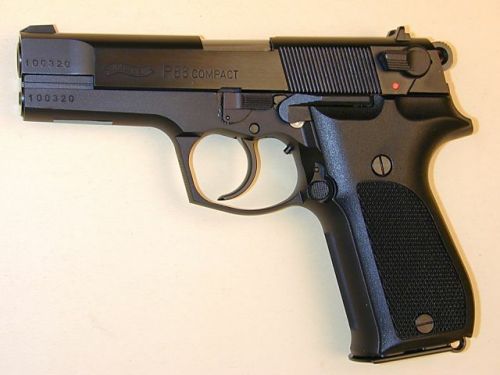
Walther P-88

Walther P88.
Walther P88.

Walther P88 Compact (note slide mounted safety instead of frame mounted decocker of the early P88).

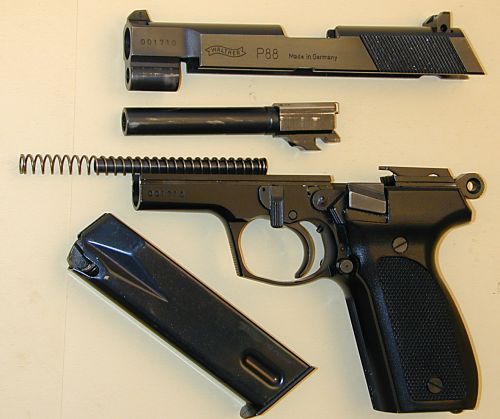
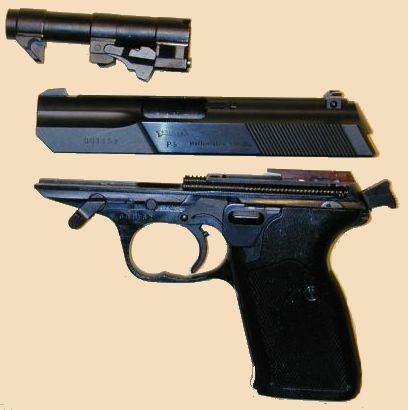
Walther P88 disassembled into major parts.

Characteristics - Data for P88 (for P88 Compact in parenthesises, when differs from P88)

Type: Double Action
Chamber: 9x19mm Luger/Parabellum
Weight unloaded: 900 g (822 g)
Length: 187 mm (181 mm)
Barrel length: 102 mm (97 mm)
Capacity: 15 rounds (14 rounds)

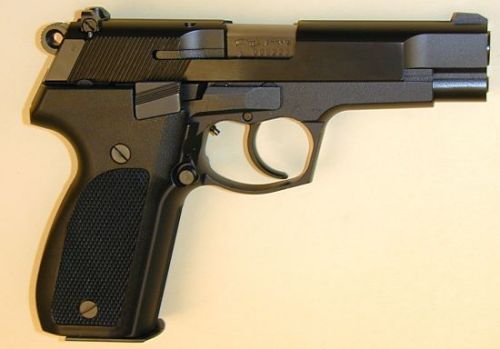
The P88 had been developed by Carl Walther Waffenfabrik, Germany, in 1988, as a high capacity, military and law enforcement pistol. The production of the P88 had been ceased in 1996, and it had been replaced in production by P88 Compact, which is somewhat lighter and a little bit smaller, and have some techical diffrences from original P88. The P88 Competition, with ajustable sights and other minor changes, also had been produced as a sporting firearm.
The P88 is a recoil operated, locked brech semi-automatic pistol. It differs from previous Walther pistols, such as P38/P1, P5 in fact that it uses conventional Browning style locking with barrel lowered by shaped cam trach in the barrel extension under the chamber. The locking ius achieved by single massive lug on the barrel, that locks into the ejection port of the slide. The P88 trigger system is quite similar to that of Walther P5, but P88 has ambidexrous frame mounted decocker lever. The same internal safeties, as in P5, also available (firing pin safety, out of the batery safety/disconnector). P88 featured steel construction, with fixed sights and high capacity, double stack magazines. Being a good pistol, the P88 whas too high price, so Walther discontinued it in tha favour of the slightly lighter and smaller P88 Compact, which also featured redesigned safety - the frame mounted decocker had been replaced by ambidextrous slide mounted safety.

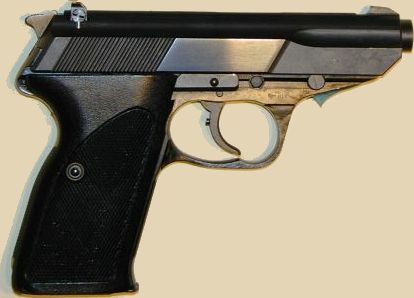
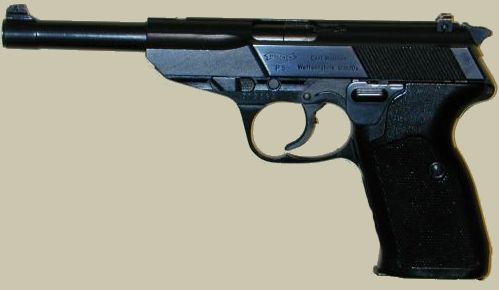
Walther P-5

Walther P5.
Walther P5.

Walther P5 Compact.
Walther P5 Compact.

Walther P5 with long barrel.

Walther P5 disassembled into major parts.

Characteristics - Data for P5 (data for P5 Compact in parenthesises, when differed from P5)

Type: Double Action with decocker
Chamber: 9x19mm Luger/Parabellum; also 7.65mm Luger/Parabellum and 9x21mm IMI
Weight unloaded: 795 g (780 g)
Length: 180 mm (169 mm)
Barrel length: 90 mm (79 mm)
Capacity: 8 rounds

The Walther P-5 had been developed in 1979 on request by German Police for safe police sidearm. Basically, it is a further development of the famous Walther P-38 pistol, but with significantly improved safety system.
The P5 is a recoil operated, locked breech semi-automatic pistol. The barrel to slide locking/unlocking is achieved by wertically tilting underballer locking piece, after the barrel moves straight back for short time. The trigger is Double Action, with frame mounted decocker at the left side of the frame. P5 also featured addtional internal safeties, such as firing pin safety, which removes the rear part of the firing pin from under the hammer, unless trigger is pressed, and also a firing pin block which disablet the forward movement of the firing pin unless the triger is pressed. The trigger bar disconnector disables the firing unless the slide in fully closed. This allows the gun to be carried in "condition two", with round chambered and hammer lowered, safely, and ready for action in DA mode. For improved accuracy the SA firing is also available. The P5 Compact is an even more compact firearm, similar in design but with shorter barrel and slide. The sporting version of P5 had been manufactured for some time, and it had longer barrel and fixed or ajustable sights. P5 and P5 Compact both featured fixed sights.
The P5 had been adopted by German Police, as well as by Portuguese Army, Neteherland Police and other security and police forces, and also sold on European civil market. The P5 and P5 Compact are still in production by its originator, Carl Walther Sportwaffen GMBh, Uhlm, Germany.

Walther P38, P1 and P4 pistol

Walther
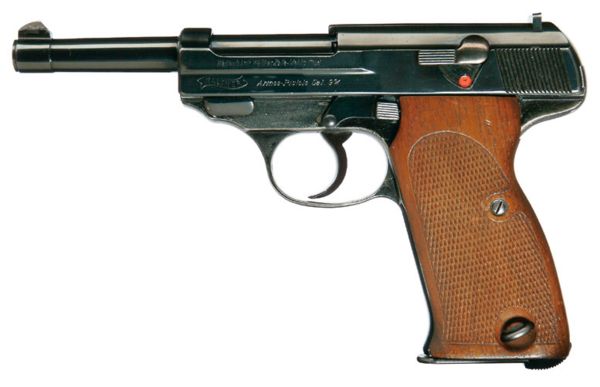
Walther "Armee pistole" or AP in short, a direct predecessor to the P38. Note that it has concealed hammer.
 
Walther
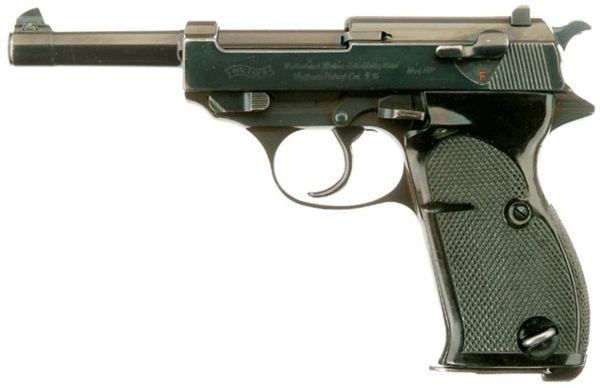
Walther "Heeres Pistole" or HP in short, an early commercial version, produced before its official adoption as P38.
 
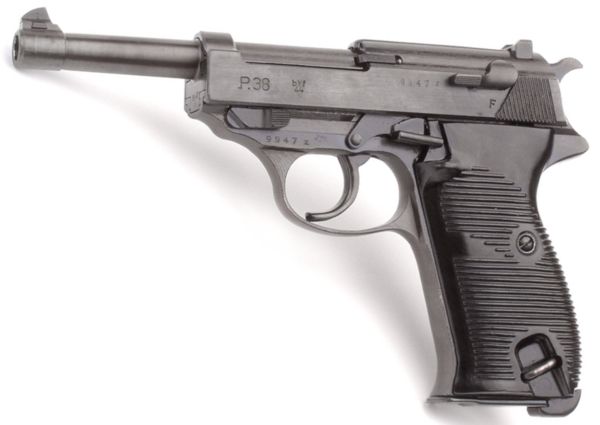
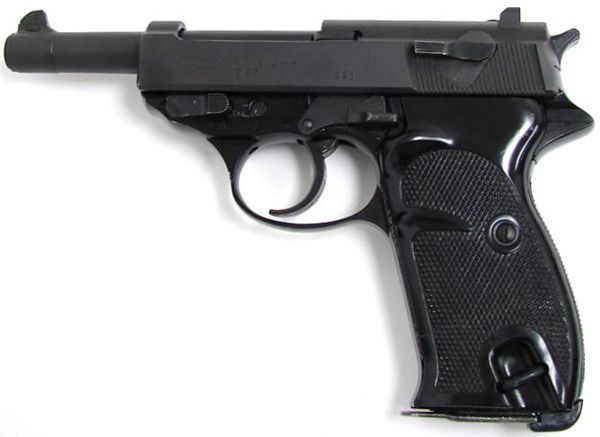
Walther P38, produced in 1944 for Hitler's army.

Walther P1, a post-war military version of P38 with aluminum frame.

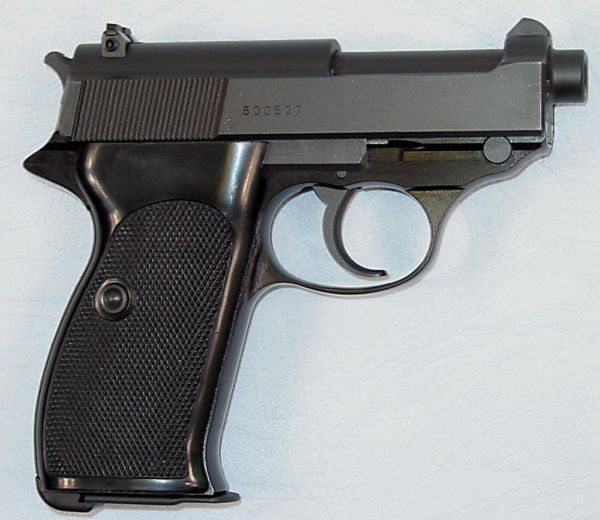
Walther P4, a post-war police version of P38 with aluminum frame, shortened barrel and modified safety system.

Walther P38K, a short-barreled version of P4 produced for KSK during early 1980s.

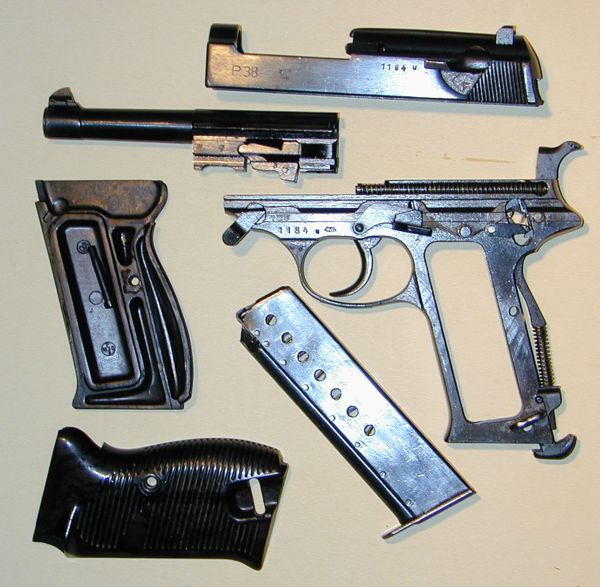
Walther P38 partially disassembled.

Characteristics

  Walther P38, P1 Walther P4
Type Double action semiautomatic
Caliber 9x19 Luger / Parabellum
Weight empty 840 g (steel frame)
770 g (aluminum frame)
740 g
Length 216 mm 197 mm
Barrel length 125 mm 104 mm
Magazine capacity 8 rounds

The Walther P38 pistol was developed as a military pistol for the German army (Wehrmacht) during the late 1930s. It first appeared in 1938, and small numbers of the original HP (Heeres Pistole – army pistol) were bought by Sweden before the Wehrmacht adopted it as the Pistole 38 and took over all production guns. During the war, P38 pistols were made by a number of factories, including the Walther itself. After the war, most of the ex-Walther machinery ended up in France as war reparations, and many of the post-war P38 pistols were actually built in France, by the Manurhin factory.
In 1957 the newly formed Bundeswehr adopted a slightly modified P38 pistol with a lighter aluminum frame as the Pistole 1, or P1 in short. Commercial pistols were still manufactured under the original P38 designation. Most of the post-war P38 pistols were made with aluminum frames, only handful of commercial pistols were made with steel frames. There were a couple of modifications of the P38, intended for police use, which appeared during the 1970s. The first was the P4, the first pistol to conform to new German requirements for police sidearms. Actually, the P4 was the P38 (or P1) with barrel cut back by 25mm (1 inch), fitted with an automated firing pin safety and decock-only lever. Early P4 pistols were actually made using P38 components, including slides, and thus were marked “P38 IV” instead of more common “P4”.
Another, less well-known variation was the P38K (Kurz, for Short in German), made for some special users such as the KSK – an elite counter-terror unit. This was a P4 (rather than original P38) with the barrel cut down at the front of the slide, and it was intended for concealed carry. The front sight was mounted on the slide, unlike the full-size model. It must be noted that a similar model was produced in small numbers during WW2 for the Gestapo and other such organizations. Wartime Kurz P38’s differed from post-war version by having a slightly longer barrel with the front sight mounted on the barrel. However, the service life of police derivatives of the P38 was much shorter than of the military P1 – most P4 pistols were declared obsolete and sold as surplus during the 1980s, while the P1 served until 1995. The last commercial P38 pistol was manufactured in 2000.
While P38 pistols were in some aspects revolutionary in design and concept, their post-war P1 versions were less than popular in the Bundeswehr, deserving the unofficial description of “eight warning shots plus one aimed throw”. Also, these pistols showed a typical German obsession for unnecessary over-complication of design – for example, the P38 pistol had eleven springs (mostly of very small size) – about twice that of the older P08 Luger pistol it replaced in service. It also had plenty of small parts and pins that were easy to lose during full disassembly, and a firing pin of intricate shape that easily broke.
The Walther P38 is short-recoil operated, locked-breech pistol. The barrel is locked to the slide using a wedge-shaped locking piece, which can tilt up and down below the barrel, while following the inclined surfaces on the frame. When the barrel and slide are in battery, the locking piece is in its upper position, and its lugs securely lock the slide to the barrel. Upon recoil, the locking piece drops down and out of the engagement with the slide, unlocking it and allowing it to recoil and complete the reloading cycle. Because of the short slide, the P38 has two captive return springs, located on either side of the frame and inside the slide. With time it was found that the aluminum frame developed cracks in the most highly stressed area, where the locking piece and barrel were slamming against it on recoil, so the frames of late production pistols were reinforced with the addition of a hexagonal cross-pin, made from steel. The trigger is double-action, with an exposed hammer and trigger bar (the link between the trigger and sear) unusually located outside of the frame at the right side. The standard safety also acted as a decocker, and was located at the left side of the slide. On the P4 pistol, the slide lever retained only the decock function and, once pressed and released, automatically returned to the fire position. P4 pistols were also fitted with a firing pin block safety. Magazines were single-stack, with the magazine release located at the heel of the grip. The sights were fixed. P38 pistols were also fitted with a loaded chamber indicator in the form of a small pin that projected from the rear of the slide, above the hammer, when a cartridge was loaded in the chamber.
How to field-strip (disassemble) Walther P38: 1) remove the magazine by pressing the magazine release button; 2) check that the chamber is empty; 3) pull the slide all the way back and lock it there with slide stop lever; 4) turn the disassembly lever down and forwards (located at the front of the frame, on left side); 5) while holding the slide, release the slide stop lever and carefully ease the slide into battery, then push it forward and out of the frame; 6) turn the slide upside down, and push forward the small pin at the base of the barrel, this will unlock the barrel from the slide; 7) pull the barrel out of the slide.
Reassemble in reverse order.

Walther PP Super pistol

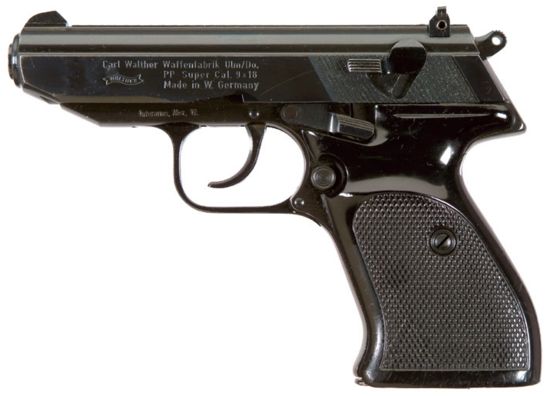
Walther PP Super pistol (Germany)

Characteristics

Type: Double Action
Calibers: 9x18 Police and 9x17 Browning Short (9mm Kurz/.380ACP)
Weight unloaded: 780 g
Length: 176 mm
Barrel length: 92 mm
Capacity: 7 rounds

The Walther PP Super pistol came into existence circa 1972, as a proposed service handgun for West German police. At that period, German police looked for a new standard handgun and ammunition, to replace obsolete and underpowered pistols then in service. During the early 1970s there was much debate about a new service cartridge, and two major contenders were the already famous 9x19mm Luger/Parabellum, and the relatively new 9x18 Police cartridge. The 9x18 Police cartridge has been based on pre-WW2 9x18mm Ultra ammunition, developed in Germany by the Geco and Walther on request from Luftwaffe (German Air Forces). The 9x18 cartridge offered about a maximum power which could be used in relatively compact and lightweight blowback pistols. This, in turn, allowed these pistols to be simpler and less expensive than locked-breech 9x19mm pistols. Recognizing these advantages of 9x18 ammunition, the Walther company developed a police pistol, roughly based on the famous Walther PP pistol, and called it PP Super. However, by mid-1970s German law enforcement authorities selected the more powerful 9x19mm ammunition as a standard, and by the end of 1970s the 9x18 Police ammo went out of favor; Only about 2 000 of 9x18 PP Super pistols were purchased by Bavarian Police during 1970s. Some of PP Super pistols were also made in 9x17 short caliber, but the future of the police handguns was in 9mm Luger, and the Walther company dropped the PP Super from manufacture circa 1979, focusing on 9x19mm pistols like P5 and P38 / P1 / P4
The Walther PP Super is an all-steel, blowback operated, double action pistol. Unlike its predecessor, the Walther PP, the PP Super featured an external slide stop lever, and a manual decocker on the left side of the slide, which, when pushed down, locked the firing pin and released the hammer, and then automatically returned to the 'fire' position. There was no manual safety, but the PP Super has a firing pin safety, and was intended to be carried with the loaded chamber and hammer down, ready to be fired in double action mode. The magazine catch is located on the side of the grip, next to triggerguard.
A word of caution to the owners of Walther PP Super pistol. The scarce 9x18mm Police/Ultra ammunition is NOT compatible with Soviet 9x18 Makarov PM ammunition. Attempts to fire 9x18 Makarov ammunition from PP Super pistol are very dangerous due to the larger diameter of 9mm Makarov bullet.

Walther PP, PPK and PPK/S pistol

Experimental Walther
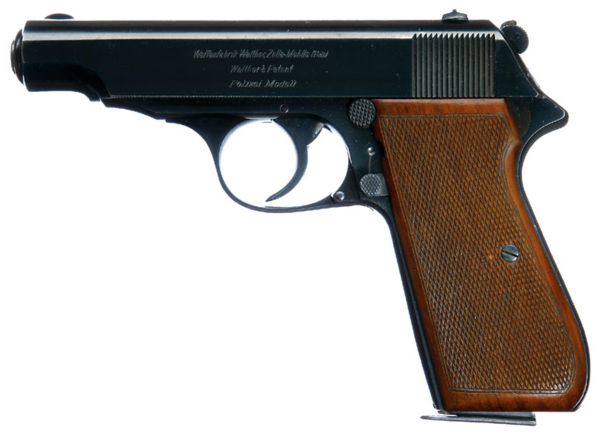
Experimental Walther "Police model" pistol which served as a prototype for PP; note that it has longer grip for 10-round magazine, and frame-mounted manual safety.

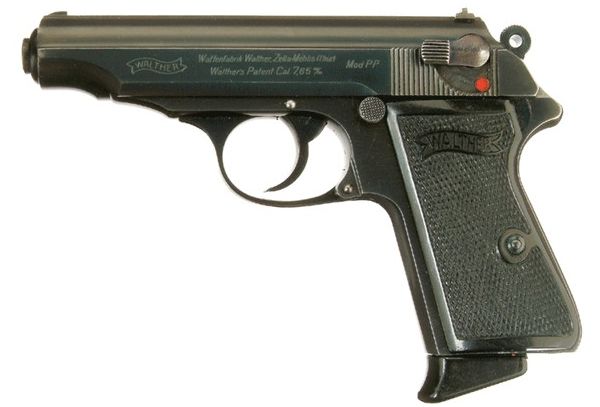
Early production Walther PP pistol with so-called 90-degree safety.

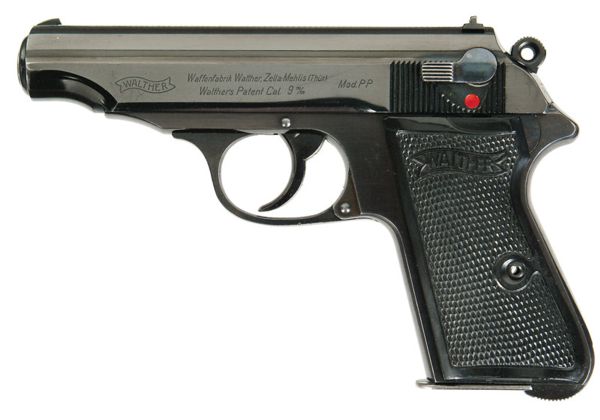
Rare pre-WW2 variation of Walther PP with bottom-mounted magazine release.

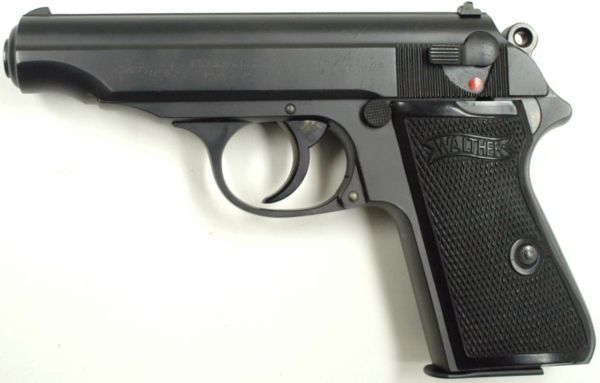
A typical prewar Walther PP pistol.

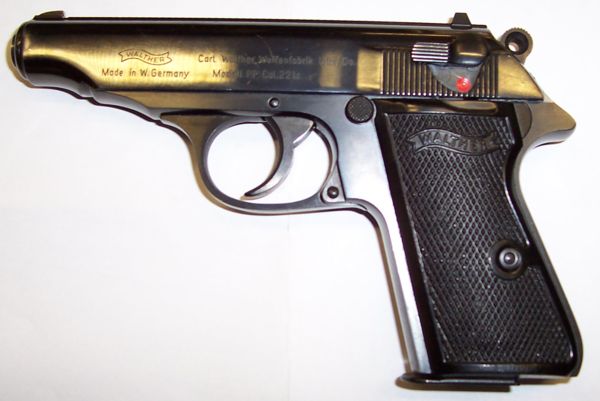
Post-war Walther PP pistol in .22LR.

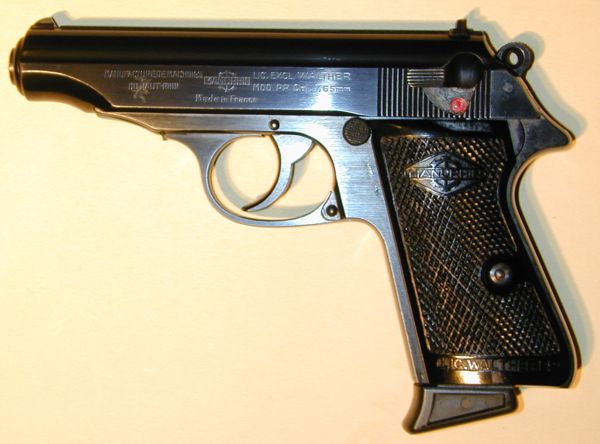
Post-war Walther PP pistol made under license in France by Manurhin.

Post-war Walther PP pistol made in East Germany.

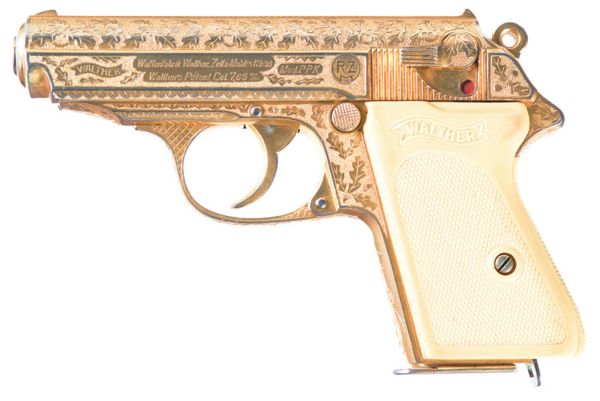
Pre-war Walther PPK pistol in presentation gold finish with engraving, issued by RZM.

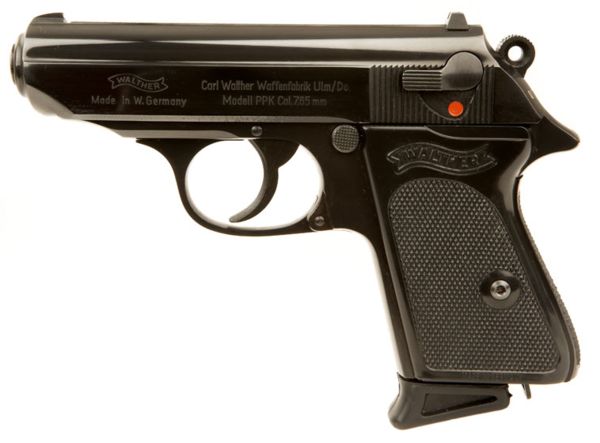
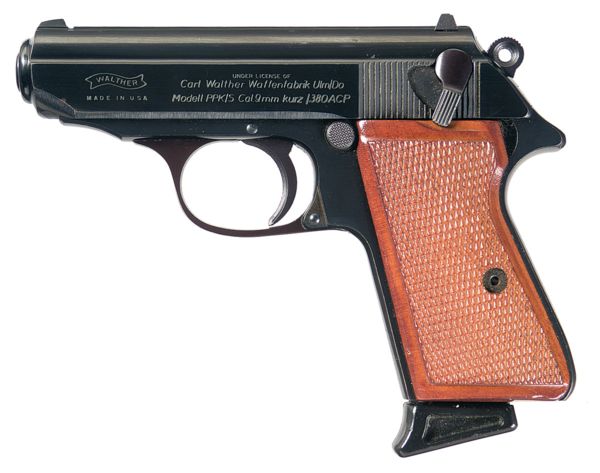
Post-war Walther PPK pistol.

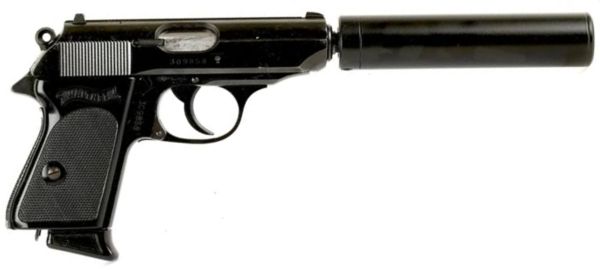
Walther PPK pistol fitted with silencer - a setup, closely associated with James Bond, agent 007.

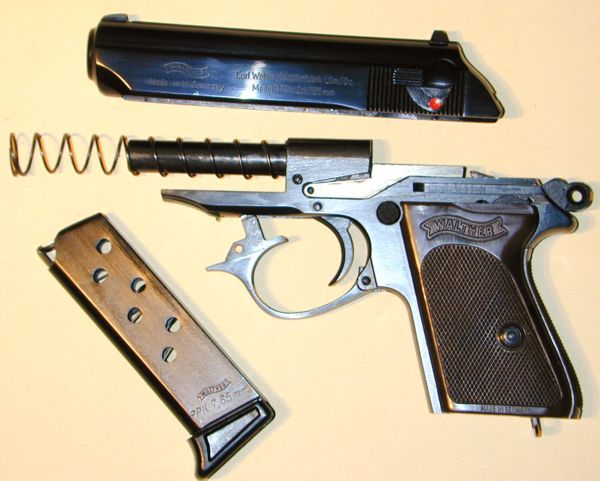
Walther PPK pistol, partially disassembled.

Walther PPK/S.
Walther PPK/S.

Characteristics

Type: Double Action
Caliber: .22LR or 6.35mm auto (.25 ACP) or 7.65x17mm Auto or 9x17mm (.380 ACP)
Length overall 173mm PP, 154 mm PPK
Weight: 682g PP, 568g PPK
Barrel length: 99mm PP, 84mm PPK
Capacity: 8 (PP), 7 (PPK) rounds

Walther PP pistols were among the most important developments of the inter-war period. Produced between 1929 and 1945 in significant numbers, these pistols, among with the basically similar but smaller PPK, were widely used as police and military guns in Hitler’s Germany. After the war, production of the PP and PPK pistols was resumed in France by Manurhin under German licence. Later on, production was returned to the re-established Walther factory in the city of Ulm ab Donau (pre-war Walther factory was located in the city of Zella-Mehlis), and these pistols have seen widespread use by civilians and police, as well as for personal defense by many non-infantry officers in several European armies. Very close copies of the Walther PP were manufactured after the war by East Germany, Hungary, Romania, Turkey and USA. At the present time, Walther PP, PPK/S and PPK pistols are manufactured in the USA by the Smith & Wesson Company under licence from Walther.
Walther PPK pistols are essentially similar to the larger PP pistols, except for the different design of the grip frame – while on PP pistols the grip backstrap is integral to the frame and grip panels are two separate items (left and right), on PPK pistols grip frame has a rectangular shape of a magazine channel and the backstrap is formed by the single-piece U-shaped grip unit, also usually made of plastic. While most PPK pistols were made with steel frames, in the post-war period Walther also produced some aluminum-framed PPK/L (Lightweight) pistols.
Also, there are Walther PPK/S pistols, which are a cross-breed between PP and PPK, combining the PP frame with shorter PPK-style barrel and slide. These pistols were designed to avoid limitations imposed by the American Firearms Owners Protection Act of 1968. This act, in particular, limited the minimum size of a “sporting purpose” pistols that are allowed to be imported in USA, and use of the larger grip frame allowed importing these pistols instead of smaller PPK pistols, banned from importation under this law.
The Walther PP is blowback-operated pistol with a fixed barrel, usually of all-steel construction. A few aluminum-framed PP pistols were built in Germany before the war, and stainless steel versions are manufactured in the USA under Walther’s licence since the mid-1980s. The trigger is double-action, with an exposed hammer and a frame-mounted manual safety/decocker; the lockwork is somewhat complicated in a typical German manner and has many small parts and pins. Sights are fixed, with the rear sight blade dovetailed into the slide. Magazines are single-stack; the magazine release button is usually located at the left side of the frame, just below the slide and in front of the grip panel. However, at least some PP pistols were made both before and after the war with so called “European-style” magazine release, located at the heel of the grip. Walther PP and PPK pistols are fitted with a loaded chamber indicator, made in the form of a small pin that protrudes from the rear of the slide (above the hammer) when a cartridge is in the chamber. This indicator is not present on .22LR models.
It must be noted that most of PP and PPK pistols were made in 7,65mm (.32ACP) caliber, with 9mm Kurz (9x17, .380ACP) running distant second. The .22LR version was made in some numbers, and so far most rare is the 6,35mm / .25ACP version, with very few guns made early in production history of both pistols.
How to field-strip (disassemble) Walther PP or PPK: 1) remove the magazine by pressing the magazine release button; 2) check that the chamber is empty; 3) pull the trigger-guard downwards, then swing it to one side to lock in the open position; 4) pull the slide all the way back, then raise the rear of the slide to the top, and off the frame rails; 5) carefully ease the slide forward and off the barrel; 6) remove the return spring from the barrel.
Reassemble in reverse order.

 
Design by Free WordPress Themes | Bloggerized by Lasantha - Premium Blogger Themes | Online Project management