Tampilkan postingan dengan label Machine Guns. Tampilkan semua postingan
Jumat, 21 Juni 2013
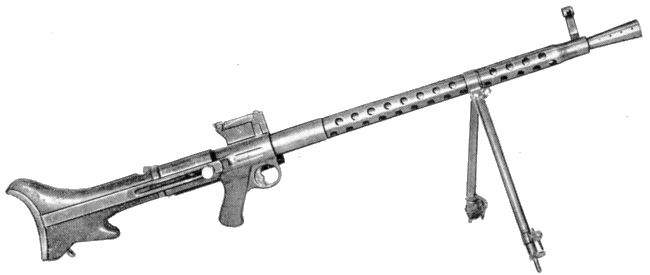
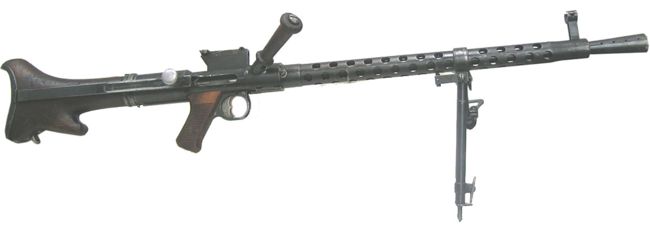
Steyr-Solothurn MG30
Steyr-Solothurn S2-100 / S2-200 / MG 30 / 31M machine gun (Switzerland /Austria)
| Caliber | 7.92x57, 8x56R |
| Weight | 9.5 kg |
| Length | 1162 mm |
| Barrel length | 600 mm |
| Feed | Magazine, 30 rounds |
| Rate of fire | 550 rounds per minute |
During the late 1920s Waffenfabrik Solothurn, a Swiss private business that emerged in the watch-making industry but later turned to the production of small-armsparts, was bought by the German concern Rheinmetall, to serve as a research and development facility away from the watchful eyes of the Allied Control Commission, established in 1918 as a result of Treaties of Versailles. In 1929 Waffenfabrik Solothurn brought out its first practical machine gun, known by the factory as the S2-100, and in export catalogs as the MG 29. Next year Solothurn announced an updated version, the S2-200, also known as theMG 30. It was, in essence, a typical light machine gun – recoil operated and magazine fed, although Solothurn also offered a complicated universal tripod for this gun. The Solothurn MG30 earned its place in history by being adopted by Austria in 1930 and Hungary in 1931 (in both cases chambered for 8x56R ammunition), and it also served as the starting point for several German machine guns, such as the MG 15 (aircraft) and MG 34. It is also must be noted that most of components of the MG30 were produced in Austria at the Steyr factory; Solothurn carried out the final assembly and test-firing.
The Solothurn S2-200 machine gun is a short-recoil operated, air cooled, magazine-fed weapon. It uses a locking ring, which is located at the end of the barrel extension, to lock the bolt. Inside the locking ring, there are six sets of locking lugs, arranged as an interrupted thread. These lugs are mated with lugs cut at the rear of the bolt. Rotation of the ring, which locks and unlocks the bolt, is controlled by rollers mounted on the outside of the ring. Upon recoil, these rollers follow cam tracks cut into the receiver. The gun is of relatively simple design, with most parts having a round cross-section. The tubular receiver is an extension of the barrel jacket. The butt hosts a tube which contains the return spring and its guide. During disassembly, the butt is unlocked and rotated to disengage it from the receiver, then removed. This permits the entire barrel / bolt group to be pulled or shaken off the receiver for replacement. Since the bolt is held attached to the barrel extension, it needs to be removed from the hot barrel and attached to the cold one before reassembly; this procedure requires a heat-insulated glove to handle the hot barrel.
The trigger is of the rocking type and allows for single shots and automatic fire. The selection of fire mode is made by pressing either the top (single shots) or bottom (automatic) part of the trigger.Ammunition feed is from curved box magazines, inserted from the left side; ejection is to the right.
The gun is normally fitted with a folding bipod, although Solothurn also produced a sophisticated universal tripod, with a remote trigger and a traverse and elevation mechanism, and recoil buffers.
Modifications:
S2-100 / MG 29: a direct predecessor to the S2-200, made in very limited numbers in 1929-30. Key difference from S2-200 is that buttstock cannot be removed so quickly.
MG 30 (Austria): same as S2-200 except for ammunition used – it was chambered for 8x56R rimmed ammunition, which required magazines of more curved shape
31M (Hungary): same as MG 30.
The Solothurn S2-200 machine gun is a short-recoil operated, air cooled, magazine-fed weapon. It uses a locking ring, which is located at the end of the barrel extension, to lock the bolt. Inside the locking ring, there are six sets of locking lugs, arranged as an interrupted thread. These lugs are mated with lugs cut at the rear of the bolt. Rotation of the ring, which locks and unlocks the bolt, is controlled by rollers mounted on the outside of the ring. Upon recoil, these rollers follow cam tracks cut into the receiver. The gun is of relatively simple design, with most parts having a round cross-section. The tubular receiver is an extension of the barrel jacket. The butt hosts a tube which contains the return spring and its guide. During disassembly, the butt is unlocked and rotated to disengage it from the receiver, then removed. This permits the entire barrel / bolt group to be pulled or shaken off the receiver for replacement. Since the bolt is held attached to the barrel extension, it needs to be removed from the hot barrel and attached to the cold one before reassembly; this procedure requires a heat-insulated glove to handle the hot barrel.
The trigger is of the rocking type and allows for single shots and automatic fire. The selection of fire mode is made by pressing either the top (single shots) or bottom (automatic) part of the trigger.Ammunition feed is from curved box magazines, inserted from the left side; ejection is to the right.
The gun is normally fitted with a folding bipod, although Solothurn also produced a sophisticated universal tripod, with a remote trigger and a traverse and elevation mechanism, and recoil buffers.
Modifications:
S2-100 / MG 29: a direct predecessor to the S2-200, made in very limited numbers in 1929-30. Key difference from S2-200 is that buttstock cannot be removed so quickly.
MG 30 (Austria): same as S2-200 except for ammunition used – it was chambered for 8x56R rimmed ammunition, which required magazines of more curved shape
31M (Hungary): same as MG 30.
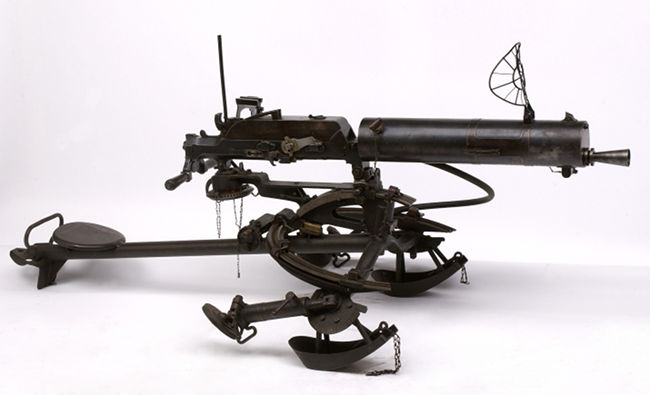
Schwarzlose M1907 and M1907/12
Schwarzlose M1907 and M1907/12 machine gun (Austro-Hungary /Austria)
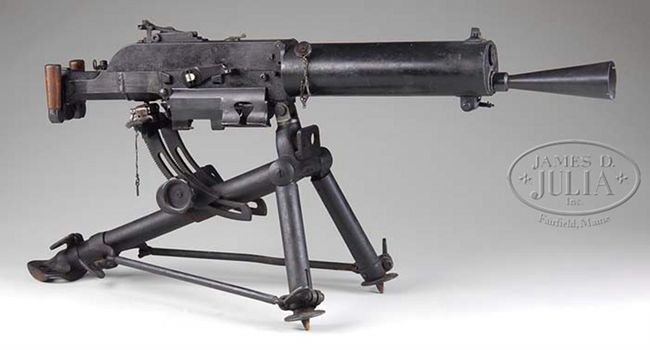
Schwarzlose M1907/12 machine gun on standard Austrian tripod; spade grips are folded up.
Image courtesy of James D. Julia auction house, Maine, USA
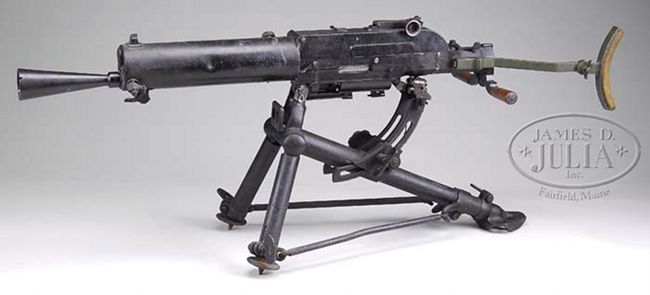
Schwarzlose M1907/12 machine gun on standard Austrian tripod; spade grips are in ready position, and a shoulder stock is attached.
Image courtesy of James D. Julia auction house, Maine, USA
Schwarzlose M1907/24 (Vz.24) machine gun, interwar Czechoslovak conversion to 7.92x57 mauser caliber; note that it has longer barrel and jacket.
| Caliber | 8x50R Mannlicher and others |
| Weight | 20 kg (gun body) + 3 kg (water) + 20 kg (tripod) |
| Length | 1067 mm |
| Barrel length | 527 mm |
| Feed | belt |
| Rate of fire | 400 rounds per minute |
German arms designer Andreas Wilhelm Schwarzlose patented a basic design for a machine gun in 1902. He subsequently sold his patent rights to the Steyr arms factory in Austria, which produced the first guns of the Schwarzlose pattern in 1905. After two years of trials and development, the military forces of the Empire adopted the Schwarzlose machine gun in 1907; this gun was also later adopted in a range of calibers by the Netherlands and Sweden (who both manufactured Schwarzlose machine guns under licence until the 1930s), and by Greece, Serbia, Romania, Bulgaria and Turkey – all before the World War I. In 1912 it was modified with the introduction of stronger parts and slightly reshaped retarding levers (struts). The primary visible difference between original M1907 guns and modified M1907/12 guns is the lack of the gap between the hump on the receiver and the barrel jacket on the latter guns.
After the WWI and the fall of the Austro-Hungarian Empire, a great many Schwarzlose guns were adopted by smaller countries that emerged from the remains of the Empire, such as Czechoslovakia (which put the gun into production) and Hungary. Many Schwarzlose guns also went to Italy as war reparations, and subsequently saw some use during WW2, mostly in Africa in the original 8x50R caliber. Another user of Schwarzlose machine guns was Russia, which captured several thousands of Austrian machine guns during the early parts of World War One.
The Schwarzlose machine gun, although overshadowed by more famous weapons such as the Maxim or Browning, has its own merits. It is quite simple in construction, robust in service, and usually quite reliable. Its drawbacks come from its basic design, which centers on a retarded-blowback action. This action calls for a relatively short barrel so that the chamber pressure drops before the case begins to leave the chamber; otherwise it would rupture – although when the Czechoslovak army converted their old 8x50R Schwarzlose machine guns to the more powerful 7.92x57 Mauser ammunition, they had no problems associated with high pressure, even with new, significantly longer barrels. Nevertheless, most of the Schwarzlose guns retained short barrels throughout their service life. This obviously limited the muzzle velocity and thus the maximum range and possible bullet penetration at any given range, compared with contemporary guns with a locked breech. The short barrel also called for a dedicated flash hider, to suppress the significant muzzle flash which otherwise would blind the gunner at night. Finally, the lack of primary extraction required an integral oiler, which squirted a small amount of oil into the chamber just before chambering the next round. Nevertheless, the Schwarzlose was a good weapon and saw considerable use through both world wars, although during the Second World War it was mostly relegated to second-line troops, fortifications and other such uses.
After the WWI and the fall of the Austro-Hungarian Empire, a great many Schwarzlose guns were adopted by smaller countries that emerged from the remains of the Empire, such as Czechoslovakia (which put the gun into production) and Hungary. Many Schwarzlose guns also went to Italy as war reparations, and subsequently saw some use during WW2, mostly in Africa in the original 8x50R caliber. Another user of Schwarzlose machine guns was Russia, which captured several thousands of Austrian machine guns during the early parts of World War One.
The Schwarzlose machine gun, although overshadowed by more famous weapons such as the Maxim or Browning, has its own merits. It is quite simple in construction, robust in service, and usually quite reliable. Its drawbacks come from its basic design, which centers on a retarded-blowback action. This action calls for a relatively short barrel so that the chamber pressure drops before the case begins to leave the chamber; otherwise it would rupture – although when the Czechoslovak army converted their old 8x50R Schwarzlose machine guns to the more powerful 7.92x57 Mauser ammunition, they had no problems associated with high pressure, even with new, significantly longer barrels. Nevertheless, most of the Schwarzlose guns retained short barrels throughout their service life. This obviously limited the muzzle velocity and thus the maximum range and possible bullet penetration at any given range, compared with contemporary guns with a locked breech. The short barrel also called for a dedicated flash hider, to suppress the significant muzzle flash which otherwise would blind the gunner at night. Finally, the lack of primary extraction required an integral oiler, which squirted a small amount of oil into the chamber just before chambering the next round. Nevertheless, the Schwarzlose was a good weapon and saw considerable use through both world wars, although during the Second World War it was mostly relegated to second-line troops, fortifications and other such uses.
The Schwarzlose machine gun is a retarded-blowback operated, water cooled, belt-fed weapon that fires from a closed bolt. The method of operation requires a heavy breechblock, connected to the receiver through a pair of knee-joint struts. When the bolt is in battery, the struts are folded forward, with their joint axis lying relatively low above the barrel axis. Upon firing, the pressure of the powder gases acts on the breechblock through the base of the cartridge case. The rearward movement of the breechblock unfolds the struts, but because of a carefully arranged redirection of forces through the struts and joints, most of the initial pressure is transferred to the receiver. Upon further recoil, joint axis rises above the barrel, and thus the recoil force is re-distributed with more and more of it being used for bolt acceleration. Upon recoil, the bolt compresses a massive and powerful return spring which forces it forward and into battery once the recoil stroke is completed. The charging handle is attached to the axis of the forward strut, and has to be rotated back to cycle the bolt.
Due to the lack of primary extraction, the Schwarzlose has to use oiled cartridges. To avoid the problems associated with factory-oiled or waxed ammunition (which tends to collect fine dust and then cause jams) the gun has an internal oiling system which squirts a small amount of oil into the chamber just before the chambering of each round. This system includes an oil reservoir, located in the receiver’s top cover, and a small oil pump, which is operated by the reciprocating bolt.
The belt feed system is very simple, and involves few parts. The major part is the star-wheel, located in the lower left corner of receiver. Upon bolt recoil, the star-wheel is rotated for one step by the interaction of the cam surfaces on the bolt and the wheel. Each cartridge has to make three steps in the feed before being presented to the bolt for chambering, therefore initial belt loading requires three deliberate pulls on the charging handle. The feed direction is from the right side only, ejection being to the left.
The trigger system also is of rather simply design. It involves a separate striker, a striker spring and a sear, mounted on the bolt. The sear is cocked by a lever attached to the rear bolt delaying strut, and this cocking movement adds to the retarding force applied to the bolt. After cocking the striker is held to the rear by the sear. The thumb trigger is located at the rear of the receiver, and once pushed by the operator, it holds the connection bar so it trips the sear when the bolt is in battery. A manual safety is located next to the trigger and blocks it unless pushed forward by the operator’s left thumb. Dual spade grips are located horizontally at either side of the receiver, and can be folded up for storage or transportation.
The most common mounting was a tripod of solid construction, with tubular legs of adjustable height and traverse and elevation mechanisms. An optional armored shield was available for this gun, which was unusual in that it also provided frontal and lateral armored protection for the thin metal of the water jacket. Alternatively, a low-height, lightweight tripod was provided for the “light” role. This tripod had no traverse and elevation mechanisms.
Due to the lack of primary extraction, the Schwarzlose has to use oiled cartridges. To avoid the problems associated with factory-oiled or waxed ammunition (which tends to collect fine dust and then cause jams) the gun has an internal oiling system which squirts a small amount of oil into the chamber just before the chambering of each round. This system includes an oil reservoir, located in the receiver’s top cover, and a small oil pump, which is operated by the reciprocating bolt.
The belt feed system is very simple, and involves few parts. The major part is the star-wheel, located in the lower left corner of receiver. Upon bolt recoil, the star-wheel is rotated for one step by the interaction of the cam surfaces on the bolt and the wheel. Each cartridge has to make three steps in the feed before being presented to the bolt for chambering, therefore initial belt loading requires three deliberate pulls on the charging handle. The feed direction is from the right side only, ejection being to the left.
The trigger system also is of rather simply design. It involves a separate striker, a striker spring and a sear, mounted on the bolt. The sear is cocked by a lever attached to the rear bolt delaying strut, and this cocking movement adds to the retarding force applied to the bolt. After cocking the striker is held to the rear by the sear. The thumb trigger is located at the rear of the receiver, and once pushed by the operator, it holds the connection bar so it trips the sear when the bolt is in battery. A manual safety is located next to the trigger and blocks it unless pushed forward by the operator’s left thumb. Dual spade grips are located horizontally at either side of the receiver, and can be folded up for storage or transportation.
The most common mounting was a tripod of solid construction, with tubular legs of adjustable height and traverse and elevation mechanisms. An optional armored shield was available for this gun, which was unusual in that it also provided frontal and lateral armored protection for the thin metal of the water jacket. Alternatively, a low-height, lightweight tripod was provided for the “light” role. This tripod had no traverse and elevation mechanisms.
Rabu, 26 Januari 2011
Machine Guns
First machine gun was invented in USA by Hiram Maxim in 1883 and patented two years later. First wars Maxims' MGs was taken into was colonial war in South Africa and Russia-Japan war (1904-1905). During WW 1 all sides used many machineguns, both heavy (on wheels or tripods) and ligth (on bipods). After WW1 MGs become a standart issue as a squad weapons for ground and anti-aircraft warfare. Most widely used MGs were Maxims (in many modifications), Brownings M1919, Gotchkiss. Between two World Wars first appeared large caliber MGs (as a rule, its caliber was .50", or 12.7mm). Best examples - Belgian/American Browning M2 and Soviet DShK-12.7. During WW2 Germans developed first mass "universal" MG (Mg42, later - Mg43), which can be used as a "ligth" MG on bipod or as a "heavy" one on tripod agains ground or air targets. This MGs set the trend, so almost all modern "medium" MGs such as Belgian MAG, American M60, Russian PKM may be used on bipod or tripod, as needed.
Today the main role of all MGs is to provide sustained firepower for troops against enemy troops and unarmored targets. Heavy (.50/12.7mm) MGs can deal with lightly armored targets such as APCs, recon vehicles, helicopters.
Almost every infantry squad in the world has at least one light MG. Russian squad usually equipped with one RPK-74 MG, US Army squad - with two M249 SAWs. Medium MGs usually are installed on vehicles (APCs, Jeeps, tanks) and used in infantry on ground mounts on troop and company level. Heavy MG are sometimes used as anti-aircraft weapons on tanks, main weapons on APCs and recon veichles and company level support weapons in infantry.
Almost all heavy and medium MGs, and many light ones, have quick interchangeable barrels. Usually every MG comes from factory with one or two spare barrels, wich may be changed in battle environment within seconds. This feature provides ability to sustain intensive fire for longer time while one barrel is being used, the spare one can be cooled - intensive heating during the fire can dramatically decrease accuracy and reduce the lifetime of the barrel.
The feeding systen of almost all medium and heavy MGs is build around belted (or linked) ammunition. Early belts were made from textile, modern belts are made from metal. Metal belts may be "desintegrated" or non-desintegrated.
In the desintegrated belt the metal links are linked ty each other by the cartridge. When feeding system of the MG removes cartridge to feed the MG, links fall apart, thus "desintegrate" the single belt into the links. In non-desintegrated belts links are connected by the means of special details, and belts remains "one piece" even when all cartridges are removed. Usual belt capacity for heavy MG is 50-100 rds, for medium and light ones - 100-250 rds.
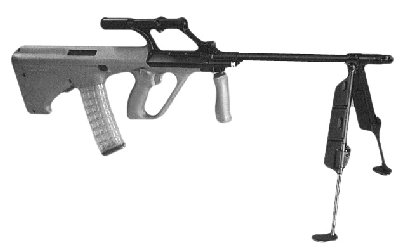
Light MG often employs the magazine feeding system, using the snandart 'assault-rifle' style box magazines for 30-45 rounds each or hi-capacity drum or dual drum (Beta-C and others) magazines for 50-100 rounds each. In light MGs, made from assault rifles, magazines usually exchangeable between LMG and assault rifle. Good examples are AK and RPK Russian, Steyr AUG Austrian and L85/L86 British systems. Some light MGs such as FN Minimi/M249 are dual-feed and can use belts or box magazines without any modifications.


09.06
Jack The Ripper