Tampilkan postingan dengan label Italy. Tampilkan semua postingan

Jumat, 21 Juni 2013

Armi Chiappa "Rhino"

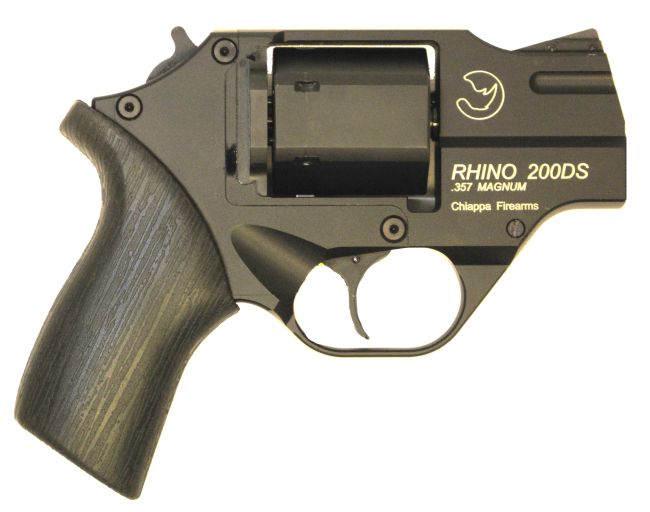
Armi Chiappa "Rhino" revolver with 2 inch barrel

Armi Chiappa "Rhino" revolver, cross-section diagram


TypeDouble Action revolver
Caliber(s) .357 Magnum
Weight unloaded720 g / 1.58 lbs with 2" barrel
Length164 mm / 6.5" with 2' barrel
Barrel length51 mm / 2", (also 101mm/4", 127mm/5" and 152mm/6")
Cylinder capacity6 rounds

The Rhino revolver is a new offering from Italian company Armi Chiappa. This revolver was designed by Antonio Cudazzo and Emilio Ghisoni, the latter also being the designer of a line of Mateba revolvers, including the Unica semi-automatic revolver. The "Rhino" revolver, which is initially offered in "pocket-carry" self-defense version (longer barreled versions are to follow soon), is designed from the scratch to provide most controllable and accurate shooting, thanks to its specially designed trigger / hammer system and extremely low barrel axis, as the gun fires from the bottom chamber of the cylinder, rather than the top one. It must be noted that while this setup is quite rare, it is not unique - the Mateba Unica revolver also fired from the bottom chamber, as well as the Russian OTs-38. The overall layout of the revolver is optimized for concealed carry, with cylinder made with hexagonal (rather than round) cross-section, to made the gun thinner. The low barrel axis also helps to manage recoil, as its force goes straight back into the shooter's palm, and does not cause the muzzle of the gun to jump up, as it happens with traditional revolvers where recoil force is applied above the holding points, causing the gun to rotate up (jump) under recoil. The result of this layout is that the Rhino revolver has somewhat complex trigger setup.
The Rhino revolver is a double / single action revolver with swing-out cylinder. Frame of the gun is made from "Ergal" aluminum alloy; cylinder, barrel and other important parts are made from high quality steel. Reloading of the cylinder is achieved by swinging the cylinder to the left, then pushing the ejector rod to extract all six spent cases at once. Once chambers are empty, fresh cartridges can be loaded into cylinder, individually or using the speedloader. Loaded cylinder then is snapped into the place and locked. The cylinder latch lever has unusual location, as it installed at the top rear of the frame, co-axially with the cocking lever ("false hammer"). To unlock the cylinder for opening operator must push the latch lever forward with his thumb.
The trigger setup is unusual as it features fully concealed hammer which is located inside the frame. To provide "Single Action" firing mode with manual hammer cocking before each shot, Rhino revolver is fitted with cocking lever ("false hammer"), which is placed at the top rear of the frame, where traditional hammer is usually located on conventional revolvers. This cocking piece / "false hammer" is connected to the concealed hammer via push link. To cock the hammer in the Single Action mode, operator must pull the spur on the cocking piece / "false hammer" back as far as it will go, and then release it. This movement will cock the concealed hammer via internal linkage, but the cocking piece / "false hammer" will return to the forward position once it is released. For Double Action firing, operator can pull the trigger as usual, and this will first cock the internal hammer and then release it at the end of the trigger pull.
In teh basic "concealed carry" version. the "Rhino" revolver is fitted with fixed open sights. Longer barreled versions will be available with fixed or adjustable sights.

Mateba Model 6 Unica

Mateba Model 6 Unica auto-revolver in .454Casull caliber

Drawing from original patent (US 4,712,466 to Emilio Ghisoni) which explains the basic design of Mateba Model 6 Unica auto-revolver


TypeDouble Action semiautomatic revolver
Caliber(s).357 Magnum, also .44 Magnum and .454 Casull
Weight unloaded1250 g and more
Lengthdepending on barrel length; 275mm with 152mm (6") barrel
Barrel length76mm (3"), 102mm (4"), 127mm (5"), 152mm (6") and 205mm (8")
Magazine capacity6 rounds

Mateba Model 6 Unica is one of the more unusual modern weapons, which combines advantages and disadvantages of two different types of handguns - semi-automatic pistols and traditional revolvers. Obviously based on 1900-wintage British Webley-Fosbery semi-automatic revolver, Mateba Model Unica adds several novel features to this old and relatively unsuccessful design. Mateba Model 6 Unica auto-revolver has been developed by Italian designer Emilio Ghisoni by late 1980s, and put into limited production by Italian company Macchine Termo Balistiche, now Mateba Srl. Basic design was developed in three calibers (and sizes), as well as in carbine versions, fitted with long 457mm (18") barrels and shoulder stocks. Revolvers of Model 6 Unica line-up apparently are still produced on limited basis.
Mateba Model 6 Unica auto-revolver utilizes two-part frame, where upper part is allowed to recoil on the rails, machined on the lower frame. Upper frame holds cylinder and barrel; lower frame hosts the trigger and hammer unit and a grip. Six-shot cylinder swings to the left for reloading, but, unlike most revolvers, cylinder crane axis is located above the cylinder (not below), and cylinder swings up and to the left, instead of more traditional down and to the left. Also unlike most other revolvers, the barrel is located co-axially with lower chamber in the cylinder (not upper); this is done to decrease muzzle flip through smaller bore axis to grip distance. Barrels are easily removable, with separate barrel jackets; therefore, barrels of various lengths can be installed on a single gun using special wrench. Upon discharge, upper frame recoils against it return spring, automatically cocking the hammer and rotating cylinder; if necessary, revolver also can be fired for first shot in traditional single or double action mode. Sights are adjustable, but again unlike most other guns, it is front sight that is fully adjustable, and rear sight is fixed; this is necessary because front sights are fixed on removable barrel shrouds.
Like its much older predecessor, the Webley-Fosbery semi-automatic revolver, Mateba Model 6 Unica has advantage of significantly reduced felt recoil; however, there are some serious penalties for that, as it is also somewhat heavier than traditional revolvers of similar caliber and barrel length, is more complicated and sensitive to proper grip during discharge - gripping it too weakly may produce failures to cycle the action through insufficient recoiling movement. Also, it is sensitive to weak and mild rounds that may generate insufficient recoil, and the gun will fail to cycle the action.

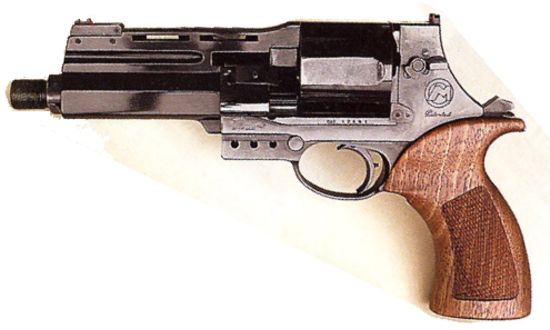
Mateba MTR-8

Mateba MTR-8 revolver


TypeDouble Action revolver
Caliber(s).357 Magnum / .38 Special
Weight unloaded1230 g
Length265 mm (10.4")
Barrel length76 mm (3")
Magazine capacity 8 rounds 

The Mateba MTR-8 revolver is one of most unusual weapons of its class, developed during early 1980s for sport shooting, especially for rapid fire events. To achieve minimum shot-to-shot time through minimized barrel rise, designer of this weapon, Emilio Ghisoni, decided to put the barrel as low as possible. To do so, he put the cylinder in front of the triggerguard, rather than above it. He also used a high-capacity cylinders, which contained 8 rounds of .357 or .38 caliber ammunition (model MTR-8), 12 rounds of .32 caliber ammunition (model MTR-12) or 14 rounds of .22LR (model MTR-14). Revolvers with capacity of up to 20 .22 caliber rounds were proposed in this lineup, but supposedly not built. Very limited manufacture of these finely made and unusual weapons was made by Macchine Termo Balistiche (Mateba) company in Italy. It is believed that MTR line of Mateba revolvers is no longer in production.
Obviously, these revolvers had limited use outside of shooting sport, as they were way too heavy and too long for everyday concealed or open carry, especially considering their relatively short barrels.
Mateba MTR-8 revolver is a double / single action revolver of all-steel construction. 8-shot cylinder is located in the frame ahead of the triggerguard, and swings out to the left for reloading. Cylinder release latch is located at the front of the cylinder, on the cylinder crane. For faster reloading, special flat clips were developed for these revolvers. Trigger unit design was also unusual - hammer is fully concealed within the frame and is located in the grip, with the long firing pin passing above the trigger towards the rear of the cylinder. Hammer can be manually cocked and de-cocked using a thumb lever, located on the frame above the left grip panel.

Kamis, 24 Januari 2013

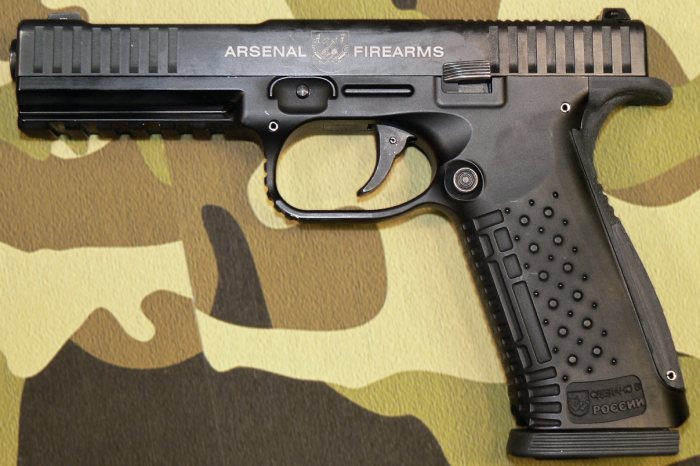
Arsenal "Strike One" pistol


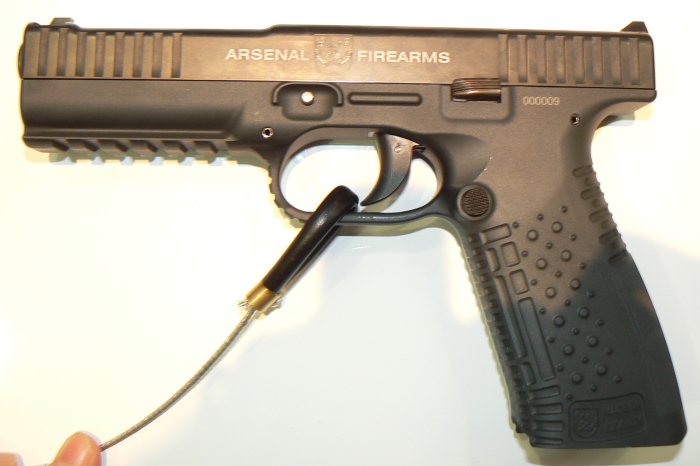
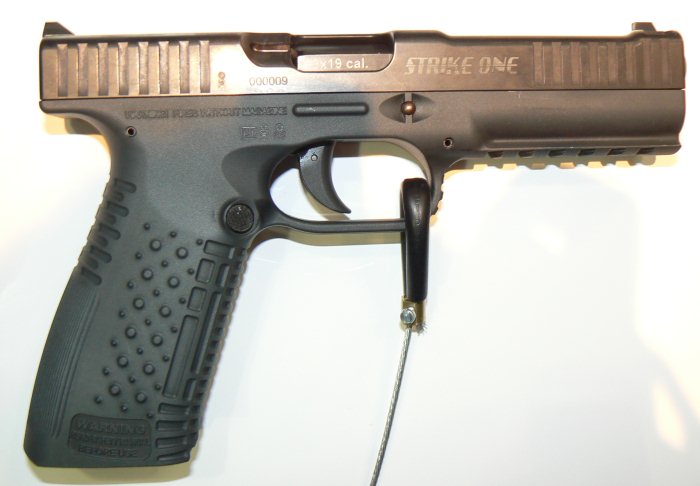
"Strike One" pistol (prototype, as shown at IWA 2012)
 

"Strike One" pistol (prototype, as shown at IWA 2012)
 

"Strike One" pistol partially disassembled, showing barrel with locking piece in place
 

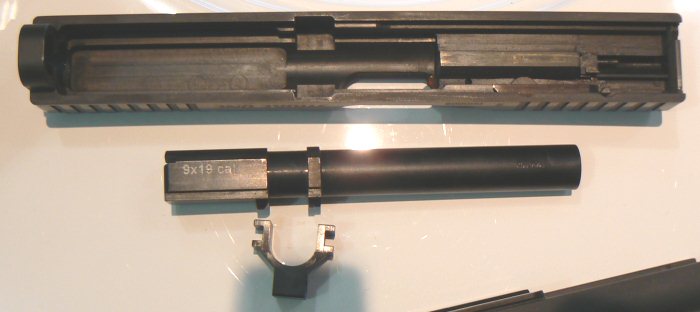
"Strike One" pistol slide, barrel and locking piece (separated from the barrel)
 

"Strike One" pistol with extended barrel


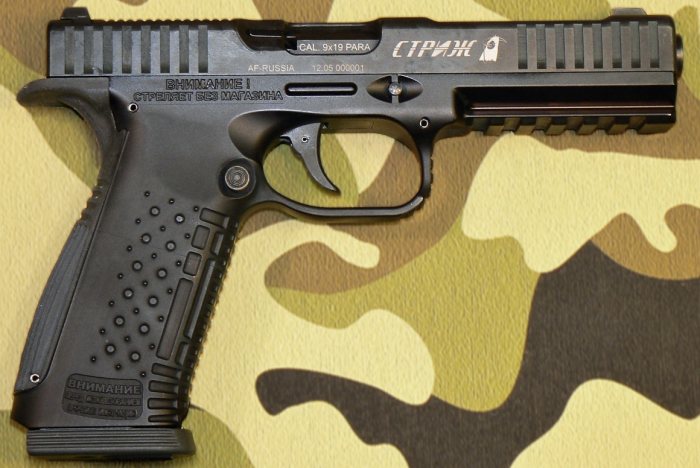
9mm "Strizh" pistol, made in Russia to be offered to Russian Armed Forces and Police. 4th generation prototype, produced in summer of 2012. Note numerous differences from eralier prototype, shown above.
Photo by Arsenal Firearms
 
9mm "Strizh" pistol, made in Russia to be offered to Russian Armed Forces and Police. 4th generation prototype, produced in summer of 2012.
Photo by Arsenal Firearms
 

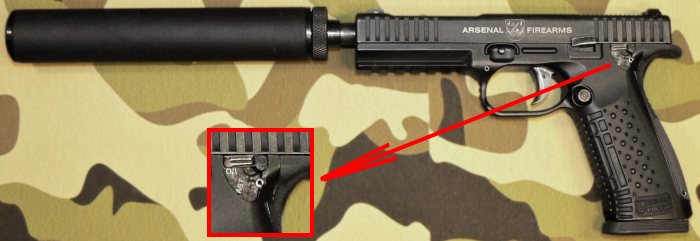
9mm "Strizh" pistol, made in Russia to be offered to Russian Armed Forces and Police. 4th generation prototype, produced in summer of 2012. "Spetsnaz" version with extended threaded barrel that accepts quick-detachable silencer, and select-fire capability (fire mode selector is shown enlarged in the insert)
Photo by Arsenal Firearms
Type     Semiautomatic, Single Action (pre-cocked)    
Caliber(s) 9x19 Luger/Parabellum, 9x21 IMI, .357SIG, .40SW   
Weight unloaded 750 g 
Length    210 mm
Barrel length 128 mm
Magazine capacity 17 rounds   

“Strike One” pistol is a very new product of an young international company Arsenal Firearms, which has headquarters in Russia and manufacturing facilities in Russia, Italy and Austria. Prototypes of this pistol were first displayed to the public in March, 2012 during IWA-2012 exhibition in Nuremberg, Germany. Strike One pistol, which is also known as «Ð¡Ñ‚риж» ("Strizh", Swift bird) in its Russia-made version, is intended to compete for the role of a service pistol for various military and law enforcement forces (in Russia and elsewhere). It will be also offered for civilian sales as self-defense and/or sport weapon, where permitted by law. At the moment of this writing (mid-March, 2012), Strike One pistol is still in prototype / pre-production stage, and its final version most probably will differ from the ones shown here in certain respects. One most noticeable feature of the Strike One pistol is its extremely low bore axis, which helps to control recoil and muzzle rise during rapid fire.
At the moment of last update (June, 2012), Strizh pistol is at its 4th iteration of prototypes. Versions, developed and manufactured in Russia, feature numerous improvements over early prototypes made in Italy. Arsenal Firearms plans to offer Strizh to Russian Armed Foreces and Police. For this purpose, Strizh pistol is especally adapted for Russian service 9mm ammunition, known as 7N21 and 7N31. This 9x19 ammnunition is loaded with AP (Armor Piercing) bullets and rated at +P+ power level. Arsenal Firearms also is developing "Spetsnaz" versions of the basic pistol, that can mount quick-detachable silencers. Another special purpose variant can provide select-fire capabilities via fire selector, located on the left side of the frame.

“Strike One” is a semi-automatic pistol which uses single polymer frame with different upper kits (barrel and slide) for several calibers. It utilizes striker-fired trigger system with Glock-style pre-cocked striker which can be fully cocked only through the pull of the trigger. Like the Glock, Strike One pistol does not offer a “second strike” capability in case of misfire. To ensure lowest possible bore axis and good accuracy, Strike One pistol employs slightly unusual version of the short recoil operation. Roots of this system could be traced to the century-old system, developed at the turn of the 20th century by Louis Schmeisser for Bergmann “Mars” pistol, although in the Strike One it is heavily modified. In this system, barrel is allowed to recoil against the frame in a linear motion, without any tilting or rotation. Separate vertically sliding locking piece is employed to lock the barrel to the slide during initial stages of recoil cycle. In this particular case, the locking piece is “Y”-shaped. Its upper fork part goes around the bottom of the barrel, in front of the chamber. Barrel has vertical grooves for this fork, so it can slide up and down in relation to the barrel, but moves along with the barrel forward and rearward. Outer sides of the “fork” have externally projecting lugs that engage cuts inside the slide to lock it to the barrel. Lover part of the locking piece projects down and into the frame, and has cam-shaped cut which is engaged by a cross pin, set into the frame. Upon recoil, interaction of the cam cut in locking piece (which moves rearwards along with the barrel) and stationary pin causes the locking piece to move down, disengaging its locking lugs from the slide. Once the slide is free from lock, recoil of the barrel is stopped against the steel insert in the frame, and the slide is free to complete recoil cycle, ejecting and extracting spent case. Upon forward movement, slide chambers the fresh round from magazine, and then pushes barrel forward, into the battery. Forward movement of the barrel causes the locking slide to move up and engage the slide for a positive lock.
Other features of the Strike One pistol include double stack, single feed box magazines with ambidextrous release buttons, slide stop with manual slide release lever on the left side, and an integral Picatinny type accessory rail under the front part of the frame. Optional carbine kits (known in factory literature as LRC – Long Range Conversion) include longer 300mm barrel with flutes to reduce weight and improve heat dissipation, and removable accessory kits that can be attached to underbarrel rail.

Selasa, 29 Maret 2011

Tanfoglio "Force" and "Force 99"


Tanfoglio

Tanfoglio "Force"

Tanfoglio
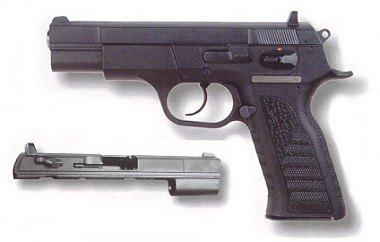
Tanfoglio "Force 99" with optional slide shown below with slide mounted safety/decocker

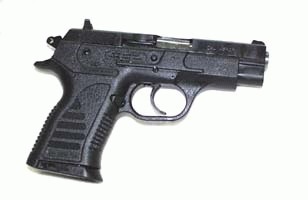
Tanfoglio "Force 99 Carry" - compact version of the Force 99


Type: Double Action 
Chamber: 9x19mm Luger/Para, 9x21mm IMI, .40SW, .38Super, 10mm auto and .45ACP in "Force" models; 9mm and .40SW in "Force 99" models
Weight unloaded: 850 - 880 gramms, depending on caliber 
Length: 205 mm 
Barrel length: 115 mm 
Capacity: 17 (.38super), 16 (9mm), 12 (.40sw), 11 (10mm) or 10 (.45acp) rounds 

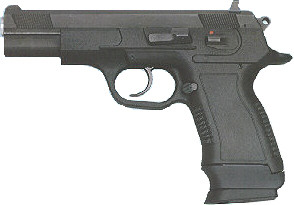
Tanfoglio pistols are manufactured by Fratelli Tanfoglio SpA. company, Italy. Basically, Force and Force 99 models are polymer frame versions of the Tanfoglio T95 Combat models, that, in turn, are clones of the famous CZ-75 design. The Force model was introduced in 1997, while the Force 99 model appeared two years later, in 1999.
Tanfoglio Force and Force 99 pistols are similar in design except for the new, redesigned frame of the Force 99. Both pistols are blowback operated, locked breech semi-auto pistols, that use browning hi-power style linkless system. Both models feature DA triggers with frame mounted ambidextrous safety that allows "cocked and locked" carry mode, as well as internal firing pin block safety. New slide with slide-mounted safety/decocker lever (similar to T95 Standart) is available for Force 99 as a factory option. Both have fixed sights with three dots for increased viosibility.
The Tanfoglio company also developed compact versions of the both Force and Force 99 pistols, that featured shortened to the 92 mm barrels and shorter grips.
Tanfoglio polymer framed Force pistols are popular defensive and sporting firearms across the Europe. They also are imported into USA by EAA Corp. under the name "Witness Polymer" (Force) and "Witness Polymer P" (Force 99).

Tanfoglio T95 "Standart" and "Combat" / EAA Witness pistol


Tanfoglio

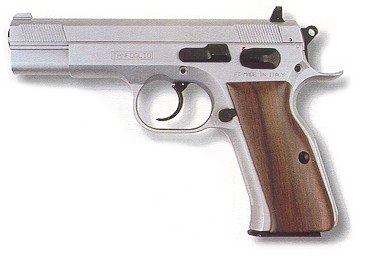
Tanfoglio "Standart" (shown here with EAA Corp, USA import marks)

Tanfoglio
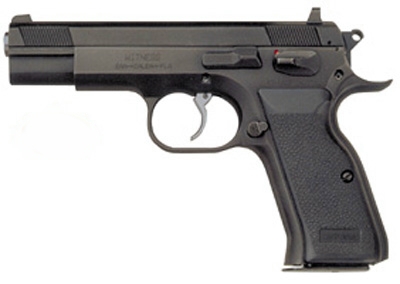
Tanfoglio "Combat"

Tanfoglio
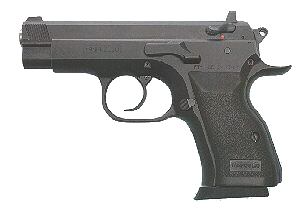
Tanfoglio "Compact"

Tanfoglio
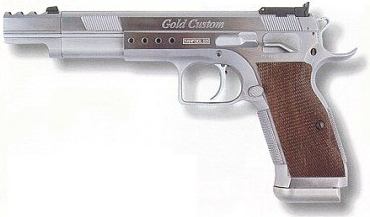
Tanfoglio "Custom Hybrid"


Type: Double Action 
Chamber: 9x19mm Luger/Para, 9x21mm IMI, .40SW; also .38Super, 10mm auto and .45ACP in "Combat" models
Weight unloaded: 930 - 1000 gramms, depending on caliber 
Length: 205 mm 
Barrel length: 115 mm 
Capacity: 17 (.38super), 16 (9mm), 12 (.40sw), 11 (10mm) or 10 (.45acp) rounds 

Tanfoglio pistols are manufactured by Fratelli Tanfoglio SpA. company, Italy. Basically, all standart, combat and compact models are all-steel clones of the famous CZ-75 design.
All Tanfoglio Standart and Combat pistols (also known as T95-series) are blowback operated, locked breech semi-auto pistols, that use browning hi-power style linkless system. All T95 pistols feature DA triggers. The "Standart" models feature slide mounted hammer drop safety/decocker lever (ambidextrous as an option), while "Combat" featured frame mounted ambidextrous safety that allows "cocked and locked" carry mode, as well as internal firing pin block safety. Both "Standart" and "Combat" models feature all-steel design. Both have fixed sights with three dots for increased viosibility.
Other than basic models described above, Tanfoglio also manufactured compact models with shortened barrels (down to 92mm) and grips, as well as "Factory Custom" guns for self defence, service carry and competition. The custom features may include extended ambidextrous controls (slide stop lever and safety lever), match triggers and hammers, different compensators and sights.
Tanfoglio pistols are popular defensive and sporting firearms across the Europe. They also are imported into USA by EAA Corp. under the name "Witness".

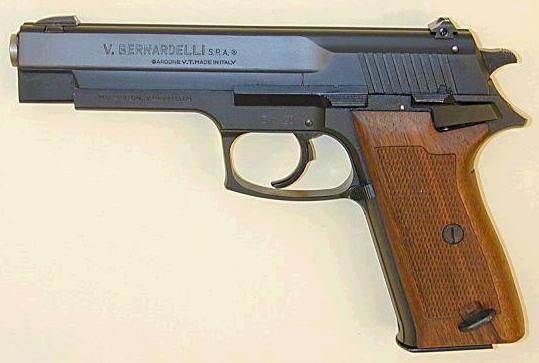
Bernardelli P-018


Bernardelli P-018 pistol

Bernardelli P-018 pistol

P-018 field-stripped


Type: Double Action 
Chamber: 9x19mm Luger/Parabellum; 7.65mm Luger/Parabellum; 
Weight unloaded: 998 g 
Length: 213 mm 
Barrel length: 122 mm 
Capacity: 16 rounds 

The Bernardelli P-018 pistol appeared on the market in the mid-1980s, as a police and civilian side-arm. The 9mm version was intended mostly for the police use, while 7.65mm version ws intended for European civilian market, where in some countries such as Italy or France, civilians are prohibited to own guns in "military" calibers. P-018 was used by some European police forces.
Technically, P-018 is a quite straightforward design, with Browning-type, linkless short recoil system of automatic and double-action trigger, The asfety is frame-mounted, and the sights are dovetailed into slide.

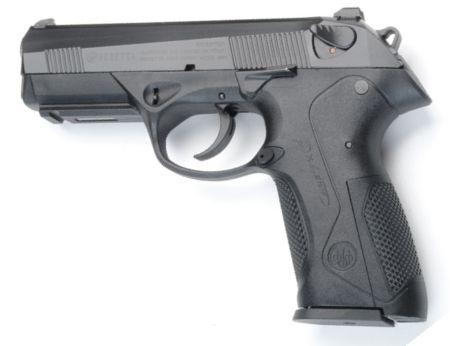
Beretta PX4 Storm pistol


Beretta PX4 pistol
Beretta PX4 pistol

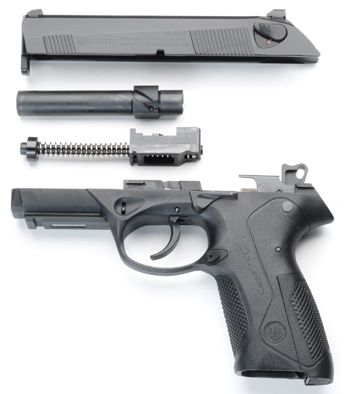
PX4 pistol partially disassembled

The grip of PX4 pistol features removable backstraps of various sizes and shapes

Type: Double Action 
Calibers: 9x19 mm Luger/Para and .40S&W 
Weight unloaded: 780-800 g 
Length: 193 mm 
Barrel length: 102 mm 
Capacity: 17 (9mm) or 14 (.40) rounds

The PX4 Storm pistol is the latest addition to Beretta's line of semiautomatic pistols. The PX4 is designed using most modern concepts in combat handguns, such as maximum flexibility, most modern polymer materials, and most popular calibers. Available in the USA since late 2004, this pistol is an obvious attempt of the famous Italian company to regain its position on the US market. We yet shall see, if this attempt will succeed.
Technically, the PX4 pistol is a further development of the Beretta 8000 Cougar series pistols. PX4 pistol uses same recoil operated, locked breech system with rotating barrel. Much like the Cougar, the PX4 has a special frame insert with top- projecting stud, which causes the barrel to rotate on recoil to unlock from the slide. This insert is mounted on the recoil spring guide rod, and is spring-buffered to reduce peak recoil, which is transferred from barrel to frame. The frame is made from high strength polymer, with dual disassembly buttons, located on both sides of the frame, ahead of the trigger guard. To remove the slide and barrel, one must unload the pistol, then push both buttons inward and then pull the slide forward and off the frame. The slide stop levers are situated on both sides of the frame and are ergonomically shaped. Modular trigger system of PX4 Storm pistol is available in four basic models: Type F - conventional double action with manual safety/decocker; Type D - double action only, less safety or decocker, with spurless hammer; Type G - conventional double action with manual decocker and no safety; and Type C - with so called "constant action" and spurless hammer (sort of DAO system with less trigger pull weight). In the F and D modifications, safety / decocker levers are located on both sides of the slide. The grip of the PX4 has removable backstraps; each gun is supplied with three backstraps of different sizes, so the actual grip can be adapted to most shooters. The frame also features a standard Picatinny-type accessory rail as a standard. Magazine capacity is 17 rounds of 9mm ammo or 14 rounds of .40SW ammo. With optional extended capacity magazine baseplates (also available from Beretta), capacity is increased to impressive 20 rounds of 9mm or 17 rounds of .40SW.

Beretta 9000S


Beretta 9000S (Italy)

Type: Double Action (9000S type F) or Double-Action Only (9000S type D)
Chamber: 9x19mm, 9x21 IMI, 40 S&W
Weight unloaded: 730-780 g
Length: 168mm
Barrel length: 88mm
Capacity: 12 rounds (9mm versions) or 10 rounds (.40SW versions) 

This is first polymer frame Beretta handgun ever made. Compact but very potent, this handguns looks pretty good for me, except for front sight blade that may snatch in your pocket. Model 9000S developed in tvo versions - F (single & double action, with manual safety lever that also works as decocker) and D (double action only, without manual safety). Both versions feature an automatic firing pin block that prevents the gun from firing in case of inadvertent drops or strikes against hard surfaces. It is de-activated only when the trigger is pulled back. All 9000S models feature also a chamber-loaded indicator.

Beretta Cougar mod.8000/8040/8045 pistol


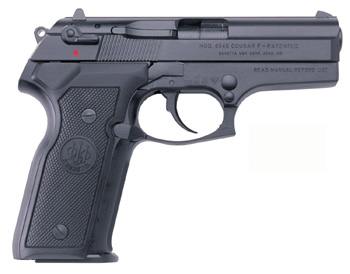
Beretta Cougar 8045 in .45ACP

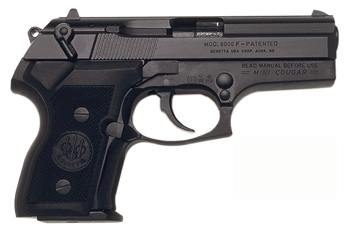
Beretta Cougar 8040 mini in .40S&W

Caliber: 9x19mm Luger (mod 8000D, also .40SW in 8040F and 9x21 in mini 8000F; .45ACP in 8045)
Overall Length: 179 mm 
Barrel Length: 92 mm 
Weight Unloaded: 770 g
Magazine capacity: 15 rounds (9mm), 11 rounds (.357 and .40) and 8 rounds (.45)

Beretta 8000 series pistols, also known under the Cougar name, first appeared on the market in 1994 as a more compact alternative to bulky, full-sized Beretta M92F service pistols. Cougar pistols were originally developed for the then new .40S&W cartridge, and latter were adopted to other calibers, such as 9x19mm Para. .357 SIG and .45ACP. These pistols offer good compromise between concealability, ease of carry, accuracy and firepower. These pistols are well suited for both police duty and for civilian self-defense. These pistols are no longer manufactured in Italy; its production has been moved to Stoeger factory in Turkey, which is also owned by Beretta group.
Cougar 8000 series pistols are recoil operated, locked breech semiautomatic pistols. These pistols use relatively rare rotating barrel locking system, in which the barrel rotates on recoil to unlock itself from the slide. The rotating motion of the barrel is controlled by the stud on its bottom, which follows the cam track in the steel frame insert. To decrease peak recoil and stress to the frame, the insert is mounted on the recoil spring and is buffered. The frame is made from lightweight aluminum alloy. The basic version of the Cougar pistol is the F model, with double action trigger with exposed hammer, and ambidextrous safety/decocker levers, located on the slide. Alternative is D version, which is double action only, and thus have spurless hammer and no safety/decocker levers. Cougar pistols use double-stack magazines in 9mm, .357 and .40 caliber models, and single stack magazines in .45 caliber models.

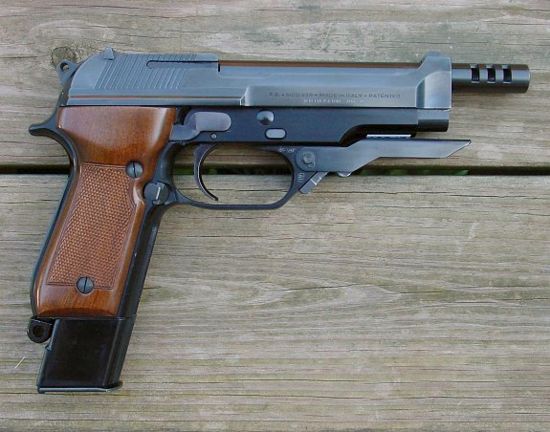
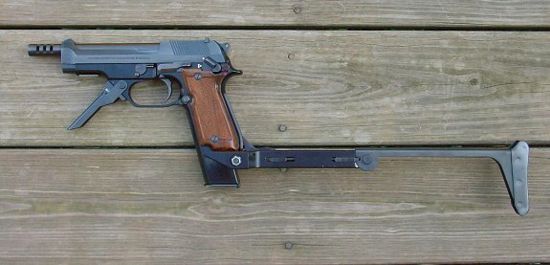
Beretta 93R automatic pistol


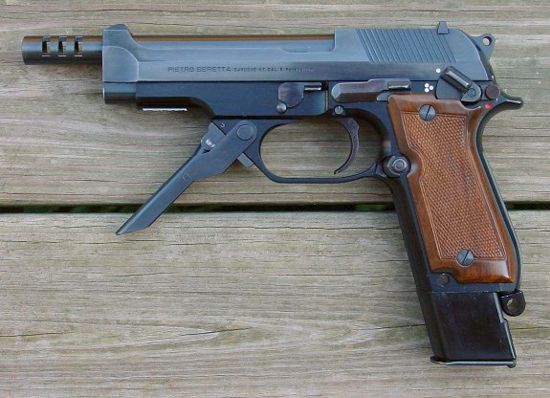
Beretta 93R pistol, left side, with front grip unfolded.
image source: www.autoweapons.com 

Beretta 93R pistol, right side view, with front grip folded.
image source: www.autoweapons.com

Beretta 93R pistol, with front grip unfolded and shoulder stock attached.
image source: www.autoweapons.com  

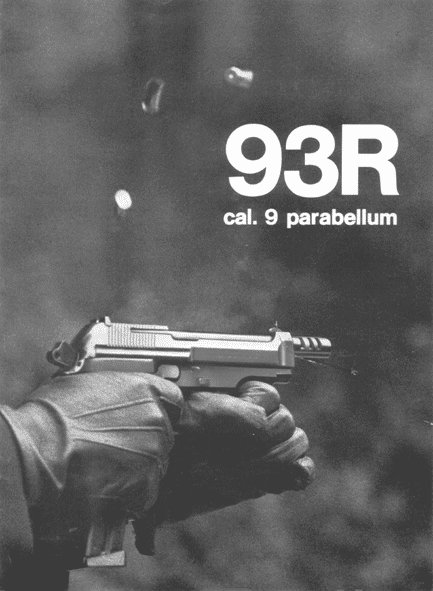
Promotional image from Beretta catalogue (possible 1980's vintage), showing the burst fire from Beretta 93R pistol; note three spent cartridges flying in the air.
Promotional image from Beretta catalogue (possible 1980's vintage), showing the burst fire from Beretta 93R pistol; 
note three spent cartridges flying in the air.

Characteristics

Type: Single Action automatic (machine) pistol 
Calibers: 9x19mm Luger/Parabellum/NATO 
Weight unloaded: 1170 g 
Length: 240 mm 
Barrel length: 156 mm (with compensator) 
Magazine capacity: 20 rounds standard

Beretta 93R automatic (or machine) pistol has been in development during the second half of the 1970s, and first appeared circa 1977. The index 93 stands for "9mm, 3rd model", and the suffix "R" means "Raffica" - burst[-firing] in Italian language. This special purpose sidearm was intended for police and military forces who may require improved firepower in compact weapon during the close-quarter combat, such as room-to-room search or VIP protection. Because the compact size and relatively powerful 9mm Parabellum ammunition necessary resulted in high cyclic rate of fire, Beretta designers decided do limit the practical rate of fire by introducing a burst limiter, which allowed only for three shot bursts, in addition to the standard semi-automatic fire. To further improve the control during the burst fire, the pistol was fitted with folding forward grip, and the detachable folding shoulder stock. Early production pistols also featured a ported barrel to decrease barrel climb, but later this feature was dropped. The Beretta 93R is no longer listed in Beretta military & law enforcement catalogs, but it is used by some Italian police and anti-terrorist forces, such as Carabineri's GIS and NOCS, and by some other paramilitary forces. The burs fire mode is of dubious value for anybody but the most professional shooters, who need the improved effectiveness at very short to short ranges; the folding shoulder stock probably can help for long range single shot accuracy.

The basic design of the Beretta 93R machine pistol is based on the famous Beretta 92 pistol; The 93R uses the same short recoil operated, locked breech system with vertically cammed lock. The slide retains typical Beretta-style open-top design. The trigger mechanism, however, is somewhat different from Beretta 92, as it is a single action only, with non-ambidextrous frame mounted safety and additional fire mode selector (both mounted on the same axis, with the selector lever pointing forward and safety lever pointing backward). The mechanism which controls the length of the bursts is located behind the right grip panel. Beretta 93R pistol is supplied with proprietary 20-rounds magazines but also can use standard Beretta 92 type magazines. 

 
Design by Free WordPress Themes | Bloggerized by Lasantha - Premium Blogger Themes | Online Project management