Tampilkan postingan dengan label Russia. Tampilkan semua postingan

Jumat, 21 Juni 2013

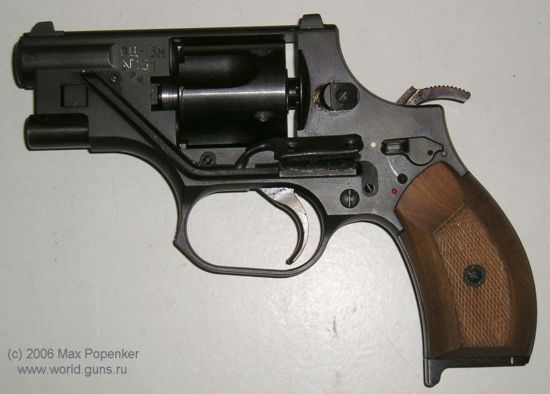
OTs-38 silent

OTs-38 revolver, left side. Note that hammer is cocked and locked by manual safety. The button that controls built-in laser sight is visible above the trigger guard.
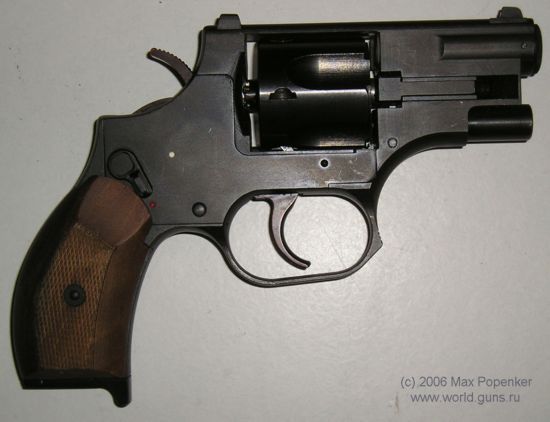

OTs-38 revolver, right side. Hammer is lowered and safety is off.
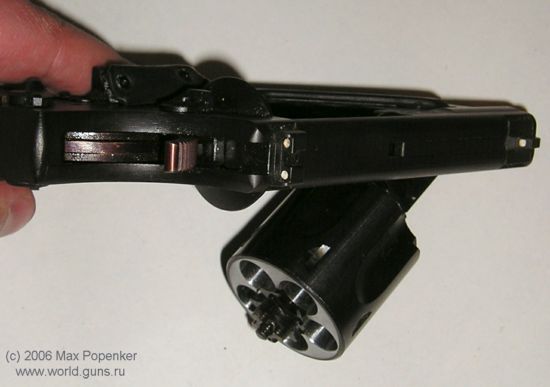

OTs-38 revolver, top view with cylinder opened for reloading. Note the most unusual way of cylinder opening.
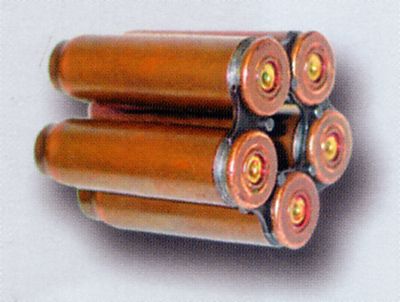

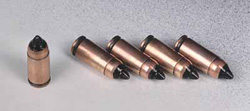
SP-4 silent ammunition loaded into 5-round OTs-38 flat clip
Image: KBP


TypeDouble Action revolver
Caliber(s) 7,62x42 SP-4
Weight unloaded880 g (with integral laser sight)
Length191 mm
Barrel lengthn/a
Magazine capacity5 rounds in special flat clip

The OTs-38 (ОЦ-38) revolver is one of most unusual revolvers ever made. It was developed by the TSKIB SOO (Central Bureau for Sporting and Hunting Arms, a division of famous KBP organization, located in Tula, Russia) on request from Russian FSB (Federal Security Service). Because of its specific nature, OTs-38 is a limited production item, and it is being used by various Special Purpose law enforcement units. The OTs-38 is an integrally silenced weapon, which produces almost no sound and absolutely no flash upon firing. It is built as alternative to PSS silent pistol, and uses same special, integrally silenced ammunition known as SP-4. The OTs-38 is one of the last designs by the late I. Ya. Stechkin, a famous Russian gun designer.
OTs-38 resembles a traditional double-action revolver but it has many uncommon features. For the start, it has a more or less common exposed hammer with double-action trigger, but the action fitted with ambidextrous manual safety which allows for safe "cocked & locked" carry, for fast and accurate first shot. Next, the OTs-38 fires from the bottom chamber of the cylinder, as opposed to most revolvers that fire from upper chamber. Therefore, the barrel axis of OTs-38 is relatively low and muzzle jump is minimal. The large cylindrical housing, located above the barrel of OTs-38, contains an integral laser pointer / sight. The cylinder fixture is also of most unusual nature. The cylinder axis is hinged to the frame at the front, so once cylinder release (at the left side of the frame) is pushed forward, the cylinder can be swung open to the right and forward (while on most modern revolvers cylinders are swung down and to the left). Upon the opening of the cylinder, an automatic ejector partially withdraws the clip with rounds (or empty cases) from cylinder. This unusual cylinder mounting is essential to provide minimum play between the firing chamber in cylinder and barrel throat, since the SP-4 bullets are of pure cylinder shape, and thus cannot self-align itself with the barrel upon firing, unlike most conventional bullets that have conical or ogive nose shape. Since SP-4 ammunition is rimless, it is loaded into OTs-38 using special flat clips that hold 5 rounds together.
As said above, OTs-4 is fitted with integral laser sight. It is also fitted with traditional fixed iron sights, that have contrast white inserts.

OTs-20 "Gnom"

OTs-20 "Gnom" revolver with laser aiming module at the front of the frame and sample rounds of ammunition


TypeDouble Action revolver
Caliber(s) 12.5x40R
Weight unloaded1100 g
Length250 mm
Barrel length100 mm
Cylinder capacity5 rounds

This monstrous revolver was developed circa 1993 by Central Design Bureau for Sporting and Hunting Arms (TsKIB SOO) in the city of Tula. It was developed under the R&D program "Udar" (blow), initiated by Russian MVD (Internal Affairs Ministry) which, at the time, was looking for a more versatile and powerful sidearm for 'street' police, to replace old and venerable Makarov PM pistols. New revolver was to have greatly enchanced stopping power with standard ammo (lead bullet), and to have significant penetration effect against steel plate with special Armor Piercing round (steel pointed bullet). Other types of ammo include less-lethal rounds with rubber bullets or tear gas. New ammunition was developed by shortening 32 gauge shotgun shells to 40mm, and loading these with appropriate propellant and projectiles. It seems that the whole concept of the "Udar" R&D program, the large-bore police revolver, was met with little enthusiasm by actual users, and only few OTs-20 revolvers were made during mid- and late 1990s
The OTs-20 "Gnom" revolver is a conventional double-action revolver with exposed hammer and side-opening cylinder that holds 5 rounds. The only departure from 'the usual' in this revolver is that it has a smooth (non-rifled) crome-lined bore, and thus its accuracy is adequate only for very short-range encounters.

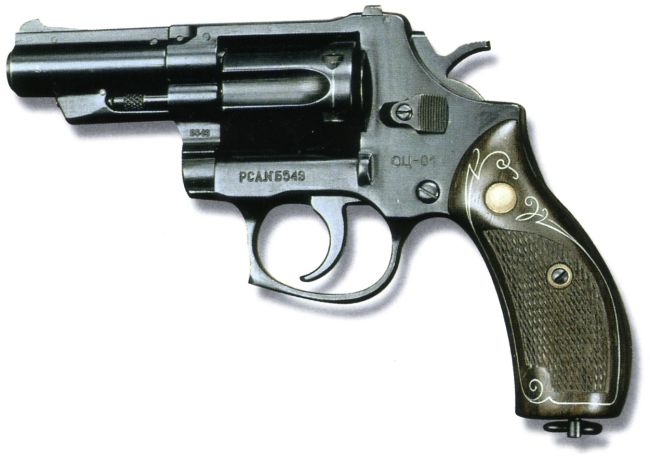
OTs-01 / TKB-0216 / RSA "Kobalt"

OTs-01 / TKB-0216 / RSA "Kobalt" revolver (Russia)


TypeDouble Action revolver
Caliber(s)9x18 Mak, 9x17 Browning Short
Weight unloaded800 g
Length200 mm
Barrel length75 mm
Cylinder capacity6 rounds

The OTs-01 "Kobalt" revolver, also know as RSA (Revolver Stechkina-Avraamova, after the names of designers, Stechkin and Avraamov) was developed in Central Design Bureau for Sporting and Hunting Arms (TsKIB SOO) in the city of Tula. This revolver apeared during early 1990s along with several other Russian-made revolvers in an attempt to provide Russian police (Militia) and private security companies with weapon that is as simple to use as possible. The RSA / OTs-01 was never accepted as a police weapon in Russia, but it became somewhat popular as individual weapon among the private security companies, which are licensed under the Russian law to issue its personnel with firearms. It is also used by bank and armored truck security personnel in Russia. It must be noted that private sector companies are allowed to use this weapon only in 9x17 Browning Short (a.k.a. .380ACP) chambering, the 9x18 Mak version was developed strictly for Government use.
The OTs-01 "Kobalt" / RSA revolver is a conventional double-action revolver with exposed hammer and side-opening cylinder that holds 6 rounds. Since ammunition, for which this revolver is intended, is rimmless, cartridges are loaded into flat steel clips prior to loading into the cylinder. Loading and extraction is performed using this clip, with all 6 rounds at once. Revolver also can be fired when loaded with loose cartridges (no clip) but in this case extraction would be problematic.

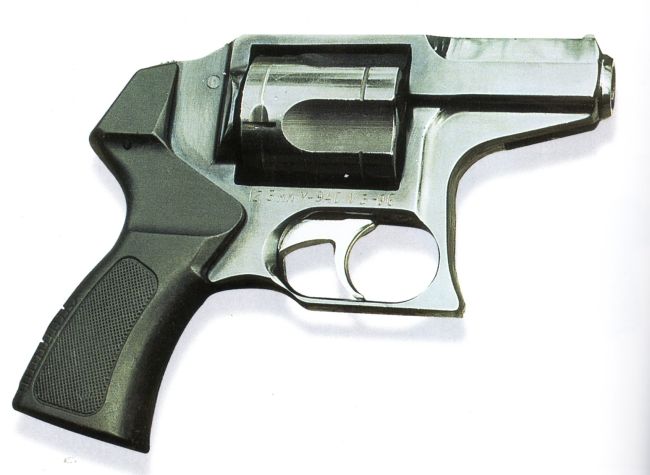
U-94 "Udar"


U-94


TypeDouble Action revolver
Caliber(s) 12.3x50R, 12.3x22R
Weight unloaded920 g
Length173 mm
Barrel lengthmm
Magazine capacity5 rounds

The U-94 "Udar" (Strike or Blow in Russian) revolver was developed during early 1990s at the famous KBP design bureau in Tula, Russia. It was intended primary for police use as a concealed carry weapon with enhanced effectiveness against a variety of targets, by developing a variety of 12.3mm rounds with various bullets (lead bullets for maximum stopping power, hardened steel AP bullets for maximum penetration against barriers such as doors or car bodies etc). The rimmed ammunition was based on shortened 32 gauge brass shotgun shells, cut to necessary length. For various reasons the police version didn't caught on with Russian law enforcement, and a reduced power version, known as U-94S "Udar-S" was developed for private security companies. It used shorter cartridges with lead bullets only (no AP).
U-94 "Udar" revolver is a conventional double-action revolver with semi-exposed hammer (hammer head is accessible through the opening at the top rear of the frame for manual cocking or decocking) and side-opening cylinder that holds 5 rounds. Cylinder opens to the left, spent cartridges are ejected all at once when ejector rod is pressed, fresh rounds are loaded one after another manually. Revolver has unusual appearance as it was optimized for concealed carry and short-range use only. It had a steel frame and cylinder, and polymer grips.

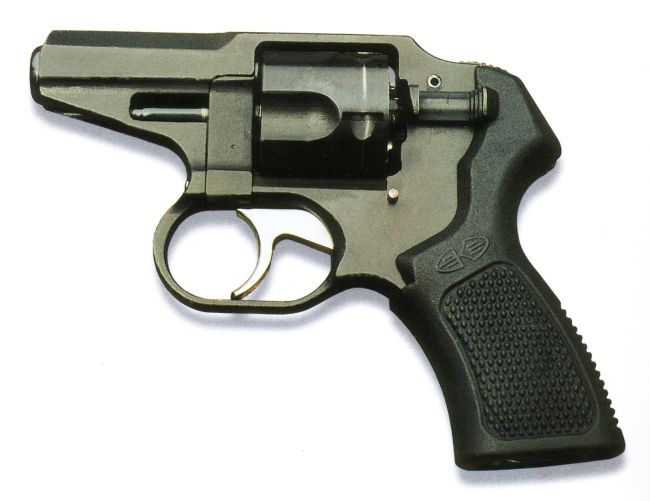
R-92

R-92 revolver (Russia)


TypeDouble Action revolver
Caliber(s) 9x18 Mak, 9x17 Browning Short
Weight unloaded520 g
Length157 mm
Barrel length63 mm
Magazine capacity5 rounds

The R-92 revolver was designed circa 1992 by Instrument Design Bureau (KBP) in Tula, in an attempt to provide Russian police and private security personnel with compact, easily concealable weapon which is simple and reliable in use. It seems that, like other contemporary Russian revolvers, it never gained any significant acceptance in official use (despite being formally adopted for MVD use in 1994), and only 'private security' version, chambered for 9x17 Browning ammunition, was manufactured in any noticeable numbers. This revolver has somewhat unconventional appearance, with trigger and grip moved further forward that usual in an attempt to make the gun more compact.
R-92 revolver is a more or less conventional double-action revolver with semi-exposed hammer (which protrudes from frame at the top, allowing it to be manually cocked or de-cocked) and side-opening cylinder that holds 5 rounds. Since ammunition, for which this revolver is intended, is rimmless, cartridges are loaded into flat steel clips prior to loading into the cylinder. Loading and extraction is performed using this clip, with all 5 rounds at once.

MP-412 Rex

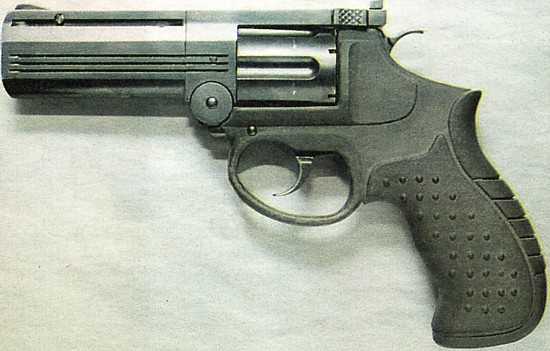
MP-412 Rex revolver
MP-412 Rex revolver

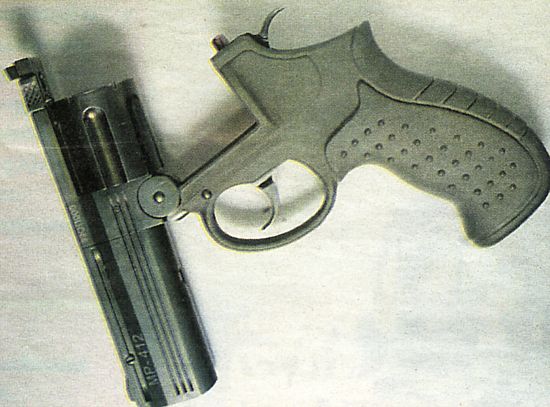
MP-412 Rex revolver, with barrel tipped down for reloading


Type: Double Action
Caliber: .357 Magnum
Weight unloaded: 0.9 kg
Length: 232mm (4" barrel)
Barrel length: 102mm (4") or 152mm (6")
Capacity: 6 rounds

The MP-412 revolver has been designed at IZHMECH (State-owned Russian Izhevsk Mechanical Plant, a large factory known as a prime maker of Makarov PM pistols among other things). This revolver was intended for export, as a handgun ownership is generally prohibited for ordinary citizens in Russia. First prototypes of REX (Revolver for EXport) revolver were displayed at IWA-2000 arms exhibition in Nurenberg (Germany). It is not exactly known what killed this rather interesting project, but most possibly it was a lack of market, as the biggest export market, the USA, has been closed for Russian handguns since mid-1990s, because of Clinton / Yeltsyn mutual agreement.
The MP-412 is a double action revolver with break-open frame and simultaneous extraction. The bottom frame is of composite type - it consists of a steel basic frame and a polymer envelope, which forms the grip and trigger guard. Polymer grip / trigger guard unit can be removed from steel frame if necessary. Trigger is of conventional type, double / single action, with exposed hammer. Firing pin is mounted in the frame. Barrel / cylinder group latch is located at the top rear of the frame, and is operated by two buttons that must be pushed inwards to unlock the frame. Cylinder holds 6 rounds and has an automatic ejector that throws the cases out of cylinder once barrel is fully tipped down. If necessary, automatic ejection feature can be manually switched off.

Nagant model of 1895

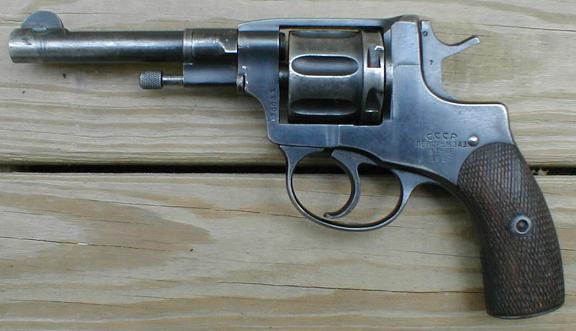
Russian-made Nagant revolver (circa 1925)

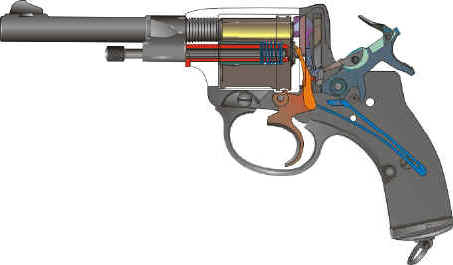
Cut-out view of the M1895 Nagant revolver

 
Type: Double Action
Chamber: 7.62mm Nagant
Weight unloaded: 750 g
Length: 230 mm
Barrel length: 114 mm
Capacity: 7 rounds

This revolver was designed in Belgium by Nagant brothers (Emile and Leon) in the late 1880s - early 1890s, and was adopted by numerous countries, including Sweden and Poland, but the major user and manufacturer was undoubtfully Russia (and later Soviet Union). Russian government adopted Nagant revolver in 1895, and local production began in 1898 (first shipments were from Belgium). It was a standard russian sidearm until 1930, when M1895 Nagant was declared obsolete, but it was widely used and manufactured during World War 2, and manufacture was finally ceased circa 1950.
Later, some sporting revolvers, both in 7.62mm and in .22LR were developed on Nagant platform. Intertestingly enough, the M1895 revolvers still can be seen carried by some security personnel in Russia, especially by Railroad Security and by some armed guards. Usually, those revolvers are 2 to 4 times older than men who carry these guns.
From technical point of view, Nagant revolvers were already almost outdated at the moment of its adoption in 1895, since newest revolvers like S&W Hand Ejectors or Colts with side-opened cylinders were much faster to reload. On the other hand, M1895 had some unusual and interesting features, one of which was gas sealed cylinder, which made the Nagant a rare example of revolver suitable for mounting a silencer. Such a practice was known by NKVD and some Red Army special forces (recon and scouts) during WW2. Special silencer, called "Bramit device" was designed by Mitin brothers and could be mounted on the barrel.
M1895 Nagand was a solid frame, seven shot revolver with non-removable cylinder. The loading and unloading was committed wia the loading gate at the right side of the frame, one cartridge by one. Spent cases were ejected by the ejector rod, which, when not in use, was concealed within the cylinder axis and swung to the side on the ejector rod link to be used. Original guns were double action ones, but Tsarists government ordered that some of M1895 should be retrofitted with Single Action triggers and issued to enlisted men, and DA guns should be issued only to the Officers and Police. In Red (Soviet) army only Double Action Nagants were issued.
The gas sealed cylinder, mentioned above, was made to use all of powder gases to propel the bullet (in most revolvers some gases escape from the gap between the cylinder face and barrel breech). To achieve that, the cylinder moves ahead a bit when hammer is cocked, enclosing a barrel breech area with recess in the front of each chamber. The cartridge, unique to that design, had long case with tapered mouth and a bullet totally enclosed inside the case. When cylinder moves forward, the cartridge case mouth entered the barrel breech and was used as additional seal. This was a complicated mechanism, useful mostly when guns were used with silencer.
Being somewhat complicated and relatively slow to reload, with ammunition of marginal power, Nagants were otherwise good guns, reliable, acurate and quite popular among the troops.

Kamis, 20 Juni 2013

Nagant model of 1895

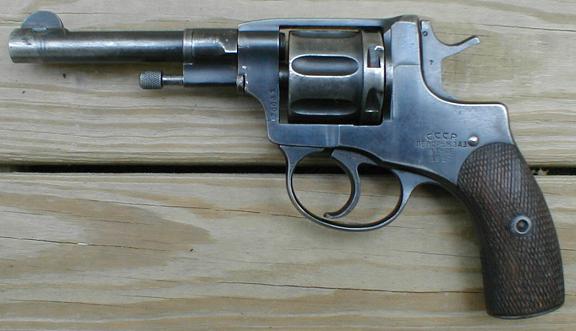
Russian-made Nagant revolver (circa 1925)

Cut-out view of the M1895 Nagant revolver

 
Type: Double Action
Chamber: 7.62mm Nagant
Weight unloaded: 750 g
Length: 230 mm
Barrel length: 114 mm
Capacity: 7 rounds

This revolver was designed in Belgium by Nagant brothers (Emile and Leon) in the late 1880s - early 1890s, and was adopted by numerous countries, including Sweden and Poland, but the major user and manufacturer was undoubtfully Russia (and later Soviet Union). Russian government adopted Nagant revolver in 1895, and local production began in 1898 (first shipments were from Belgium). It was a standard russian sidearm until 1930, when M1895 Nagant was declared obsolete, but it was widely used and manufactured during World War 2, and manufacture was finally ceased circa 1950.
Later, some sporting revolvers, both in 7.62mm and in .22LR were developed on Nagant platform. Intertestingly enough, the M1895 revolvers still can be seen carried by some security personnel in Russia, especially by Railroad Security and by some armed guards. Usually, those revolvers are 2 to 4 times older than men who carry these guns.
From technical point of view, Nagant revolvers were already almost outdated at the moment of its adoption in 1895, since newest revolvers like S&W Hand Ejectors or Colts with side-opened cylinders were much faster to reload. On the other hand, M1895 had some unusual and interesting features, one of which was gas sealed cylinder, which made the Nagant a rare example of revolver suitable for mounting a silencer. Such a practice was known by NKVD and some Red Army special forces (recon and scouts) during WW2. Special silencer, called "Bramit device" was designed by Mitin brothers and could be mounted on the barrel.
M1895 Nagand was a solid frame, seven shot revolver with non-removable cylinder. The loading and unloading was committed wia the loading gate at the right side of the frame, one cartridge by one. Spent cases were ejected by the ejector rod, which, when not in use, was concealed within the cylinder axis and swung to the side on the ejector rod link to be used. Original guns were double action ones, but Tsarists government ordered that some of M1895 should be retrofitted with Single Action triggers and issued to enlisted men, and DA guns should be issued only to the Officers and Police. In Red (Soviet) army only Double Action Nagants were issued.
The gas sealed cylinder, mentioned above, was made to use all of powder gases to propel the bullet (in most revolvers some gases escape from the gap between the cylinder face and barrel breech). To achieve that, the cylinder moves ahead a bit when hammer is cocked, enclosing a barrel breech area with recess in the front of each chamber. The cartridge, unique to that design, had long case with tapered mouth and a bullet totally enclosed inside the case. When cylinder moves forward, the cartridge case mouth entered the barrel breech and was used as additional seal. This was a complicated mechanism, useful mostly when guns were used with silencer.
Being somewhat complicated and relatively slow to reload, with ammunition of marginal power, Nagants were otherwise good guns, reliable, acurate and quite popular among the troops.

Sabtu, 26 Januari 2013

K6-92 / Borz

K6-92 / Borz submachine gun.

Characteristics

Caliber 9x18 Makarov PM
Weight 1.96 kg
Length (stock closed/open) 370 / 700 mm
Barrel length 150 mm
Rate of fire ? rounds per minute
Magazine capacity 17, 25 or 30 rounds

The K6-92 submachine gun was developed during early 1990s in the republic of Armenia, which gained its independence in 1991 after the fall of the Soviet Union. At the time Armenia was engaged in the local conflict with Azerbaijan (another ex-USSR republic), and was in desperate need for small arms. The submachine gun is one of the simplest automatic arms to design and manufacture, so Armenian engineers quickly developed a straightforward weapon, which can be easily manufactured by almost any mechanical workshop.
Later on, more than few K6-92 submachine guns made its way through the borders into the Chechen republic, the most turbulent part of the Russia. During mid-1990s Chechnya was heavily infested with separatists, Islamic extremists and other kinds of bandits, which found submachine guns to be convenient weapons for urban fighting. Separatist Chechen government attempted to produce a "local" copy of the K6-92 at one of machine-building factories in the city of Groznyj, but very few were made there due to production problems and quality issues. Chechen-made copies of the K6-92 submachine gun are usually referred to as "Borz" (which means "wolf" in Chechen language). It also must be noted, however, that underground workshops, run by separatist forces, also made some "generic" crudely made submachine guns, generally known under the same name (Borz). These "homemade" submachine guns can be distinguished by tubular receiver and extremely poor fit and finish. Overall, the K6-92 submachine guns are reported as crude arms, suitable mostly for close combat. Over last two decades, plenty of these submachine guns turned up in Russia and other former USSR states during various crimes of violence and illegal arms trafficking.
The K6-92 submachine gun is a simple blowback operated weapon  that fires from open bolt. Receiver is made from steel stampings, welded together. Cocking handle is located at the top, safety / fire mode selector is located at the left side of the gun, above the trigger guard. Gun can be fired in single shots or in full automatic. It is fitted with plastic pistol grip and a top-folding metallic buttstock.

Kamis, 24 Januari 2013

Arsenal "Strike One" pistol


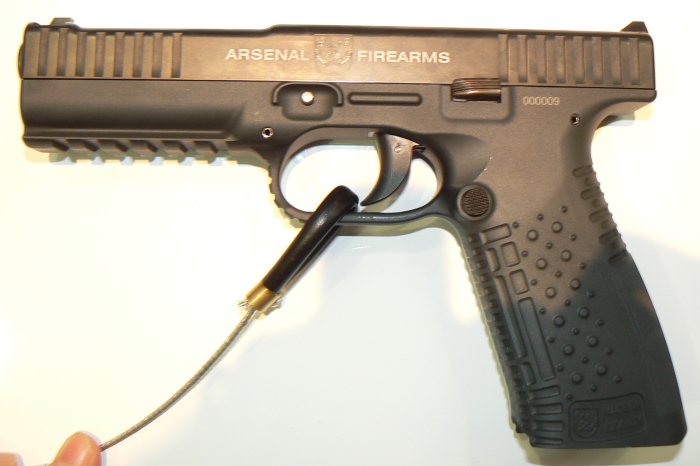
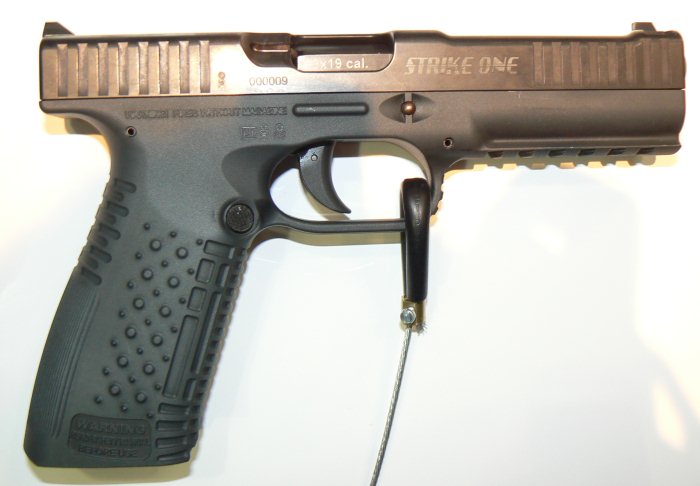
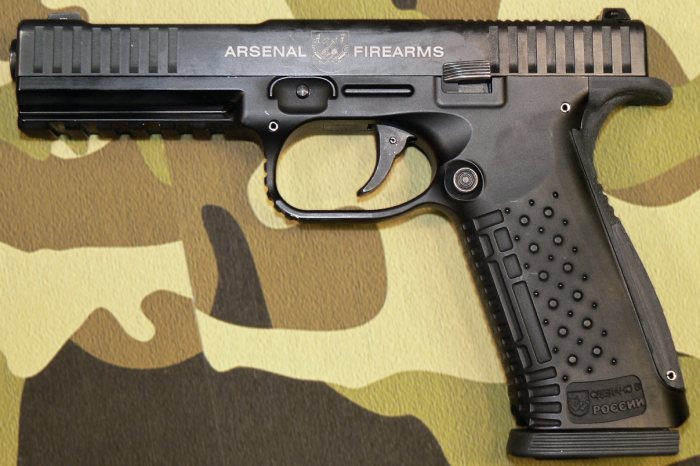
"Strike One" pistol (prototype, as shown at IWA 2012)
 

"Strike One" pistol (prototype, as shown at IWA 2012)
 

"Strike One" pistol partially disassembled, showing barrel with locking piece in place
 

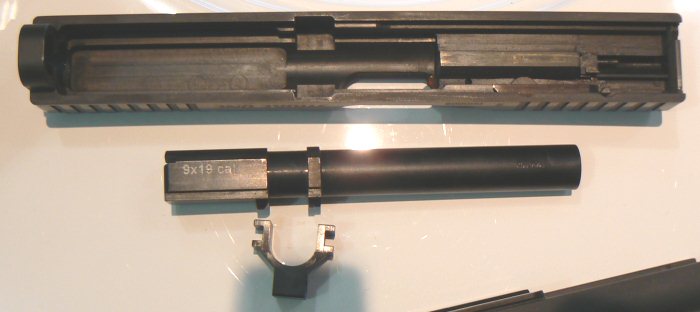
"Strike One" pistol slide, barrel and locking piece (separated from the barrel)
 

"Strike One" pistol with extended barrel


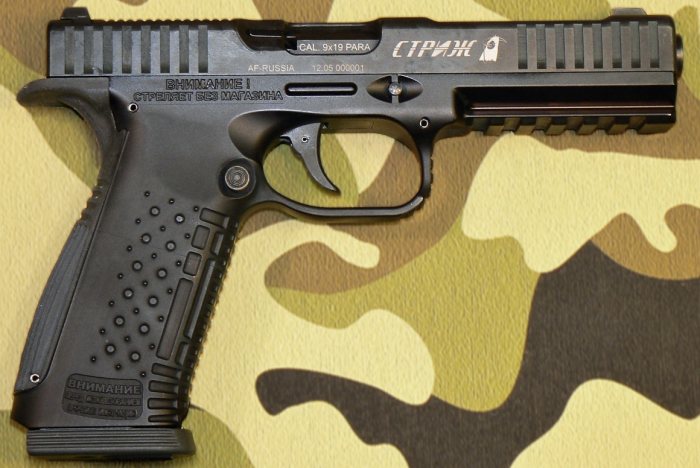
9mm "Strizh" pistol, made in Russia to be offered to Russian Armed Forces and Police. 4th generation prototype, produced in summer of 2012. Note numerous differences from eralier prototype, shown above.
Photo by Arsenal Firearms
 
9mm "Strizh" pistol, made in Russia to be offered to Russian Armed Forces and Police. 4th generation prototype, produced in summer of 2012.
Photo by Arsenal Firearms
 

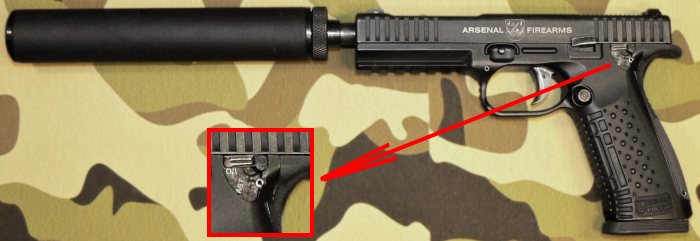
9mm "Strizh" pistol, made in Russia to be offered to Russian Armed Forces and Police. 4th generation prototype, produced in summer of 2012. "Spetsnaz" version with extended threaded barrel that accepts quick-detachable silencer, and select-fire capability (fire mode selector is shown enlarged in the insert)
Photo by Arsenal Firearms
Type     Semiautomatic, Single Action (pre-cocked)    
Caliber(s) 9x19 Luger/Parabellum, 9x21 IMI, .357SIG, .40SW   
Weight unloaded 750 g 
Length    210 mm
Barrel length 128 mm
Magazine capacity 17 rounds   

“Strike One” pistol is a very new product of an young international company Arsenal Firearms, which has headquarters in Russia and manufacturing facilities in Russia, Italy and Austria. Prototypes of this pistol were first displayed to the public in March, 2012 during IWA-2012 exhibition in Nuremberg, Germany. Strike One pistol, which is also known as «Ð¡Ñ‚риж» ("Strizh", Swift bird) in its Russia-made version, is intended to compete for the role of a service pistol for various military and law enforcement forces (in Russia and elsewhere). It will be also offered for civilian sales as self-defense and/or sport weapon, where permitted by law. At the moment of this writing (mid-March, 2012), Strike One pistol is still in prototype / pre-production stage, and its final version most probably will differ from the ones shown here in certain respects. One most noticeable feature of the Strike One pistol is its extremely low bore axis, which helps to control recoil and muzzle rise during rapid fire.
At the moment of last update (June, 2012), Strizh pistol is at its 4th iteration of prototypes. Versions, developed and manufactured in Russia, feature numerous improvements over early prototypes made in Italy. Arsenal Firearms plans to offer Strizh to Russian Armed Foreces and Police. For this purpose, Strizh pistol is especally adapted for Russian service 9mm ammunition, known as 7N21 and 7N31. This 9x19 ammnunition is loaded with AP (Armor Piercing) bullets and rated at +P+ power level. Arsenal Firearms also is developing "Spetsnaz" versions of the basic pistol, that can mount quick-detachable silencers. Another special purpose variant can provide select-fire capabilities via fire selector, located on the left side of the frame.
“Strike One” is a semi-automatic pistol which uses single polymer frame with different upper kits (barrel and slide) for several calibers. It utilizes striker-fired trigger system with Glock-style pre-cocked striker which can be fully cocked only through the pull of the trigger. Like the Glock, Strike One pistol does not offer a “second strike” capability in case of misfire. To ensure lowest possible bore axis and good accuracy, Strike One pistol employs slightly unusual version of the short recoil operation. Roots of this system could be traced to the century-old system, developed at the turn of the 20th century by Louis Schmeisser for Bergmann “Mars” pistol, although in the Strike One it is heavily modified. In this system, barrel is allowed to recoil against the frame in a linear motion, without any tilting or rotation. Separate vertically sliding locking piece is employed to lock the barrel to the slide during initial stages of recoil cycle. In this particular case, the locking piece is “Y”-shaped. Its upper fork part goes around the bottom of the barrel, in front of the chamber. Barrel has vertical grooves for this fork, so it can slide up and down in relation to the barrel, but moves along with the barrel forward and rearward. Outer sides of the “fork” have externally projecting lugs that engage cuts inside the slide to lock it to the barrel. Lover part of the locking piece projects down and into the frame, and has cam-shaped cut which is engaged by a cross pin, set into the frame. Upon recoil, interaction of the cam cut in locking piece (which moves rearwards along with the barrel) and stationary pin causes the locking piece to move down, disengaging its locking lugs from the slide. Once the slide is free from lock, recoil of the barrel is stopped against the steel insert in the frame, and the slide is free to complete recoil cycle, ejecting and extracting spent case. Upon forward movement, slide chambers the fresh round from magazine, and then pushes barrel forward, into the battery. Forward movement of the barrel causes the locking slide to move up and engage the slide for a positive lock.
Other features of the Strike One pistol include double stack, single feed box magazines with ambidextrous release buttons, slide stop with manual slide release lever on the left side, and an integral Picatinny type accessory rail under the front part of the frame. Optional carbine kits (known in factory literature as LRC – Long Range Conversion) include longer 300mm barrel with flutes to reduce weight and improve heat dissipation, and removable accessory kits that can be attached to underbarrel rail.

OTs-21 Malysh

OTs-21 Malysh pistol
 
Type
Double Action Only
Caliber
9Ñ…18 PM, 9Ñ…17 Browning Short
Weight, empty
560 g
Length
126 mm
Barrel length
 
Magazine capacity
5
 
OTs-21 “Malysh” (“a little one”) is a deep concealment handgun, developed by Russian Central Design Bureau for Hunting and Sporting arms (TsKIB SOO), located in the city of Tula. It is intended for law enforcement and security use, as a last-chance weapon.
The OTs-21 is of all-steel construction, blowback operated. The trigger is of double-action only type, and there’s no manual safeties or a slide stop (hold-open) device. Magazine is of single stack design and holds only 5 rounds, magazine catch is located at the base of the grip. Fixed sights are of very basic design, as the gun is intended for use at very short ranges.

P96 / P96S / P96M

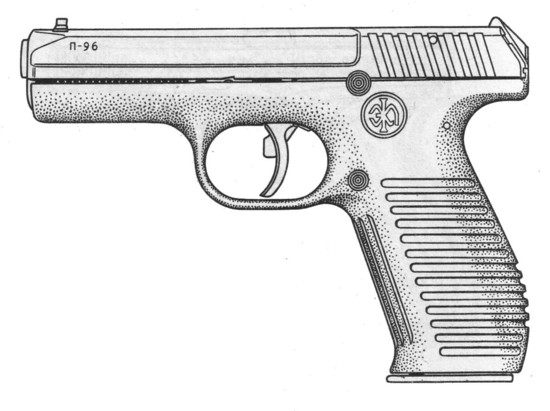
P96 prototype (drawing)
 
P96S pistol
P96S pistol


  P96M P96S
Type Double Action semiautomatic
Caliber(s)  9x18 PM 9x17 Browning Short
Weight unloaded 450 g
Length 151 mm
Barrel length n/a
Magazine capacity 15 rounds 10 rounds

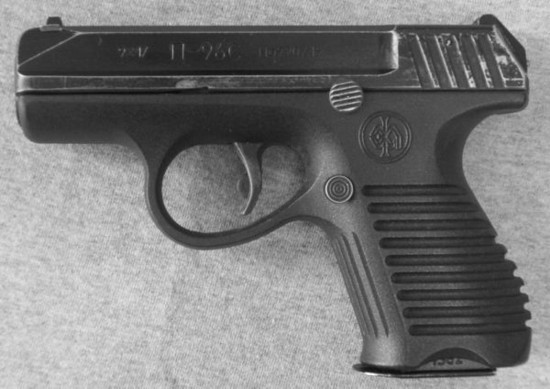
P-96S / P-96M pistols were off-side developments of the bigger, but generally unsuccessful P-96 pistol, designed by the KBP in Tula during mid-nineties. While full-size P-96 was considered as a possible military weapon, its designers also tried to pursuit police and private security markets as well, and simply scaled down the P-96 to create more compact weapons, chambered for 9x18 PM (for Militia / domestic police market) and 9x17 Browning (for private security companies). These versions were designated as P-96M and P-96S, respectively. Despite the fact that neither cartridge was powerful enough to require any form of locked breech, designers retained the rotary barrel, locked breech system of full-size 9x19 prototype. The P-96S pistol is rather unpopular among private security personnel in Russia (which is authorized to carry weapons only in 9x17, and only under strict government regulations), as its ergonomics and reliability are inferior to 9x17 versions of Makarov PM pistol. The only positive sides of P-96S are its light weight and compact size. The "police" version of the same design languished for years, until the very recently, when it was brought back to local law enforcement market. It is yet to be seen if P-96M will prove itself any better than its "civilian" brother. The full size P96 pistol, on the other hand, has been quickly dropped from development, and was subsequently replaced by more successful GSh-18 pistol.
P-96M/P-96S pistol is short recoil operated, locked breech weapon with polymer frame. It uses rotary barrel locking, with single lug at the top of the barrel that engages ejection window in the slide. Trigger is of double action only, striker fired; for each shot, striker is pre-cocked during opening movement of the slide, and then brought to full cock before release by the pull of the trigger. There are no manual safeties, and trigger is fitted with automated trigger safety (of rather uncomfortable shape). Sights are fixed. Magazines are double stack, and hold 15 rounds in "police" and 10 rounds in "private security" versions. P-96S 10-round magazines are flush-fit with grip, while P-96M 15-round magazines are extended and provided with polymer cover/thumb rest at the bottom. Magazine release button is located at the base of the triggerguard.

MP-448 'Skyph'

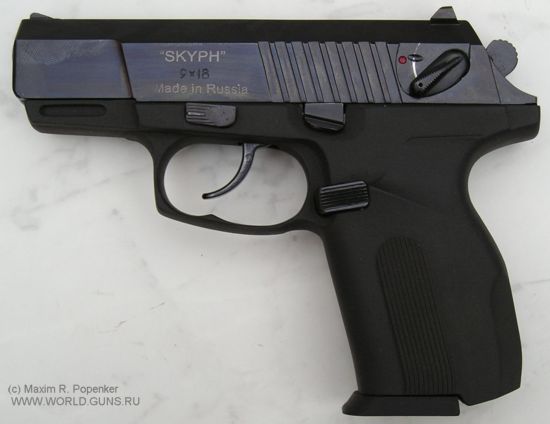
MP-448 Skyph pistol, left side
 
MP-448 Skyph pistol, right side, with magazine removed
 
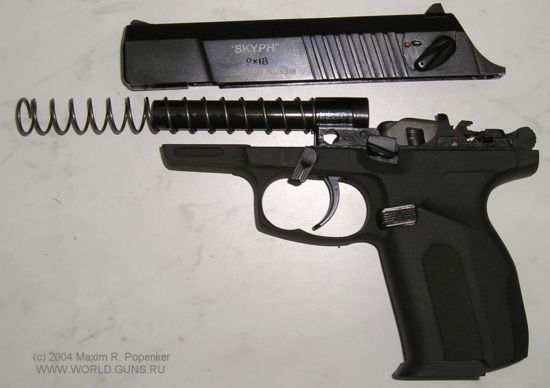
MP-448 Skyph pistol, partially disassembled


Type: Double Action
Calibers: 9x18 Makarov
Weight unloaded: 590 g
Length: 162 mm
Barrel length: 94 mm
Capacity: 12 rounds

The MP-448 'Skyph' pistol has been developed at Izhevsk Mechanical Plant (IzhMech, also known under the trademark "Baikal") during late 1990s, as an enhanced version of the famous Makarov PM pistol, which is also manufactured by IzhMash. The MP-448 'Skyph' pistol is offered for export sales and for local authorities.
The MP-448 'Skyph' pistol is a blowback operated, semiautomatic pistol with polymer frame. The double action trigger with external hammer and slide-mounted safety-decocker is similar in design to Makarov PM pistol. The disassembly procedure for MP-448, however, is different as the trigger guard is integral to the frame, and there's a separate disassembly lever at the left side of the frame, above the trigger. The magazine release is also different from PM, as it is made in the form of large rectangular button, located at the left side of the grip, next to trigger guard. Double-stack magazine has a polymer buttplate and contains twelve rounds of 9x18mm Makarov ammunition. The slide, while similar in design to PM pistol, has different shape and is not interchangeable with it. Sights are fixed, with the rear sight being dovetailed into the slide.

MP-446 'Viking'

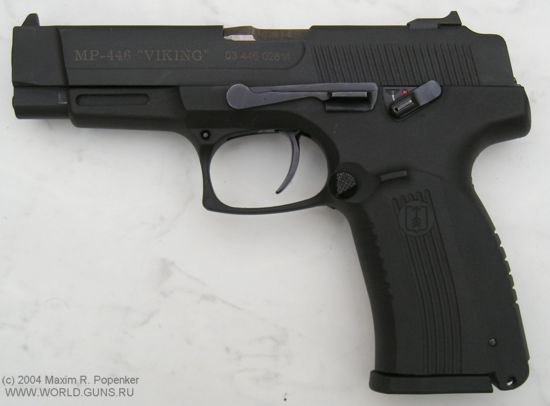
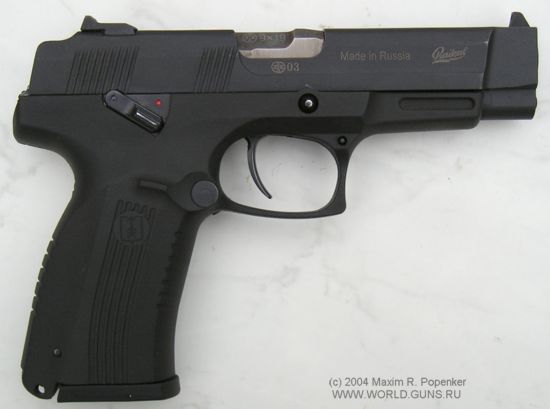
MP-446 'Viking' pistol, left side
 
MP-446 'Viking' pistol, right side
 
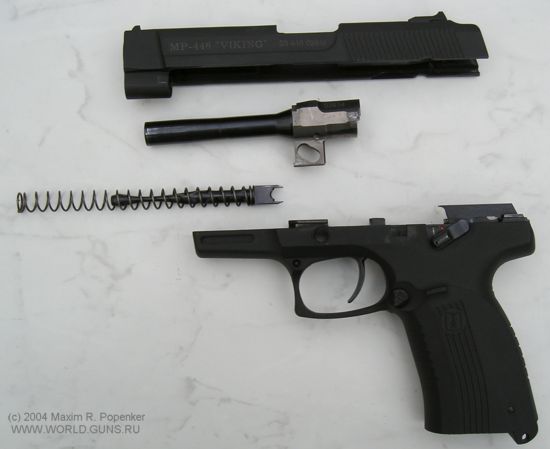
MP-446 'Viking' pistol, partially disassembled
MP-446 'Viking' pistol, partially disassembled 


Type: Double Action
Calibers: 9x19 Luger / Parabellum
Weight unloaded: 830 g
Length: 198 mm
Barrel length: 112 mm
Capacity: 17 rounds

The MP-446 'Viking' pistol is a recent development of the Izhevsk Mechanical Plant (IzhMech, also known in the West by its trademark 'Baikal'). The MP-446 'Viking' is a sporting derivative of the Yarygin PYa pistol, which has been adopted by Russian military in 2003. The key differences between MP-446 and PYa are frame material and sights.
MP-446 'Viking' pistol is a short recoil operated, locked breech pistol. The Browning-type locking is achieved using traditional cam system and one large lug on the breech of the barrel, which engages the enlarged ejection port in the slide. Frame of the pistol is made from high-strength polymer. MP-446 has a double action trigger with ambidextrous frame-mounted safety lever. External hammer is enclosed from the sides by the rear extensions of the slide, which makes decocking procedure somewhat complicated, as pistol has no decoking mechanism. When engaged, safety locks the sear, trigger and slide, and allows for 'cocked and locked' carry, with the hammer cocked and safety engaged. Magazine catch is located at the bottom of the trigger guard and can be installed on either side of the gun. Double-stack magazine contains seventeen rounds of 9mm ammunition. Rear sight is dovetailed into the slide and can be had either in fixed or adjustable versions.

SPP-1 underwater

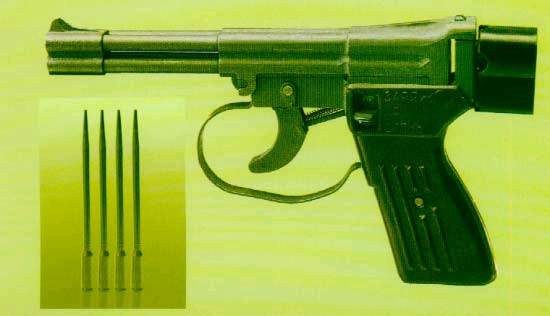
SPP-1 underwater pistol (Russia)
 
 
Type: Double Action Only
Caliber: 4.5x40R
Weight: 950 g empty
Length: 244 mm
Barrel length: 203 mm
Capacity: 4 rounds in separate barrels

The SPP-1 (Spetsialnyj Podvodnyj Pistolet = Special Underwater Pistol) has been developed in late 1960s by the TSNIITOCHMASH organization on request from the Soviet Navy. The SPP-1 was intended for Soviet combat divers ("frogmen"). Later the SPP-1 has been modified to SPP-1M, with several internal upgrades, and is still used by Russian Navy special forces, as well as offered for export through Russian Governments' military sales organization, RosOboronExport.
SPP-1 is a non-automatic, manually operated handgun with four barrels. Barrels are hinged to the frame in the same manner as on break-open shotguns. For reloading, barrel cluster is tipped to expose chambers, and four cartridges are inserted into barrels. To speed up ejection and reloading cycle, cartridges are loaded using flat clips, made from steel. The double-action trigger unit consists of a striker, mounting on a rotating base, so during the each trigger pull the striker is cocked and simultaneously rotated to the next, unfired barrel. The single lever, located at the left side of the frame, controls the safety and reloading. It has three positions, top for "Reloading" (barrel release), middle for "Safe" and bottom for "Fire".
To be effective underwater, SPP-1 uses special proprietary ammunition, with rimmed bottlenecked cases 40mm long, sealed from water. Unusually long bullets are made from mild steel, and are drag-stabilized underwater; on air, bullets are not stabilized at all, so the effective range "above the air" is limited, but the "lethality range" is about 15 to 20 meters. When underwater, lethality range degrades with the increase of the depth: at 5 meters depth, the effective range is about 17 meters; at 20 meters depth, the effective range is only about 11 meters.

OTs-33 "Pernach" automatic pistol

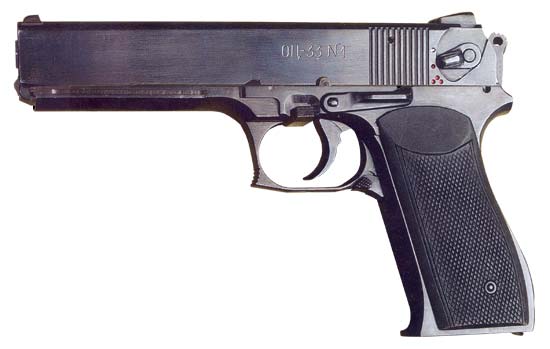
OTs-33 prototype pistol

Type: Double Action automatic (machine) pistol
Calibers: 9x18 PM/PMM
Weight unloaded: 1.15 kg with empty 18-round magazine
Length: 222 mm
Barrel length: n/a
Rate of fire: 900 rounds per minute
Capacity: 18 or 27 rounds

OTs-33 "Pernach" (pernach = multivaned mace) is a recent entry into the small and very special class of automatic (machine) pistols, and is intended to replace obsolete Stechkin APS pistols in the hands of various special units in Russian police and other paramilitary units. Developed circa 1995-96 by the Igor Stechkin at the TSKIB SOO (central design bureau for sporting and hunting arms, Tula, Russia), the same designer who developed the APS, the OTs-33 is now in limited production by the KBP design bureau. OTs-33 has simplified "squared" shape and is much easier (and less expensive) to manufacture, as well as simpler in design. It is capable of fully automatic and semi-automatic fire, and can be fitted with detachable folding shoulder stock, made of steel. It is in limited use with some OMON units in Russian police.

OTs-33 is a blowback operated, selective fire weapon. While there's no positive lock between the slide and barrel, the barrel is allowed to recoil in the frame for a short distance. As the gun is fired, the slide recoils back, and at the final stage of recoil it hits the barrel and carries it back. The additional weigh of the barrel helps to slow down the slide and thus decrease the felt recoil and the cyclic rate of fire without the complicated rate reducer, found in APS pistol. The OTs-33 has double action trigger with exposed hammer. The ambidextrous slide mounted safety / fire mode selector has thee positions, for safe (top), single shots (middle) and full automatic mode (down). When the safety/selector lever is pulled above the "save" position, it safely de-cocks the hammer and then returns to safe position. The ambidextrous lever inside the triggerguard, just ahead of the trigger, is used to disassemble the pistol (unload pistol, pull lever down, then remove the barrel/slide assembly). OTs-33 is fed using double column magazines with capacity of 18 (standard) or 27 (optional) rounds. The OTs-33 frame has integral accessory rails under the barrel for tactical lights or laser pointers. Frontal parts of the barrel and slide are ported to act as a muzzle jump compensator. Fixed sights have white inserts for improved visibility. OTs-33 is issued with leather holster with separate magazine pouches and a shoulder stock pouch.

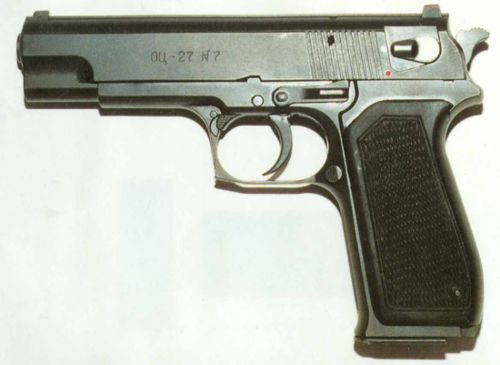
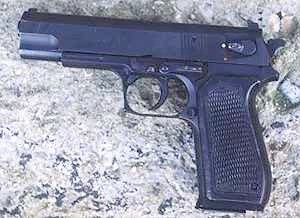
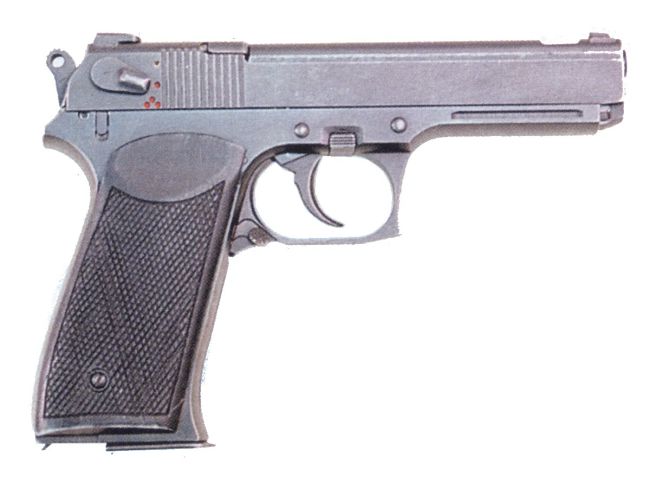
OTs-27 "Berdysh"

Early prototype of OTs-27 pistol
 
current production OTs-27 pistol


Type: Double Action semiautomatic pistol
Calibers: 9x18 PM/PMM and 9x19 Luger/Para
Weight unloaded: 930 g
Length: 200 mm
Barrel length: 125 mm
Capacity: 18 rounds

OTs-27 "Berdysh" (pole-axe; index also sometimes incorrectly spelled as OC-27), also known as the PSA (pistolet Stechkina-Avraamova - Stechkin & Avraamov pistol) has been developed for "Grach" trials, with the goal being the replacement for the venerable Makarov PM as a standard issue sidearm for Russian army. According to the initial specifications, the OTs-27 was produced as a multicaliber pistol, capable of firing the 7.62x25 TT, 9x18 PM and 9x19 Para ammunition with the swap of the barrel, return spring and the magazine. Due to various reasons Ots-27 has been dropped from the Grach trials, but the development continued. Pistol first appeared circa 1994, originally developed by the TSKIB SOO (central design bureau for sporting and hunting arms, Tula, Russia); as the TSKIB SOO was merged with famous KBP design bureau, the latter continued the development and limited production of the pistol. At the present time OTs-27 is offered only in two calibers, 9x18 PM and 9x19 Para, and, apparently, is in limited use with some Russian police units.
The OTs-27 is a blowback-operated pistol with fixed barrel and traditional double action trigger. OTs-27 is made entirely of steel. The barrel has integral feeding ramp and can be easily removed from the frame and replaced by the barrel of another caliber. Disassembly lever is located within the trigger guard, ahead of the trigger. Return spring is located around the barrel, with additional polymer recoil buffer mounted within the slide, below the barrel. Ambidextrous slide mounted safety has three positions - down is for fire, medium is for safe, and up is for safe hammer decocking (safety will return into the middle position after decocking). With the safety applied the firing pin, the hammer and the slide are blocked; safety can be applied with the hammer either cocked or uncocked. Sights are of fixed type, on current production models frame has underbarrel rails for tactical light or laser pointer.

OTs-23 / OC-23 "Drotik" automatic pistol

OTs-23 / OC-23 "Drotik" automatic pistol (Russia)
 
 
Type Double Action select-fire
Caliber(s)  5.45x18 MPTs
Weight unloaded 850 g
Length 195 mm
Barrel length 125 mm
Magazine capacity 24 rounds

The OTs-23 “Drotik” (Dart) machine pistol was developed by Russian Central Design Bureau for Sporting and Hunting Arms (TSKIB SOO, located in the city of Tula) during the early nineties in an attempt to provide a type of micro-sub-machine gun for law enforcement operatives. At the time of its introduction the 9x18 and 9x19 armor piercing ammunition was still in development, but many criminals used body armor, so Igor Stechkin proposed the use of small-calibre 5.45x18 ammunition, which is known for good penetration against soft body armor. To provide some ‘stopping power’, Stechkin also proposed to use a burst-fire mode with very high rate of fire (about 1 800 rounds per minute). In theory, the key idea was to hit the “bad guy” with three rounds almost at once, and to create more wound shock. However, in real life the tiny 5.45 cartridge lost most of its already diminutive energy quite quickly as distance increased, and even at short ranges and in burst-fire mode (3-round bursts) its effectiveness was rather unspectacular. Very few OTs-23 pistols were produced, and the main achievement of this design was to create the developmental basis for more practical weapons such as 9mm OTs-33 machine pistol.
The OTs-23 is blowback-operated pistol; however, the barrel is allowed to recoil against its own buffer spring and is used as an additional weight to slow down the slide at the end of its rearward movement. To further decrease muzzle jump, the barrel and slide are ported at the front. The trigger is double action, with an exposed hammer. The safety / fire selector lever is located at the slide, and also doubles as a decocker. Magazines are double stack; the magazine release lever is located at the base of the trigger-guard. Sights are fixed, and the frame has an integral accessory rail below the frame.
Manual safety:levers at both sides of the slide. Rotate lever to horizontal position (marked with white dot) to engage safety (it will lock the hammer either in cocked or half-cock position). Rotate lever down to first position (marked with one red dot) to set to semi-automatic mode; rotate lever further downwards (to position marked with three red dots) to set it to burst fire mode. To safely decock the hammer, rotate lever up from “safe” position until the hammer falls to half-cock position, then release it; the lever will return to “safe” position

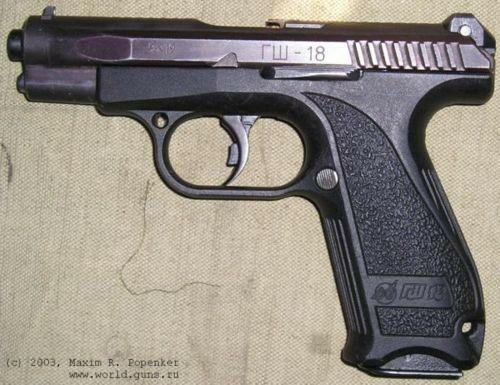
GSh-18

GSh-18 - production version, left side
 
GSh-18, same production pistol, right side
 
GSh-18 with the slide locked back by slide stop; multiple locking lugs are clearly visible on the barrel.
 
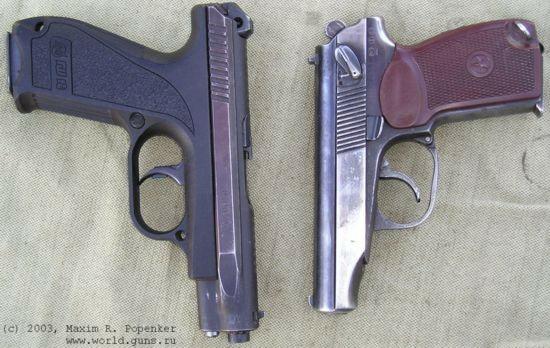
Gsh-18 compared to the famous Makarov PM pistol
 
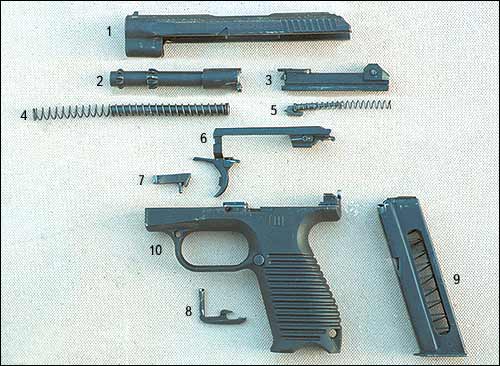
GSh-18 field-stripped
 
9x19mm PBP armour-piercing ammunition, developed for GSh-18


Type: Double Action Only
Chamber: 9x19mm Luger / Parabellum (also 9x19mm +P+)
Weight with empty magazine: 580 g
Length: 183 mm
Barrel length: 103 mm
Capacity: 18 rounds

The GSh-18 pistol was developed in mid-to-late 1990s in Russia, by the KBP (Equipment manufacturing Design Bureau) in Tula. The GSh stands for Gryazev and Shipunow - a chief designers of the pistol, who are famous for their aircraft cannons, bearing the same name (GSh-23, GSh-301 etc). 18 stands for magazine capacity.
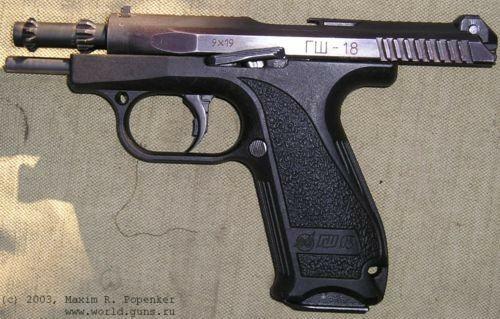
GSh-18 was developed as a military sidearm, capable to defeat current body armour. To achieve good penetration, designers of KBP first developed a special, very hot version of the 9x19mm Luger / Parabellum round, with light and fast bullet with hardened steel core (4.2 gram @ 600 meters per second, or 65 grains @ 1970 fps), called 9mm PBP. PBP ammo can penetrate 8mm plate of mild steel at 20 meters, or any Class III bulletproof vest at the same range. Early prototype pistols of the KBP were known as P-96 but they were unsuccessful, so new pistol was developed about 1998. It went to official military trials in 2000 and passed it successfully. It probably had been purchased in small numbers by some Russian law enforcement and Internal Affairs ministry units, and also offered for export. The opinions on this pistol are somewhat mixed, from very high to almost disappointing, and, due to official adoption of the PYa as an official Russian army sidearm and availability of the more powerful 9x21mm SR-1 "Gyrza" pistol (which is quite popular across Russian special forces), it is doubtful that GSh-18 will ever appear in large numbers. But, anyway, this pistol is interesting enough to be mentioned here.
GSh-18 is a recoil-operated, locked breech pistol. It uses short recoiling barrel that rotates to lock and unlock from the slide. Unlike the other rotating barrel pistols, barrel of the GSh-18 has multiple (10) locking lugs, and rotation angle is as low as 18 degrees. The frame is made from tough polymer with steel inserts and slide rails. Slide is stamped from the steel, with pinned locking insert and detachable breech block. The trigger is Glock-alike - striker-fired, with pre-cocking during the recoil cycle and manual full cocking by the pull of the trigger. When striker is half-cocked, its rear portion [protrudes from the back of the slide for about 1 mm, giving an visual and tactile indication that gun is ready to fire. GSh-18 is equipped with automated, Glock-like trigger safety and additional firing pin safety. Ejection port is located at the top of the slide with ejection straight up and to the back. Magazine is a two-column type without transformation to the single column at the magazine exit for increased feed reliability. The latest variants featured removable front sight and rear sights mounted on the breech block (not on the slide, which is a bad idea by many opinions). Sights feature white-dot inserts for faster aiming. One of the most discussed features of the GSh-18 is a slide that is open at the front. Critics said that the dirt will easily go into the slide interior via this opening and pistol reliability will be decreased at least. Designers said that it is OK and dirt will not pass deep into the gun interior. Probably designers has all the reasons to say so, because GSh-18 successfully passed rigorous military trials, but only the future and actual field reports will tell us the full story.
GSh-18 can fire any commercial or military 9mm Luger/Parabellum and 9mm NATO ammunition, plus Russian armour-piercing, high-power (roughly equivalent to 9mm +P+ or even hotter) ammunition, 9mm 7N21 and 9mm PBP. GSh-18 is reported as accurate and comfortable to fire, and very light for its class, but it is still to be seen if it has any significant future.
I had the chance to hold this pistol (pictured above) in September, 2003, at some local Russian Law Enforcement competition event, but did not fired it, pitifully. Out of the three latest Russian military / LE pistols (GS-18 itself, Yarygin PYa and Serdjukov SPS / SR-1) the GSh-18, in my opinion. has the best and most comfortable grip shape. It also fits perfectly into the open-top police-type Makarov holster. Sights are not the best, but acceptable, and the trigger pull is relatively heavy, but short and consistent.

Yarygin PYa / MP-443 "Grach"

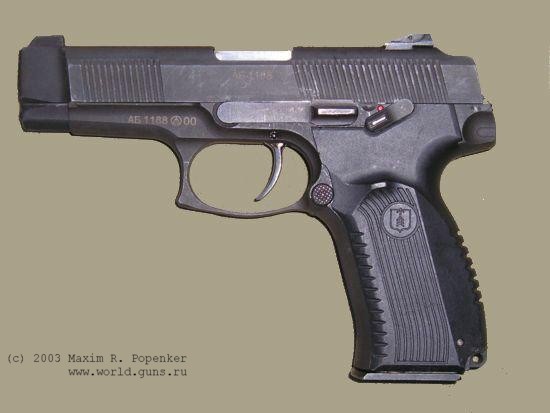
Yarygin PYa pistol, left side
 
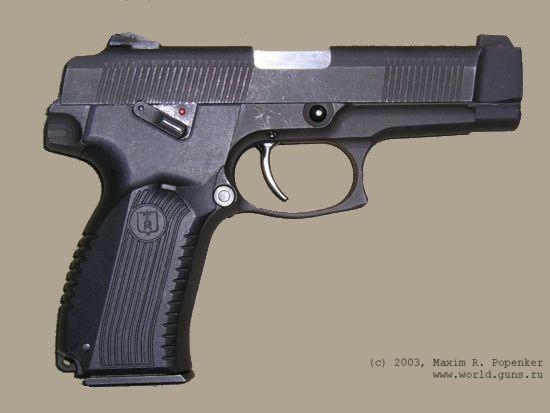
Yarygin PYa pistol, right side; note ambidextrous safety in the "ready to fire" position
 
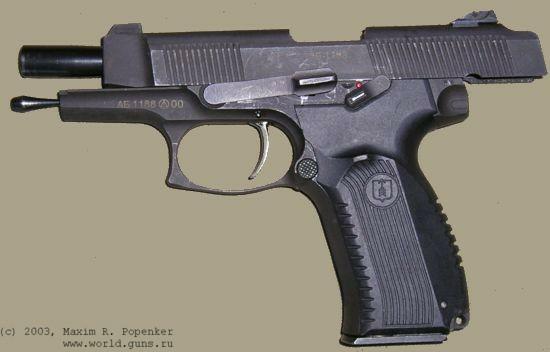
Yarygin PYa pistol, with the slide locked open


Type: Double Action
Caliber: 9x19 mm 7N21 (9mm Luger/Para)
Weight unloaded: 950 g (with empty magazine)
Length: 198 mm
Barrel length: 112 mm
Capacity: 17 rounds

The PYa (Pistolet Yarygina - Yarygin pistol) was developed for the Russian Army trials, codenamed "Grach" (rook). These trials were started by issuing initial requirements for a new military pistol in 1993. Than new pistol should had have a DA trigger, large capacity magazine, all steel construction and be able to be converted into 9x18 PM and PMM, 9x19mm Luger, and 7.62x25mm TT chamberings. Later on, the multicaliber option was dropped from military requirements, and in the late 1990s Russian army settled on the improved version of the worlds' most popular 9mm Luger/Parabellum round, very hot loaded (peak pressure generated by 7N21 is well beyond 9mm +P standards) and fitted with armour piercing bullet with hardened steel core. Several designs were submitted to the trials, but eventual winner was the pistol, designed at the state Izhevsk Mechanical Plant by the Vladimir Yarygin. This pistol, initially known as the 6P35 (military index during trials) or as MP-443 "Grach" (manufacturer's designation), now is officially adopted by the Russian Government for Military and Law Enforcement use under the PYa designation, and already issued to some Russian Army units, most probably located in Chechnya.
In those ages of lightweight alloys and plastics, and complicated trigger systems, the all steel DA pistol may look little outdated and conservative, but, in my opinion, there's nothing wrong with the conservative approach, especially if it the result is well balanced and fits the intended niche well, which PYa does. I had the chance to examine the production pistol, as well as to see it in action (during Russian Law Enforcement IPSC competition, held in September, 2003, near the St.Petersburg). For me, PYa appeared as a well balanced, sturdy pistol with adequate accuracy and decent firepower. The only things that could be improved, in my opinion, are the fixed sights, and the shape of the polymer grip panels, that felt too angular in my palm.
The PYa is a short recoil operated, locked breech pistol. It uses a modified Browning "High Power"-style locking, with the cammed slot under the barrel, that is used to lock and unlock the single lug on the barrel with the ejection window in the slide. The slide and frame are made from carbon steel, the barrel is made from stainless steel. The conventional DA trigger features an ambidextrous manual safety on the frame, that could lock the hammer either in lowered or in cocked position, allowing for "cocked and locked" mode carry. There's no decocker, and additional automated safety is built into the system, that locks the firing pin when trigger is not pressed. The external hammer on production pistols is partially enclosed from the sides by the slide extensions, to facilitate snag-proof handling. Front sight is machined with the slide, rear sight is dovetailed into the same. Both sights featured white non-luminous inserts (tritium-filled "night" sights available as option). Wrap-around grip panels are made from polymer, and the grip is provided with the lanyard ring. Button-operated magazine release is located at the base of the triggerguard, and can be mounted on either side of the frame, depending on the user preferences (easily re-installed by the user itself in a minute). Dual stack magazines are made from steel and hold 17 rounds of 9x19mm ammunition, plus one in chamber. There's also some information that a 18-rounds magazine will be introduced for PYa in 2004.

 
Design by Free WordPress Themes | Bloggerized by Lasantha - Premium Blogger Themes | Online Project management