Tampilkan postingan dengan label Shotguns. Tampilkan semua postingan

Jumat, 21 Juni 2013

Greener police gun

Greener police gun Mark III

diagram of the Greener-improved Martiny action, as used in Greener police guns
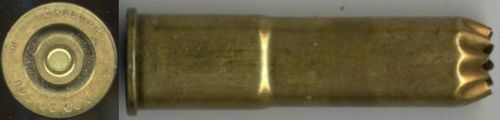
special 14 gauge shot shell for Greener police gun Mark III


Caliber
12 Gauge or 14 Gauge Greener
Type
Single shot
Overall length
1060 mm
Barrel length
610 mm
Weight, empty
3,5 kg
Magazine capacity
-

The Greener police shotgun is one of most unusual fighting shotguns which were employed by law enforcement organizations throughout former British empire. Despite its obsolete design (which traces its roots as far back as 1860s) Greener police gun can be still encountered in hands of police officers in some more remote parts of the world, mostly in Asia and Africa.
Story of the Greener police gun began shortly after the WW1, when British colonial police forces requested a weapon, suitable for riot control and prison guard duty. Another request was that the gun should use proprietary ammunition, not available through commercial channels. This was requested to made illegal use of guns, stolen or taken away from police more complicated for criminals. This request was fullfilled by famous British gunmaker W.W. Greener, who developed a single-shot shotgun, based on the long-obsolete but rugged Martiny single-shot action. This new gun fired proprietary 14 gauge shells, loaded with shot, and featured very rugged wooden full stock with steel nose cap and buttplate, so it can be safely and routinely used not only as a gun, but also as a club, banging doors and occasional hot heads in the course of upkeeping the law and order.
Greener police gun mark I appeared in around 1921, and tens of thousands were delivered to organisations like Egyptean colonial police etc. However, it was soon discovered that criminals, who managed to get hold on Greener guns, used standard 16 gauge shells, tightly wrapped into paper or tape to fire from Greener guns. To made commercial ammunition completely unusable, Greener responded with improved design, Greener police gun mark III. This gun used proprietary ammunition with bottlenecked case made of brass, with thick rim. Base of the case was roughly same as standard 12 gauge case, but toward the forward end of the shell it has reduced diameter equivalent to 14 gauge shell size. To further complicate illegal use of its police shotgun, Greener provided its Mark III guns with trident-shaped strikers. Greener police shells had grooved base and recessed primers, and attempt to fire any commercially available shell from Greener gun would fail every time as the side projections of the striker would hit the flat base of the shell, stopping the central part (the firing pin itself) before it can reach the primer. Some Greener Mark III police guns were also made to fire standard, commercially available 12 gauge ammunition or Mark I 14 gauge straight case ammunition.
Typical 14 Gauge cartridges available for Greener police gun were usually loaded by Kynoch with 30-36 gram of lead shot of small or medium size.

The Greener police shot gun Mark III is a single shot weapon. It uses Martiny type hinged block action, controleld by a lever located below the stock. Pulling the lever down and forward will rotate (drop) the front of breechblock down, exposing the chamber and extracting the fired shell. Fresh round then can be chambered and breech block raised by pulling the lever up. Gun is striker fired, and internal striker is cocked automatically as the breech block is opened. Manual safety is provided on the right side of the receiver. Greener police shot gun is fitted into two-piece wooden stock of solid construction, with steel nose cap and steel buttplate. On some Greener guns, nose cap was provided with bayonet mount, to achieve more intimidating effect on rioters or prisoners.


Browning Auto-5

Browning Auto-5 / A5 and Remington model 11 shotgun (Belgium, USA)

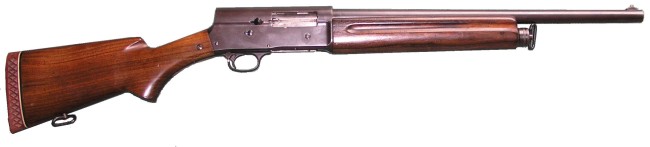
Browning Auto-5shotgun of early Belgian manufacture, left side.
 Browning Auto-5shotgun of early Belgian manufacture, left side.

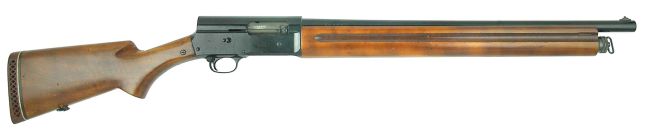
 Browning Auto-5 shotgun of early Belgian manufacture, right side.
  Browning Auto-5 shotgun of early Belgian manufacture, right side.

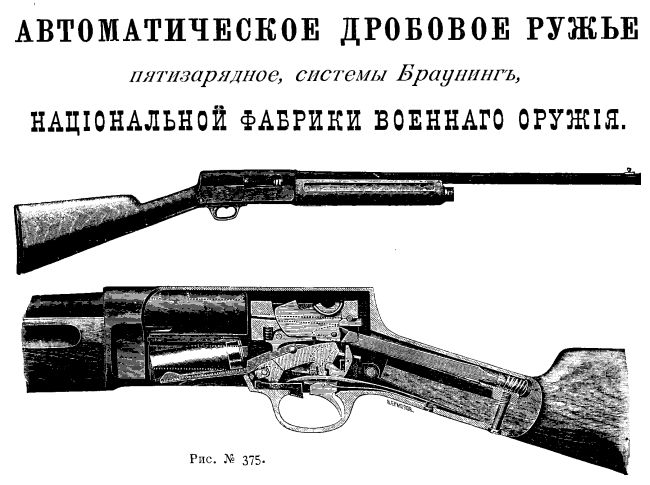
Advertising from pre-WW1 era Russian mail-order hunting supplies catalog that offered
  Advertising from pre-WW1 era Russian mail-order hunting supplies catalog that offered "New autoloading shotgun, five-shot, Browning system, made by Fabrique Nationale".


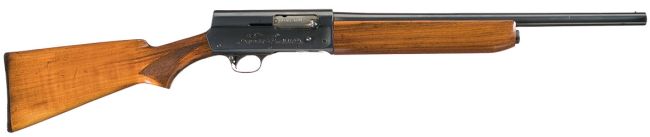
 BrowningAuto-5 "12 gauge Light model" shotgun of late Belgian manufacture.

BrowningAuto-5 shotgun of Belgian manufacture in military configuration, as used by British forces under L32A1 designation.
  BrowningAuto-5 shotgun of Belgian manufacture in military configuration, as used by British forces under L32A1 designation.

 BrowningAuto-5 shotgun of Belgian manufacture, special version for police use,with factory extended 8-round magazine.
 BrowningAuto-5 shotgun of Belgian manufacture, special version for police use,with factory extended 8-round magazine.

Early productionRemington model 11 shotgun, commercial model.
 Early productionRemington model 11 shotgun, commercial model.

Remington model 11shotgun in
 Remington model 11shotgun in "Riot" configuration, for police or guard use.

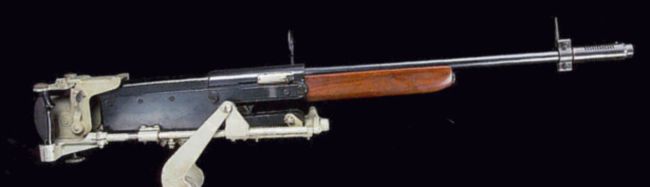
Remingtonmodel 11 shotgun with recoil pad and Cutts compensator, as used by USAFduring WW2 to train aircraft machine gunners.

Remingtonmodel 11 shotgun set up into special mount to emulate aircraft machine gun. This setup was used by US Air Force during WW2 to train aircraft machine gunners on shooting at moving targets.
  Remingtonmodel 11 shotgun set up into special mount to emulate aircraft machine gun. This setup was used by US Air Force during WW2 to train aircraft machine gunners on shooting at moving targets.

Type:semi-automatic, recoil operated
Gauge:12, 16 and 20
Length: varies with model
Barrel length: varies with model
Weight varies with model
Capacity: 4 rounds in underbarrel tube magazine

John Moses Browning, the legendary American gun designer, invented thefirst practical self-loading shotgun in 1898. In fact, Browning designed and patented three different systems, but finally choose the last one to go ahead. It must be noted, that at the time the autoloading shotgun was something of absolute novelty, and the task of designing such gun was severely complicated by the fact that the switch over from black powder to smokeless ammunition was well under way, and general quality of shotgun ammunition was rather uneven,to say the least. Nevertheless, Browning managed to make hist prototype model work, and work well. He first offered this shotgun to Winchester,which was the sole buyer for his designs from 1886 on. However, severe technical conservatism on the part of the Winchester's boss,T.G.Bennett, and financial disagreements (Browning insisted on royalty-based payments, but Winchester at the time always bought new designs for fixed amount of money) resulted in break between the designer and the company. Browning then turned to Remington, but tragicdeath of the Remington's president from hear attack just minutes before scheduled meeting with Browning put an end to this route as well. Browning thenturned to the Belgian company Fabrique Nationale (FN), which at this time (1901) produced first Browning-designed self loading pistol (M1900)as fast as it could be made. FN management greeted Browning and his new gun with great enthusiasm, and in a short while FN produced the first FN Browning autoloading shotgun, known as Browning Auto 5, or A-5 inshort. Browning himself ordered 10,000 A-5 shotguns from the first batch for sales and distribution in USA, and sold all 10 thousands in about a year. Following the introduction of the new, increased custom tariffs by US government, Browning found that it was economically not reasonable to import more A-5 guns into USA, so he pursued FN to release rights tomake and sell Browning auto loading shotgun on US market to RemingtonArms Co (FN originally had worldwide rights for manufacture of Auto 5).In 1906 Remington offered the Browning-designed auto loading shotgun as Model 11, and manufactured it without interruption until 1947, with well over 800,000 guns made. Between 1949 and 1968 Remington also produced an updated (lightened and streamlined) version of the Browning's design, known as Remington Model 11-48. The FN produced Browning Auto 5 shotguns continuously (with interruptions for German occupation during both World Wars) until 1999, making Auto-5 probably the most successful and longest-producing sporting shotgun in the history. Overall output of Auto-5 shotguns made and sold by FN (During WW2, A-5 shotguns were made for Browning Arms Co by Remington, and since mid-1970s Auto-5 shotguns were also produced for FN in Japan by Miroku, under FN license) over the century well exceeds two million guns (2,000,000th Auto-5 was produced in 1970). Total estimate of worldwide production numbers for this legendary Browning design is well over three million guns.
 Copies and clones of the Auto-5 shotgun were also manufactured in Italy by Franchi and Breda, in USA by Savage and in USSR / Russia by TOZ, and by some other manufacturers around the world. Many Auto-5 guns, made many decades before, are still used for hunting and shooting today, but, as time goes, Browning Auto-5 shotguns increasingly become collector's pieces.
Over the time, both FN and Remington produced wide variety of versions of the basic design. Hunting guns were made with plain or ribbed barrels of various lengths and gauges(12, 16 and 20), with magazine capacities of 4 or 2 rounds, various stocks, finishes etc. For police and military applications, FN andRemington created shorter-barreled shotguns with plain barrels. Many Remington guns have seen extensive use by US police and securityservices; US military also used Remington shotguns to train AA and aircraft gunners in shooting at fast-moving flying targets (clay pigeons), usingtraditionally stocked guns or guns, mounted in special fixtures to emulate aircraft machine guns. Belgian-made guns have seen less military service, although British army issued more than few A-5 shotguns as L32A1 during Malay counter-insurgency operations and later.
BrowningAuto-5 shotgun uses recoiling barrel to operate its action. The system is of so-called long-recoil type, as barrel and bolt recoil together for entire length of the recoil stroke, being securely locked by pivoting piece, installed in the bolt. This piece, when pivoted up, engages the cut in the barrel extension with its large locking lug. Upon completion of the full recoil path, the bolt is arrested in the rearmost position,and the locking piece inside it is tipped down to release the barrel.Barrel, under pressure of its own return spring, located around the magazine tube, slams forward, leaving the empty shell on the bolt face.Once the empty shell is clear of the barrel, it is ejected out of the gun. When barrel comes to the rest in the forward position, it automatically releases bolt catch, allowing the bolt to run forward,picking the fresh cartridge from the raised cartridge lifter, and locking the to the barrel at the end of the forward run. Bolt return spring is located in the butt. To achieve reliable functioning with wide variety of loads, Browning used self-adjusting friction brake in the recoil system, which consisted of several (one or two, dependingon the exact model) friction rings, located around the magazine tube.The tubular magazine holds four rounds; fifth one can be loaded into the chamber, making the total capacity of five rounds. One importantdifference between FN Auto-5 and Remington Model 11 shotguns is that the FN guns had a magazine cut-off lever, located on the left side of the receiver. This lever, when turned to the rear, locks the cartridgesin the magazine, allowing for quick replacement of the loaded round with another (presumably, with different type of projectile(s), i.e.shot to slug or vice versa). Remington shotguns did not have this feature.

Rabu, 26 Januari 2011

Shotguns

US marine aiming with the Remington 870 pump-action shotgun

The shotgun is probably the oldest type of all shoulder-fire firearms. Many earliest guns were smoothbore and loaded with multiple projectiles simultaneously. The shotguns were and still are used for hunting, since multiple projectiles increase the chances to hit the target with one shot, but shotguns also were used in combat in almost all wars since their introduction. The devastating short-range firepower and flexibility in loads are the key advantages of shotguns as the fighting weapons. During the XX century shotguns seen lot of combat, both as a police riot weapons and as a military trench, and later - jungle and urban close quarters battle weapons. Police used shotguns for riot and crowd control, and as a general purpose short and medium range weapons for about 150 years. First well known military use of shotguns is dated back to the Great War (1st World War), when Allied forces used various pump-action and self-loading shotguns in the trench warfare. During the 2nd World War shotguns were used as a security weapons (for guarding and anti-riot purposes), for close combat in jungle environments of SE Asia, where the self-loading shotguns (like the Remington 11 and Auto-5 - both of Browning design) proved to be very valuable for their devastating short-range firepower. The shotguns were also used for aerial gunnery training. Vietnam war also seen many shotguns used by US troops in the jungles, but these were mostly pump-action shotguns. At the present time shotguns formed a valuable part of equipment of both police and military forces around the world, and its development continued. There were several programs intended to increase shotguns effectiveness and combat range, but these proved mostly to be less than successful. Most combat shotguns were and still are the adaptations of commercial, hunting firearms for the new role, but during the last three decades of the XX century some specialized combat shotguns were developed. Some of these remained only in prototype or pre-production status, others flourished and found its way into the police and military stocks.

SWAT officer with the short-barreled pump-action shotgun

Combat shotguns usually designed with two basic action styles - repeating "pump-action" or semi-auto. Double-barreled shotguns were also used in early periods, but these are too slow to reload for combat purposes. However, a sawed-off versions of the double shotguns, with the most of the barrel and the butt removed, seen some use on both sides of law as a very-short range, hide-away weapons of devastating power.

General features of shotgun.


Main advantages of shotguns are their versatility and short-range firepower. Shotguns can fire multiple projectiles of various sizes, creating a lethal pattern, which will increase chances of hitting target, or single large projectile, powerful enough to drop down a large brown bear, or incapacitate a human being protected in all but the heaviest body armour. Shotguns also can fire special purpose ammunition, such as door buster slugs, and even a high explosive and incendiary rounds, as well as the less lethal ammunition, useful for riot control and other police operations. Most, if not all modern combat shotguns are magazine fed repeaters, with the underbarrel tubular magazines being the most common type. Those magazines offer a sleek, slim profile of the gun, but are slow to reload. Some recently developed combat shotguns featured a detachable, box-type magazines, which can be replaced very quickly. Few combat shotguns were developed with rotary, revolver-like magazines or drum-type magazines of relatively large capacity (10-12, and up to 28 rounds), but those magazines are extremely bulky, heavy, expensive and sometimes slow to reload.
The disadvantages of the combat shotguns are the limited effective range of fire (about 50-70 meters with standard buckshot, up to 100-150 meters with specially designed subcaliber or fleschette loadings). Shotguns also are sometimes relatively large (especially when compared to modern submachine guns), and can have a heavy recoil with the most powerful loadings. The size and weight of the shotgun ammunition effectively limits both the magazine capacity and the amount of ammunition a soldier can carry in the mission.

Pump action shotguns


Winchester model 1897 trench-gun, widely used by US troops during the 1st World War

Pump action means, that for each shot shooter cycles the handguard back and forward (in some guns, such as Russian RMB-93 or S. African Neostead - forward then back). This movement removes the used shell, cocks the action and chambers the new shell. This design is little slower than semi-auto, but offers greater flexibility in shotshells selection, allowing mixing of the different types of loads and usage of low-power or unreliable loads. This feature especially useful for police and home defense usage, since the pump-action shotguns can fire low-powered less-lethal ammunition (with tear gas or rubber buckshot).

Remington 870 pump action shotgun in the Tactical configuration

Mossberg 500

Semi-automatic shotguns


Remington model 11

Semi-automatic shotguns can use several different actions - inertia recoil (Benelli), gas (Russian AK-47-derived Saiga-12 and Italian Franchi SPAS-15), barrel recoil (Browning designed Auto-5 and Remington 11). Semi-autos usually have less recoil (especially gas-operated ones), and higher rate of fire, but somewhat more sensitive to the loads selection. The greater firepower, offered by semi-automatic shotguns, is especially useful for military applications, where short-range encounters are usually very rapid, and the amount of firepower used in a short period of time is essential to win the scenario and save one's life.

Saiga-12K semi-automatic shotgun, based on the modified AK-47 action, features a detachable box magazine and a folding butt, making it a very effective combat weapon

To use advantages of both pump and semi-auto designs, some manufacturers designed select-action shotguns, where user may select the action style with just turn of the lever or so. Such shotguns are Franchi SPAS15, or Benelli M3S90, for example. The disadvantages of those selective systems are somewhat increased weight and greater unit price.

 
Design by Free WordPress Themes | Bloggerized by Lasantha - Premium Blogger Themes | Online Project management