Jumat, 21 Juni 2013

Steyr ACR

Steyr ACR - Advanced Combar Rifle

Steyr ACR
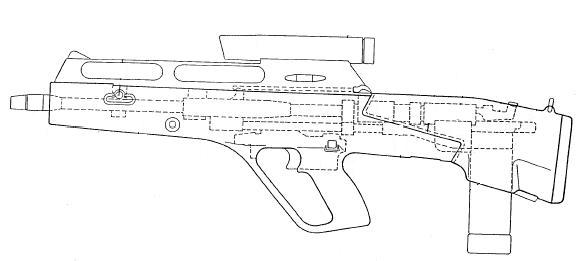
Steyr ACR


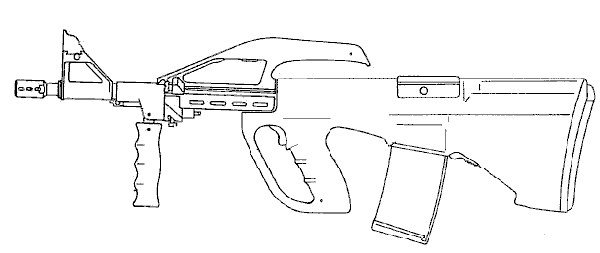
Steyr ACR layout shematic


Steyr ACR action drawing from Steyr patent gas piston in forward position, breech block with chamber in upper position
Steyr ACR action drawing from Steyr patent
gas piston in forward position, breech block with chamber in upper position


Caliber: 5.6 mm fleschette
Action: Gas operated, rising breech
Overall length: mm
Barrel length: 540 mm
Weigth: 3.23 kg w/o magazine
Rate of fire: rounds per minute
Magazine capacity: 24 rounds

The Advanced Combat Rifle program was started by the US Army in the late 1980s with the main goal to improve the hit probability of average infantry soldier by at least 100 percents above the M16A2 capabilities. During this trials, held in the early 1990s, some new and existing designs from several companies were tested, with more or less sucess, but no one achieved the 100% improvement in hit probablility over the existing M16 rifle, so program was terminated and all participating designs were freezed, which is pity. One of the most interesting participants was a design of the austrian company Steyr-Mannlicher AG.
The Steyr ACR was built as an attempt to revive the fleschette ammunition concept, first tried in the 1960s during US Army SPIW program. In 1960s, the fleschette concept was a failure. In 1990s, it was much more sucessful, but not enough to be worth of total rearming to the new infantry weapon system.
Steyr ACR is built around a specially designed cartridge of nominal caliber of 5.56mm. This cartridge has simple, cylindrically shaped plastic case. The fleschette, or dart, is totally enclosed in the case. Fleschette diameter is about 1.5 mm (.06 inch), lenght is about 41 mm (1.6 inch), weight 0.66 gramm (10 grains). Fleschette is partially enclosed into discarding sabot, and leaves the muzzle at impressive velocity of 1450 meters per second (4750 fps), still retaining velocity of 910 m/s (2980 fps) at the range of 600 meters. The plastic case had no rim or extracting groove, and priming compound is located annually at the inside wall of the case.
To fire such uncommon cartridge, Steyr ACR has equally uncommon design. Barrel of nominal caliber of 5.56mm, has a very slow rifling to give initial stabilisation to the fleschette, which is stabilised in flight by its own small fins. Instead of common linear-moving bolt, Steyr ACR have separate chamber (breech block), which can be moved up and down. The whole action is powered by gas drive, which has annual gas piston, located around the barrel. To understand this system i will explain how it works:
at first, lets suppose that chamber is empty and rifle is manually cocked for the first shot.In this position the chamber block is its lowest position, aligned with the topmost round in magazine.The gas piston with its operating rod is in its rearmost position and under the pressure of the return spring.When trigger is pressed, the operating rod with gas piston are released and started forward under the pressure of the return spring, which is located around the barrel. This movement, at first, via special rammer, feeds the first round forward from magazine and into the chamber, and then, via shaped cam and breech block spring, rises the breech block with the cartridge into the topmost position. In this position the fixed firing pin passes through the hole in the top of the chamber and penetrates the cartridge wall, igniting the primer composition and firing the round. When projectile (fleschette with sabot) passes the gas port, some of powder gases began to move the gas piston back. This movement, via the operating rod and shaped cam, loweres the breech block with empty case out of alignment with barrel and down to the magazine. When breech comes to stop in the lowest position, a separate rammer feeds next cartridge forward and out of magazine, chambering it. At the same time, the fired case is pushed forward out of the chamber by the next cartridge, and when cleared from the chamber, the spent case simply falls down out of the rifle via the ejection port. The ejection port is located at the bottom of the rifle, ahead of magazine, and this eliminates one of the biggest problems of any bull-pup rifle - a non-ambidextrous (or, in this case - fully ambidextrous) ejection.
If rifle is set to the full auto mode, the firing cycle is repeated as descibed above. Otherwise, the loaded breech remains in its lowest position, awaiting for the next trigger pull.
This quite comprehensive action was concealed in sleek and comfortable polymer case with AUG-styled pistol grip and large ventilated upper rib with fixed sights. Optical sights also were fitted. Due to extremely high projectile velocity, flight time was very short at any practical ranges, and trajectory was wery flat, giving the shooter almost ray-gun performance, which allowed to fire withouth prior calculations of point of impact - speaking simply, at any practical combat ranges shooter will hit where it aimed, regardless target movements (projectile flight time to the target at 300 meters is about 0.2 seconds). Due to high velocity, Steyr ACR had good killing power and armour piercing capablities, and due to the low weight of the projectile recoil was low. But it was not enough to double the M16 performance, so, for now, the Steyr ACR remains in prototype or preproductional state and the program is freezed if not abandoned at all.

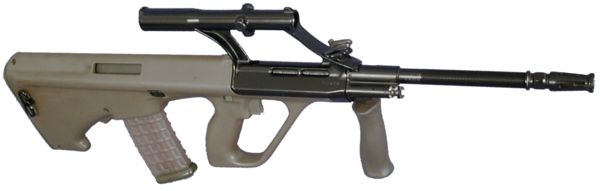
Steyr AUG

Steyr Stg.77 AUG assault rifle

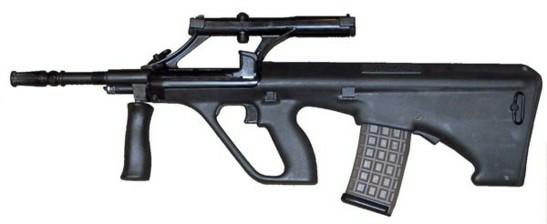
Steyr AUG A1 in standard rifle configuration (military green colour)
 Steyr AUG A1 in standard rifle configuration (military green colour)

The drawing of the Steyr AUG prototype (circa 1974). From original patent. Notethe open sights instead of the latter built-in telescope sights

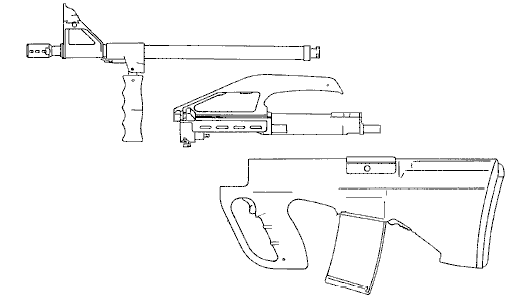
Same prototype drawing, major components: barrel group, receiver, plastic housing with magazine and trigger group (from top to bottom)
 Same prototype drawing, major components: barrel group, receiver, plastic housing with magazine and trigger group (from top to bottom)

Steyr AUG with M203 40mm grenade launcher
Steyr AUG with M203 40mmgrenade launcher

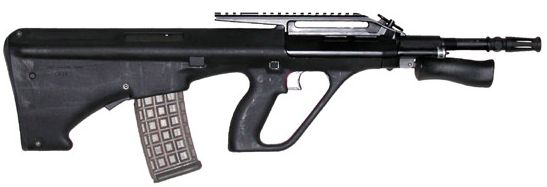
Steyr AUG A1 Carbine (police black colour)

Steyr AUG A2 with Carbine configuration (shorter barrel) and with Picatinny-type rail installed instead of standard telescope sight
 Steyr AUG A2 with Carbine configuration (shorter barrel) and with Picatinny-type rail installed instead of standard telescope sight

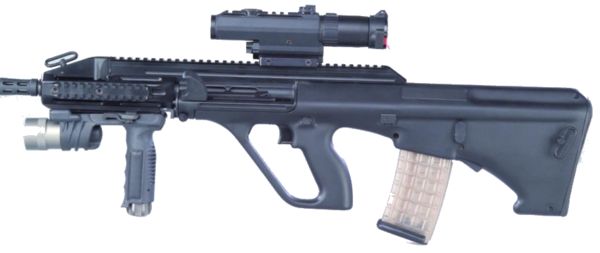
Steyr AUG A3 Carbine with 16inch barrel and optional forward grip / tactical flashlight and telescope sight
 Steyr AUG A3 Carbine with 16inch barrel and optional forward grip / tactical flashlight and telescope sight

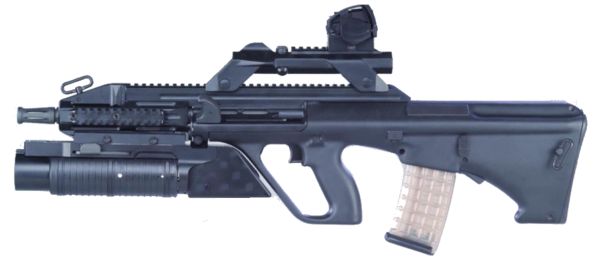
Steyr AUG A3 Carbine with 16inch barrel and special 40mm grenade launcher; grenade launcher sight is attached to the top of removable telescopic riflesight
Steyr AUG A3 Carbine with 16inch barrel and special 40mm grenade launcher;grenade launcher sight is attached to the top of removable telescopic riflesight

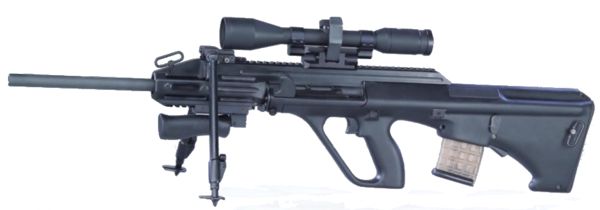
Steyr AUG A3 in Sniper configuration, with heavier and longer 20inch barrel,detachable bipod and long-range telescopic sight

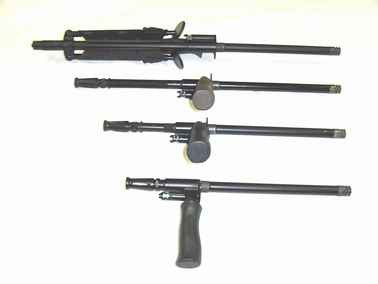
Comparison of various AUG barrels, from top to bottom: LMG/heavy barrel with bipod;standard rifle barrel; carbine barrel; SMG barrel.

Click here to see the cross-section ofthe Steyr AUG rifle (58 Kb JPEG, will open in the new window)

Caliber: 5.56mm NATO (.223rem)
Action: Gas operated, rotating bolt
Overall length: 805 mm (with standard 508 mm barrel)
Barrel length: 508 mm (also 350 mm SMG, 407 mm Carbine or 621 mm LMG heavy barrel)
Weight: 3.8 kg unloaded (with standard 508 mm barrel)
Magazines: 30 or 42 rounds box magazines
Rate of fire: 650 rounds per minute
Effective range of fire: 450-500 meters with standard assault rifle barrel

The Steyr AUG (Armee Universal Gewehr - Universal Army Rifle) had been indevelopment since the late 1960s, as a replacement for venerable but obsolete Stg.58 (FN FAL) battle rifles for Austrian army. It was developed by the Austrian Steyr-Daimler-Puch company (now the Steyr-Mannlicher AG & Co KG) in close conjunction with Austrian Army. The major design is attributed to the three men - Horst Wesp, Karl Wagner and Karl Möser, who developed most of the rifle features. From the Austrian Office of Military Technology the project was supervised by the Colonel Walter Stoll. The new rifle has been adopted by the Austrian Army in 1977, as the Stg.77 (Assault rifle, model of 1977), and production began in 1978. Since then, the AUG gained serious popularity, being adopted by the armed forces of Australia, Austria, New Zealand, Oman, Malaysia, Saudi Arabia, Ireland and some others. It also was widely purchased by various security and law enforcement agencies worldwide, including the US Coastal Guard. The Steyr AUG can be considered as the most commercially successful bullpup assault rifle to date. Since the 1997, the Steyr-Mannlicher produced an updated version of the AUG, the AUG A2.
In around 2005, Steyr-Mannlicher introduced the most recent version of AUG, the AUG A3. This version is characterized by addition of four Picatinny-type accessory rails - one at the top of the receiver, and three around the barrel, in front of the receiver - at both sides and below it. Therefore there AUG A3 has no standard / integral sighting equipment; instead, any open, telescope or night vision sights can be installed on the upper rail, using appropriate mountings. Lower rail can be used to mount various attachments like tactical front grips, flash-lights, and a specially designed 40mm grenade launcher. Side rails can be used for equipment like laser-aiming devices.

Some said that the AUG rifle was revolutionary in many respects when it first appeared, but this is not true. In fact, the AUG is a clever combination of the various previously known ideas, assembled into one sound, reliable and aesthetically attractive package. Let's look at this a little closer. Bullpup configuration: The Steyr AUG is not a first military bullpup ever devised. In fact, BritishEnfield EM-2 and Soviet Korobov TKB-408 bullpup assault rifles precede the AUG by some 25-30 years. The French  FAMASbullpup also appeared on the scene at the very same time, as the AUG did. Plasticfirearm housing: Another Soviet experimental bullpup design, Korobov TKB-022, had the plastic housing as early as in 1962, and the  FAMAS rifle, again, has this same feature at the same time as AUG did. Telescope sight as a standard: The British  EM-2 bullpup rifle of late 1940s, as well as the experimental Canadian FN FAL prototypes of early 1950s, also featured a low-magnification telescope sights as their prime sighting equipment. A modular design: First systems, consisting of various firearms based on the same receiver and action (automatic rifle, light machine gun, carbine) were originally developed in 1920s in France by Rossignol and in Soviet Russia by Fedorov. Considering all said above, one must agree that the AUG was a logical development of various well known ideas,and a really successful one.
In general, the AUG is known for good ergonomics,decent accuracy and a good reliability.
Technical description.
The Steyr AUG is a gas operated, magazine fed, selective fire rifle of bullpup layout.

AUG is built around the aluminium casting receiver, with steel reinforcement inserts. One such insert is used to provide the locking to the removable barrels and the rotating bolt, thus relieving the receiver from most of the firing stress. Other inserts are used as a bearings for the bolt carrier guide rods.

The AUG uses a short piston stroke, gas operated action, with the gas piston mounted inside the compact gas block, which is fixed to the barrel. The gas cylinder is offset to the right from the barrel. Gas piston has its own return spring, contained inside the gas block. The gas system features a three positions gas regulator, which allows for two open positions (for normal and fouled conditions) and one closed position (for launching the rifle grenades). The gas block also contains a barrel fix / release lock and a front grip hinge. Each barrel has eight lugs, that lock into the steel insert in the receiver, and there's four basic barrel patterns for the AUG: standard rifle barrel is 508 mm (~20 in) long. "Compact" or "Submachine gun" barrel is 350 mm (13.8 in) long, "Carbine" barrel is 407 mm (16 in) long, and the heavy / LMG (light machine gun) barrel is 621 mm (24.4 in) long. On each rifle barrels can be exchanged in the matter of seconds. Each barrel is fitted with the flash hider, and the heavy 621 mm barrel also is fitted with lightweight folding bipods. There's no bayonet lug on Austrian service rifles, but it can be installed if required.

Barrel replacement procedure, as noted above, takes only few seconds (assuming that the shooter has the spare barrel handy). To remove the barrel, one must take off the magazine, and clear the rifle by operating the cocking handle. Then, grasp the barrel by the front grip, push the barrel retaining button at the gas block, and rotate the barrel and pull it out of the rifle. To install a new barrel, simply push the barrel down into the front of the receiver all the way and then rotate it until it locks. The rifle now is ready to be loaded and fired.

The bolt system consists of the bolt carrier, which has two large hollow guide rods, attached to its forward part. The left rod also serves as a link to the charging handle, and the right rod serves as the action rod, which transmits the impulse from the gas piston to the bolt carrier. The rotating bolt has 7 locking lugs, claw extractor and a plunger-type spring loaded ejector. Standard bolt has its extractor on the right side, to facilitate right-side ejection, but the left-side bolts (with mirrored positions of extractor and ejector) are available for those who need left-side ejection. The two return springs are located behind the bolt carrier, around the two string guide rods, that are located inside the bolt carrier guide rods. The cocking handle is located at the left side of the gun and normally does not reciprocate when gun is fired, but it can be solidly engaged to the bolt group if required by depressing the small button on the charging handle. On the latest AUG A2 variant, the charging handle was made folding up and of slightly different shape. The AUG action features a bolt stop device, that holds the bolt group open after the last round of ammunition from the magazine is fired. To release the bolt after the magazine replacement, one must pull the charging handle.

The hammer unit is made as a separate assembly and almost entirely of plastic (including the hammer itself). Only springs and pins are steel. The hammer unit is located in the butt and is linked to the sliding trigger by the dual trigger bars. The safety is of the cross-bolt, push-button type and located above the pistol grip. There's no separate fire mode selector on the AUG rifles. Instead, the trigger itself is used to control the mode of fire. Pulling it half the way back will produce single shots, while the full pull will produce automatic fire. The enlarged triggerguard encloses the whole hand and allows the gun to be fired in winter gloves or mittens.

The standard sighting equipment of the Steyr AUG rifle is the 1.5X telescope sight, with aiming reticle made as a circle. This circle is so dimensioned so its visible inner diameter is equal to the visible height of the standing man at 300 meters range. The adjustment knobs on the sight are used only for zeroing. The sight housing, which is integral to the receiver on the AUG A1 models, also features an emergency backup iron sights at the top of the telescope sight housing. Some early production AUG rifles of A1 pattern were fitted with receivers that had an integral scope mounts. On the AUG A2 models, the standard scope mount can be quickly removed and replaced by the Picatinny-type mounting rail.

The housing of the AUG rifles, integral with the pistol handle and triggerguard, is made from the high impact-resistant polymer, and is usually of green (military) or black (police) colour. The housing has two symmetrical ejection ports, one of which is always covered by the plastic cover. The rubber-coated buttplate is detachable and, when removed, opens the access to the rifle internals, including the hammer unit and the bolt group. The buttplate is held in position by the cross-pin, which also serves a s a rear sling swivel attachment point.

The AUG is fed from the detachable box magazines, that hold 30 (standard rifle) or 42 (light machine gun) rounds. The magazines are made from semi-translucent, strong polymer. The magazine release button is located behind the magazine port and is completely ambidextrous (some said that it is equally NOT comfortable for either hand use).

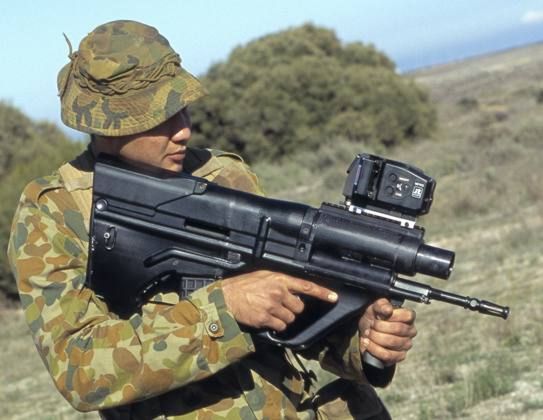
EF88 / F90

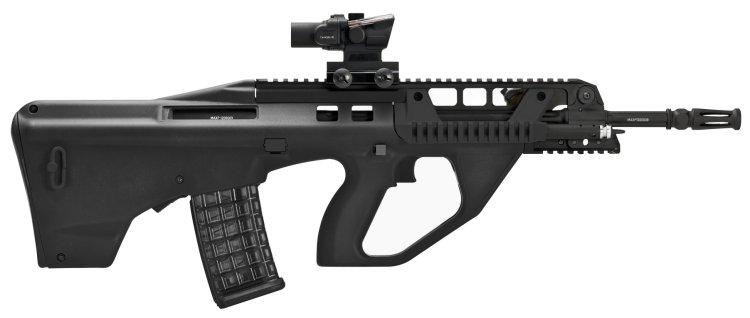
Thales EF88 / F90 assault rifle


Thales EF88 / F90 assault rifle with 40cm barrel


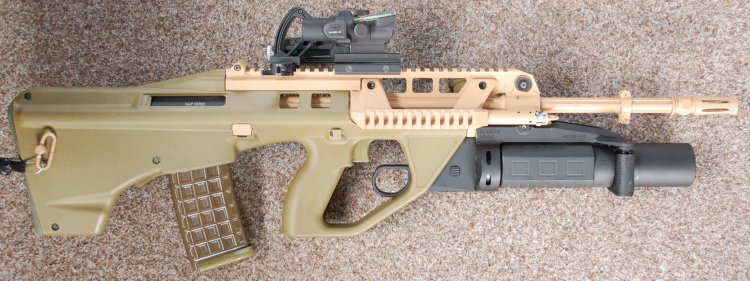
Thales EF88 / F90 assault rifle with 50cm barrel and underbarrel grenade launcher


F90 carbine
F90
Caliber
5.56x45 NATO
5.56x45 NATO
Length
700 mm
802 mm
Barrel length
407 mm
508 mm
Weight
3.25 kg
3.39 kg
Rate of fire
850 RPM
850 RPM
Magazine
30 rounds
30 rounds

F90 assault rifle, also known as EF88 (enhanced F88) is an evolution of the F88 assault rifle, which was adopted by Australian and New Zealand armed forces during late 1980s. The original F88 rifle is a licensed copy of the Austrian Steyr AUG rifle, and it was produced in Australia at Australian Defense Industries factory in Lithgow. Today this same factory is operated by the Thales Australia, which developed EF88 / F90 rifle as a next weapon for Australian army, as well as for export.
While internally and externally the F90 is still close to Steyr AUG, it has many distinctive upgrades and changes, developed by Thales to fulfill current and near-future requirements of Australian armed forces. The Thales F90 rifles were first displayed to the public in mid-2012, and initial production is scheduled for 2013.
The resulting weapon is said to be much more reliable and comfortable than original F88 / Steyr AUG rifle. It is also noticeably lighter: standard F90 with 50 cm / 20” barrel is about 0.5 kg / 1.1 lbs lighter than standard F88 rifle; with new 40mm underbarrel grenade launcher installed, resulting weapon is more than 1.6 kg / 3.5 lbs lighter than F88 rifle equipped with M203PI grenade launcher.


F90 / EF88 assault rifle is gas operated, selectively fired weapon of bullpup layout. It uses polymer housing with improved shape of buttstock (including the new buttpad and added comb for better cheek-weld). Gas operated, short-stroke, rotary bolt action is similar to that of original Steyr AUG, but the gas block is modified. Aluminum alloy receiver is also modified to improve reliability and reduce weight. Ejection ports and ejection covers also modified to ensure reliable extraction under all conditions.
Unlike all previous versions of the Steyr AUG, the F90 has non-removable barrels, cold-hammer forged and externally fluted. Standard F90 rifles are offered with 50 cm / 20” barrels; other versions include carbines with 40 cm / 16” barrel and CQB variants with 36 cm / 14.1” barrel. Other clearly visible changes include extended Mil-Std (Picatinny) rail at the top; bottom rail has replaced original folding forward grip of the Steyr AUG / F88. Third accessory rail is mounted on the right side of the weapon. Trigger guard is redesigned to accept new, specially designed 40mm Underbarrel Grenade Launcher. This lightweight add-on weapon can be quickly attached directly to the bottom rail of the host rifle, and then easily removed when not required. Less visible changes include addition of the bolt hold-open device to facilitate faster reloads. F90 will feed from the same proprietary translucent magazines, made from polymer as the original Steyr AUG / F88 rifles, although optional STANAG-compatible version is said to be available in the near future. Basic sighting is provided by Trijicon ACOG optical sights with 1.5X or 3.5X magnification, although sights can be easily changed, thanks to MilStd mounts.

AICW

AICW - Advanced Infantry Combat Weapon

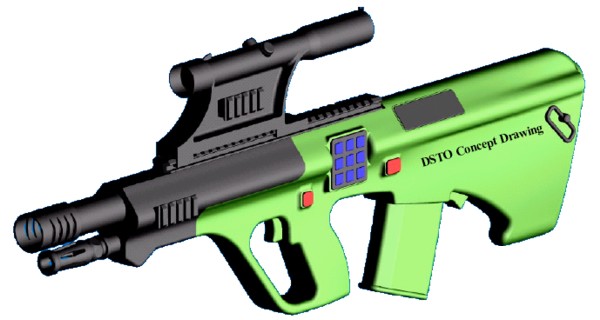
2001 concept of the AICW system

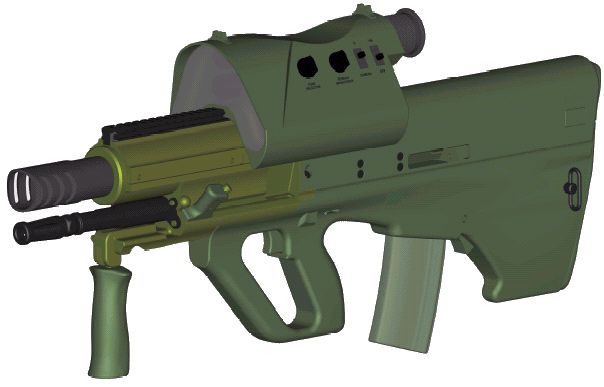
2003 concept of the AICW system

2005 testing prototype AICW VX3 weapon


Caliber: 5.56x45mm NATO + 40mm
Action: Gas operated, rotating bolt + Metal Storm patented stacked-projectile caseless
Overall length: 738 mm
Barrel length: n/a
Weigth: 6.48 kg unloaded, w/o sight; 7.85 kg loaded w/o sight (30 5.56mm + 3 40mm rounds); 9.9-9.9 kg loaded w. electronic sight
Rate of fire: 650 rounds per minute (for 5.56mm barrel)
Capacity: 30 rounds (5.56mm) magazine plus 3 40mm rounds in the G/L barrel

The AICW (Advanced Infantry Combat Weapon) is a joint development of the Australian DSTO (Government operated Defence Science and Technology Organisation), and private companies Metal Storm and Tenix Defence. This development has been carried out since the turn of 21st century, closely following the concept of the American XM29 OICW system. Overall, AICW represents the modular weapon system that combines the 5.56mm rifle/carbine copmponent as a host (basic) platform with 40mm multi-shot grenade launcher (G/L) module and multi-purpose electro-optical sighting system, which can be used to fire either rifle or G/L component, and also can provide recon data to external "consumers" such as tactical computers.
The host rifle component of the AICW is the updated Australian-made F88 rifle, which is a license-built Steyr AUG.However, the basic F88 rifle has been extensively modified to accept other elements of the system - for example, receiver has been upgraded to receive the G/L module at the top, and the buttstock has been enlarged to accomodate G/L electronic fire contol module. Other changes include modification to the safety and trigger arrangements - AICW system has a single trigger for both weapon components (5.56 and 40mm), and a three position (safe - rifle - G/L) safety/selector switch at the side of the pistol grip.
The most interesting part of the AICW weapon is the multi-shot Metal Storm 40mm grenade launcher, which looks like a single 40mm G/L barrel but contains three 40mm projectiles stacked one behind the another. These projectiles are launched using the electric ignition impulses, provided by the fire control module built into the buttstock of the host rifle. Since the muzzle velocity of these projectiles is slightly more than usual for 40mm handheld G/L (95m/s instead of 75m/s), host rifle incorporates the recoil reduction buffer, that allows the Metal Storm G/L barrel to recoil against the spring, decreasing the peak recoil impulse.
The top of the receiver hosts the multi-role sights of various type and make. At the AICW VX3 live fire demonstartions that took place in the summer of 2005, AICW prototypes were displayed with ITL Viper multi-purpose rifle sight (that incorporates laser range-finder and digital compas), or with Vinghog Vingsight Fire Control System. At the present time (late 2005) AICW prototypes have not yet fired 40mm grenades with live warheads, nor incorporated an airburst facility. However, it is stated that it is possible to easily adapt most of the existing 40mm grenade warheads to the Metal Storm technology, including air-bursting grenades that are now in development in several countries.
At the present time AICW weapons are available only as the "3rd generation technology demonstartors", that completed first live-fire trials (as a complete system) in the summer of 2005. Current Australian MOD plans state that ADF may start to purchase AICW systems in around 2010-2012.

Rifle model 1943 / puska 43M / G.98/40

G98/40 or 43M rifle.
 G98/40 or 43M rifle.

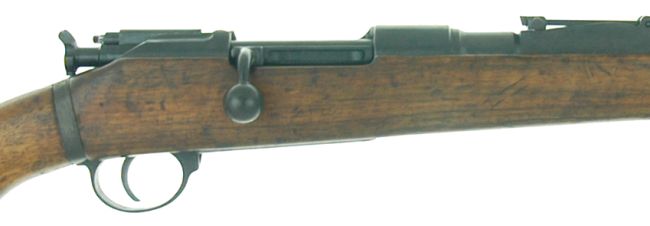
 G98/40 or 43M rifle, close-up view to receiver.
 G98/40 or 43M rifle, close-up view to receiver.

Caliber: 7.92x57 mm
Action: manually operated, rotating bolt
Overall length: 1092 mm
Barrel length: 605 mm
Weigth: 3.91 kg
Magazine capacity: 5 rounds

The Gew.98/40 rifle, also known as Puska 1943. Minta (Rifle, model of 1943, or 43M in short) was developed at Hungarian FEG arms factory in around 1941 under German contract. It was intended for German troops, as weel as for Hungarian troops that were serving along with German troops on Soviet front. In German service, this rifle was known as Infanterie Gewehr 98/40 or Gew.98/40 or G.98/40 in short. It was also adopted by Hungarian army in 1943, as rifle 43M, with minor cosmetic changes from German-contract rifles. Despite having significant external similarities to German Mauser K.98K rifle, the G.98/40 is not a 'Mauser' design, but an amalgam of the Mannlicher-type action (based on Hungarian 35M rifle) and Mauser-type integral box magazine. This rifle was produced by FEG between 1941 and 1945, with total production of German-contract G.98/40 rifles estimated at around 140 000; plus, some 90 thousands of 43M rifles were produced for Hungarian army.
The 43M / Gew.98/40 rifle is a manually operated rotary bolt action weapon. It uses Mannlicher-type rotating bolt with dual locking lugs, located at the front of the bolt body, and detachable bolt head which hosts extractor and ejector. The receiver has a split rear bridge. Feed is from integral Mauser-type box magazine, holding five cartridges in a two rows. Magazines are loaded usingMauser-type stripper clips. Manual safety is provided at the rear of the bolt body, just above the exposed cocking piece. Rifle was fitted with blade front sight and tangent type rear sight marked from 100 to 2000 meters range. Wooden stock is made of two separate parts - buttstock with semi-pistol grip and a forend. A carrying sling and a Mauser Kar.98K-type knife bayonet were provided as standard accessories.

35M

 Rifle model 1935 / puska 35M.
 Rifle model 1935 / puska 35M.

Rifle model 1935 / puska 35M, close-up view to receiver and magazine.
 Rifle model 1935 / puska 35M, close-up view to receiver and magazine.

Caliber: 8x56R mm
Action: Manually operated, rotating bolt
Overall length: 1105 mm
Barrel length: 610 mm
Weigth: 4.04 kg empty
Magazine capacity: 5 rounds

The Puska 1935. Minta (Rifle, model of 1935, or 35M in short) was developed at FEG arms factory in Budapest during early 1930s, with intent to replace obsolete Steyr Mannlicher M1895 rifles then in use by Hungarian army. The rifle was designed to accept newly developed 8x56R 31M ammunition, and was broadly based on design features, originated by famous Austrian arms designer Ferdinand Ritter Von Mannlicher. This rifle was adopted in 1935 and manufactured at FEG factory. It was used by Hungarian army before, during and shortly after the WW2, and to much lesser extent, by German army during WW2. Total production of 35M rifles is estimated at about 160 000 guns.
The 35M rifle is a manually operated rotary bolt action weapon. It uses Mannlicher-type rotating bolt with dual locking lugs, located at the front of the bolt body, and detachable bolt head which hosts extractor and ejector. The receiver has a split rear bridge. Feed is from integral box magazine, holding five cartridges in a single row. Magazines are loaded using Mannlicher type en-block clips that stay within the magazine until the last round is chambered, and then fall down freely through the opening in the base of magazine, and out of the gun. Manual safety is provided at the rear of the bolt body, just above the exposed cocking piece. Rifle was fitted with blade front sight and tangent type rear sight marked from 100 to 2000 meters range. Wooden stock is made of two separate parts - buttstock with semi-pistol grip and a forend. A carrying sling and a knife-type bayonet were provided as standard accessories.

 
Design by Free WordPress Themes | Bloggerized by Lasantha - Premium Blogger Themes | Online Project management